

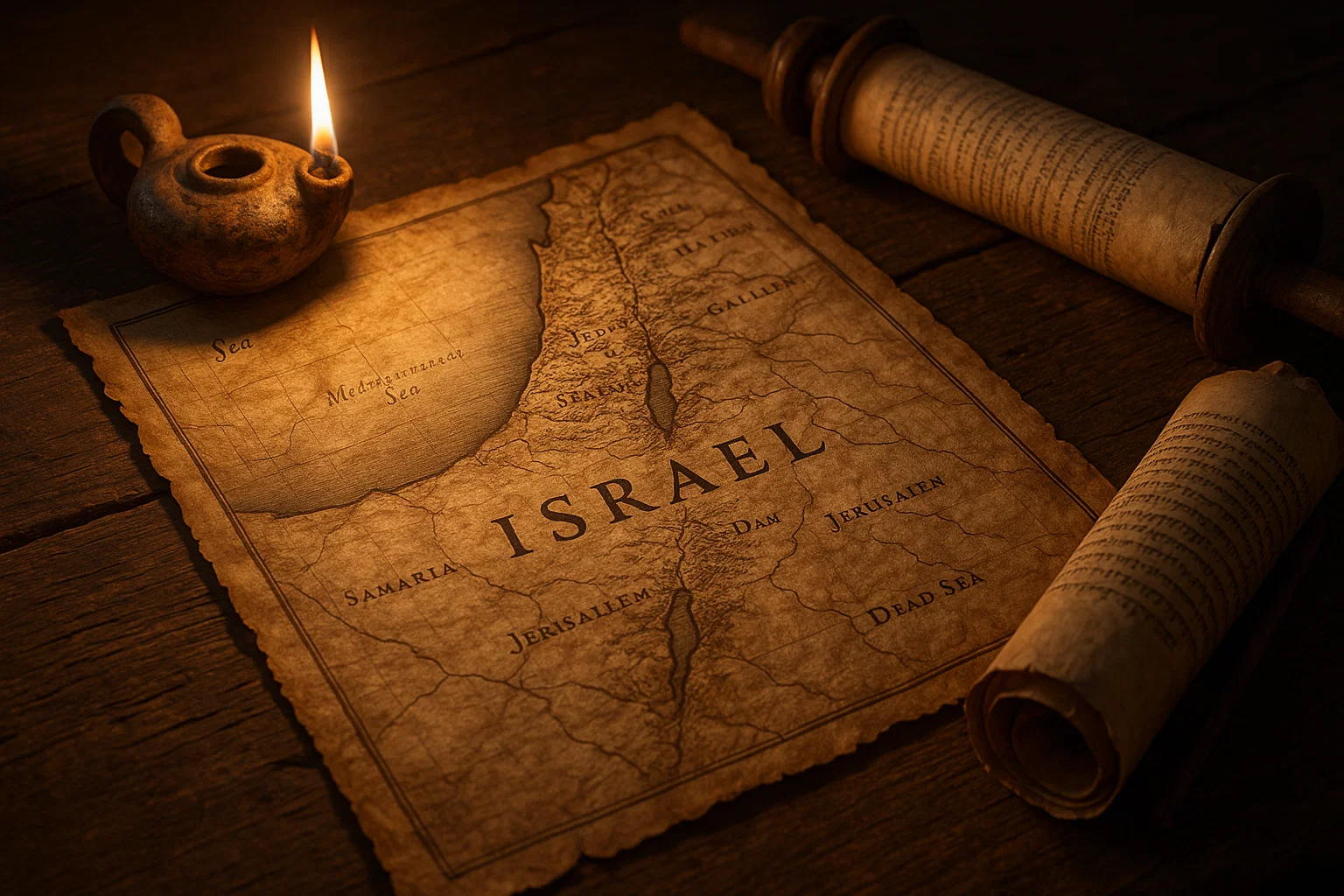
The Story That Begins a Nation
From the first pages of Genesis, the Bible speaks of a people set apart a family through whom God would reveal His promise to the world.
That family became known as the Israelites.
They were not chosen because they were powerful or many, but because God loved them and had a plan that reached far beyond their borders. The story of the Israelites is not just history; it is the story of how God’s mercy, justice, and faithfulness unfold through generations.
The word Israel first appeared when God changed Jacob’s name after a night of wrestling (Genesis 32:28). “You have struggled with God and with humans and have overcome.” From that moment, Jacob’s descendants were called the children of Israel a name that symbolized both struggle and divine calling.
The Beginning of God’s Covenant with Israel
Every story has a starting point, and the Israelites’ began with a promise to one man: Abraham.
In Genesis 12:2-3, God said,
“I will make you into a great nation, and I will bless you; I will make your name great, and you will be a blessing.”
Abraham believed that promise, though he had no child. His faith became the foundation of a covenant that defined not only his descendants but also the entire history of redemption.
Through Abraham, Isaac, and Jacob, God built a nation that would bear His name. The covenant was not a contract of convenience but a bond of love sealed with trust, obedience, and grace.
God’s covenant included three key promises:
- A People Abraham’s descendants would become a great nation.
- A Land They would inherit Canaan, a tangible sign of God’s provision.
- A Blessing Through them, all nations would be blessed (Genesis 22:18).
That third promise foreshadowed Jesus Christ, the ultimate blessing who came through Israel to bring salvation to the world.
The Journey from Slavery to Freedom
Generations after Abraham, the Israelites found themselves enslaved in Egypt. What once began as protection during famine became a place of bondage. Yet God did not forget His people.
In Exodus 3:7-8, God told Moses,
“I have indeed seen the misery of my people in Egypt… So I have come down to rescue them.”
The Exodus was not merely a political event; it was a spiritual revelation. Through signs, plagues, and the crossing of the Red Sea, God showed that He alone had power over kings and nature.
He led His people with a pillar of cloud by day and a pillar of fire by night symbols of guidance and presence.
At Mount Sinai, He gave them the Ten Commandments, shaping them into a holy nation that reflected His character.
Their freedom came with purpose:
to be a light among nations, showing what life under God’s rule looked like. Yet that freedom was also tested by wandering hearts. Again and again, the Israelites doubted, complained, and disobeyed. Still, God’s patience endured.
Israel’s Role as God’s Chosen People
What does it mean that Israel was chosen?
Deuteronomy 7:7-8 answers clearly:
“The Lord did not set His affection on you because you were more numerous than other peoples… but because the Lord loved you and kept the oath He swore to your ancestors.”
To be chosen was not a privilege of pride; it was a calling to represent God’s holiness. The Israelites were meant to show the world what covenant relationship looked like faithful worship, justice, compassion, and obedience.
Through prophets like Moses, Samuel, Isaiah, and Jeremiah, God reminded them of this sacred identity.
Their festivals, sacrifices, and laws were visual sermons pointing toward purity and redemption.
But when Israel forgot their God and followed idols, consequences followed: division, exile, and sorrow. Still, even in judgment, God spoke of restoration.
Isaiah 49:6 records His vision:
“I will also make you a light for the Gentiles, that my salvation may reach to the ends of the earth.”
That was always the heart of Israel’s calling not to keep God for themselves, but to reveal Him to all.
Lessons from Israel’s Faith and Failures
Reading Israel’s story is like looking in a mirror. Their triumphs and mistakes echo our own walk with God.
- When they trusted Him, seas parted and walls fell.
- When they doubted, fear and confusion took hold.
The Israelites remind us that faith is not built on perfection but on relationship.
Psalm 78 tells how each generation must remember God’s works so that “they would put their trust in God and would not forget His deeds.”
The same lesson applies today. Forgetting God’s past faithfulness often leads to spiritual drift. Remembering His mercy strengthens hope.
What Did Jesus Say About the Israelites?
By the time Jesus was born, Israel had waited centuries for the promised Messiah.
He came to “the lost sheep of Israel” (Matthew 15:24), fulfilling the prophets and renewing God’s covenant not by law but by grace.
Jesus honored Israel’s heritage. He taught in their synagogues, read their Scriptures, and celebrated their feasts. Yet He also challenged their leaders to see that belonging to Israel meant more than ancestry.
In John 8:39, He told them,
“If you were Abraham’s children, then you would do what Abraham did.”
Faith, not lineage, defines true children of God. Jesus loved His people deeply He wept over Jerusalem (Luke 19:41) because they missed the peace He offered.
Still, His mission did not end with rejection. It opened the door for all humanity to share in Israel’s blessings. Through His death and resurrection, Jesus fulfilled every covenant promise ever made to Abraham’s family.
The Spiritual Meaning of Israel in the New Testament
The New Testament writers carried forward this truth: God’s promises to Israel were never forgotten, but expanded through Christ.
Paul explained in Romans 9-11 that Israel’s story is a mystery of mercy.
Gentile believers are like branches grafted into Israel’s olive tree part of the same faith root, not a replacement for it.
Romans 11:17-18 says,
“You, though a wild olive shoot, have been grafted in among the others and now share in the nourishing sap from the olive root. Do not consider yourself to be superior… you do not support the root, but the root supports you.”
In Christ, there is no division between Jew and Gentile (Galatians 3:28). All who believe become heirs of Abraham’s promise.
That does not erase Israel’s distinct place in God’s plan; it shows how vast His redemption is. The covenant that began with one nation became a blessing for every nation.
Why the Israelites Still Matter in God’s Story
Some wonder: if the Church now includes all believers, why does Israel still matter?
Because God’s faithfulness never expires.
Throughout Scripture, He calls Himself “the God of Israel.”
Even in exile, He promised, “I will bring them back to their own land” (Jeremiah 30:3).
Prophecies in Ezekiel, Isaiah, and Zechariah speak of Israel’s restoration not only physically but spiritually.
Their survival through centuries of persecution and dispersion stands as living testimony to God’s covenant integrity. The Israelites’ story proves that when God speaks, He keeps His word.
For Christians, Israel reminds us that our faith has deep roots ancient, tested, and trustworthy.
The same God who led them by fire and cloud leads us by His Spirit today.
What the Bible Actually Says About Israel
Across both Testaments, the Bible portrays Israel in three interconnected ways:
- A People the physical descendants of Abraham, Isaac, and Jacob.
- A Land the territory God promised, rich with covenant meaning.
- A Spiritual Identity those who trust in God’s promise, ultimately fulfilled in Christ.
From Genesis to Revelation, Israel’s name appears over 2,500 times more than any other nation. It anchors prophecy, poetry, and promise.
In Revelation 7, John saw 144,000 from the tribes of Israel sealed by God, showing that His purpose for them remains part of the final redemption story.
Israel’s story is not finished; it continues in God’s unfolding plan for the world.
The Israelites and the Message of Grace
One of the most moving truths in Scripture is that God used imperfect people to carry His perfect plan.
The Israelites doubted, disobeyed, and often turned away, yet God’s grace pursued them.
The book of Hosea paints this vividly: a prophet called to love an unfaithful spouse symbolizing God’s relentless love for Israel.
In Hosea 11:8-9, God cries,
“How can I give you up, Ephraim? How can I hand you over, Israel? … My heart is changed within me; all my compassion is aroused.”
Grace was not a New Testament invention; it was present from the beginning. Every sacrifice, every prophet, every act of mercy pointed toward the Lamb who would take away the sin of the world.
The Israelites in Historical Perspective
Beyond theology, archaeology and ancient records confirm much of Israel’s existence cities like Jericho, Hazor, and Jerusalem bear witness to their long presence.
Inscriptions and pottery fragments echo the same names and customs found in the Old Testament.
These findings remind us that the Bible’s narrative is not myth but memory a record of real people walking with a real God through time.
Yet history alone cannot capture what made Israel unique: their relationship with the Divine.
While other ancient nations built empires around kings, Israel’s foundation rested on covenant a spiritual bond between Creator and people. That idea changed human history.
How the Bible Describes the Israelites
When the Bible describes the Israelites, it speaks not just of a nation but of character traits shaped by their encounters with God.
- Faithful and Fearful quick to trust when led by miracles, quick to doubt when tested.
- Chosen but Challenged set apart to bless the world, yet often tempted by the world.
- Courageous but Forgetful crossing seas by faith, then questioning God in the desert.
Their humanity makes their story timeless. Every believer can see a reflection of their own faith journey in Israel’s path rescued, guided, disciplined, and redeemed.
Why Were the Israelites So Important to God?
The simplest answer: because of His promise and His love.
God’s relationship with Israel shows that divine love is not earned; it is chosen and steadfast.
Deuteronomy 9:6 reminds them,
“Understand, then, that it is not because of your righteousness that the Lord your God is giving you this good land, for you are a stiff-necked people.”
God’s choice of Israel reveals His grace. He used them to preserve His Word, reveal His character, and bring forth the Messiah.
Through them, the Ten Commandments, the Psalms, and the prophets all came into the world.
Without Israel, we would not have the stories that teach us what faith, repentance, and covenant mean.
Their importance lies not in their perfection but in their purpose.
The Israelites and the Promise of Redemption
In the end, every thread of Israel’s story leads to Jesus.
He was born into their line, lived among them, and fulfilled their Scriptures.
Through His resurrection, He became the bridge between God and humanity the ultimate expression of the covenant first made with Abraham.
Paul summarized it in Galatians 3:29:
“If you belong to Christ, then you are Abraham’s seed, and heirs according to the promise.”
That means every believer regardless of nation or background is part of God’s redemptive plan that began with Israel.
The Israelites’ journey from bondage to blessing mirrors the spiritual journey every Christian takes from sin to salvation.
What This Teaches Us About God’s Faithfulness
The Bible’s portrayal of the Israelites teaches one unshakable truth: God keeps His promises.
He remained faithful when they wandered, merciful when they rebelled, and patient when they returned.
Their story invites us to trust that same faithfulness in our own lives.
When we feel lost, we remember the pillar of fire.
When we face impossible seas, we remember the Red Sea.
When we doubt God’s plan, we remember that He never abandoned Israel and He won’t abandon us.
Psalm 100:5 says,
“For the Lord is good and His love endures forever; His faithfulness continues through all generations.”
Israel’s history is living proof of that verse.
Final Reflection
The Israelites were not perfect, yet God called them His own.
He shaped their destiny through promise, discipline, and grace revealing a God who is both just and merciful.
To read about the Israelites is to encounter the heartbeat of Scripture: a faithful God reaching out to imperfect people so that the world might know His love.
And that same God still calls people today not to build a nation of borders, but a kingdom of hearts bound by faith, hope, and love.

Dr. Rachel is very smart and knows a lot about the Bible. He helps us understand the Bible better by talking about the old texts in a simple way.