 When we hear the word Pentecost, most of us picture flames resting on people’s heads, a rushing wind, and voices speaking in different languages. It’s one of the most breathtaking moments in the entire Bible. But beyond the miracle and wonder, have you ever paused to ask what does the word Pentecost actually mean?
Let’s slow down, open the Bible together, and explore where this word came from, what truly happened that day, and why Pentecost still matters for you and me today.
The Meaning Behind the Word “Pentecost”
The word Pentecost comes from the Greek word Pentēkostē, which literally means “fiftieth.” It marks fifty days after Passover, and in Christian understanding, fifty days after the resurrection of Jesus.
For the Jewish people, Pentecost wasn’t a brand-new holiday. It was rooted in the ancient Feast of Weeks, known in Hebrew as Shavuot (pronounced sha-VOO-ot). This feast celebrated the wheat harvest and also remembered the day God gave the Law to Moses on Mount Sinai.
So when the book of Acts tells us that the Holy Spirit came on the day of Pentecost, it happened on a day already full of meaning a day when Jews from all nations were gathered in Jerusalem to give thanks for God’s provision and His covenant.
In other words, Pentecost was already a sacred appointment, and God chose that exact day to write His law not on tablets of stone, but on human hearts through His Spirit.
What Happened on the Day of Pentecost
The story unfolds in Acts 2, and it begins quietly:
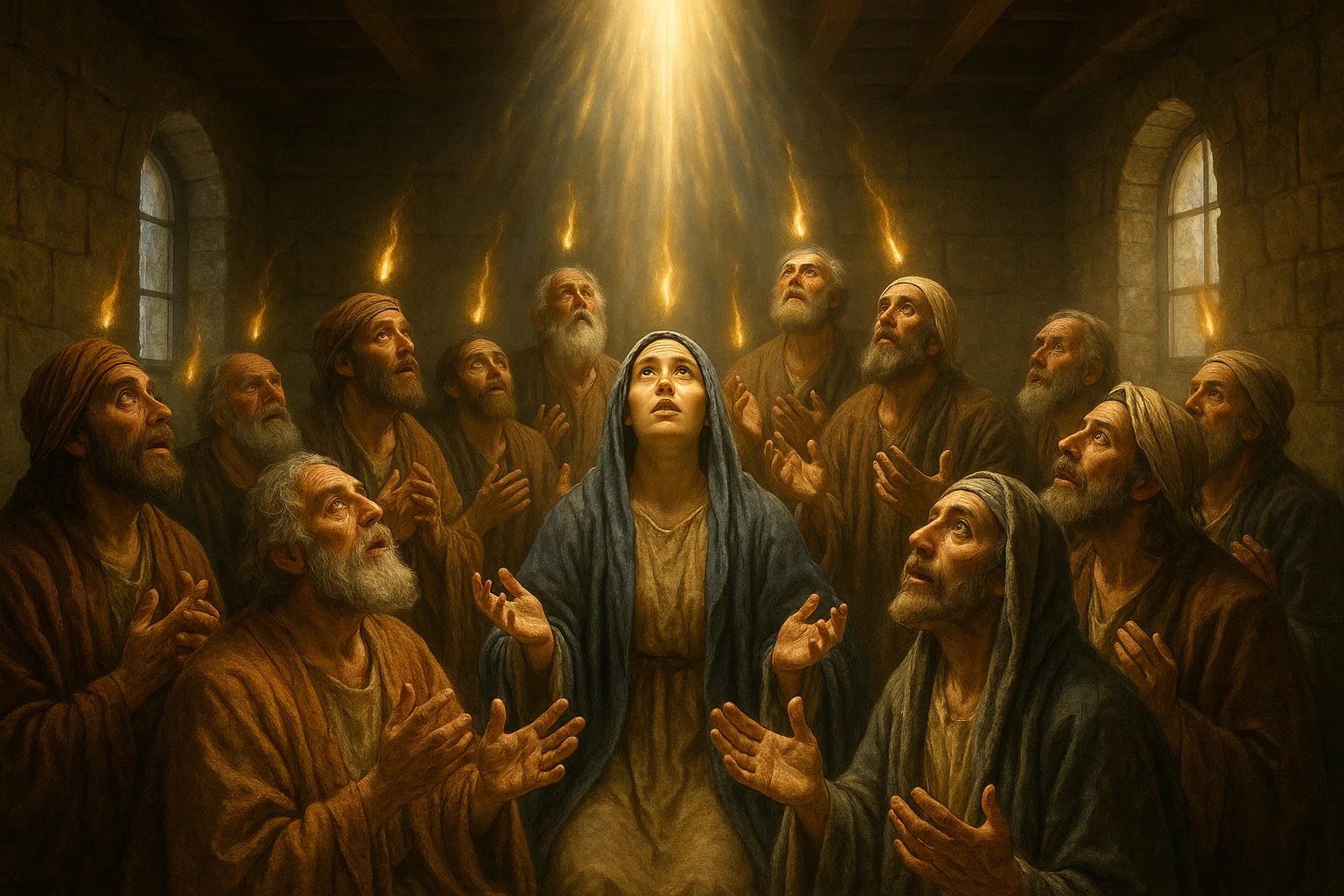
“When the day of Pentecost had fully come, they were all with one accord in one place.” Acts 2:1 (KJV)
The disciples were waiting, just as Jesus had told them:
“But you shall receive power when the Holy Spirit has come upon you…” Acts 1:8
Then suddenly wind, fire, and power.
- A sound like a mighty rushing wind filled the room.
- Tongues of fire appeared and rested on each of them.
- They were filled with the Holy Spirit and began to speak in other languages, declaring “the wonderful works of God.”
People from every nation under heaven were in Jerusalem that day. When they heard their own languages spoken by simple Galileans, they were amazed. Some mocked. Others asked, “What does this mean?”
That’s when Peter stood up and preached the first Gospel message after the resurrection. He explained that what they were witnessing had been foretold by the prophet Joel:
“I will pour out My Spirit on all flesh.” Joel 2:28
Peter proclaimed that Jesus whom they had crucified had risen, ascended, and poured out the Holy Spirit. His sermon pierced hearts. About three thousand people believed and were baptized that very day.
What Three Things Happened at Pentecost
When we read Acts 2 carefully, three major things stand out that define Pentecost:
- The Holy Spirit Came to Dwell Within Believers.
Before this moment, the Spirit would come upon people for special tasks. But now, God’s Spirit came to live inside those who believed in Christ. Humanity became His dwelling place. - The Church Was Born.
Pentecost marks the beginning of the Christian Church. Those three thousand new believers formed the first spiritual community devoted to teaching, fellowship, breaking bread, and prayer. - The Gospel Crossed Language and Cultural Barriers.
The Spirit enabled the disciples to speak languages they had never learned, symbolizing that the message of Jesus was for every nation. Pentecost broke down walls that divided humanity since Babel.
Each of these moments still speaks today: God is with us, His Church is alive, and His message is for all people.
The Hebrew Meaning and Roots of Pentecost
As mentioned earlier, Pentecost traces back to the Feast of Weeks (Shavuot). In Hebrew tradition, it occurs seven weeks after Passover, making it the fiftieth day hence the Greek name Pentēkostē.
Shavuot carried two deep meanings for Israel:
- Agricultural meaning: thanksgiving for the first fruits of the wheat harvest.
- Spiritual meaning: remembrance of the giving of the Torah at Mount Sinai.
Both of these connect beautifully with the Christian Pentecost:
- The Holy Spirit is God’s new gift, just as the Law was His old gift.
- The first fruits of the Spirit came, bringing a new harvest souls coming to faith.
So Pentecost represents not just a new beginning, but also a fulfillment of God’s ancient promises. The same God who spoke from Sinai now writes His word on hearts through the Spirit.
How Many Days After Easter Is Pentecost?
Pentecost is celebrated fifty days after Easter Sunday seven full weeks.
If you start counting from Easter (the day of resurrection), the fiftieth day brings you to the Sunday known as Pentecost Sunday. That timing isn’t random; it connects the resurrection of Jesus with the outpouring of His Spirit.
- Easter shows us new life through Christ’s victory.
- Pentecost shows us new power through Christ’s Spirit.
It’s like two chapters of the same story resurrection and empowerment. Easter opens the tomb; Pentecost opens the heart.
The Promise Fulfilled
Jesus had promised the Holy Spirit before His death and again after His resurrection. He told His disciples not to leave Jerusalem until the promise of the Father had come.
“And I will pray the Father, and He will give you another Helper, that He may abide with you forever.” John 14:16
When the Spirit came at Pentecost, that promise became reality. God Himself came to dwell among His people not in a temple made of stone, but in living temples: our hearts.
This was revolutionary. It changed everything. The followers of Jesus, once fearful and uncertain, became bold witnesses. The same Peter who had denied Jesus now preached publicly to thousands.
Pentecost turned followers into witnesses, students into apostles, and fear into faith.
The Wind, the Fire, and the Spirit
Each symbol on that day carried a message:
- Wind represents the invisible yet powerful breath of God. In both Hebrew (ruach) and Greek (pneuma), the word for “Spirit” means breath or wind.
- Fire symbolizes purity, presence, and passion. Just as fire refines gold, the Spirit refines hearts.
- Languages (tongues) show that God’s message transcends all boundaries.
These aren’t random symbols. They tell us that the Spirit is active, purifying, and inclusive.
Imagine that scene: flickering light filling the room, hearts burning with courage, and the message of Jesus spreading like wildfire. That’s Pentecost.
Pentecost and the Birth of the Church
After the Spirit descended, something extraordinary began. Believers gathered daily. They devoted themselves to learning, praying, sharing meals, and helping one another.
Acts 2:44–47 paints a picture of early Christian community:
“All the believers were together and had everything in common… and the Lord added to their number daily those who were being saved.”
This was the Church in its purest form united, generous, Spirit-filled. Pentecost wasn’t just a miracle; it was a movement.
Every church today, whether large or small, finds its roots in that moment. Pentecost is our family’s birthday.
Why Pentecost Still Matters Today
It’s easy to think of Pentecost as something that happened long ago. But its message is timeless. The same Spirit who filled those first believers still works in the world today.
Here’s why Pentecost still matters for us:
- It reminds us that we’re not alone. The Spirit of God lives within every believer, guiding and comforting us.
- It empowers us for purpose. Pentecost wasn’t about emotional experience; it was about mission. We are called to carry God’s love into our world.
- It unites believers across cultures. The Spirit breaks barriers of race, language, and background reminding us that we’re one family in Christ.
Every time we see the Church serve, love, and forgive, we see Pentecost continuing.
Living in the Power of Pentecost
You don’t have to wait for a special day to experience the Spirit’s power. Pentecost invites us into daily relationship with God’s presence.
The same Spirit who comforted the disciples wants to comfort you when life feels heavy.
The same Spirit who gave them courage wants to strengthen you to face fear.
And the same Spirit who transformed a small group of believers can transform communities today.
Paul wrote,
“The Spirit Himself bears witness with our spirit that we are children of God.” Romans 8:16
That’s the heartbeat of Pentecost God living in His children.
Pentecost and the Story of Salvation
When you look closely, Pentecost is part of the bigger story of redemption:
| Biblical Event | Meaning | God’s Action |
|---|---|---|
| Passover | Deliverance from death through the lamb’s blood | God rescues |
| Resurrection (Easter) | Victory over death | God redeems |
| Pentecost | Spirit poured out | God empowers |
Each stage reveals more of God’s plan. He doesn’t just save us; He fills us and sends us.
How to Celebrate Pentecost Spiritually
Churches today mark Pentecost in different ways through worship, prayer, and the color red, symbolizing the fire of the Spirit. But you can celebrate it personally too:
- Pray for renewal. Ask God to fill you with His Spirit again.
- Read Acts 2. Let the story come alive in your heart.
- Reach out to others. The Spirit always moves us toward love.
- Reflect on gratitude. Thank God for His presence and power.
Pentecost isn’t about ritual it’s about relationship. It’s the day heaven touched earth and never left.
The Gentle Invitation of the Spirit
Sometimes people imagine the Holy Spirit as distant or mysterious. But the Spirit’s voice is gentle, like a whisper in the heart.
He reminds you that you’re loved.
He convicts you when you stray.
He comforts you when you’re weary.
He gives you words when you pray and don’t know what to say.
Pentecost is God’s way of saying, “You are never alone again.”
Final Reflection: The Meaning of Pentecost for You
When we ask, “What does the word Pentecost mean in the Bible?” we discover more than a definition. We discover God’s heart.
Pentecost means fifty days after Passover, yes but spiritually it means a new beginning for humanity. It’s the day God’s presence moved from a temple to His people, from stone walls to living hearts.
So as you remember Pentecost, don’t just recall a historical moment. Welcome the same Spirit who changed history into your daily life.
“Not by might, nor by power, but by My Spirit,” says the Lord. Zechariah 4:6
The wind still blows. The fire still burns. And God still speaks.

Reverend James has spent years studying and teaching the Bible. With warmth and wisdom, he shares deep truths in a way that’s clear, simple, and easy to understand.