

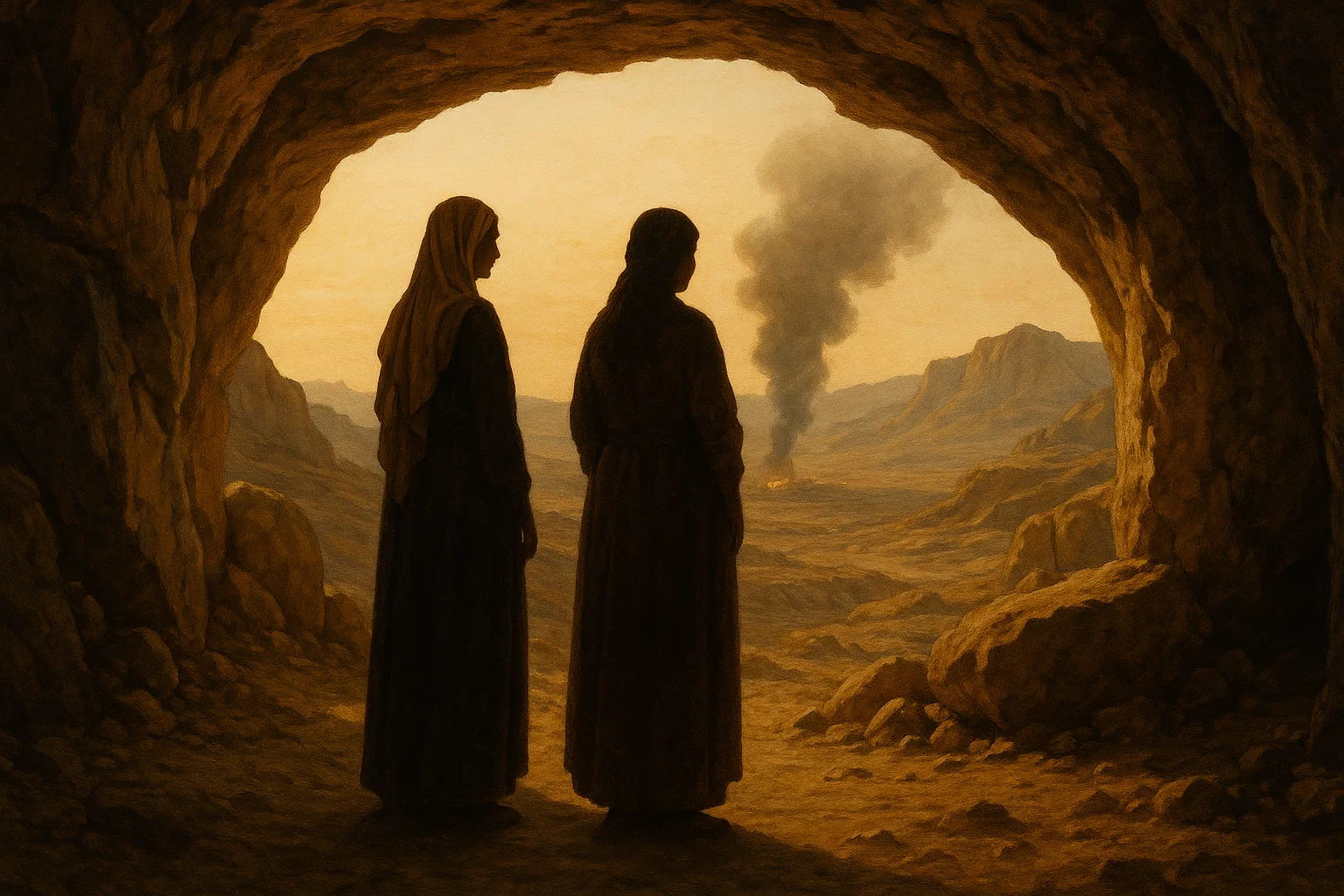
 The story of Lot’s daughters is one of the most striking and honest passages in the Book of Genesis. It reveals the fragile state of the human heart, the weight of isolation, and the quiet way God still carries His plans forward through imperfect people.
You’ll find their story in Genesis 19, tucked between the judgment of Sodom and Gomorrah and the story of Abraham’s growing family. It’s not an easy story, but it is a real one a mirror to our human weakness and a testimony to how God’s mercy endures even after sin and failure.
The Escape from Sodom A Night of Divine Mercy
Lot was Abraham’s nephew a man who once lived near the lush valley of the Jordan, where Sodom and Gomorrah stood. The cities were prosperous, but they were also filled with wickedness and pride. Yet even in a place like that, God’s mercy reached out.
In Genesis 19, God sends two angels to warn Lot that destruction is coming. They urge him to gather his family and flee before the fire falls from heaven. Lot hesitates, but the angels take him and his daughters by the hand, leading them out in compassion.
As dawn rises, they’re told to run for their lives and not look back. But Lot’s wife, torn between her home and the call to leave, looks back toward the burning city and Scripture tells us she becomes a pillar of salt (Genesis 19:26).
That image is haunting: a heart divided between God’s call and the life left behind. Lot and his daughters press forward, hearts heavy, toward the hills. The sky glows red behind them, and every step reminds them that mercy and loss can walk side by side.
Living in the Cave Fear, Isolation, and a Tragic Choice
When Lot and his daughters reach the small town of Zoar, they fear staying there. Perhaps they think more destruction will follow. So they leave even that refuge and move into a cave in the mountains.
The Bible is quiet about what happens next until it tells us that Lot’s daughters, believing the world has ended and that no men remain alive, come up with a desperate plan. They say to each other,
“There is not a man in the earth to come in unto us after the manner of all the earth.”
Genesis 19:31
They get their father drunk and lie with him not out of lust, but fear and confusion. Still, it’s a heartbreaking sin. The text doesn’t defend or justify it. It simply records it as history a moment when despair led to moral blindness.
Their choices carry heavy consequences. Both daughters become pregnant by their father, and each gives birth to a son. These sons will grow into two powerful nations Moab and Ammon.
It’s a painful story, but one the Bible includes for a reason: to show how human fear can distort truth, and how God’s mercy still finds its way even through brokenness.
The Birth of Moab and Ammon Two Nations from Lot’s Daughters
Lot’s daughters each give birth the elder names her son Moab, which means “from the father.” The younger names her son Ben-Ammi, meaning “son of my people.”
From these sons come the Moabites and the Ammonites two nations that will play large roles throughout the Old Testament.
At times, these nations became enemies of Israel. They worshiped other gods and often opposed God’s people. Yet, even through them, God continued writing His story. These were not forgotten branches on the human tree they were part of a bigger, unfolding plan.
When we read about Moab later in Scripture, we find both tension and grace. Moabite kings would later fight against Israel, yet one of the most faithful women in the Bible Ruth came from Moab.
Her story, found in the Book of Ruth, is one of love, loyalty, and redemption. And through Ruth’s marriage to Boaz, she becomes part of the family line that leads to King David, and eventually to Jesus Christ Himself (Matthew 1:5–16).
So, from an act born in confusion and shame, God still drew forth a story of redemption. That’s the quiet heartbeat of the Gospel God bringing beauty out of ashes, light out of darkness, and hope out of human failure.
What Happened to the Children of Lot
The children of Lot Moab and Ben-Ammi became founders of tribes who lived east of the Jordan River. Their descendants settled in fertile lands but struggled spiritually. The Moabites and Ammonites worshiped idols such as Chemosh and Molech.
Throughout the Old Testament, these nations often clashed with Israel. Yet they were also family distant relatives of Abraham’s line.
When the Israelites journeyed through the wilderness after the Exodus, God commanded them not to attack Moab or Ammon, saying,
“Do not harass Moab or provoke them to war, for I will not give you any part of their land.”
Deuteronomy 2:9
Even though the origins of these nations were tainted by sin, God still showed compassion and restraint. He remembered His covenant with Abraham and extended grace even to those far from Him.
That’s a humbling truth. God’s mercy isn’t limited to perfect beginnings. It reaches into every broken branch and still calls us toward His redemption.
Why the Story Matters Faith, Fear, and God’s Grace
When we look at Lot’s daughters, we see more than an ancient tragedy. We see ourselves our fears, our attempts to control what we don’t understand, and our struggle to trust God’s unseen plan.
Their story reminds us that fear can cloud faith. Instead of trusting that God could provide a future, they took matters into their own hands. How often do we do the same?
We panic, we plan, we grasp and forget that God’s mercy doesn’t run out when things look hopeless. Lot’s daughters lived in a world that had just burned. Their fear was real. But so was God’s power to rebuild.
It’s comforting to know that even when we fail, God doesn’t erase the story He redeems it. The same mercy that led Lot out of Sodom eventually led Ruth into Bethlehem. One story of shame becomes another story of grace.
The Connection to Tamar and the Threads of Redemption
Some readers compare the story of Lot’s daughters with another difficult story Tamar in Genesis 38. Tamar, like Lot’s daughters, faced loneliness and injustice. Her actions were also desperate and misunderstood, yet through her came the line that led to King David.
Why mention Tamar here? Because the Bible often takes the paths we’d rather skip over and shows that God walks even there. Both stories show that divine plans are not thwarted by human confusion.
From Lot’s daughters, the Moabites were born.
From Tamar, the tribe of Judah continued.
From Ruth the Moabite, came David and from David, came Christ the Redeemer.
It’s not a coincidence. It’s a reminder that no moment of human failure can silence God’s greater plan.
Who Was the Beautiful Daughter in the Bible?
When people ask this question, they often refer to different women called beautiful in Scripture Sarah, Rachel, Esther, and others. But the story of Lot’s daughters isn’t about outward beauty. It’s about how God sees beyond appearance and works in the unseen.
Lot’s daughters weren’t remembered for beauty or fame. They were remembered because their story became part of a divine chain that led to salvation history. The beauty of their story is not in what they did, but in how God redeemed it.
The Nations Born from Lot’s Daughters Moab and Ammon
The two nations from Lot’s daughters lived side by side east of the Jordan River. They had wealth and power, yet their spiritual journeys were complex.
The Moabites, for instance, invited Israel into idolatry at Peor (Numbers 25). Yet later, God used a Moabite woman, Ruth, as a vessel of grace. The Ammonites often warred against Israel but were also descendants of the same family line as Abraham.
In prophetic writings, both nations are judged for pride and idolatry but judgment never erases the possibility of repentance. God’s justice is always balanced with mercy.
Even in Isaiah and Jeremiah, when the prophets speak against Moab and Ammon, there are glimpses of restoration. God never stops reaching for those who turn their hearts toward Him.
The Lessons We Can Learn
Lot’s daughters show us several lessons that echo across generations:
- Desperation can lead to poor choices When fear takes over, faith can fade. We must hold to God’s promises even when the world seems lost.
- Sin has lasting effects, but God’s mercy lasts longer The Moabites and Ammonites remind us that our choices echo through generations, yet redemption always remains possible.
- God can redeem every story From Lot’s cave to Ruth’s loyalty, the same divine thread runs grace triumphs over guilt.
- Faith begins with remembering God’s power Even when everything seems destroyed, God can rebuild something beautiful.
Every family, every heart, every broken moment can become a testimony of grace when surrendered to Him.
What This Teaches Us About God’s Grace
When Reverend James Stone preaches about this passage, he reminds us that the Bible doesn’t hide human failure it redeems it. Lot’s daughters remind us that even when people fall short, God’s story continues.
There’s no wound too deep, no past too dark, no mistake too heavy that God cannot bring light into it. Just as He brought Ruth the Moabite into the lineage of Christ, He can bring redemption out of your story too.
So when life feels like a cave when fear and regret whisper that it’s over remember this:
God can still bring new beginnings from broken places.
The story of Lot’s daughters teaches that grace is not limited by where we come from but renewed by whom we turn to.
“Where sin increased, grace abounded all the more.”
Romans 5:20
From Sodom’s ashes to Bethlehem’s light, the same mercy flows reaching from Lot’s cave to the cradle of Christ.

Reverend James has spent years studying and teaching the Bible. With warmth and wisdom, he shares deep truths in a way that’s clear, simple, and easy to understand.