

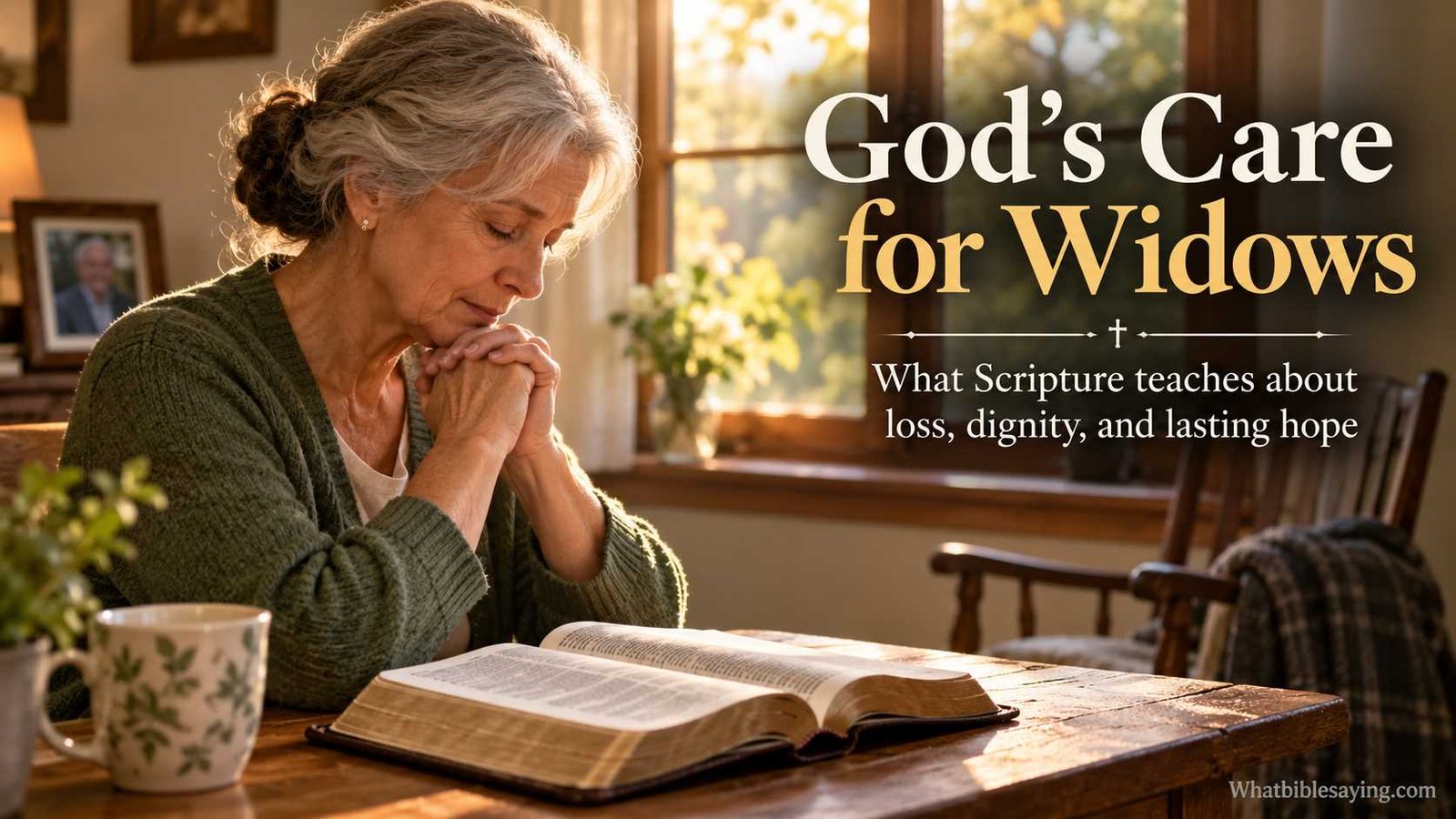
 Losing a husband can change almost every part of a woman’s life. A home that once felt full of conversation may suddenly become quiet. Familiar routines can bring painful memories, while worries about the future may feel overwhelming.
During such difficult moments, many women turn to Scripture for comfort. They want to know whether God understands their grief, hears their prayers, and still has a purpose for their lives.
What does the Bible say about a widow? Scripture teaches that God cares deeply for widows, defends their rights, comforts them in grief, and commands families and communities to treat them with dignity and compassion.
Psalm 68:5 describes God as a defender of widows. James 1:27 teaches Christians to care for widows in distress. In Luke 7:11–17, Jesus personally responds to a grieving widow with compassion.
These passages reveal something important about God’s character. He does not measure a woman’s worth by whether she is married. Her value remains, even when the person she loved is no longer beside her.
The Bible also offers practical instructions about financial support, family responsibilities, prayer, and remarriage. Together, these teachings provide both spiritual encouragement and guidance for everyday life.
What Does the Bible Say About a Widow Who Is Grieving?
The Bible does not describe grief as a weakness or a failure of faith. Losing someone we love is painful, and Scripture gives people room to express that sorrow.
Psalm 34:18 teaches that the Lord is near to those whose hearts are broken. Psalm 147:3 describes God as the one who heals broken hearts and cares for their wounds.
For a grieving widow, these promises can bring comfort during some of life’s loneliest moments.
Grief may appear in many ways. One day, a woman might remember her husband with gratitude and peace. The next day, a familiar song or an empty chair may bring tears.
Both experiences are natural parts of mourning.
God does not ask a widow to pretend she is happy. Throughout the Psalms, people bring their sadness, confusion, and fears directly to Him.
Even Jesus wept when Lazarus died (John 11:35). His tears remind us that sorrow and faith can exist together.
A widow can trust God while still missing her husband deeply.
Does God Understand the Pain of Losing a Husband?
God’s concern for grieving people appears throughout Scripture.
In Isaiah 61:1–3, the prophet describes comfort for those who mourn. Christians also recognize this passage as connected to the ministry of Jesus, who came to bring hope to people facing suffering and loss.
This does not mean every painful experience will disappear quickly. Grief often changes slowly, and different people heal at different speeds.
A widow may need time to adjust to decisions she once made with her husband. She may face financial concerns, family responsibilities, or uncertainty about living alone.
God’s care does not remove the need for practical help. Instead, Scripture encourages believers to support one another through life’s difficulties.
For further encouragement, read God Heals Broken Hearts Through His Love and Promises.
Does God Hear the Prayers of a Grieving Widow?
Yes. The Bible presents prayer as an important source of hope for widows.
In 1 Timothy 5:5, Paul describes a widow who places her hope in God and continues praying.
Her example shows that a woman can maintain a meaningful relationship with God after losing her husband.
Prayer does not require perfect words. Sometimes it may be a quiet expression of gratitude. At other times, it may simply be asking God for strength to face another day.
A widow might pray for peace during sleepless nights, wisdom when making decisions, or patience while adjusting to a different future.
The Bible does not promise that every prayer will receive the answer we expect. Yet it repeatedly encourages believers to bring their concerns before God.
A grieving woman does not have to hide her feelings when she prays.
Why Are Widows Special to God?
One of the clearest biblical explanations appears in Psalm 68:5.
The King James Version describes God as:
“A father of the fatherless, and a judge of the widows.”
This verse presents God as someone who actively cares for people who may lack protection or support.
In ancient societies, many women depended on their households for income, property rights, and social security. Losing a husband could therefore bring serious financial and legal challenges.
Not every widow was poor or helpless, but some faced exploitation or neglect.
God’s law addressed these dangers.
Deuteronomy 10:18 explains that God defends the rights of widows and fatherless children. This reveals His concern for justice, not simply sympathy.
Widows are special objects of God’s care because He takes their vulnerability seriously and commands others to protect their dignity.
This does not mean God loves widows more than other people. It means He pays particular attention to those who may be overlooked, mistreated, or left without support.
Why Does God Call Himself a Defender of Widows?
A defender protects someone against injustice.
Throughout the Old Testament, God warns His people not to take advantage of widows.
Exodus 22:22–24 contains a strong warning against mistreating widows and fatherless children. The passage also emphasizes that God hears the cries of those who are afflicted.
These instructions reveal that mistreating a vulnerable person is not a small matter in God’s eyes.
A widow should not lose her dignity because she has lost her husband. Her voice deserves to be heard, her possessions should be respected, and her needs should not be ignored.
Isaiah 1:17 calls God’s people to seek justice and defend widows.
For Christians, these passages are reminders that honoring God includes treating vulnerable people fairly.
Kind words matter, but justice matters too.
What Does the Bible Say About a True Widow?
The phrase true widow, or widow indeed in older translations, appears in 1 Timothy 5.
Paul gives instructions about how the Christian community should care for widows, especially those who have no family support.
In 1 Timothy 5:3–5, he distinguishes widows who have relatives able to help from women who are left without such support.
His concern is how the church should recognize and assist those with genuine needs.
A true widow, in this specific context, is a woman who has lost her husband, lacks adequate family support, and looks to God in faith.
However, this passage should not be understood as dividing widows into women whom God loves and women whom He does not.
Every widow deserves compassion and respect.
Paul is addressing practical responsibilities within the Christian community.
What Does “Widow Indeed” Mean in 1 Timothy 5?
The expression emphasizes genuine need and the absence of suitable family support.
Paul first teaches that children and grandchildren should care for their widowed relatives when they are able.
In 1 Timothy 5:8, he strongly emphasizes the responsibility of believers to provide for their households.
The message is clear: caring for family members is an important expression of Christian faith.
A son or daughter should not neglect a widowed mother while assuming that the church will handle every responsibility.
At the same time, widows without suitable family assistance should not be forgotten.
The church has a responsibility to respond to their needs.
Paul also describes a widow whose hope is in God and whose life includes prayer. This highlights spiritual devotion alongside practical circumstances.
It is important not to turn this description into a harsh test of a grieving woman’s spiritual worth.
A widow who struggles to pray because she is overwhelmed with sorrow still deserves kindness and support.
Does a Widow Have to Be Over 60 to Receive Help?
First Timothy 5:9 refers to a widow being at least sixty years old before being placed on a particular church list.
This instruction can be confusing when read without its surrounding context.
Paul is discussing a formal arrangement for recognizing certain widows. He also mentions a history of faithfulness, hospitality, caring for others, and good works.
The age requirement concerns enrollment on that particular list. It is not a general biblical rule forbidding help to younger widows.
The early church also cared about the needs of younger women and families facing hardship.
James 1:27 gives a broad instruction to care for widows in distress without introducing an age restriction.
The central lesson is that churches should use wisdom when organizing long-term support while remaining compassionate toward people with immediate needs.
No widow should be denied basic kindness simply because of her age.
How Did Jesus Treat Widows in the Bible?
Jesus showed concern for widows through His actions and teachings.
He noticed their suffering, recognized their faith, and warned religious leaders against exploiting them.
Three Gospel accounts are especially meaningful.
Jesus Comforted the Widow of Nain
Luke 7:11–17 tells the story of a woman who had already lost her husband and was now facing the death of her only son.
Jesus encountered a funeral procession near the town of Nain.
The woman was grieving a terrible loss. Her son was being carried away for burial, and a crowd accompanied her.
When Jesus saw her, He was moved with compassion.
He approached the funeral procession, spoke to the young man, and raised him from the dead. He then gave the son back to his mother.
This extraordinary miracle revealed Jesus’ authority over death and His personal concern for the woman’s suffering.
The account does not say that every widow will experience a similar miracle. We should never promise that every loss will be reversed during this earthly life.
The lasting lesson is that Jesus sees the person behind the suffering.
The widow of Nain was not treated as an unimportant figure in the crowd. Her grief mattered to Him.
Jesus Noticed the Poor Widow’s Offering
In Mark 12:41–44, Jesus observed people giving money at the temple.
Some wealthy people contributed large amounts. Then a poor widow gave two very small copper coins.
Jesus called His disciples’ attention to her offering.
He explained that, although the amount was small, it represented a much greater sacrifice because she had given out of her poverty.
The story teaches us that outward amounts do not always reveal the true cost of a gift.
There is also an important warning in the surrounding passage.
Immediately before this account, Jesus criticized religious teachers who exploited widows while appearing outwardly religious.
For that reason, the story should never be used to pressure poor widows into giving away money they need for food, housing, or medicine.
Jesus recognized the seriousness of the widow’s sacrifice. He did not issue a general command that people in poverty must give everything they own.
Jesus Warned Against Exploiting Widows
Mark 12:40 records Jesus condemning religious leaders who took advantage of widows.
This warning shows that religious appearance cannot excuse injustice.
A person may speak about faith, offer public prayers, and hold a respected position while still treating vulnerable people unfairly.
Jesus rejected such hypocrisy.
His teaching remains relevant when widows face manipulation, financial dishonesty, pressure over property, or demands made in the name of religion.
Christian care should protect a widow’s well-being, not increase her burdens.
What Does the Bible Say About a Widow in Need?
The Bible gives clear instructions about meeting the needs of widows.
God’s concern includes spiritual comfort, but it also involves food, financial assistance, protection, and fair treatment.
In Deuteronomy 24:19–21, Israel was instructed to leave portions of harvested crops for foreigners, fatherless children, and widows.
This arrangement allowed vulnerable people access to food rather than leaving them entirely dependent on occasional generosity.
The instruction reflected a wider principle: God’s people were expected to create opportunities for those facing hardship.
James 1:27 carries this concern into the New Testament.
James connects sincere religion with looking after widows and orphans in their distress.
The message is simple. Faith should influence how believers treat people who need help.
How Should the Church Support Widows Today?
Acts 6:1–6 provides a practical example from the early Christian church.
A complaint arose because some Greek-speaking Jewish widows were being overlooked in the daily distribution of food.
Instead of dismissing the problem, the apostles arranged for seven qualified men to oversee the responsibility.
This account teaches that good intentions are not enough. Churches also need fair and dependable ways of caring for people.
Today, support might include assistance with essential expenses, transportation to medical appointments, regular visits, or help understanding financial and legal matters.
Churches can also provide companionship and include widows in ordinary community life.
Some widows may need substantial assistance. Others are financially secure and prefer to remain independent.
Respectful care begins by asking what a person actually needs.
A widow should not have to accept unwanted decisions simply because someone is offering help.
Christian generosity honors the person receiving it.
For related biblical teaching, see Bible Verses About Giving Generously and Helping Others With Love.
Widows in the Bible Who Showed Faith and Courage
The Bible includes several widows whose stories reveal courage, devotion, sorrow, and perseverance.
Their experiences were different, but each account offers something worth remembering.
Ruth: Faithfulness Through Loss
The Book of Ruth begins with deep family sorrow.
Naomi lost her husband and later both of her sons. Her daughters-in-law, Ruth and Orpah, had also lost their husbands.
When Naomi decided to return to Bethlehem, Ruth chose to remain with her.
Ruth’s loyalty is one of the most memorable parts of the story.
She left her familiar surroundings and accompanied Naomi into an uncertain future.
Later, Ruth worked in the fields gathering leftover grain. She met Boaz, who treated her with kindness and took steps to protect her.
The story eventually records Ruth’s marriage to Boaz and the birth of their son, Obed, who became an ancestor of King David.
Ruth’s story teaches us that loyalty, kindness, and faithful choices can matter greatly during difficult seasons.
It does not mean every widow will remarry or receive the same outcome.
Its deeper message includes God’s providence and the importance of people caring for one another.
Naomi: A Widow Who Spoke Honestly About Grief
Naomi’s story is especially meaningful for anyone struggling with loss.
When she returned to Bethlehem, she openly expressed her bitterness and sorrow (Ruth 1:20–21).
She did not pretend that her life had been easy.
Her words reveal how deeply grief had affected her.
Yet her story did not end with isolation. Ruth remained beside her, and Naomi later shared in the joy surrounding Ruth’s family.
Naomi reminds us that people of faith can experience painful emotions.
A widow does not have to hide her sadness to remain a person who belongs to God.
Anna: A Widow Devoted to Prayer
Luke 2:36–38 introduces Anna, a prophetess who had been widowed for many years.
She worshiped God with fasting and prayer and was present at the temple when Mary and Joseph brought the infant Jesus.
Anna recognized the importance of the child and spoke about Him to others who were waiting for Jerusalem’s redemption.
Her story is brief but powerful.
Although her married life had ended long before, her life still held spiritual meaning and purpose.
Anna was remembered for her faithfulness, worship, and witness.
She shows that growing older or living without a spouse does not end a person’s opportunities to serve God.
The Widow of Zarephath: Faith During Hardship
In 1 Kings 17:8–24, the prophet Elijah met a widow living in Zarephath during a severe drought.
She had only a small amount of flour and oil remaining for herself and her son.
Elijah asked her for food and gave her God’s promise concerning the flour and oil.
The biblical account records that her supplies did not run out during the period described.
Later, when her son became seriously ill and died, Elijah prayed, and the child was restored to life.
This account shows God’s provision in an extraordinary situation.
It also reminds readers that a widow’s concerns may involve more than her own needs. She may carry responsibility for children while facing poverty or uncertainty.
The miracle should not be treated as a promise that every struggling family will receive supernatural food or financial wealth.
Rather, the story reveals God’s concern for people experiencing desperate hardship.
The Persistent Widow: Courage in Seeking Justice
In Luke 18:1–8, Jesus told a parable about a widow who repeatedly approached an unjust judge.
She wanted justice against someone who had wronged her.
At first, the judge refused to help. Eventually, he responded because she continued seeking justice.
Jesus used the story to teach His followers about persistent prayer and not losing heart.
The parable contrasts the unjust judge with God, who is righteous. It does not suggest that God is unwilling to listen.
The widow’s determination also reminds readers that vulnerable people deserve justice and should not simply be ignored.
Can a Widow Remarry According to the Bible?
Yes. The Bible permits a widow to remarry.
First Corinthians 7:39 explains that when a woman’s husband dies, she is free to marry again. Paul adds that a Christian widow should marry someone who belongs to the Lord.
This means remarriage is not automatically a betrayal of the husband who died.
A woman can treasure the memories of her previous marriage while eventually choosing to begin another relationship.
At the same time, Scripture does not require every widow to remarry.
In 1 Corinthians 7:40, Paul also speaks positively about remaining unmarried.
The decision may depend on a woman’s circumstances, convictions, family responsibilities, and personal hopes.
Some widows find companionship through another marriage. Others find peace and purpose while remaining single.
Neither choice makes a woman more valuable to God.
What Does 1 Timothy 5 Say About Younger Widows?
In 1 Timothy 5:14, Paul encourages younger widows to marry and manage their households.
His advice appears within a discussion of church support, conduct, and the circumstances facing the Christian community.
This passage should be read alongside 1 Corinthians 7, where Paul recognizes both marriage and remaining unmarried as possible paths.
A younger widow should not be pressured into marriage merely because someone believes she ought to find another husband.
Marriage is a serious commitment that should be entered with wisdom and freedom.
A widow who decides not to remarry can still live a faithful, meaningful Christian life.
How Can Christians Comfort and Honor Widows Today?
The Bible’s message about widows is not limited to ancient history.
Families, friends, churches, and communities still have opportunities to show God’s love through practical actions.
A widow may need different kinds of support at different stages of grief.
During the first weeks after a husband’s death, people may gather around her. Months later, when others return to their routines, loneliness may become more noticeable.
This is why steady care matters.
Here are several ways Christians can respond with kindness:
- Listen without rushing grief. Allow a widow to speak about her husband, her memories, or her sadness without feeling that she must quickly move on.
- Offer specific practical help. Providing a meal, arranging transport, or helping with household tasks may be more useful than a vague promise of assistance.
- Respect her independence. Ask before making decisions or taking responsibility for matters she prefers to manage herself.
- Include her in community life. Invitations to church gatherings, family occasions, and ordinary social activities can help prevent isolation.
- Protect her from exploitation. Be alert to financial pressure, dishonest dealings, and anyone attempting to misuse her trust.
- Continue checking in. Important dates, anniversaries, and holidays may be especially difficult long after the funeral.
These actions reflect the biblical instruction to carry one another’s burdens in Galatians 6:2.
They also remind us that helping a widow should never become a way of controlling her life.
True compassion respects dignity.
What Should You Say to a Grieving Widow?
Sometimes people avoid speaking to a widow because they fear saying the wrong thing.
Yet simple, sincere words are often more helpful than long explanations.
You might say that you are sorry for her loss, that you remember something kind about her husband, or that you would be glad to listen whenever she wants to talk.
It is wise to avoid claiming to know exactly why God allowed the death.
Statements suggesting that grief should already be over can also cause unnecessary pain.
The Bible encourages compassion, patience, and kindness.
Romans 12:15 teaches believers to mourn with those who mourn.
Often the most meaningful support is not a perfect explanation. It is the presence of someone willing to care.
Finding God’s Love and Hope After Losing a Husband
For a widow, learning to live without a husband can be a long and difficult journey.
There may be questions about the future, concerns about finances, and moments when loneliness feels especially heavy.
The Bible does not promise an easy life after loss.
But it does teach that suffering does not place a person beyond God’s concern.
Psalm 68:5 identifies God as a defender of widows. Luke 7 shows Jesus responding to a grieving mother’s pain. First Timothy 5 calls believers to care for widows who need support.
Together, these passages show that grief, justice, faith, and practical compassion all matter.
A widow’s story is not finished simply because her marriage has ended.
She may continue caring for children or grandchildren, serving others, building friendships, learning new skills, praying, and finding meaning in daily life.
Her value does not depend on how quickly she recovers from grief or whether she chooses to marry again.
And her memories of her husband do not need to disappear for her to experience moments of happiness.
Christian hope also looks beyond the present life.
Jesus speaks of resurrection and eternal life in John 11:25–26. His words offer hope that death does not have the final victory in God’s purposes.
For a fuller discussion of this teaching, read What the Bible Says About Life After Death.
A Prayer for a Grieving Widow
Heavenly Father,
You know the pain of every person who has lost someone deeply loved.
Please bring comfort to the widow who feels lonely today. Give her strength when daily responsibilities seem difficult and peace when memories bring tears.
Surround her with people who will offer kindness, patience, and practical support.
Protect her from injustice, guide her decisions, and remind her that her life continues to have dignity and purpose.
Help her find hope without feeling that she must forget the person she loved.
In Jesus’ name, Amen.
Remembering God’s Promise to Widows
What does the Bible say about a widow? It teaches that God sees her sorrow, cares about her well-being, defends her rights, and calls others to treat her with love.
No widow should have to prove her worth through suffering, poverty, constant prayer, or a particular choice about remarriage.
The Lord’s concern is not limited to a woman’s marital status. He cares about her whole life.
And when the road ahead feels uncertain, Scripture offers this lasting encouragement: she is not forgotten by God.

Reverend James has spent years studying and teaching the Bible. With warmth and wisdom, he shares deep truths in a way that’s clear, simple, and easy to understand.