
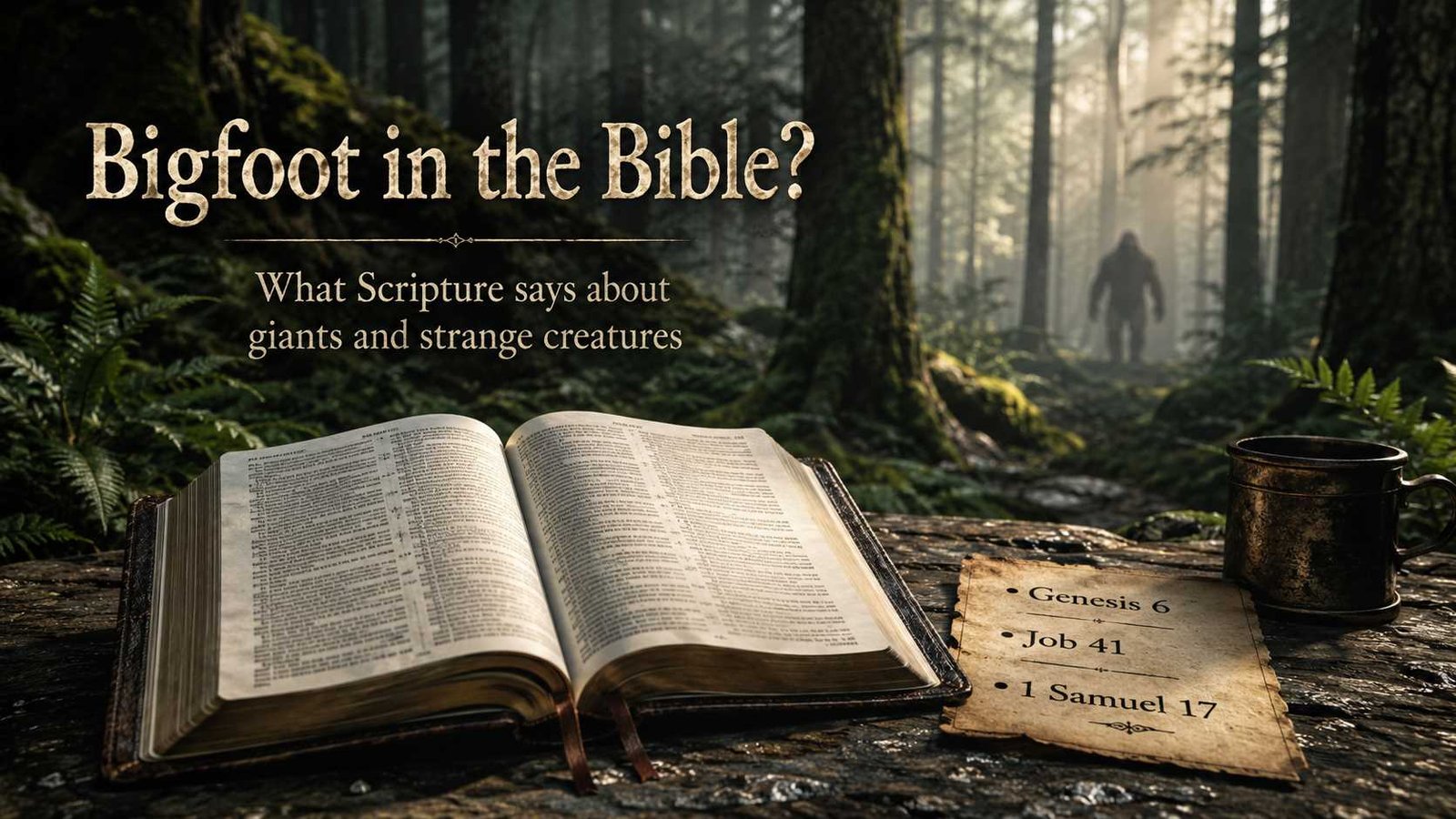
 Bigfoot has fascinated people for generations. Stories describe a large, hairy, human-like creature walking through remote forests, especially in North America. It is also commonly called Sasquatch. Bigfoot has become an important part of North American folklore, although most scientists remain skeptical that such an undiscovered creature exists.
That naturally raises an interesting question for Bible readers: Is Bigfoot in the Bible?
The short answer is no. The Bible does not identify any creature as Bigfoot or Sasquatch. It never describes a hidden race of giant, hairy, ape-like beings living in forests.
Still, the question is not as strange as it may first sound.
Scripture does mention the mysterious Nephilim, very large warriors such as Goliath, powerful creatures such as Behemoth and Leviathan, and even a man named Esau who was unusually hairy. These passages have sometimes been connected to Bigfoot by modern writers.
But similarity is not proof.
If we want to understand the Bible faithfully, we need to separate what Scripture actually says from ideas added many centuries later.
Is Bigfoot in the Bible by Another Name?
There is no biblical name that can confidently be translated as Bigfoot or Sasquatch.
Modern Bigfoot stories usually describe a tall, hairy, two-legged creature with human-like or ape-like features. The Oregon Encyclopedia describes Bigfoot as a mysterious humanoid said to live in wild areas of western North America. Reports commonly portray it as hair-covered, upright, and unusually large.
That description does not match any biblical creature closely enough to say they are the same thing.
People usually make the Bigfoot connection through four biblical subjects:
- The Nephilim
- Giants such as Goliath
- Strange or powerful creatures such as Leviathan
- Hairy people such as Esau
Each deserves a closer look.
Is Bigfoot in the Bible Connected to the Nephilim?
The Nephilim are probably the most common biblical figures connected with Bigfoot theories.
They first appear in Genesis 6:4.
The passage says the Nephilim were on the earth in those days and refers to ancient “mighty men” or “men of renown.” Some translations keep the Hebrew word Nephilim, while the King James Version and some other translations use the word giants.
The Nephilim appear again in Numbers 13:33. When Israelite spies returned from Canaan, some of them reported seeing the Nephilim and described themselves as being like grasshoppers by comparison.
These are certainly unusual passages.
However, neither passage says the Nephilim were covered with hair, lived secretly in forests, walked like apes, left enormous footprints, or became the creatures now called Bigfoot.
That distinction matters.
Were the Nephilim Giants?
This question has been discussed for centuries.
Genesis 6:4 uses the Hebrew term Nephilim. Some English translations retain the Hebrew word, while others traditionally translate or associate it with giants. Numbers 13 also connects the Nephilim with the sons of Anak in the spies’ fearful report.
Christians have different views about exactly who the Nephilim were and how Genesis 6 should be understood. Because of those differences, we should avoid claiming more than the passage tells us.
What we can say is simple:
The Bible never identifies the Nephilim as Bigfoot.
If you want to study this mysterious group more deeply, a related topic is where are Nephilim mentioned in the Bible.
Could Bigfoot Be a Surviving Nephilim?
This idea appears in modern speculation, but Scripture does not teach it.
The reasoning often goes like this: the Nephilim were unusually large, Bigfoot is said to be unusually large, therefore Bigfoot might somehow be connected to the Nephilim.
The problem is the jump between those two ideas.
Being large does not make two beings identical.
A giraffe and an elephant are both large animals, but they are clearly not the same creature. In the same way, even if someone understands the Nephilim to have been literal giants, nothing in Genesis says they became hairy forest creatures.
Numbers 13:33 mentions the Nephilim again, but it still gives no Bigfoot-like description.
A careful Bible reader should therefore say:
The Nephilim are biblical. Bigfoot is part of later folklore. A connection between them is speculation, not Scripture.
That does not mean Christians cannot wonder about unexplained creatures. Curiosity is not the problem. The problem begins when a theory is presented as though God clearly revealed it in the Bible.
Is a Giant Real According to the Bible?
If someone asks, “Is giant real according to the Bible?”, the biblical answer is easier.
Yes, Scripture describes people of extraordinary size and groups remembered for great height.
The most famous example is Goliath.
Goliath Was a Very Large Warrior
First Samuel 17 introduces Goliath as a Philistine champion from Gath.
Many familiar English Bibles, following the traditional Hebrew text, give his height as “six cubits and a span.”
There is an interesting textual detail here. An ancient Qumran manuscript of Samuel, the Greek Septuagint tradition, and Josephus preserve a reading of “four cubits and a span” instead. The NET Bible notes this textual difference.
Either way, the main point of the biblical story does not change.
Goliath was an intimidating Philistine warrior. David faced him while trusting God rather than depending on physical size or military strength.
Most importantly for our question, Goliath was human.
He spoke with people. He served in a human army. He carried weapons. He challenged Israel. David killed him in battle.
Nothing about Goliath resembles a hidden species of forest creature.
For a deeper study, see the related topics how tall were the giants in the Bible and what does the Bible say about giants.
The Anakites and Other Large People
The Bible also speaks about people connected with unusual height.
The Israelite spies feared the descendants of Anak in Numbers 13. Deuteronomy refers to other ancient peoples remembered as tall and powerful. Second Samuel 21 also records battles involving formidable Philistine warriors connected with Gath.
These passages show that giant traditions are genuinely present in Scripture.
But once again, biblical giants should not automatically be turned into Bigfoot.
They belonged to peoples, families, armies, and places known within biblical history. They are presented as people, not mysterious woodland animals.
What Is the Biggest Monster in the Bible?
Another question closely connected with Bigfoot discussions is: What is the biggest monster in the Bible?
The Bible does not provide a list ranking creatures from smallest to largest, so we cannot name one biblical creature as the official “biggest monster.”
However, two extraordinary creatures stand out in the book of Job: Behemoth and Leviathan.
Behemoth
Job 40 describes Behemoth as tremendously strong.
It feeds on grass, has great strength in its body, and is pictured with bones and limbs of extraordinary power. The passage calls attention to the greatness of the creature as part of God’s creation.
Readers have proposed different identifications for Behemoth. Some see a known large animal behind the poetic description, while others emphasize the elevated imagery of the passage.
Whatever position someone takes, Job does not describe Behemoth as Bigfoot.
Leviathan
Leviathan is even more dramatic.
Job 41 describes a creature that humans cannot easily capture or control. The chapter speaks of its frightening teeth, strong exterior, great power, and terrifying presence.
Leviathan also appears elsewhere in Scripture.
Psalm 104 places Leviathan in the sea among God’s creatures, while Isaiah 27 uses Leviathan in striking serpent and sea-monster imagery.
This makes one point especially clear:
Leviathan is not a good biblical candidate for Bigfoot.
Bigfoot stories normally concern a land-dwelling, hairy humanoid. Leviathan is associated with water and sea imagery.
Readers curious about this subject can also study what is the Leviathan in the Bible and were there dragons in the Bible.
Is Bigfoot in the Bible Because Esau Was Hairy?
This is another argument sometimes raised because Genesis gives Esau an unusual physical description.
Genesis 25:25 says that when Esau was born, his body was like a hairy garment. The passage later describes him as a skillful hunter and a man of the open country.
That may sound interesting to someone searching for a hairy wilderness figure.
But the rest of Genesis leaves no mystery about Esau.
He was the son of Isaac and Rebekah and the twin brother of Jacob. He married, had children, interacted with his family, and became the ancestor of Edom.
Esau was a human man.
The Bible’s statement that he was hairy is a physical description. It is not evidence that Esau was Bigfoot or that a Bigfoot-like race existed in Bible times.
This is a good example of why context matters.
If we pull one unusual phrase from a Bible verse and ignore everything around it, almost any theory can begin to sound possible.
When we read the whole story, the confusion disappears.
What Animal Did God Not Let Into Noah’s Ark?
A popular question asks, “What animal did God not let into Noah’s ark?”
Sometimes jokes and internet stories answer with dinosaurs, unicorns, Bigfoot, or another mysterious creature.
Genesis does not say that.
The biblical account describes clean and unclean animals, birds, and creatures that move along the ground entering the ark. Genesis 7 says male and female animals came to Noah and entered as God commanded.
Scripture never tells us about a particular animal arriving at the ark and being refused entry by God.
There is therefore no biblical verse saying:
“Bigfoot was not allowed onto the ark.”
There is no verse saying the same about unicorns or any other creature often mentioned in modern jokes.
Those are later stories, not part of Genesis.
Could Bigfoot Have Missed Noah’s Ark?
Again, that would be speculation.
Someone might imagine a creature failing to enter the ark and then build a story around the idea. But Genesis gives us no information supporting such a theory.
The safer approach is very simple:
Where the Bible speaks, we can speak confidently.
Where the Bible is silent, we should be careful.
Questions about unusual animal names in older Bible translations can be interesting in their own right. A useful related study is is unicorn in the Bible, because the history of that word involves translation rather than a story about an animal being rejected from Noah’s ark.
Does the Bible Describe Hairy Human-Like Creatures?
Not in the way Bigfoot is normally described.
The Bible certainly mentions hairiness. Esau is the clearest example. It also includes wild animals, wilderness scenes, unusually large warriors, strange prophetic imagery, and creatures that may sound unfamiliar to modern readers.
But these details occur in different contexts.
Putting them together to create one new creature would be like taking Goliath’s height, Esau’s hair, Leviathan’s strength, and a wilderness setting and saying the Bible has described Bigfoot.
It has not.
Those details belong to different people, creatures, books, and purposes.
Good Bible interpretation asks what a passage meant in its own setting before asking whether it resembles something from modern culture.
What About Strange Beasts and Dragons in the Bible?
Older English Bible translations sometimes contain animal words that sound surprising today.
One important example appears in Isaiah 27:1, where the King James Version uses the word “dragon” while other translations use terms such as serpent or sea monster in the same poetic description of Leviathan.
This reminds us that an English word can change over time.
Seeing “dragon,” “unicorn,” or another unusual word in an older translation does not automatically prove that the Bible describes the creature exactly as modern movies and fantasy stories imagine it.
The same principle applies to Bigfoot.
We must study the original setting and language rather than starting with a modern creature and searching for verses that sound similar.
Which Generation Will Not Pass Away?
The question “Which generation will not pass away?” comes from Jesus’ teaching in Matthew 24.
Jesus says:
“Truly I tell you, this generation will certainly not pass away until all these things have happened.”
Matthew 24:34 records that statement within Jesus’ teaching about coming events, watchfulness, and the future. Verse 36 immediately warns that no one knows the day or hour.
Christians have understood parts of Matthew 24 in different ways. Some connect much of the chapter with events surrounding Jerusalem and the destruction of the temple. Others see portions pointing toward events still future. Some understand the discourse as containing both near and future fulfillment.
Those differences deserve thoughtful study.
But one thing is clear for our present question:
Matthew 24:34 does not mention Bigfoot.
It does not say that a generation of Nephilim would survive. It does not predict Sasquatch. It does not describe giant creatures hiding until the end times.
Connecting “this generation” to Bigfoot requires adding an idea that is not present in the passage.
Bigfoot, Giants, and Biblical Creatures Compared
The differences become much clearer when we place the main subjects side by side.
| Figure or Creature | In the Bible? | What Scripture Describes | Bigfoot Connection |
|---|---|---|---|
| Bigfoot/Sasquatch | No | No biblical description | None stated |
| Nephilim | Yes | Ancient mysterious figures linked with mighty men | No biblical connection |
| Goliath | Yes | Large Philistine warrior from Gath | Human, not Bigfoot |
| Anakites | Yes | People feared for their size | No biblical connection |
| Esau | Yes | Hairy son of Isaac and brother of Jacob | Human, not Bigfoot |
| Behemoth | Yes | Extremely powerful creature in Job | Not identified as Bigfoot |
| Leviathan | Yes | Fearsome creature strongly associated with water | Not Bigfoot |
| Noah’s animals | Yes | Animals preserved through the Flood | No rejected Bigfoot mentioned |
The table shows why the Bigfoot theory can initially seem interesting while still lacking biblical support.
There are pieces that sound similar: size, hair, unusual beings, wilderness, powerful creatures.
But Scripture never combines those pieces into Bigfoot.
Why Do People Connect Bigfoot With the Bible?
Human beings naturally look for connections.
When we hear about a mysterious creature today, we may search ancient books for anything that sounds similar.
The Bible is especially rich in memorable images. It contains giants, strange creatures, prophetic visions, wilderness stories, angels, demons, mighty warriors, and animals whose ancient names can be difficult to identify.
That makes it easy for modern theories to grow.
There are several reasons Bigfoot gets connected with Scripture.
The Mystery of the Nephilim
Genesis 6 gives only a short description of the Nephilim. Because the passage raises questions without answering every one of them, people often fill the gaps with theories.
Biblical Giants Are Real Characters in the Story
Goliath and other large warriors make the idea of unusual human size feel less foreign to Bible readers.
But giant humans and Bigfoot are still different categories.
Strange Creatures Capture Our Imagination
Behemoth and Leviathan are among the Bible’s most vivid creature descriptions. Job uses them to emphasize a much bigger truth: human beings are limited, but God is not.
Bigfoot Is Already a Powerful Cultural Story
Bigfoot traditions have become deeply rooted in the folklore and popular culture of the Pacific Northwest and beyond. Reports of large hairy humanoids, footprints, and supposed sightings helped develop the modern legend.
When two mysterious subjects exist, people naturally try to connect them.
Still, an interesting connection is not the same as a biblical teaching.
Does Believing in Bigfoot Conflict With the Bible?
The Bible does not require Christians to believe in Bigfoot, and it does not require them to deny that an unknown animal could ever be discovered.
The world contains an enormous variety of creatures. Scripture itself celebrates the greatness of God’s creation. Psalm 104 speaks of the sea filled with living things both large and small and presents even Leviathan as part of God’s created world.
So there is nothing wrong with asking whether undiscovered animals might exist.
The more important question is how strongly we make our claims.
A Christian can say:
“I wonder whether Bigfoot could exist.”
That is an opinion about nature.
But saying:
“The Bible teaches that Bigfoot is a Nephilim.”
is something very different.
That makes a claim about Scripture, and Scripture does not support it.
Faithful reading requires us to know the difference.
Is Bigfoot Real According to the Bible?
The Bible cannot be used to prove that Bigfoot exists.
It also was not written as a catalog of every animal species that would ever live on Earth.
Therefore, the absence of the word Bigfoot is not by itself a scientific argument about whether an unknown animal could exist somewhere.
The scientific question and the biblical question are different.
Historically, Bigfoot is treated as part of North American folklore. Claims have included sightings, footprints, photographs, and stories of large hairy figures, while most scientists have remained skeptical of the evidence.
Biblically, we can say something much simpler:
Scripture does not identify Bigfoot as a real biblical creature.
That is the limit of what the text allows us to say with confidence.
What the Bible Actually Lets Us Say About Bigfoot
After looking at the passages most often connected with Bigfoot, several points are clear.
- Bigfoot and Sasquatch are not named in Scripture.
- The Nephilim are biblical, but Scripture never describes them as Bigfoot.
- Goliath was an unusually large warrior, not an ape-like forest creature.
- The Bible describes other large people and warrior groups, but none are called Bigfoot.
- Esau was hairy, but Genesis clearly presents him as a human man.
- Behemoth and Leviathan are extraordinary biblical creatures, but neither is identified as Bigfoot.
- Genesis does not name an animal that God refused to allow onto Noah’s ark.
- Matthew 24’s “this generation” statement has no connection with Bigfoot or surviving Nephilim.
- The idea that Bigfoot is biblical remains modern speculation rather than biblical teaching.
That gives us room for curiosity without confusing curiosity with revelation.
What This Mystery Teaches Us About Reading Scripture
Bigfoot may seem like a lighthearted subject, but the question teaches us something important about Bible study.
We all bring ideas with us when we open Scripture.
Sometimes those ideas come from movies. Sometimes they come from social media, folklore, family traditions, sermons, documentaries, or popular theories.
The danger comes when we begin looking for isolated verses to prove an idea we already believe.
A healthier approach works in the opposite direction.
Start with the passage.
Ask who is being described.
Look at the surrounding verses.
Notice whether the language is history, poetry, prophecy, or another kind of writing.
Compare related passages.
Then stop where Scripture stops.
Genesis allows us to talk about the Nephilim. First Samuel allows us to talk about Goliath. Job allows us to stand in awe before descriptions of Behemoth and Leviathan. Genesis tells us Esau was unusually hairy.
But none of those passages gives us Bigfoot.
And that is perfectly fine.
The Bible does not need to contain every mystery for it to accomplish its purpose. Its central message is not about proving cryptids. It tells the much greater story of God, humanity, sin, redemption, faith, and His work throughout history.
We can enjoy mysteries. We can ask unusual questions. We can wonder what creatures may remain undiscovered in distant places.
But our faith grows stronger when we learn to say, with humility, “The Bible says this,” and also, when necessary, “The Bible does not tell us.”
So, is Bigfoot in the Bible?
No biblical passage identifies Bigfoot or Sasquatch. The Bible does contain giants, Nephilim, powerful creatures, and unusual descriptions, but connecting them directly with Bigfoot goes beyond what Scripture says.
Curiosity can lead us to the Bible.
Careful reading helps us stay faithful to it.

Dr. Rachel is very smart and knows a lot about the Bible. He helps us understand the Bible better by talking about the old texts in a simple way.