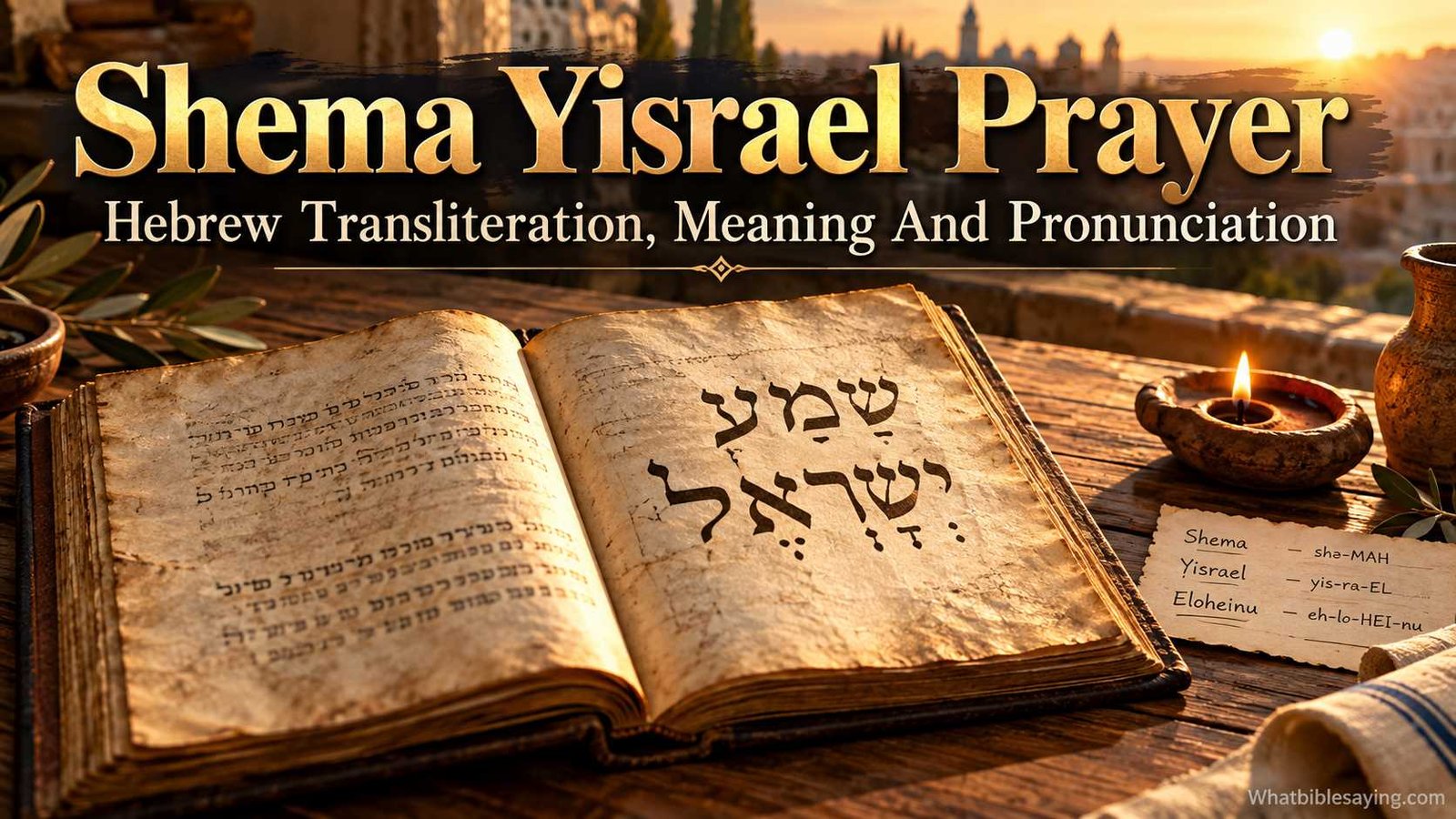
 The words Shema Yisrael have been spoken for thousands of years. They begin one of the best-known declarations of faith in the Bible:
Shema Yisrael, Adonai Eloheinu, Adonai Echad.
In simple English, this means:
Hear, O Israel: the Lord is our God, the Lord is one.
These words come from Deuteronomy 6:4. They stand at the heart of the Shema, an ancient biblical confession that calls God’s people to hear Him, recognize Him as the one God, and love Him with their whole lives.
If you are looking for the Shema Yisrael prayer transliteration, the important thing to understand is that the Shema is more than one sentence. The opening verse is its most famous part, but the traditional full Shema contains three passages from the Torah: Deuteronomy 6:4–9, Deuteronomy 11:13–21, and Numbers 15:37–41.
For Christian Bible readers, the Shema also has special importance because Jesus quoted its opening words when He was asked about the greatest commandment.
What Does Shema Yisrael Mean?
The Hebrew words are:
שְׁמַע יִשְׂרָאֵל
Transliteration:
Shema Yisrael
English:
Hear, O Israel
The Hebrew word shema comes from a word connected with hearing or listening. Yet biblical listening often means more than allowing words to enter your ears. It carries the idea of paying attention and responding faithfully.
That gives the opening of the Shema great depth.
God is not simply saying, “Hear this sound.”
The call is closer to:
Listen carefully.
Recognize who God is.
Remember His words.
Live according to them.
The full opening declaration is:
Shema Yisrael, Adonai Eloheinu, Adonai Echad.
Word by word:
| Hebrew term | Transliteration | Basic meaning |
|---|---|---|
| שְׁמַע | Shema | Hear or listen |
| יִשְׂרָאֵל | Yisrael | Israel |
| אֲדֹנָי | Adonai | Lord |
| אֱלֹהֵינוּ | Eloheinu | Our God |
| אֶחָד | Echad | One |
So the basic sense is:
Hear, Israel: the Lord is our God, the Lord is one.
In the Hebrew biblical text, God’s covenant name appears where Jewish prayer tradition normally says Adonai, meaning Lord. That is why most spoken forms of the Shema use Adonai.
Shema Yisrael Prayer Transliteration
For someone learning the prayer for the first time, the opening can be written simply as:
Shema Yisrael, Adonai Eloheinu, Adonai Echad.
A common pronunciation guide is:
shuh-MAH yees-rah-EL, ah-doh-NYE eh-loh-HAY-noo, ah-doh-NYE eh-KHAHD
The final word, Echad, contains a Hebrew sound that English does not represent perfectly. The “ch” is not pronounced like the “ch” in chair. It is a softer throat sound, somewhat like the “ch” heard in the Scottish word loch.
Do not worry if your pronunciation is not perfect at first. Transliteration exists precisely because many readers cannot yet read Hebrew letters.
Hebrew to English Transliteration: What Does Transliteration Mean?
Many people searching for Hebrew to English transliteration are actually looking for one of two different things.
They may want Hebrew written with English letters, or they may want its meaning translated into English.
These are different processes.
Consider:
שמע ישראל
A transliteration is:
Shema Yisrael
A translation is:
Hear, O Israel
Transliteration shows approximately how Hebrew sounds using the Latin alphabet. Translation tells you what the Hebrew means.
That distinction also explains why Hebrew transliteration to English may look different on different websites.
For example, you may see:
Shema or Sh’ma
Yisrael or Yisroel
Echad or Ekhad
These differences do not necessarily mean that one writer has the wrong Hebrew. Transliteration systems simply make different choices about how Hebrew sounds should be represented with English letters.
What Is the Full Shema Prayer?
When people ask, What is the full Shema prayer?, the answer deserves a little care.
The famous declaration in Deuteronomy 6:4 is commonly called the Shema. However, in traditional Jewish worship, the complete Shema contains three biblical sections:
- Deuteronomy 6:4–9
- Deuteronomy 11:13–21
- Numbers 15:37–41
Each part develops an important theme.
The first declares God’s oneness and commands wholehearted love for Him.
The second speaks about faithfully obeying God’s commandments.
The third speaks about remembering God’s commands and recalls God’s deliverance of Israel from Egypt.
A traditional line is also spoken after the opening declaration:
Barukh shem kevod malkhuto le’olam va’ed.
It means, in simple terms, that the glorious name of God’s kingdom is blessed forever.
This line is part of traditional recitation but is not part of Deuteronomy 6:4 itself.
The First Part of the Full Shema Transliteration
The first biblical portion is Deuteronomy 6:4–9.
Deuteronomy 6:4
Shema Yisrael, Adonai Eloheinu, Adonai Echad.
Then traditionally:
Barukh shem kevod malkhuto le’olam va’ed.
The first paragraph continues:
Ve’ahavta et Adonai Elohekha bekhol levavkha uvekhol nafshekha uvekhol me’odekha.
Vehayu hadevarim ha’elleh asher anokhi metzavvekha hayom al levavekha.
Veshinnantam levanekha vedibbarta bam, beshivtekha beveitekha uvelekhtekha vaderekh, uveshokhbekha uvekumekha.
Ukeshartam le’ot al yadekha, vehayu letotafot bein einekha.
Ukhtavtam al mezuzot beitekha uvish’arekha.
The meaning is beautiful and practical.
Israel is commanded to love God with the whole heart, soul, and strength. God’s words are to remain in the heart, be taught to children, discussed at home and while traveling, remembered at bedtime and upon rising, and kept before the people in daily life.
Faith is not presented as something reserved for one hour of worship. It is meant to shape ordinary life.
The Second Part of the Full Shema
The second section comes from Deuteronomy 11:13–21.
A readable transliteration is:
Vehayah im shamoa tishme’u el mitzvotai asher anokhi metzaveh etkhem hayom, le’ahavah et Adonai Eloheikhem ule’avdo bekhol levavkhem uvekhol nafshekhem.
Venatati metar artzekhem be’itto, yoreh umalkosh, ve’asafta deganekha vetiroshkha veyitzharekha.
Venatati esev besadekha livhemtekha, ve’akhalta vesava’ta.
Hishameru lakhem pen yifteh levavkhem, vesartem va’avadtem elohim acherim vehishtachavitem lahem.
Vecharah af Adonai bakhem, ve’atzar et hashamayim velo yihyeh matar, veha’adamah lo titten et yevulah, va’avadtem meherah me’al ha’aretz hatovah asher Adonai noten lakhem.
Vesamtem et devarai elleh al levavkhem ve’al nafshekhem, ukeshartem otam le’ot al yedkhem, vehayu letotafot bein eineikhem.
Velimmadtem otam et beneikhem ledabber bam, beshivtekha beveitekha uvelekhtekha vaderekh, uveshokhbekha uvekumekha.
Ukhtavtam al mezuzot beitekha uvish’arekha.
Lema’an yirbu yemeikhem vimei veneikhem al ha’adamah asher nishba Adonai la’avoteikhem latet lahem, kimei hashamayim al ha’aretz.
This section emphasizes obedience and faithfulness.
It reminds Israel that loving God is not only an emotion. Love is expressed through listening, remembering, teaching, and obeying Him.
The Third Part of the Full Shema
The third section is Numbers 15:37–41.
Its transliteration reads:
Vayomer Adonai el Moshe lemor.
Dabber el benei Yisrael ve’amarta alehem ve’asu lahem tzitzit al kanfei vigdeihem ledorotam, venatenu al tzitzit hakanaf petil tekhelet.
Vehayah lakhem letzitzit, ure’item oto uzkhartem et kol mitzvot Adonai va’asitem otam, velo taturu acharei levavkhem ve’acharei eineikhem asher atem zonim achareihem.
Lema’an tizkeru va’asitem et kol mitzvotai, vihyitem kedoshim l’Eloheikhem.
Ani Adonai Eloheikhem asher hotzeti etkhem me’eretz Mitzrayim lihiyot lakhem l’Elohim; Ani Adonai Eloheikhem.
This passage concerns the fringes, or tzitzit, given as a reminder of God’s commandments.
The section ends by remembering the Exodus. God identifies Himself as the One who brought Israel out of Egypt.
This gives the Shema another important dimension: biblical faith is connected with remembering what God has done.
How Do You Say the Full Shema?
If you want to learn how to say the full Shema, do not try to memorize all three sections at once.
Start with:
Shema Yisrael, Adonai Eloheinu, Adonai Echad.
Say it slowly.
Then divide it into parts:
Shema Yisrael
Adonai Eloheinu
Adonai Echad
Once those words feel natural, learn:
Barukh shem kevod malkhuto le’olam va’ed.
After that, begin the Ve’ahavta, the section starting with the command to love God.
Learning Hebrew prayer is much easier phrase by phrase than trying to pronounce a whole paragraph at once.
It also helps to learn the meaning while learning the sounds. Words remembered only as sounds can soon become mechanical. Words connected with their meaning are easier to understand and remember.
Where Is the Shema in the Bible?
The central Shema passage begins in Deuteronomy 6:4.
Its setting matters.
Moses is speaking to Israel about covenant faithfulness as the people prepare for life in the Promised Land. Just before the Shema, Deuteronomy speaks about God’s commandments. Immediately afterward comes the command to love God completely and teach His words faithfully to the next generation.
That is why anyone asking where is Shema in the Bible should read more than verse 4.
Read Deuteronomy 6:4–9 together.
The declaration that God is one leads directly to the command to love Him.
Belief and life belong together.
Why Is the Shema Said Morning and Evening?
Deuteronomy 6 tells God’s people to speak of His words:
when sitting at home,
when walking along the way,
when lying down,
and when rising.
Jewish tradition understood the references to lying down and rising as connected with evening and morning recitation.
That is why the Shema became a central part of both daily morning and evening worship.
The rhythm itself carries a lesson even for someone studying the text rather than following Jewish liturgical practice.
Begin the day remembering God.
End the day remembering God.
Let faith surround ordinary life.
Did Jesus Say the Shema?
Yes. This is one reason the Shema deserves special attention from Christian Bible readers.
In Mark 12:28–30, a teacher asks Jesus which commandment is the most important.
Jesus begins His answer with the words of Deuteronomy:
“Hear, O Israel.”
He declares that the Lord is one and then speaks of loving God with all the heart, soul, mind, and strength.
Jesus then joins this with the command to love one’s neighbor.
His answer shows that the Shema was not an obscure passage. It stood at the center of biblical faith.
For Christians trying to understand what the Bible teaches about prayer, worship, or love for God, Mark 12 offers an important bridge between Deuteronomy and the teaching of Jesus.
Is It Okay to Say Shema Yisrael in English?
Many readers ask, Is it okay to say Shema Yisrael in English?
If your purpose is Bible reading, study, understanding, or personal reflection, you can certainly read and speak the biblical passage in English.
God’s truth is not hidden from someone simply because that person does not know Hebrew.
At the same time, it is respectful to remember that the Shema has a particular place in Jewish worship. Traditional Jewish communities have their own rules and practices concerning its liturgical recitation.
So there are two different questions.
Can a Christian or Bible student read Deuteronomy 6:4–9 in English and pray over its truth? Certainly.
Does reading an English translation follow every requirement of traditional Jewish liturgical practice? That is a question governed by Jewish religious tradition and should not be oversimplified.
Respecting that distinction allows Christians to value the passage without pretending that Christian Bible study and Jewish liturgical practice are identical.
English to Hebrew Transliteration and Hebrew to English Transliteration
The phrases English to Hebrew transliteration and Hebrew transliteration to English are sometimes used interchangeably online, but technically they describe different directions.
When we write:
שמע → Shema
we are transliterating Hebrew into Latin or English letters.
If we tried to represent an English name or sentence using Hebrew characters, we would be working in the opposite direction.
The Shema normally requires Hebrew to English transliteration, because the original Hebrew sounds are being represented with letters that English-speaking readers recognize.
Transliteration cannot reproduce every Hebrew sound perfectly. That is why two trustworthy sources can sometimes spell the same Hebrew word differently.
Why Does the Shema Begin With “Hear”?
There is something deeply practical about the first word.
The passage does not begin with “argue,” “discover,” or even “speak.”
It begins with:
Shema.
Hear.
Listen.
The next verses show what that listening should produce: love, remembrance, teaching, obedience, and faithfulness.
This pattern appears throughout Scripture. Hearing God’s word is meant to change the way people live.
That makes the Shema useful when thinking about how to study the Bible as well. Biblical study is not merely collecting information. Scripture repeatedly calls people to hear God’s truth and respond to it.
What Is the Most Powerful Prayer in Hebrew?
People sometimes ask, What is the most powerful prayer in Hebrew?
The Bible does not give us a ranking in which one prayer contains more spiritual power than every other prayer.
Prayer should not be treated like a magical formula.
Still, the Shema is unquestionably one of the most important declarations in Jewish faith and worship.
Its importance comes from what it confesses:
There is one God.
He deserves wholehearted love.
His words should remain in our hearts.
Parents should teach His truth to their children.
Faith should shape daily life.
His commandments should be remembered.
His saving acts should not be forgotten.
For Christian readers, its significance becomes even clearer when Jesus Himself begins His answer about the greatest commandment with the Shema.
The strength of these words is not in producing a certain sound. Their strength lies in the truth they proclaim and the life of faithfulness to which they call us.
What the Full Shema Teaches About Loving God
The full Shema moves through several connected ideas.
First comes who God is.
Then comes how we should love Him.
Then comes remembering His words.
Then comes teaching the next generation.
Then comes obedience.
Then comes remembering God’s saving work.
That sequence is important.
Biblical faith begins with God, not with us.
We first hear who He is. Then we respond.
For parents, the Shema also contains a powerful picture of spiritual teaching. God’s words are not meant to be discussed only during formal worship. Families are told to speak about them during normal life.
At home.
On the road.
At bedtime.
In the morning.
Faith becomes part of the family’s daily language.
Hearing God With the Heart
The Shema Yisrael prayer transliteration can help you pronounce ancient Hebrew words, but pronunciation is only the beginning.
Shema Yisrael, Adonai Eloheinu, Adonai Echad.
Hear, O Israel. The Lord is our God. The Lord is one.
Those words call us beyond curiosity.
They call us to listen.
Deuteronomy moves immediately from hearing to loving God with the whole person. It then speaks about remembering His words, teaching children, and carrying those truths into daily life.
Jesus returned to these same words when He explained the greatest commandment.
So whether you are learning Hebrew, studying what language the Bible was written in, reading about the Hebrew Bible, or simply trying to understand Deuteronomy more deeply, the Shema gives you something greater than a pronunciation lesson.
It gives a picture of faith centered on one God and a life centered on loving Him.
Learning to say the words is worthwhile.
Understanding them is better.
Dr. Rachel is very smart and knows a lot about the Bible. He helps us understand the Bible better by talking about the old texts in a simple way.