

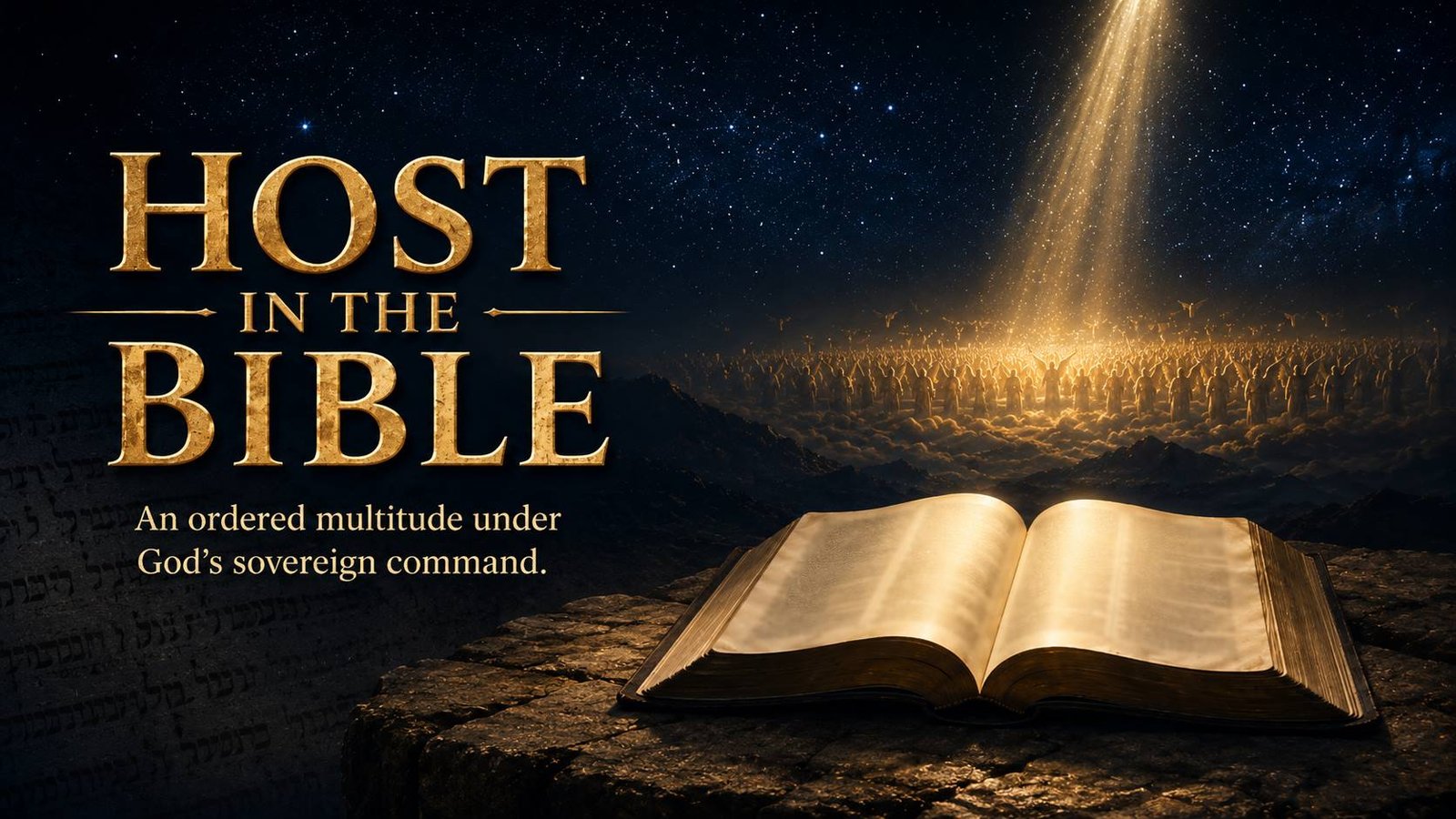
 When you hear the word host, you may picture someone welcoming guests into a home. That is one correct meaning in modern English. However, the word often means something very different in the Bible.
So, what does host mean in the Bible?
In many Bible passages, a host is a large, organized group. It may describe an army, a company of angels, the stars of heaven, or the whole created order. The title Lord of Hosts describes God as the supreme ruler over every earthly and heavenly power.
The word can also appear in Christian discussions about hospitality and Holy Communion. Because these meanings are different, the surrounding passage must guide us.
Here is the simplest answer:
In the Bible, host usually means an army, a large organized multitude, or the heavenly beings and created powers under God’s authority.
This meaning helps us understand phrases such as heavenly host, host of heaven, and Lord of Hosts. It also gives us a clearer picture of God’s power, order, and rule.
What Does Host Mean in the Bible? A Simple Definition
The older English word host often refers to a great company gathered for a purpose.
Imagine a large army arranged in rows. Each person has a place, a duty, and someone in command. That picture is close to the biblical meaning of host. The word does not usually describe a confused crowd. It describes an organized group.
Depending on the passage, host may refer to:
- Soldiers gathered for battle
- Angels serving and praising God
- The sun, moon, and stars
- All the created things in heaven
- A large company of people
- People appointed for a special service
The main Hebrew word often translated as host is ṣāḇāʾ, commonly written as tsaba. It can mean an army, warfare, service, soldiers, or an organized company. Biblical Hebrew also uses it for angels, heavenly bodies, and the wider created order.
This is why one English word may appear in several kinds of passages.
The Meaning of Tsaba
The Hebrew word tsaba carries the idea of something that goes out, serves, or stands in an ordered company.
It is frequently connected with military forces. Yet its meaning is not limited to war. It can also describe people performing appointed service or heavenly beings standing before God.
Older Bible translations, especially the King James Version, use the word host more often than many modern translations. A modern Bible may translate the same Hebrew word as:
- Army
- Multitude
- Company
- Heavenly army
- Vast array
- Heaven’s armies
These translations are not necessarily contradicting one another. They are using different English phrases to express the same basic idea.
The word points to a large, ordered company under authority.
Why the Surrounding Verse Matters
You cannot understand the word host by looking at the word alone. You must read the entire sentence and, when possible, the verses around it.
For example:
- If a king gathers a host, it likely means an army.
- If a host praises God in heaven, it likely means angels.
- If a passage mentions the sun, moon, and stars, the host may mean heavenly bodies.
- If the phrase is Lord of Hosts, it is a title for God.
- If someone welcomes travelers into a home, the subject is hospitality.
Context keeps us from forcing the wrong meaning into a passage.
What Does Hosts Mean in Different Bible Passages?
The plural word hosts usually refers to armies, companies, or multitudes. Yet the exact identity of those hosts changes from one passage to another.
Understanding these differences makes many older Bible verses easier to read.
Host as an Earthly Army
In historical passages, a host often means an army.
Kings had hosts. Nations sent hosts into battle. Military leaders were sometimes called captains of the host.
When an older translation says that a king gathered “all his host,” it does not mean that he gathered people who welcomed guests. It means that he assembled his military forces.
The word may include more than soldiers. An ancient army could include commanders, guards, servants, supply workers, horses, chariots, and other people connected with the campaign.
This military meaning explains why the word host suggests order and command. An army is not simply a large group. It is a group organized under leadership.
The biblical word can also refer to service rather than direct fighting. This reminds us that its deepest idea is not always violence. It is organized duty under authority.
The Heavenly Host as Angels
One of the best-known uses of the phrase heavenly host appears in the account of Jesus’ birth.
Luke 2 tells us that shepherds were watching their flocks near Bethlehem. An angel announced the birth of the Savior. Then a great company of the heavenly host appeared, praising God and declaring glory to Him.
The passage later says that the angels returned to heaven. This makes it clear that the heavenly host in this scene is a great company of angels.
A heavenly host is therefore not one angel. It is a multitude of heavenly beings.
The scene is sometimes pictured as a soft choir floating above the shepherds. The Bible’s language may suggest something even more powerful. The shepherds were surrounded by a vast heavenly company serving the King of heaven.
Yet the heavenly host did not appear to receive worship. They appeared to give worship.
Their message pointed to God:
“Glory to God in the highest heaven.”
The angels were God’s servants and messengers. They celebrated the coming of Christ and directed human attention toward the Lord.
This connects naturally with the question how does the Bible describe angels? Angels are not divine beings equal to God. They belong to the created order and serve according to His command.
The Host of Heaven as Stars and Creation
Genesis 2:1 says that the heavens and the earth were finished, together with “all the host of them” in the King James Version. Some newer translations say “all their vast array” or “all their multitude.”
Here, host points to the ordered fullness of creation.
It can include the lights of heaven, the living creatures God made, and all the parts of the created world in their proper places.
The stars were sometimes called the host of heaven. When we look into the night sky, the stars may appear countless. Yet Scripture presents them as part of an ordered creation known and ruled by God.
Nehemiah 9:6 speaks of God making the heavens with all their host. It also says that the host of heaven worships Him. Different translations bring out different sides of this expression. Some speak of the starry host, while others speak of the multitudes or heavenly beings who worship God.
This is another reason context matters. The phrase host of heaven can refer to heavenly bodies, heavenly beings, or the ordered population of heaven more broadly.
The central truth remains the same: God created them, preserves them, and rules over them.
What Does Lord of Hosts Mean in the Bible?
The phrase Lord of Hosts is one of the Bible’s powerful titles for God.
It does not mean that God is merely the host of a gathering or meal. It means that He is the Lord over all hosts.
The traditional Hebrew title is often written as YHWH Tseva’ot. English Bibles translate it in several ways:
- Lord of Hosts
- Lord God of Hosts
- Lord Almighty
- Lord of Heaven’s Armies
Each translation brings out part of the title’s meaning.
The title presents God as the ruler of every force in heaven and on earth. No earthly army, spiritual being, king, nation, or created power stands above Him.
God Rules Every Visible and Invisible Power
Human rulers control only what God permits them to control.
A king may command soldiers. A general may lead an army. A nation may appear strong. Yet all earthly strength is limited.
The Lord of Hosts is not limited.
He rules over what we can see and what we cannot see. The angels serve Him. Creation obeys His will. Nations rise and fall under His greater authority.
In 1 Kings 22:19, the prophet Micaiah describes a vision of the Lord on His throne with the host of heaven standing around Him. God is seated as King, while the heavenly company stands in attendance.
That picture is important. God is not one spiritual power among many. He is the sovereign Lord before whom the heavenly host stands.
Understanding what the word Lord means in the Bible makes this title even stronger. Lord speaks of authority, rule, ownership, and rightful command. The Lord of Hosts is therefore the One who commands every host.
Why Hannah Called God the Lord of Hosts
The title first appears in the Bible’s historical books in the opening chapter of 1 Samuel.
Elkanah went to Shiloh each year to worship and sacrifice to the Lord of Hosts. His wife Hannah carried deep sorrow because she had no child. She prayed with tears and addressed God as the Lord of Hosts.
This setting teaches us something beautiful.
Hannah did not use this powerful title while standing on a battlefield. She used it while bringing personal pain to God.
She knew that the God who rules heaven’s armies could also see one grieving woman.
The title did not make God feel distant. It gave Hannah a reason to trust Him. His power was greater than the situation she could not change.
This remains comforting today. You may not face an earthly army, but you may face fear, loss, uncertainty, family trouble, or a problem beyond your control.
The Lord of Hosts is still Lord.
His greatness does not prevent Him from hearing quiet prayers. The God who commands heaven also listens to the brokenhearted.
Lord of Hosts Does Not Mean Host of a Meal
Modern English can create confusion here.
A person may host a dinner, meeting, podcast, or television program. In those settings, the host receives guests or leads an event.
That is not the meaning of host in the title Lord of Hosts.
In this title, hosts means armies, organized companies, or heavenly powers. God is their Lord and commander.
A simple way to remember the meaning is:
The Lord of Hosts is the Lord over every army, angelic company, heavenly power, and created force.
This title invites both reverence and trust. God possesses complete authority, but He uses His authority with wisdom and righteousness.
What Does a Host Mean Spiritually?
People sometimes ask, what does a host mean spiritually?
The Bible does not give the word host one hidden symbolic meaning that applies everywhere. It does, however, reveal several spiritual truths through the way the word is used.
God Brings Order to His Creation
A biblical host is often ordered rather than chaotic.
The stars have their place. Angels carry out God’s commands. Armies have ranks. Those appointed for service have duties.
This does not mean that every event in life will appear organized to us. Life can feel confusing. We may not understand why something happened or what God is doing.
Yet the biblical picture of the Lord of Hosts reminds us that God is never confused. He does not lose control of His creation.
Nothing surprises Him.
This truth can bring peace when your own plans fall apart. You may not see the full picture, but God’s authority has not failed.
The Heavenly Host Worships God
The heavenly host points us toward worship.
Angels are powerful, but their power is not independent. They serve God. When the heavenly host appeared at Jesus’ birth, they praised the Lord rather than drawing attention to themselves.
That gives us a healthy pattern for what worship means in the Bible.
True worship does not make the worshiper the center. It honors God for who He is and what He has done.
The angels’ response to Christ’s birth was praise. In the same way, the more clearly we understand God’s grace, holiness, and power, the more naturally our hearts should turn toward Him.
Believers Live Under God’s Authority
Christians are not called the Lord’s host in every passage, and we should not force military language into every part of Christian life.
Still, the image of service under authority can teach us something.
Faith is not only believing that God exists. It is also learning to trust His wisdom, obey His teaching, and serve others in love.
We do not command God. He leads us.
This does not make believers unimportant. It gives our lives direction. A person serving God may have a quiet role, but faithful service still matters.
A parent caring for children, a believer encouraging someone in grief, or a church member helping a stranger may all serve God without public attention.
Host Is Not a Secret Spiritual Sign
The word host should not be treated as a private code or automatic prophecy.
Seeing a crowd, noticing many stars, or hearing the word repeatedly does not necessarily mean that God is sending a hidden message.
Scripture gives the word clear meanings within clear passages. Wise Bible study begins with what the text actually says.
Spiritual applications should grow from the biblical meaning, not replace it.
This approach protects us from fear, superstition, and exaggerated claims.
What Is Host in Christianity?
The word host can appear in several Christian settings, and not every use comes from the same biblical word.
Christians may hear it in Bible readings, hymns, prayers, older liturgies, or discussions about Holy Communion.
Host in Christian Worship and Prayer
Churches may sing or pray phrases such as:
- Lord God of Hosts
- Heavenly host
- Hosts of heaven
- God of angel armies
These expressions come from biblical language about God’s authority and the heavenly beings who serve Him.
Some Christians use the traditional phrase Lord of Hosts. Others use Lord Almighty or Lord of Heaven’s Armies. The wording differs, but the central belief is shared: God rules over all powers.
The title is therefore not meant to glorify human war. It glorifies God’s unmatched sovereignty.
It also gives believers confidence during spiritual warfare. Christians do not need to imagine themselves as people with independent spiritual power. Their hope rests in God, who is greater than every force of evil.
What Is the Eucharistic Host?
In Catholic Christianity, the word Host commonly refers to the bread consecrated during the Eucharist, also called Holy Communion or the Mass.
This meaning is different from the Hebrew word translated host in phrases such as Lord of Hosts.
The Eucharistic use developed from a Latin word connected with a sacrificial offering or victim. In Catholic worship, the consecrated bread is called the Host because of its connection with Christ’s sacrificial offering.
Official Catholic instructions use host for the consecrated bread received during Communion.
Christians from different traditions understand the Eucharist or Communion in different ways. A respectful article should not pretend that all churches explain it in exactly the same language.
Still, one distinction is clear:
- Lord of Hosts refers to God’s rule over heavenly and earthly companies.
- The Eucharistic Host refers to consecrated Communion bread in Catholic usage.
The same English spelling does not mean the two expressions have the same origin or biblical meaning.
What Does the Bible Say About Being a Host?
The Bible’s older use of host often means an army or multitude. Yet the Bible also has much to say about being a host in the modern sense of welcoming people.
The usual biblical word for this practice is hospitality.
Biblical hospitality is more than setting a beautiful table. It means making room for others with love, generosity, and care.
Welcome Others With Genuine Love
Romans 12 connects hospitality with sincere Christian living. Believers are told to share with those in need and actively pursue hospitality.
The word pursue is important.
Hospitality is not only something we do when it is convenient. It is a habit we seek to develop.
You do not need a large house, expensive food, or perfect furniture. A simple meal offered with kindness may show more love than an impressive event offered only for praise.
Hospitality begins in the heart.
A good host notices people. A good host listens. A good host helps others feel that they are not a burden.
Remember the Stranger
Hebrews 13:2 tells believers not to forget hospitality to strangers. It reminds readers that some people welcomed angels without knowing it.
This likely points readers back to Old Testament accounts in which people received unexpected heavenly visitors.
The lesson is not that every stranger is secretly an angel. The lesson is that we may not fully understand the importance of the person God has placed before us.
Hospitality stretches beyond close friends.
Welcoming only the people who can repay us is ordinary social exchange. Biblical hospitality makes room for the lonely, the traveler, the newcomer, the poor, and the person who feels forgotten.
Practice Hospitality Without Complaining
First Peter 4:9 teaches believers to show hospitality without grumbling.
This verse reaches beneath outward behavior.
A person may provide food while quietly resenting every guest. Another person may offer something simple with real joy. God sees the difference.
Hospitality may require effort. Plans change. Food costs money. Guests may stay longer than expected. Helping someone can interrupt our comfort.
The Bible does not deny that service can be tiring. It calls us to serve with a willing spirit.
That does not mean you must ignore healthy boundaries or place your family in danger. Wisdom and hospitality can work together. Christians can be generous while still acting carefully and responsibly.
Simple Ways to Practice Biblical Hospitality
Hospitality can take many forms:
- Invite a lonely person to share a meal.
- Welcome a newcomer at church.
- Offer water or food to a worker or traveler.
- Listen patiently to someone who needs to speak.
- Visit a sick or grieving person.
- Help a family facing an emergency.
- Make space for children, older people, or those with disabilities.
- Share what you have without making the receiver feel ashamed.
- Send a message to someone who feels forgotten.
- Pray with a person who is carrying a heavy burden.
These actions connect with what the Bible says about hospitality. Hospitality is not mainly about presentation. It is about love made visible.
How Can You Tell What Host Means in a Verse?
The following table can help you identify the meaning quickly:
| Phrase or setting | Likely meaning | Biblical example |
|---|---|---|
| A king gathers his host | Army or military force | Historical battle accounts |
| Captain of the host | Military commander | Old Testament narratives |
| Heavenly host praising God | Angels or heavenly beings | Luke 2:13 |
| Host of heaven | Stars, heavenly beings, or both | Genesis 2:1; Nehemiah 9:6 |
| Lord of Hosts | God as sovereign ruler | 1 Samuel 1:3, 11 |
| Showing hospitality | Welcoming and serving others | Romans 12:13 |
| Receiving the Host | Consecrated Communion bread | Catholic Christian usage |
Ask three simple questions when reading:
- Who or what is being described?
- What action is the host performing?
- Is the passage about battle, heaven, creation, worship, or hospitality?
These questions usually make the meaning clear.
Questions Readers Often Ask
Is a Heavenly Host the Same as an Angel?
No. An angel is one heavenly being. A heavenly host is a large company or multitude of heavenly beings.
Luke 2 begins with one angel speaking to the shepherds. Then the heavenly host appears with that angel. The wording shows the difference between the individual messenger and the larger company.
Does Host Always Mean an Army?
No.
An army is one of the most common biblical meanings, especially in Old Testament history. However, host may also refer to angels, stars, creation, service, or a large multitude.
The context determines the meaning.
What Does Hosts Mean?
Hosts is simply the plural of host. It means armies, companies, multitudes, or organized groups.
In the title Lord of Hosts, the plural expresses the vast range of powers under God’s authority.
Is Lord of Hosts Another Name for God?
It is better described as a biblical title for God.
Like titles such as Almighty, Most High, or Shepherd, it reveals something true about Him. Lord of Hosts reveals His complete authority over heavenly and earthly powers.
Are the Heavenly Host Good Angels?
In passages such as Luke 2:13, the heavenly host clearly praises God and announces His glory. These are faithful heavenly servants.
The wider Bible also speaks about rebellious spiritual powers. However, the phrase heavenly host should be interpreted according to each passage rather than treated as a fixed label for evil spirits.
Related subjects such as what is a principality in the Bible? need their own careful study because not every spiritual being is described in the same way.
Does Host Mean Stars or Angels?
It can mean either, and sometimes the phrase may include the ordered inhabitants and lights of heaven together.
Genesis 2:1 emphasizes the completed created order. Luke 2:13 clearly describes angels. Nehemiah 9:6 uses language that translations render as the starry host, heavenly host, or multitudes of heaven.
Read the surrounding words before deciding.
Does Being a Good Host Have Spiritual Value?
Yes.
Scripture presents hospitality as an important expression of Christian love. It can meet practical needs, comfort lonely people, build relationships, and give strangers a sense of safety.
Hospitality does not earn salvation. It is a loving response to the grace God has shown us.
Does Host Mean Communion Bread?
It does in certain Christian settings, especially Catholic worship.
However, this later Christian use should not be inserted into Old Testament phrases such as Lord of Hosts or host of heaven. Those passages are discussing armies, heavenly beings, creation, or divine authority.
What This Word Teaches Us About God’s Rule and Our Welcome
The word host may look simple, but it opens a wide view of Scripture.
It shows us armies standing under commanders, stars filling the heavens, angels praising God, and the Lord ruling over every visible and invisible power.
Most of all, it points us toward the greatness of God.
The Lord of Hosts is not weak, confused, or threatened. Heaven’s armies are under His command. Creation exists by His will. No human ruler stands above Him.
Yet this mighty Lord also heard Hannah’s tearful prayer.
That truth brings comfort. God’s power is not cold or distant. The One who rules the hosts of heaven also cares about the pain carried quietly in the human heart.
The word also leads us toward hospitality.
God’s people are called to make room for others. We welcome the stranger, share with those in need, serve without constant complaint, and treat each person with dignity.
These two meanings may seem far apart, but together they give us a balanced picture of faith.
We trust the God who commands heaven, and we open our doors to the people He places before us.
The next time you read host in the Bible, pause and examine the setting. It may mean an army, angels, stars, an ordered multitude, or God’s hosts under His sovereign rule.
Whatever the passage, remember this:
The Lord remains above every power, and those who trust Him are never outside His care.
Dr. Rachel is very smart and knows a lot about the Bible. He helps us understand the Bible better by talking about the old texts in a simple way.