
 Have you ever looked at the clock and wondered what to do with the next few hours?
Maybe nothing sounds interesting. You have already checked your phone. The television feels dull. You do not want to work, read, clean, or go anywhere. You simply feel bored.
Boredom is a normal human experience. Children feel it. Teenagers feel it. Adults feel it too. Even a person with a busy life can suddenly feel that everything has become repetitive.
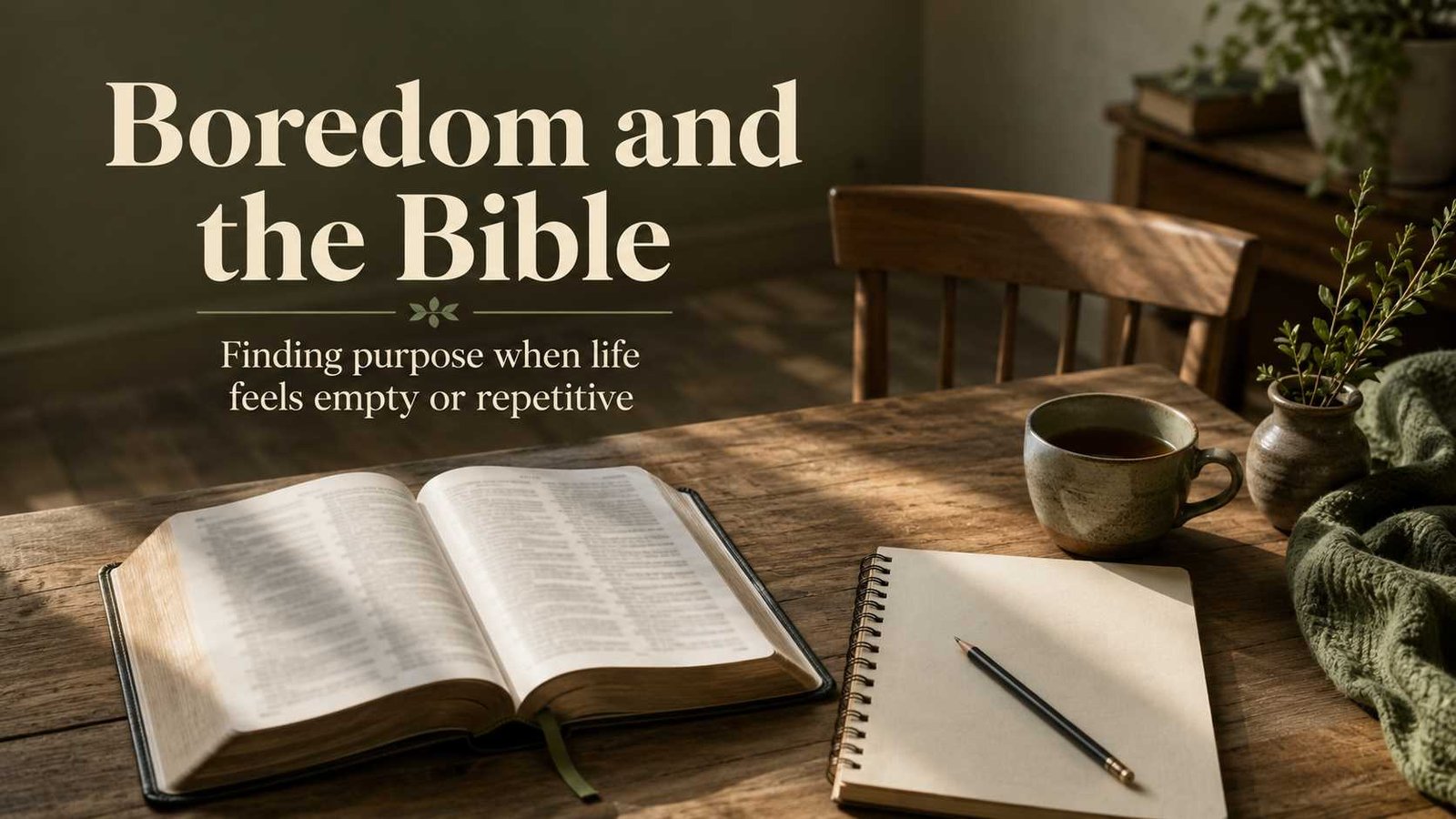
So, what does the Bible say about boredom?
The Bible does not directly say, “Being bored is a sin.” It does not give boredom one special spiritual meaning either. Instead, Scripture speaks about things that often surround boredom: idleness, work, purpose, wisdom, rest, joy, gratitude, service, and how we use our time.
That distinction matters.
Sometimes boredom may show that we are wasting time or avoiding responsibility. At other times, it may mean we are tired, lonely, waiting for change, or simply living through an ordinary season.
God does not expect every moment of life to be exciting.
But He does teach us to live each day with wisdom and purpose.
What Does the Bible Say About Boredom and Idleness?
One of the closest biblical ideas to boredom is idleness.
Proverbs 19:15 warns that laziness can lead a person into an unhealthy pattern of inactivity and need. Scripture regularly encourages diligence, responsibility, and useful work.
But boredom and idleness are not exactly the same thing.
Boredom Is Not Always Laziness
Imagine a student sitting through a long lesson. He may feel bored even though he is paying attention.
A mother may feel bored while doing the same household tasks every day, yet she is certainly not being lazy.
A person recovering from illness may become bored because there is little he can physically do.
Someone who recently retired may suddenly have many empty hours after spending decades at work.
A person can even be busy and bored at the same time.
That is why we should be careful about telling someone, “You are bored because you are lazy.”
Sometimes that may be true.
Often it is not.
The Bible gives stronger warnings about a pattern of idleness than about the temporary feeling we call boredom.
When Boredom Turns Into Idleness
Boredom becomes more serious when we use it as an excuse to avoid what we know we should do.
Imagine saying:
“I am too bored to finish my schoolwork.”
“I do not feel like helping my family.”
“I have nothing to do,” even though important responsibilities are waiting.
“I will spend another five hours scrolling because nothing else sounds exciting.”
At that point, the real issue may no longer be boredom. It may be avoidance.
Scripture encourages Christians to live responsibly.
Paul wrote in Colossians 3:23 that whatever believers do, they should do it wholeheartedly as serving the Lord.
That principle can change the way we see ordinary responsibilities.
Cleaning a room may not feel exciting.
Studying may not feel exciting.
Going to work on Monday morning may not feel exciting.
Caring for children, preparing food, paying bills, fixing something around the house, or helping an elderly relative may feel very ordinary.
Yet ordinary work can still have value.
This connects closely with the larger biblical question of what the Bible says about idleness. Scripture does not teach that every moment must be filled with activity, but it does warn us against becoming careless with our responsibilities.
What Does God Say About Being Bored?
If you ask, “What does God say about being bored?”, the clearest answer comes from biblical principles rather than one specific verse about boredom.
God calls us to use our lives wisely.
Ephesians 5:15–16 encourages believers to walk carefully and make good use of their opportunities.
That does not mean you must turn every second into work.
It means your time matters.
Your attention matters.
Your choices matter.
Ordinary Tasks Can Have Meaning
Many people assume that a meaningful life must always feel exciting.
Scripture presents a different picture.
Much of faithful life is very ordinary.
Joseph spent years working before becoming a ruler in Egypt.
David spent long periods caring for sheep before becoming king.
The apostles sometimes preached before crowds, but they also walked long roads, ate ordinary meals, repaired fishing nets, traveled by boat, waited, worked, and rested.
Jesus Himself spent most of His earthly life outside the public ministry described in detail in the Gospels.
The lesson is simple: importance and excitement are not the same thing.
Something does not have to entertain you to have value.
You may be doing something important even when it feels repetitive.
Godly Purpose Is Bigger Than Entertainment
One helpful question to ask when boredom appears is:
“What can entertain me?”
But an even better question may be:
“What good can I do with the time I have?”
That small change can completely redirect your day.
You might call someone who is lonely.
Help your parents.
Finish a job you have delayed.
Read something useful.
Pray for someone.
Take care of your health.
Encourage a friend.
Learn a skill.
Clean your home.
Spend time outside.
Prepare for tomorrow.
None of these activities may create instant excitement. But they can create something deeper: purpose.
That is why boredom naturally connects with the question of what the Bible says about purpose in life. Biblical purpose is not mainly about chasing exciting experiences. It is about loving God, loving people, living faithfully, and using what we have been given well.
What Is the Root Cause of Boredom?
People sometimes ask, “What is the root cause of boredom?”
There is no single answer for everyone.
The Bible does not teach that boredom always comes from one particular sin or spiritual problem.
Many things can cause it.
A person may feel bored because of:
- A repetitive routine
- Lack of meaningful goals
- Too much passive entertainment
- Loneliness
- Lack of challenge
- Waiting for something to change
- Physical tiredness
- Emotional exhaustion
- Discontentment
- Having free time without knowing how to use it
Understanding the cause can help you respond wisely.
Sometimes the Problem Is Lack of Purpose
You can have plenty to do and still feel bored.
Why?
Because activity is not the same as meaning.
Imagine spending three hours moving objects from one side of a room to the other and then moving them back.
You would be busy.
But you probably would not feel purposeful.
Many people experience something similar emotionally. Their days are full, yet they are not sure why they are doing what they do.
Scripture reminds us that life is more than filling time.
Our work, relationships, worship, service, learning, and responsibilities can all become part of a meaningful life when we see them in a larger spiritual picture.
A bored Christian might ask:
“Who can I serve?”
“What responsibility have I ignored?”
“What can I learn?”
“Where can I grow?”
“What has God already placed in front of me?”
These questions can turn empty time into useful time.
Sometimes You Are Tired, Not Bored
This is important.
Sometimes what feels like boredom is actually exhaustion.
You sit down intending to read, but you cannot focus.
You try to start a project, but your mind feels slow.
You look for entertainment, but nothing seems enjoyable.
You may not need another activity.
You may need rest.
The Bible does not treat rest as laziness.
God established rhythms of work and rest throughout Scripture. Jesus also withdrew from crowds and encouraged His disciples to rest after periods of demanding ministry.
Healthy rest can include sleep, quiet time, a walk, peaceful conversation, prayer, or simply allowing your mind to slow down.
The biblical idea of rest is therefore very different from careless idleness.
Before criticizing yourself for being bored, ask:
“Am I actually exhausted?”
That question may lead you toward a healthier response.
Related questions such as what the Bible says about being tired and weary and what rest means in the Bible can help us see that constant activity is not the Christian goal.
What Is the Spiritual Meaning of Boredom?
People also ask, “What is the spiritual meaning of boredom?”
We need to answer carefully.
The Bible does not say that boredom has one official spiritual meaning.
It would be unwise to claim that boredom always means God is sending you a message, that you have lost faith, or that something supernatural is happening.
Still, boredom can become an opportunity for spiritual reflection.
Quiet moments often reveal what we usually cover with noise.
You might ask yourself:
“What do I depend on for happiness?”
“Do I need constant entertainment?”
“Have I become ungrateful for ordinary blessings?”
“Am I avoiding something important?”
“Have I neglected prayer?”
“Do I need stronger relationships?”
“Am I lonely?”
“Do I need genuine rest?”
“Could I use this quiet moment to help someone?”
Those questions can turn boredom into self-examination.
Boredom Can Reveal Our Search for Satisfaction
Modern life gives us an endless supply of stimulation.
We can watch videos, play games, listen to music, browse social media, read news, shop online, and move from one form of entertainment to another without stopping.
Yet people still become bored.
Why?
Because entertainment can occupy attention without satisfying the heart.
This does not make entertainment sinful.
A good movie, game, hobby, book, sport, or television program can be enjoyable.
The problem begins when we expect entertainment to provide something it cannot give: lasting meaning.
Scripture points us toward deeper sources of joy.
Faith.
Relationships.
Love.
Service.
Gratitude.
Purpose.
Work.
Rest.
Fellowship with God.
Boredom may occasionally remind us that the human heart needs more than constant stimulation.
How Do Christians Deal With Boredom?
Christians do not need to panic when boredom appears.
Instead, we can respond thoughtfully.
Here are several simple ways.
Spend Time With God Without Making It a Chore
You do not need to read twenty chapters of the Bible every time you feel bored.
Start small.
Read one Psalm slowly.
Read part of one Gospel chapter.
Write down one verse that stands out.
Pray for one person.
Thank God for three ordinary blessings.
Sit quietly for a few minutes and think about what you have read.
The goal is not to use God as a way to “kill time.”
The goal is relationship.
Sometimes a quiet moment gives us space to notice God again.
Do Something Useful for Someone Else
One of the fastest ways to move beyond self-focused boredom is to notice another person.
Ask:
“Who needs help?”
Maybe your parents need something done.
Maybe a neighbor needs groceries.
Maybe an elderly relative would appreciate a phone call.
Maybe a friend needs encouragement.
Maybe your church or local community has a need.
Service does not have to be dramatic.
Small acts matter.
A useful hour spent helping someone may bring more satisfaction than several hours spent trying to entertain yourself.
Learn Something Worth Knowing
Boredom can become a doorway to growth.
You could:
Learn to cook something new.
Study a Bible book.
Practice another language.
Learn basic first aid.
Read about history.
Improve your writing.
Learn gardening.
Practice a musical instrument.
Take a walk and learn about plants or birds.
Learn a practical household skill.
The world God created is full of things worth understanding.
Curiosity is often a good answer to boredom.
Finish What You Have Been Avoiding
Most of us have something we keep delaying.
A drawer that needs cleaning.
A message that needs answering.
Homework that needs finishing.
A repair that needs attention.
A book we started.
A promise we made.
A bill we need to organize.
A difficult conversation we need to prepare for.
Sometimes boredom disappears when we stop searching for something new and finish something old.
Colossians 3:23 gives a strong Christian attitude toward work: do what you do wholeheartedly.
Even ordinary tasks can become acts of faithfulness.
Make Room for Healthy Enjoyment
Christian life should not be reduced to work.
Ecclesiastes repeatedly recognizes simple human joys such as eating, drinking, work, companionship, and receiving life’s ordinary gifts with gratitude.
Enjoying something good is not automatically a waste of time.
Spend time with your family.
Play a game.
Take a walk.
Read a novel.
Cook a favorite meal.
Work in the garden.
Exercise.
Laugh with friends.
Enjoying God’s gifts with gratitude is different from endlessly chasing stimulation.
This is where the topic connects naturally with what the Bible says about enjoying life. Scripture can hold responsibility and enjoyment together.
What Does the Bible Say About Boredom in Quiet Seasons?
Some boredom is connected to waiting.
You may be waiting for:
A new job.
School to begin.
A relationship to change.
Recovery from illness.
A prayer to be answered.
A child to be born.
Retirement.
A move to another city.
A difficult season to end.
Waiting can make time feel slow.
But waiting does not have to mean wasting.
Many important biblical figures lived through long periods of waiting.
David was anointed as future king long before he actually became king.
Joseph experienced years of hardship before his situation changed.
Abraham waited many years for the promised son.
The early disciples sometimes had to wait for God’s next direction.
These stories do not mean that every delay has the same spiritual reason.
They do remind us that valuable growth can happen during seasons that feel uneventful.
A quiet season can be used to prepare.
Learn.
Heal.
Serve.
Build relationships.
Pray.
Develop discipline.
Finish unfinished work.
Strengthen your character.
You may not control how quickly the season changes.
You can still choose how you live inside it.
Can Too Much Entertainment Make Boredom Worse?
Sometimes, yes.
Again, the Bible does not say that phones, television, games, or entertainment are automatically sinful.
The deeper question is one of self-control.
When our minds become used to constant stimulation, ordinary life may begin to feel unusually dull.
A quiet meal seems boring.
A slow conversation feels boring.
Reading seems boring.
Walking without headphones feels boring.
Waiting five minutes feels unbearable.
The problem may not be that ordinary life has become empty.
Our attention may have become trained to expect constant stimulation.
This is a useful place for Christian wisdom.
Instead of asking whether every form of entertainment is allowed or forbidden, we can ask:
“Does this control me?”
“Can I put it down?”
“Does it keep me from responsibilities?”
“Does it stop me from noticing people around me?”
“Does it leave me refreshed or restless?”
“Am I using entertainment, or is entertainment using me?”
Biblical self-control helps us enjoy good things without allowing them to control our lives.
Simple Things to Do When You Feel Bored as a Christian
If you are bored right now, you do not need a complicated plan.
Try one of these:
- Read a short Bible passage slowly.
- Pray for one specific person.
- Finish one responsibility you have been delaying.
- Call someone who may be lonely.
- Take a walk outside.
- Learn one useful skill.
- Write down five things you are thankful for.
- Help someone without expecting anything in return.
- Spend time on a healthy hobby.
- Rest if you are genuinely tired.
- Clean or organize one small area.
- Prepare something for tomorrow.
- Read a good book.
- Exercise for a few minutes.
- Write down one meaningful goal for the week.
- Ask God to help you use your time wisely.
You do not need to complete the whole list.
Choose one thing.
Then begin.
Motivation often grows after we start rather than before we start. That makes the broader question of what the Bible says about motivation especially useful here. Faithfulness does not always begin with strong feelings. Sometimes it begins with one good decision.
Bible Verses That Help When Life Feels Boring
Here are several Bible passages that give helpful principles for moments of boredom.
| Bible Passage | What It Can Teach Us |
|---|---|
| Proverbs 19:15 | Persistent laziness and idleness can bring harmful results. |
| Colossians 3:23 | Ordinary work can be done wholeheartedly for the Lord. |
| Ephesians 5:15–16 | Our time and opportunities should be used wisely. |
| Ecclesiastes 3:12–13 | Everyday work and enjoyment can be received as gifts from God. |
| 1 Thessalonians 4:11–12 | Quiet, responsible living has real value. |
| Psalm 90:12 | Remembering that our days are limited can teach us wisdom. |
None of these verses says, “You must never feel bored.”
Together, however, they give us a healthy picture.
Do not waste your life.
Do not worship busyness either.
Work faithfully.
Rest when needed.
Enjoy good gifts.
Serve others.
Pay attention to your days.
Live with wisdom.
What Does the Bible Say About Boredom When Nothing Feels Interesting?
There may also be times when boredom feels deeper than simply needing something to do.
Perhaps nothing seems enjoyable for a long period.
Your hobbies no longer interest you.
You stop wanting to see friends.
Your normal activities feel empty.
That experience may be different from ordinary boredom.
It could be connected to emotional exhaustion, prolonged stress, grief, loneliness, or another personal struggle.
In such a situation, telling yourself to “just stay busy” may not solve the problem.
Talk with someone trustworthy.
That could be a family member, pastor, close friend, counselor, or another person who knows you well.
Christian community exists partly because we are not meant to carry every difficult season alone.
Sometimes we need activity.
Sometimes we need rest.
Sometimes we need another person beside us.
Wisdom is learning the difference.
What the Bible Says About Boredom Can Change How We See Ordinary Life
So, what does the Bible say about boredom?
It does not condemn every bored feeling.
It does not give boredom a mysterious spiritual meaning.
Instead, Scripture gives us something more useful: principles for living well when life feels dull.
Boredom may sometimes expose idleness.
Sometimes it may reveal a lack of purpose.
Sometimes it may show that we have become too dependent on entertainment.
Sometimes it may come from loneliness.
And sometimes we are not bored at all.
We are tired.
The Christian answer is not nonstop busyness.
It is purposeful living.
Work when there is work to do.
Rest when you need rest.
Enjoy good things with gratitude.
Serve people.
Learn.
Pray.
Notice the people around you.
Use your opportunities wisely.
And remember that an ordinary day can still be a meaningful day.
You may never wake up excited about washing dishes, answering emails, studying for a test, cleaning the house, or completing another normal workday.
That is okay.
Faithfulness is often built in ordinary moments.
The next time boredom appears, instead of asking only:
“How can I stop being bored?”
Try asking:
“How can I use this moment well?”
That question may lead you toward something better than entertainment.
It may lead you toward purpose.
For deeper study, you may also want to explore what the Bible says about purpose in life and what the Bible says about enjoying life. Both topics help us understand how faith can give meaning even to simple, quiet days.

Pastor David shares Bible stories in a way that feels real and personal. The way he speaks makes it easier to understand and live out our faith every day.