

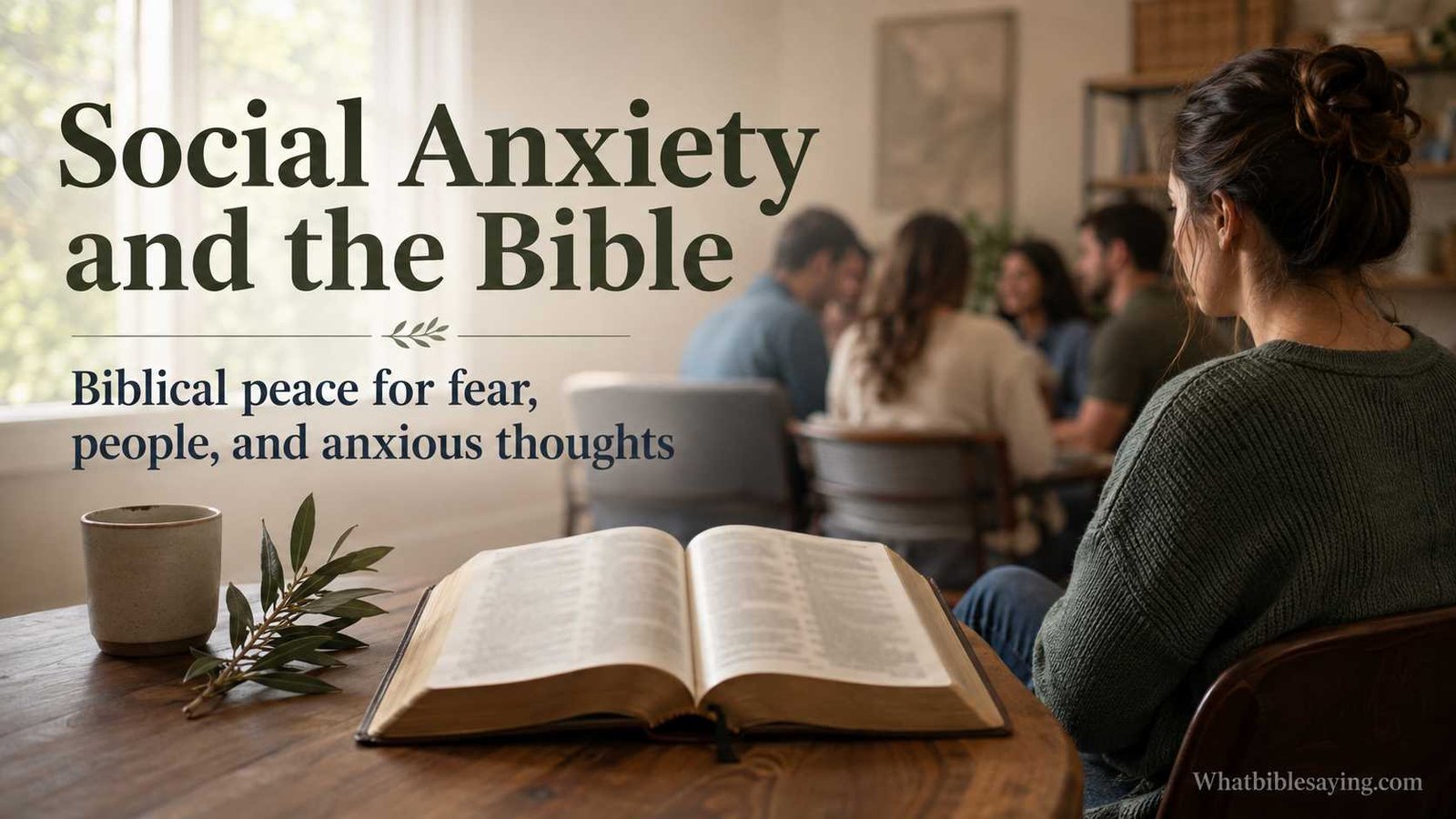
 Social anxiety can make an ordinary moment feel much harder than it looks.
You may walk into a room and wonder what everyone thinks about you. You may want to speak but worry that your words will sound foolish. You may replay a conversation for hours, thinking, “Why did I say that?” Even going to church, school, work, or a family gathering can feel stressful.
So, what does the Bible say about social anxiety?
The Bible does not use the modern term social anxiety disorder. But it says a great deal about fear, worry, insecurity, fear of people, troubled thoughts, and trusting God when we feel afraid.
Scripture repeatedly points anxious people toward God’s presence, prayer, truth, wise relationships, and courageous trust. At the same time, having strong anxiety does not automatically mean you have weak faith.
Social anxiety disorder is also a recognized mental health condition. It can involve a lasting fear of situations where a person may feel watched, judged, embarrassed, or rejected. It can affect school, work, relationships, and normal daily life. Treatment may include psychotherapy, medication, or both.
For a Christian, seeking professional help does not have to compete with prayer. You can pray, study Scripture, receive support from people you trust, and get appropriate medical or psychological care.
God can meet us through more than one kind of help.
What Does the Bible Say About Social Anxiety?
There is no verse that says, “Here is how to treat social anxiety.” The biblical writers lived long before modern mental health terms were developed.
Yet the Bible understands fear very well.
It speaks about being afraid of people, worrying about tomorrow, feeling inadequate, facing rejection, losing courage, and becoming overwhelmed.
One especially helpful verse is Proverbs 29:25, which teaches that the fear of people can become a trap, while trusting the Lord brings safety.
That describes part of what many socially anxious people experience.
You may think:
“What if they do not like me?”
“What if I embarrass myself?”
“What if people laugh?”
“What if I have nothing interesting to say?”
“What if everyone notices how nervous I am?”
Sometimes these fears become so strong that avoiding people feels safer than facing them.
The Bible does not tell us that other people’s opinions are meaningless. Kind words matter. Criticism can hurt. Rejection can be painful.
But Scripture teaches that the opinions of other people should not become the final measure of our worth.
God’s view is greater.
Fear of People Can Become a Trap
Proverbs 29:25 is often called a warning about the “fear of man.”
That phrase does not simply mean being physically afraid of another human being. It can also describe allowing human approval or disapproval to control us.
You might change yourself because you desperately want acceptance.
You might stay silent when you should speak.
You might refuse an opportunity because you fear embarrassment.
You might compare yourself with everyone around you.
You may even spend more time asking, “What will they think of me?” than asking, “What would honor God?”
That is why understanding what the Bible says about people’s opinions can be so helpful. Scripture slowly shifts our attention away from living for constant approval and toward living faithfully before God.
This change rarely happens overnight.
It grows as we learn where our true security comes from.
Social Anxiety Is More Than Being Shy
Shyness and social anxiety are not always the same thing.
A shy person may feel uncomfortable at first but still take part in social situations. Social anxiety disorder can involve persistent fear of social or performance situations where someone expects possible scrutiny, embarrassment, or humiliation.
For some people, that fear becomes strong enough to interfere with everyday life.
That distinction matters because Christians should be careful not to tell someone with serious anxiety, “Just have more faith.”
Faith is important.
But compassion is important too.
What Did Jesus Say About Anxiety?
Jesus spoke directly about worry in Matthew 6:25–34.
He talked about basic human concerns: food, clothing, life, tomorrow, and the uncertainty of what might happen next.
Jesus pointed His listeners toward the birds and the flowers. God’s care can be seen throughout creation. He reminded them that their heavenly Father knows what they need.
Then Jesus directed their attention back to today.
Matthew 6:34 teaches us not to carry tomorrow’s troubles before tomorrow arrives.
That is deeply practical advice for social anxiety.
Imagine you have to attend a gathering tomorrow.
Your mind may begin creating an entire story:
“No one will talk to me.”
“I will stand alone.”
“Someone will ask me something and I will freeze.”
“Everyone will notice how awkward I am.”
“I will make a fool of myself.”
None of those things has happened.
Yet your body may already react as though they have.
Jesus calls us back from an imagined tomorrow to the reality of today.
You do not need grace for every possible conversation you might have next week.
You need grace for the next step.
Jesus Did Not Treat Anxious People Like a Drill Sergeant
This is an important part of Jesus’ teaching.
When Jesus says not to worry, He does not simply shout a command and walk away.
He gives reasons to trust.
He speaks about the Father’s care.
He speaks about our value.
He speaks about the limits of worry.
He speaks about seeking God’s kingdom.
He speaks about living one day at a time.
Timothy Keller highlighted this feature of Matthew 6 when teaching on anxiety. Keller explained that Jesus does not address anxiety like a harsh commander. Instead, Jesus goes beneath it, reasons with us, and examines what is happening inside our hearts.
That is a much more compassionate picture.
Jesus knows fear can feel powerful.
He calls us into deeper trust rather than pretending the struggle is simple.
Who Experienced Anxiety or Fear in the Bible?
We should be careful with this question.
It would be inaccurate to diagnose ancient biblical people with modern social anxiety disorder. The Bible does not provide the kind of medical information needed to make such diagnoses.
But many people in Scripture experienced fear, distress, insecurity, reluctance, or feelings of inadequacy.
Their stories can encourage us.
Moses Was Afraid He Could Not Speak Well
When God called Moses to confront Pharaoh, Moses did not respond like a fearless hero.
He raised one concern after another.
In Exodus 3 and 4, Moses wondered who he was to carry out such a mission. He worried about what he should say. He wondered whether people would believe him. He also protested that he was not a good speaker.
Those feelings may sound familiar.
Perhaps you have been asked to stand before a group, introduce yourself, lead a meeting, pray aloud, or speak in church.
Your first thought may be, “I cannot do that.”
God did not tell Moses that his weaknesses did not exist.
Instead, God kept bringing Moses back to one central truth:
God would be with him.
That truth matters for anxious people.
Courage does not always begin with confidence in yourself.
Sometimes courage begins with confidence that you will not face the situation alone.
Gideon Felt Small and Unqualified
Gideon also felt inadequate.
When God called him in Judges 6, Gideon looked at his family, his position, and his weakness.
He did not see the person God saw.
Many of us do something similar.
We walk into a room and immediately notice the person who seems smarter, better looking, more successful, funnier, richer, more confident, or more popular.
Then we quietly decide that we do not belong.
That is one reason learning what the Bible says about insecurities matters so much.
Your weakness may be real.
Your limitations may be real.
But they do not erase God’s ability to work through your life.
Elijah Became Afraid and Overwhelmed
Elijah had seen God do extraordinary things.
Yet in 1 Kings 19, after Jezebel threatened his life, Elijah became afraid and fled.
He reached a point of deep exhaustion and discouragement.
Notice how God cared for him.
There was spiritual help, but there was also physical care.
Elijah rested.
He ate.
He drank.
Then he continued his journey.
This is a beautiful reminder that human beings are not spirits floating around inside bodies.
Our physical condition matters.
Sleep matters.
Stress matters.
Food matters.
Exhaustion matters.
Faith does not require pretending these things have no effect on us.
Jeremiah Felt Too Young
When Jeremiah received God’s call, his response was not, “I am ready for anything.”
In Jeremiah 1:6, he protested that he did not know how to speak and was too young.
God’s answer again centered on His presence.
Jeremiah was not asked to become fearless before obeying.
He was asked to trust God and move forward.
That distinction can change how you think about courage.
You do not always need to wait until you feel confident.
Sometimes you can be nervous and still take the next faithful step.
What the Bible Says About Social Anxiety and Fear of Judgment
Social anxiety often grows around one painful question:
What will people think about me?
We are social beings. We naturally care about relationships.
The problem begins when fear of judgment becomes so powerful that it controls our lives.
Maybe you avoid speaking because someone once laughed at you.
Maybe you were bullied.
Maybe you were embarrassed in front of a group.
Maybe someone constantly criticized the way you looked or spoke.
Maybe you grew up feeling that nothing you did was good enough.
Those experiences can leave deep marks.
The Bible does not ask you to pretend they never happened.
But it does invite you to build your identity on something stronger.
Psalm 139 describes God’s personal knowledge of us. Ephesians 2:10 describes believers as God’s workmanship. Romans 8 reminds Christians of God’s enduring love.
Your worth cannot safely rest on being impressive to everyone.
That goal is impossible anyway.
Jesus Himself was loved by some people and rejected by others.
A life without criticism is not the goal of Christianity.
Faithfulness is.
When You Think Everyone Is Watching You
Social anxiety can make you feel as though there is a spotlight over your head.
A small mistake feels enormous.
A pause in conversation feels embarrassing.
A strange look from another person feels like rejection.
Afterward, your mind may replay everything.
This is where what the Bible says about low self esteem becomes connected with social anxiety.
The answer is not to repeat, “I am amazing and everybody loves me.”
That is not realistic.
A stronger Christian foundation is:
“I am known by God.”
“I am loved by God.”
“I do not have to impress every person.”
“I can make mistakes and continue.”
“My value is bigger than one awkward conversation.”
That gives you something more stable than public approval.
What Are Some Biblical Ways to Deal With Anxiety?
The Bible offers spiritual practices that can help us face fear in a healthier way.
These practices are not a promise that every clinical anxiety symptom will instantly disappear.
They are ways of turning toward God while we walk through the struggle.
Tell God Exactly What You Fear
Philippians 4:6–7 connects anxiety with prayer, petition, thanksgiving, and God’s peace.
Prayer does not require polished words.
You can be specific.
“God, I am afraid nobody will talk to me.”
“I am scared I will embarrass myself.”
“I am worried about speaking in front of the class.”
“I am afraid people will reject me.”
“I do not want to go to this gathering.”
Honest prayer is better than pretending.
The Psalms are full of honest emotion.
Biblical faith is not emotional denial.
It is bringing our real emotions into God’s presence.
Examine What Your Mind Is Telling You
Philippians 4:8 encourages believers to think about what is true, honorable, right, pure, lovely, and worthy of praise.
The word true matters.
Anxiety often speaks in predictions.
“Everyone will hate me.”
“I know I will fail.”
“They probably think I am stupid.”
“No one wants me there.”
Pause and ask:
Do I actually know that?
Is this a fact, or is it a fear?
Could there be another explanation?
Maybe someone did not greet you because they were distracted.
Maybe the person who looked serious was simply tired.
Maybe your short conversation was normal rather than embarrassing.
We should not believe every thought simply because it appears in our mind.
Remember Who Gives You Worth
If your worth depends completely on people’s approval, you will always feel unstable.
One compliment lifts you.
One criticism destroys you.
One invitation makes you feel valuable.
One rejection makes you feel worthless.
God offers something more secure.
Your identity before Him is not something you have to win by being the funniest, smartest, most attractive, or most confident person in the room.
This does not mean we stop growing.
It means growth comes from a safer place.
Take One Small Step
Courage does not always look dramatic.
Sometimes courage is saying hello.
Sometimes it is remaining in the room for ten more minutes.
Sometimes it is answering one question.
Sometimes it is making one phone call.
Sometimes it is going to church even though you feel nervous.
Sometimes it is asking someone, “Can I sit with you?”
Small steps matter.
Modern treatments for social anxiety can also involve learning to face feared situations gradually rather than continually avoiding them. Cognitive behavioral therapy is among the psychotherapy approaches used for social anxiety disorder.
This does not mean you should force yourself into overwhelming situations without support.
It means avoidance does not always have to make every decision for you.
A Simple Practice for an Anxious Social Moment
When anxiety rises before a social situation, try this simple pattern.
1. Name the Fear
Do not just say, “I feel bad.”
Ask what you are actually afraid of.
“I am afraid they will reject me.”
“I am afraid I will not know what to say.”
Naming the fear makes it easier to examine.
2. Pray About That Specific Fear
Bring it honestly to God.
You do not need impressive words.
3. Remember One Biblical Truth
Choose something simple.
God is with me.
My worth is not decided by this room.
I can trust God even while I feel afraid.
Tomorrow does not need to be solved today.
4. Question the Prediction
Ask whether your anxious thought is a fact or a possibility.
There is a difference between:
“Someone may not like me”
and
“Everyone will reject me.”
5. Take One Manageable Step
Do not demand perfection from yourself.
Speak to one person.
Stay a little longer.
Ask one question.
Participate once.
6. Do Not Punish Yourself Afterwards
This part is easy to forget.
Socially anxious people often complete the difficult event and then spend hours criticizing themselves.
Try replacing that pattern with:
“I was nervous, but I went.”
“I did not say everything perfectly, but that is okay.”
“I am learning.”
That is a healthier way forward.
Does Having Social Anxiety Mean You Do Not Trust God?
No.
The presence of anxiety does not automatically prove that someone has no faith.
The Bible repeatedly shows faithful people experiencing fear.
David felt fear.
Moses felt inadequate.
Elijah became overwhelmed.
Jeremiah felt unprepared.
The disciples were frightened during a storm.
Faith is not the total absence of fear.
Faith is learning where to turn when fear comes.
Psalm 56 presents that movement clearly: when fear comes, the writer turns toward trust in God.
Notice the order.
Fear appears.
Then trust responds.
That is very different from saying a faithful person never feels afraid.
At the same time, Scripture does challenge us when fear begins ruling our lives. We should not make peace with fear as though God can never help us grow.
We can learn what the Bible says about trusting God while also recognizing that severe anxiety may need professional care.
These two truths belong together.
What Did Timothy Keller Say About Anxiety?
Timothy Keller often approached anxiety by looking beneath the surface.
In his sermon The Problem of Anxiety, based on Psalm 27, Keller noted something surprising about David.
David does not find peace merely by telling himself that bad things probably will not happen. Psalm 27 actually considers frightening possibilities.
Keller’s point is that biblical peace must be able to survive even when life does not go according to plan. He describes Psalm 27 as presenting a way of facing fear that can stand even when serious trouble is possible.
That can be helpful for social anxiety.
Sometimes we tell ourselves:
“I must know nobody will reject me.”
“I must know I will not embarrass myself.”
“I must know everyone will accept me.”
But we cannot guarantee those things.
Someone might misunderstand you.
A conversation might become awkward.
You might forget what you wanted to say.
Someone might even reject you.
Christian peace has to be deeper than a guarantee that nothing uncomfortable will happen.
Our security is ultimately found in God, not in perfect social performance.
Keller made a related point while teaching Jesus’ words about anxiety in Matthew 6. He emphasized that Jesus goes beneath anxiety and reasons with the anxious heart rather than simply treating worry as something we can switch off by command.
That approach fits Jesus’ tenderness.
He calls us toward trust while understanding the human heart.
What the Bible Says About Social Anxiety When You Feel Alone
One of the saddest parts of social anxiety is that it can create the very loneliness you fear.
You want friends.
But you fear meeting people.
You want to join the conversation.
But you worry you will say something wrong.
You want to attend church.
But walking into a crowded room feels exhausting.
You want people to know you.
But you are afraid to let them get close.
Avoidance can feel safe in the short term.
But long periods of isolation can make life smaller.
Scripture places great value on community.
Galatians 6:2 teaches believers to help carry one another’s burdens. Hebrews 10:24–25 encourages Christians to continue meeting and encouraging one another.
You do not need twenty close friends.
Start with one safe person.
Tell someone you trust:
“Crowds are difficult for me.”
“I get nervous meeting new people.”
“Would you sit beside me?”
“Could we arrive together?”
There is no shame in asking for support.
Sometimes courage grows better with company.
When Prayer Does Not Immediately Remove Anxiety
Perhaps you have prayed many times.
You still feel nervous.
You still avoid certain situations.
Your heart still races before speaking.
You may wonder, “Why hasn’t God taken this away?”
Be careful not to turn unanswered questions into self-condemnation.
Paul prayed about his own “thorn in the flesh” in 2 Corinthians 12. The difficulty was not removed in the way he requested. Instead, Paul learned about the sufficiency of God’s grace in weakness.
That passage is not specifically about social anxiety, and we should not pretend it is.
But the principle is comforting.
God’s work in your life is not limited to instantly removing every difficulty.
Sometimes He changes circumstances.
Sometimes He strengthens us inside them.
Sometimes help comes through another person.
Sometimes it comes through wise treatment.
Sometimes growth takes longer than we expected.
Social anxiety disorder can interfere with relationships, school, employment, and daily activities. Evidence-based treatment options exist, and NIMH lists psychotherapy, medication, or a combination of the two among approaches used to treat it.
If anxiety is seriously limiting your life, speaking with a qualified health or mental health professional can be a wise step.
Getting help is not spiritual defeat.
Bible Passages That Can Help When Social Anxiety Feels Strong
Here are several passages worth reading slowly.
| Situation | Bible Passage | Biblical Focus |
|---|---|---|
| You fear people’s opinions | Proverbs 29:25 | Trust God rather than being controlled by human approval |
| You feel afraid | Psalm 56:3–4 | Turn fear toward trust |
| You feel alone | Isaiah 41:10 | Remember God’s presence and help |
| You worry about tomorrow | Matthew 6:25–34 | Return your attention to God’s care today |
| Your mind feels overwhelmed | Philippians 4:6–8 | Pray and focus your thoughts on what is true |
| You are carrying heavy anxiety | 1 Peter 5:7 | Bring your cares to God because He cares for you |
| You feel weak | 2 Corinthians 12:9 | God’s grace remains sufficient in weakness |
| You fear rejection | Romans 8:38–39 | Rest in the security of God’s love |
Do not rush through these verses as though they are magic words.
Read them slowly.
Ask what each passage teaches about God.
Then ask what your anxiety is telling you.
The difference between those two voices can become clearer over time.
What the Bible Says About Social Anxiety Gives Us Real Hope
Social anxiety can make you believe that everybody else belongs and you are standing outside.
God does not see you that way.
He sees the person who struggles to walk through the door.
He knows the thoughts you never say aloud.
He understands the fear behind your silence.
And Scripture keeps calling fearful people toward Him.
Not toward pretending.
Not toward shame.
Toward trust.
You may not become the loudest person in the room.
You do not need to.
You may always prefer quiet conversations to large gatherings. That is not a spiritual failure.
The goal is not to turn every quiet person into an outgoing person.
The goal is freedom: freedom to love people without being ruled by their opinions, freedom to obey God even when you feel nervous, and freedom to receive help when anxiety becomes too heavy to carry alone.
When fear says, “Stay hidden forever,” faith can answer, “I can take one step.”
When fear says, “Everyone is judging me,” truth can answer, “I do not know what everyone thinks, and their opinions do not define my worth.”
When fear says, “You are alone,” Scripture reminds us that God is present.
And when anxiety becomes more than you can manage by yourself, asking for help can also be an act of wisdom.
You can pray and talk to a counselor.
You can read Scripture and learn healthy coping skills.
You can trust God and accept support from others.
These things do not have to fight each other.
God’s peace often grows one day, one prayer, one truth, and one courageous step at a time.

Pastor David shares Bible stories in a way that feels real and personal. The way he speaks makes it easier to understand and live out our faith every day.