

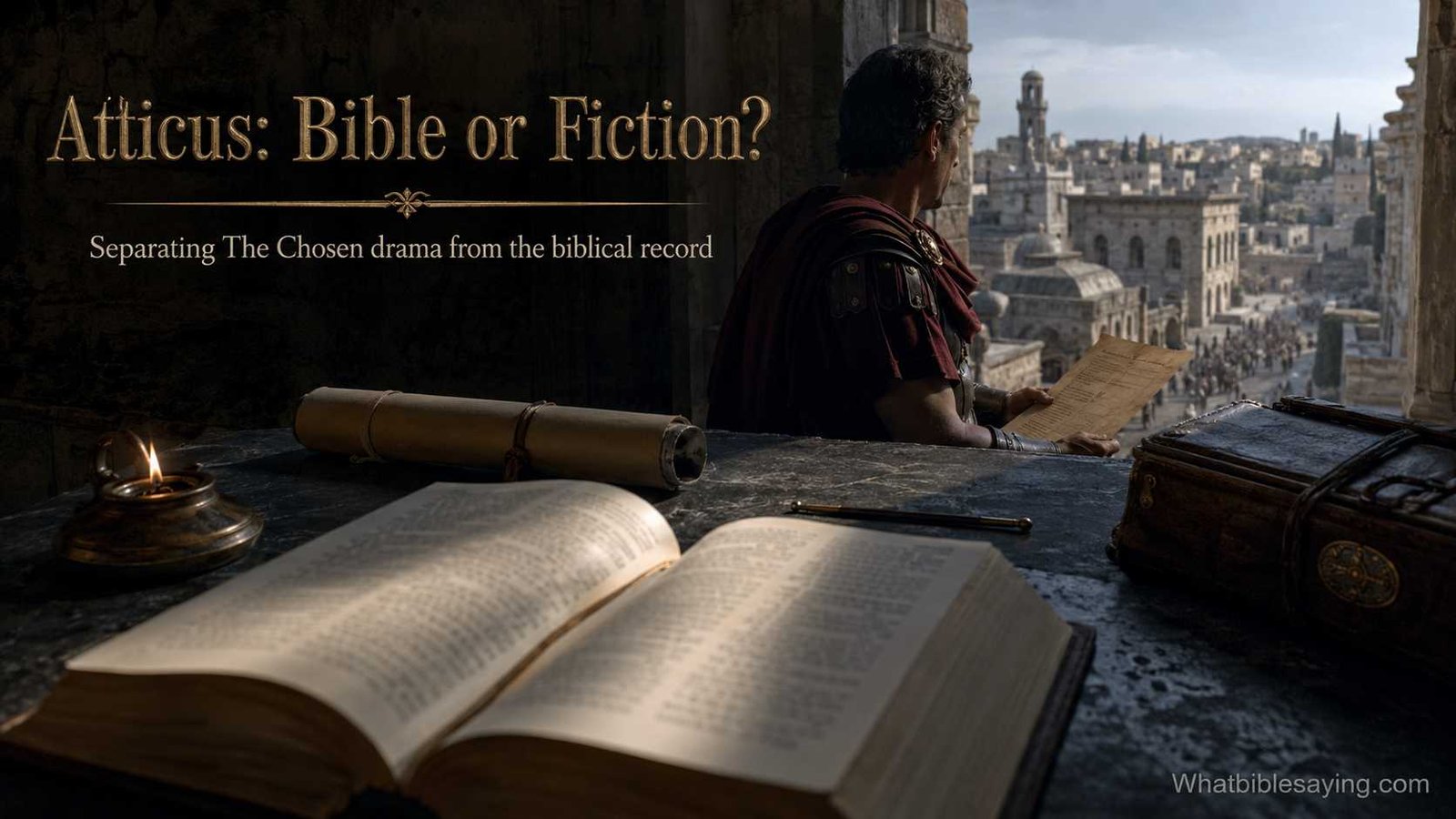
 If you have been watching The Chosen, you may wonder, who is Atticus Aemilius in the Bible? He looks and sounds like someone who could have stepped directly out of the New Testament. He wears Roman clothing, works around Roman officials, investigates unrest, and keeps a close eye on Jesus and His followers.
But there is an important fact to know:
Atticus Aemilius Pulcher is not a character in the Bible.
The Old Testament does not mention him. The four Gospels do not mention him. Acts does not mention him, and none of the New Testament letters identify a Roman official by this full name.
Atticus is a character created for the television series The Chosen. Actor Elijah Alexander portrays him as a Roman investigator who becomes interested in the Zealots and later in Jesus and His growing movement. The show’s own material describes The Chosen as a historical drama based on the Gospel accounts and openly explains that some characters, dialogue, locations, timelines, and backstories are added for storytelling purposes.
That does not mean every detail surrounding Atticus is invented. Rome really controlled Judea during the ministry of Jesus. Roman governors, soldiers, centurions, and political tensions appear throughout the New Testament. The Roman Empire was deeply concerned with public order.
What is fictional is Atticus himself and the specific role the series gives him in the story of Jesus.
Understanding that difference helps us enjoy a biblical drama without accidentally treating television scenes as Scripture.
Who Is Atticus Aemilius in the Bible? The Simple Answer
There is no biblical person named Atticus Aemilius Pulcher.
When people search for Atticus in a Bible app, concordance, or printed Bible and cannot find him, they have not missed a hidden verse. He simply is not there.
The Chosen places Atticus among people and events that are biblical. That makes the distinction less obvious.
For example, Pontius Pilate is a real New Testament figure. The Gospels describe him as the Roman governor involved in the trial and crucifixion of Jesus. Simon the Zealot is also named among Jesus’ apostles in passages such as Matthew 10:4 and Luke 6:15.
Atticus, however, belongs to the dramatic framework built around those biblical people.
This is why the question what did Atticus do in the Bible? needs a careful answer. Strictly speaking, Atticus did nothing in the Bible because the Bible does not contain an Atticus storyline.
The things viewers remember him doing come from The Chosen.
Is Atticus Named Anywhere in Scripture?
No known biblical passage identifies Atticus Aemilius Pulcher.
This is important because The Chosen often moves smoothly between direct Gospel events and imagined conversations surrounding those events.
A scene may contain Jesus, a biblical apostle, a historical Roman official, and a fictional supporting character at the same time. Unless you already know the Gospel accounts well, it can be difficult to tell where Scripture ends and dramatic imagination begins.
The creators of The Chosen acknowledge this approach. Their official explanation says that the series is based on the Gospel stories but that some backstories, dialogue, characters, locations, and timelines are added or combined. The creators also encourage viewers to read the Gospels themselves.
That is a helpful way to watch the series.
Enjoy the drama, but check the Bible when you want to know what Scripture actually records.
Is Atticus Aemilius a Real Person?
There is no reliable biblical evidence that the Atticus Aemilius Pulcher shown in The Chosen was a real Roman official who investigated Jesus.
His name sounds convincingly Roman, and his job is designed to fit the political world surrounding the Gospel story. That historical feel can make him seem like a person taken from an ancient Roman record.
But historical plausibility and historical proof are not the same thing.
The series identifies Atticus as a Roman investigator connected with the cohortes urbanae, or urban cohorts. These were real Roman security forces. Historically, the urban cohorts were established under Augustus and were mainly connected with maintaining order in Rome and, later, certain other important cities.
So the show is drawing from genuine Roman history.
However, that does not prove that a man named Atticus Aemilius Pulcher carried out the missions shown in the series.
A good way to think about him is this:
Atticus is a fictional character placed inside a historically believable Roman setting.
That single distinction answers much of the confusion surrounding him.
Is Atticus From The Chosen in the Bible?
No. Atticus from The Chosen is not in the Bible.
Elijah Alexander plays Atticus Aemilius Pulcher in the series. The character is presented as a Roman agent who becomes involved in investigating Zealot activity and eventually turns much of his attention toward Jesus. Descriptions of the character consistently identify his role as a member of the Roman cohortes urbanae sent to investigate unrest.
His first major storyline becomes connected to Simon the Zealot.
This is a clever storytelling choice because the New Testament tells us very little about Simon before he became one of Jesus’ twelve apostles.
Luke calls him Simon who was called the Zealot in Luke 6:15. Acts 1:13 also lists Simon the Zealot among Jesus’ followers.
But Scripture does not tell us about a Roman investigator hunting Simon before he followed Jesus.
The Chosen creates that larger story.
Why Does Atticus Feel So Biblical?
Atticus feels biblical because the world around him is filled with real biblical concerns.
Rome did rule Judea.
Pontius Pilate was a real governor.
Jesus attracted large crowds.
Jewish resistance to Roman rule existed.
The Gospels show that questions about political power could be dangerous. Jesus was even questioned about paying taxes to Caesar in passages such as Matthew 22:15–22.
At Jesus’ trial, political accusations also became important. According to John 19, the issue of loyalty to Caesar was used in the pressure placed upon Pilate.
So Roman concern about a growing movement is not an absurd idea.
What we should not do is move from saying, “This could fit the period,” to saying, “Therefore Atticus must have existed.”
Scripture does not make that claim.
What Did Atticus Aemilius Do in The Chosen?
Atticus begins as an observer and investigator, but his role becomes more complicated as the series continues.
At first, he is especially concerned with violent resistance against Rome. He follows the activity of the Zealots and becomes connected to the storyline of Simon the Zealot.
In Season 2, the official episode description for “Spirit” says Jesus is being pursued by Simon the Zealot, Atticus, and Shmuel.
That one sentence helps explain Atticus’s basic dramatic purpose.
Three different people are watching Jesus for very different reasons.
Simon is wrestling with his future.
Shmuel is concerned about Jesus from a religious perspective.
Atticus is approaching events through Roman political and security concerns.
Jesus stands in the center, yet everyone sees Him differently.
Atticus and Simon the Zealot
The series builds a large fictional backstory for Simon.
Simon is shown as part of a Zealot movement preparing to assassinate a Roman official. His brother Jesse has been unable to walk for many years.
Then Jesus heals Jesse at the Pool of Bethesda.
Simon sees what has happened and begins moving away from the violent path he had planned to follow.
Atticus becomes involved because he has been investigating the Zealots.
This makes for powerful television, but readers should separate the different layers.
The healing at Bethesda is biblical. John 5 tells of Jesus healing a man who had been disabled for thirty-eight years.
Simon the Zealot is biblical.
But the Bible does not say the healed man was Simon the Zealot’s brother. It does not tell us Simon was preparing an assassination at that moment. And it does not place Atticus beside these events.
Those are dramatic connections created for the series.
Atticus Becomes Interested in Jesus
Once Jesus begins affecting people Atticus is watching, Jesus becomes impossible for him to ignore.
Atticus is trained to look for threats, patterns, motives, and possible unrest.
But Jesus does not fit neatly into those categories.
He gathers crowds, yet He is not raising an army.
He attracts Zealots, yet His teaching does not call them to violent revolt.
People treat Him as someone with extraordinary authority, yet He does not behave like a normal political rebel.
This tension becomes one of the interesting parts of Atticus’s character.
He watches Jesus because Rome cares about order, but he also seems increasingly curious about the Man he is watching.
By Season 3, the official episode description for “Sustenance” says that Shmuel and Atticus travel toward the Decapolis after hearing what is happening there, concerned about the possibility of a revolt.
Again, Atticus interprets Jesus first through the political world he understands.
Yet the more he observes, the harder Jesus becomes to explain.
Why Was Atticus Against Jesus?
The question why was Atticus against Jesus? assumes Atticus is simply an enemy of Jesus.
His character is more complicated than that.
Atticus is loyal to Rome. His first concern is not Christian theology because Christianity, as a later organized religion, does not yet exist within the story. His concern is imperial stability.
Crowds can become riots.
Religious excitement can become political resistance.
Zealots can turn frustration into violence.
A Roman security officer would naturally watch anything capable of disturbing public order.
This is the lens through which The Chosen makes Atticus view Jesus.
Atticus Is Not Shown as a Simple Villain
Atticus does not always behave like someone who personally hates Jesus.
At different points, he appears cautious about Roman officials using unnecessary force. Analyses of his early scenes note that he sometimes urges restraint and seems more interested in preventing disorder than in attacking Jesus’ followers simply because they follow Jesus.
This is why calling him simply a “bad guy” misses part of the character.
He is a Roman loyalist.
He wants control.
He distrusts movements that could threaten Rome.
But he also notices things about Jesus that unsettle his normal understanding of power.
That makes Atticus useful to the writers. Through his eyes, viewers see someone trying to explain Jesus without beginning from faith.
Why Rome Would Be Nervous About Jesus
The Gospels themselves help us understand why Roman authorities would eventually become involved.
When Jesus entered Jerusalem, crowds welcomed Him.
The city was already full of Passover pilgrims.
Passover reminded Jewish people of freedom from slavery.
Rome was the occupying power.
That combination created a politically sensitive situation.
Still, the Gospels never say Atticus was observing the triumphal entry or reporting on Jesus.
They identify other people and groups involved in Jesus’ final days, especially chief priests, religious leaders, Judas, Roman soldiers, and Pontius Pilate.
Atticus’s presence is the show’s way of giving Roman political concern a continuing human face.
How Atticus Changes in Season 5
Season 5 moves Atticus beyond simply watching events.
Jesus enters Jerusalem. Tensions rise. Religious leaders become more determined to stop Him. Pilate must think about Roman order during a crowded festival.
Atticus sees danger where others, including Pilate at times, appear less concerned.
A Season 5 recap describes Atticus watching Jesus’ triumphal entry and warning Pilate not to dismiss what is happening too easily.
Later, Atticus learns more about plans surrounding Jesus’ arrest and pushes Pilate to take the situation seriously.
He also becomes involved with Kafni and his angry group.
By the final episode of Season 5, Atticus is no longer merely collecting information. Pilate confronts him over the situation he has helped create. The official description of Season 5, Episode 8 specifically says that Pilate summons Atticus and strongly reprimands him.
This is an important development.
Atticus begins as someone trying to understand unrest.
He gradually becomes someone willing to influence events himself.
That does not turn his actions into biblical history. The Bible does not record this Roman agent arranging political pressure around Jesus.
It is part of the show’s dramatic explanation of how Roman fear, local anger, religious opposition, and political calculation could converge during Jesus’ final days.
What Happens to Atticus Aemilius in The Chosen?
As of August 17, 2026, viewers do not yet have Atticus’s complete story.
Season 5 has been released. Season 6 has not.
The official Chosen site says Season 6 will begin streaming on Prime Video on November 15, 2026. The season will focus on Jesus’ final day leading toward the crucifixion, while the season finale is planned as a theatrical release in spring 2027.
That means we should be careful about claims such as:
“Atticus eventually becomes a Christian.”
“Atticus dies.”
“Atticus becomes the centurion at the cross.”
“Atticus secretly helps Jesus.”
At this point, those statements should not be presented as established facts unless the series itself eventually shows them.
Does Atticus Die in The Chosen?
Through the released Season 5 story, Atticus has not been given a final death scene.
His ultimate fate remains unresolved.
There is also no biblical death account for Atticus because, again, he is not a biblical person.
Does Atticus Become a Follower of Jesus?
The released story does not establish Atticus as one of Jesus’ disciples.
He is clearly affected by what he sees. His fascination with Jesus grows. He cannot treat Jesus as an ordinary rebel.
But curiosity is not the same as conversion.
Until the series clearly shows what he believes, viewers should avoid turning theories into facts.
Is Atticus the Centurion at the Cross?
This is another kind of theory viewers may form because the Gospels do mention a Roman centurion at Jesus’ crucifixion.
Mark 15:39 describes the centurion witnessing Jesus’ death and making a remarkable confession about Him.
Matthew 27:54 also describes the centurion and others responding with fear after seeing what happened.
But neither passage names that centurion Atticus.
If The Chosen ever connects Atticus with that biblical scene, it would still be an adaptation choice unless historical evidence supported the identification.
Scripture itself does not make that connection.
Atticus Aemilius Compared With Real Romans in the Bible
The easiest way to understand Atticus is to compare him with Roman characters connected to the series.
| Character | In the Bible? | In The Chosen? | What We Know |
|---|---|---|---|
| Atticus Aemilius Pulcher | No | Yes | Fictional Roman investigator |
| Pontius Pilate | Yes | Yes | Roman governor involved in Jesus’ trial |
| Quintus | No, not as this character | Yes | Dramatic Roman authority figure |
| Gaius | No clear identification | Yes | The name Gaius appears in Scripture, but the show’s character is not clearly one of those men |
| Roman centurion at the cross | Yes | Yes/biblical event | Scripture does not give him the name Atticus |
Pontius Pilate is the clearest contrast.
He appears repeatedly in the Gospel accounts of Jesus’ final hours. Matthew 27, Mark 15, Luke 23, and John 18–19 all place Pilate in the trial of Jesus.
Atticus has no corresponding biblical passage.
Quintus raises a similar question. Readers often ask was Jesus questioned by Quintus in the Bible? because the series places Quintus around Jesus’ ministry. But the specific Quintus portrayed in The Chosen is another dramatic character rather than someone identified by the Gospels.
Gaius requires more care because several people named Gaius appear in the New Testament. Acts, Romans, 1 Corinthians, and 3 John contain the name. However, that does not mean the Roman Gaius portrayed in The Chosen can automatically be identified with one of them.
A shared ancient name is not enough to prove they are the same person.
Why The Chosen Adds Characters Like Atticus
A television drama has a different storytelling challenge from a Gospel.
The Gospel writers were not trying to give us hour-by-hour biographies of every person living near Jesus. They selected events and teachings for specific purposes.
John even explains near the end of his Gospel that Jesus did many other things that were not recorded there.
A modern television series, however, needs scenes, recurring characters, conversations, and continuing storylines.
That creates spaces where writers must make choices.
The official Chosen website says openly that backstories, dialogue, characters, locations, and timelines may be added or combined while the creators seek to remain faithful to the intention of Scripture.
Atticus is one example.
Ramah is another.
Viewers who ask is Ramah from The Chosen in the Bible? discover a similar answer: the series uses invented characters to build emotional stories around biblical events.
The question is Ramah a real person in the Bible? is therefore part of a much larger issue: how should Christians watch dramatized Bible stories?
The answer is not that we must reject every invented detail.
It is that we should know which details are invented.
Scripture and Dramatic Imagination Are Not the Same
Imagine watching a film about a famous historical king.
The king may have been real.
The battle may have been real.
The city may have been real.
But a private conversation between the king and a fictional soldier may have been created by the screenwriter.
The fictional conversation can help viewers understand the historical setting without becoming a historical document itself.
That is how many scenes in The Chosen work.
This also explains questions such as did Simon’s wife really have a miscarriage in the Bible?. The New Testament indicates that Peter was married because Jesus healed Peter’s mother-in-law in passages such as Matthew 8:14–15. But many personal details given to Peter and his family in the show are dramatic additions.
Knowing this protects us from two opposite mistakes.
One mistake is assuming everything on screen happened exactly as shown.
The other is assuming that because some details are invented, nothing in the series has a biblical basis.
Neither approach is careful.
The better question is always:
What does Scripture actually say?
Can Atticus Teach Us Anything About the Gospel Story?
Yes, as long as we remember that we are learning from a dramatic character rather than a biblical witness.
Atticus represents one possible way a Roman observer might have struggled to understand Jesus.
Rome understood armies.
Rome understood taxes.
Rome understood rebellion.
Rome understood public punishment and political authority.
Jesus did not fit easily into those categories.
He spoke of a kingdom, yet His kingdom did not operate like Caesar’s.
He attracted crowds, yet He did not organize them into an army.
He welcomed people Rome considered unimportant.
He taught His followers to love enemies.
He entered Jerusalem as a king, yet He came riding a donkey.
The dramatic Atticus keeps looking at Jesus as a political problem because politics is the language he understands.
But Jesus keeps refusing to behave like the kind of threat Atticus expects.
That contrast can send us back to the Gospels with better questions.
What kind of King is Jesus?
What kind of kingdom did He announce?
Why did political and religious leaders find Him so difficult to control?
Those questions are genuinely biblical, even if Atticus himself is not.
How to Watch The Chosen Without Confusing It With the Bible
You do not need to keep a suspicious eye on every scene. You can enjoy the characters and emotional storytelling.
But a few habits help.
First, read the Gospel passage connected with an episode.
If Jesus heals someone, find that healing in Matthew, Mark, Luke, or John. Notice what the Bible actually says and what the program adds.
Second, pay special attention to characters whose names you do not recognize.
Search Scripture before assuming they are biblical.
Third, separate three categories in your mind:
- Direct biblical material such as Jesus’ parables, miracles, crucifixion, and named disciples.
- Historical background such as Roman rule, Jewish customs, geography, clothing, political tensions, and ancient occupations.
- Dramatic additions such as invented conversations, combined timelines, fictional relatives, and characters like Atticus.
That simple method lets you appreciate the series while keeping Scripture in its proper place.
What This Teaches Us About Scripture and Story
So, who is Atticus Aemilius in the Bible?
The clearest answer is that Atticus Aemilius Pulcher is not in the Bible.
He is a fictional Roman character in The Chosen, portrayed by Elijah Alexander. The series uses him as an investigator, political observer, and eventually an active participant in the growing Roman concern surrounding Jesus.
His world is partly historical.
Rome was real.
Roman occupation was real.
Pontius Pilate was real.
Zealot resistance was real.
Jesus’ ministry, His entry into Jerusalem, His arrest, His trial, and His crucifixion are central parts of the Gospel record.
But Atticus’s personal involvement in those events belongs to television storytelling, not Scripture.
That distinction does not have to spoil the series. It can actually deepen the experience.
A good biblical drama may make us curious.
Scripture tells us where that curiosity should lead.
When a character or scene makes you wonder, open the Gospels and check. Notice what Matthew says. Read Mark’s account. Compare Luke. Look carefully at John.
Stories can help us picture the world around Jesus.
The Bible remains the source for knowing what the biblical record actually says.

Dr. Rachel is very smart and knows a lot about the Bible. He helps us understand the Bible better by talking about the old texts in a simple way.