

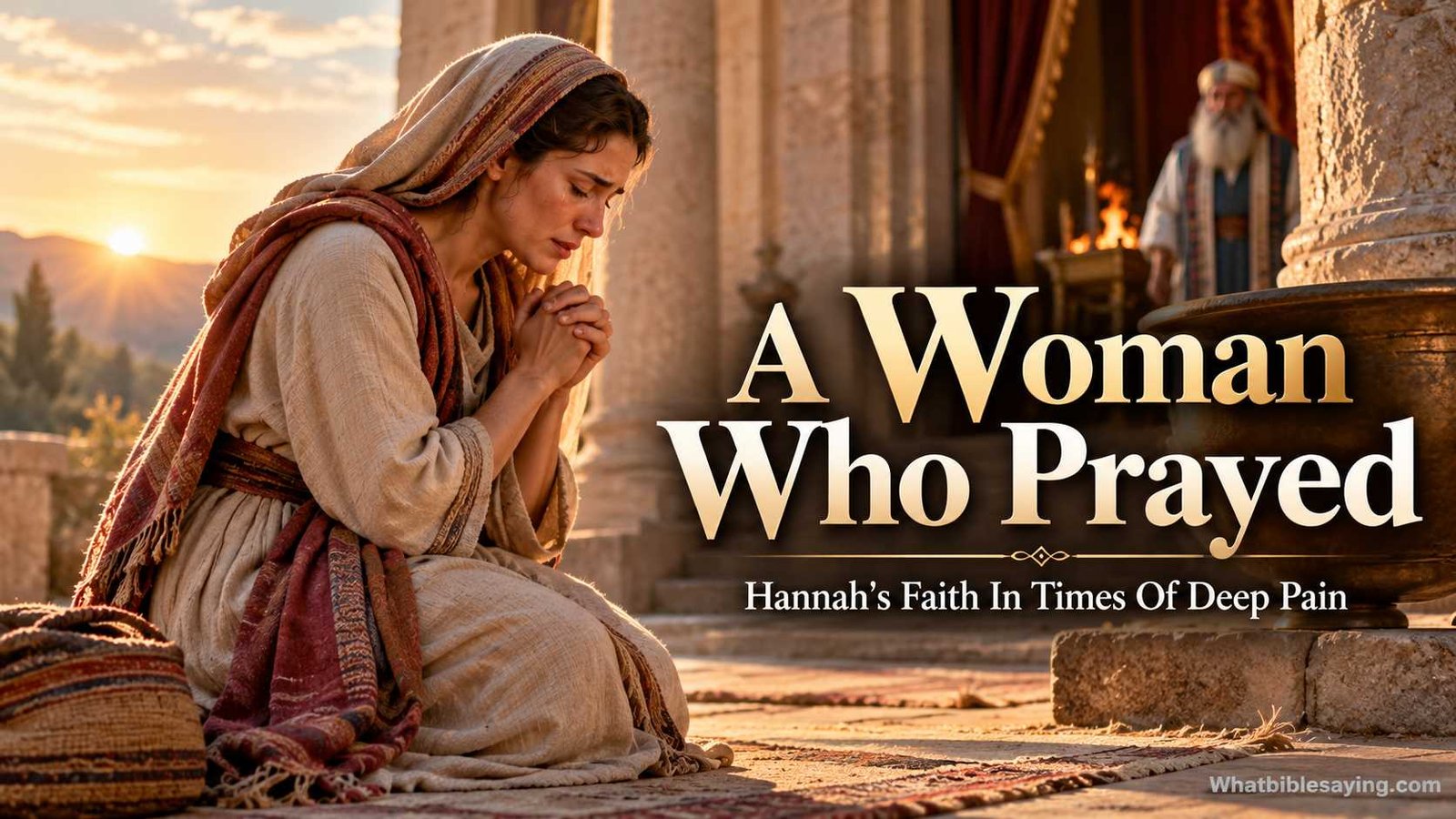
 When people search for a woman in the Bible who prayed, Hannah is one of the clearest and most beautiful examples.
Hannah came to God with a broken heart. She wanted a child, but year after year she remained childless. Her pain became so deep that she wept and could hardly eat. Yet instead of turning away from God, Hannah brought her sorrow directly to Him.
Her story in 1 Samuel shows us something important about prayer: you do not have to hide your pain from God.
Hannah prayed honestly. She prayed quietly. She prayed while hurting. And when God answered her, she remembered the promise she had made.
She was not the only woman who prayed in the Bible. Anna spent years worshiping, fasting, and praying. Mary praised God when she learned she would become the mother of Jesus. The Syrophoenician woman pleaded with Jesus for her daughter. Other women gathered together in prayer as the early Church began to grow.
Their circumstances were different, but they shared something powerful.
They turned toward God.
Hannah: The Woman In The Bible Who Prayed Through Deep Pain
Hannah’s story begins in 1 Samuel 1.
She was married to a man named Elkanah. He loved Hannah, but she had no children. Elkanah’s other wife, Peninnah, had children and repeatedly provoked Hannah because of her childlessness.
This caused Hannah deep emotional pain.
Each year, the family traveled to Shiloh to worship and offer sacrifices to the Lord. During one of these visits, Hannah became overwhelmed with grief.
First Samuel 1:10 says she was deeply distressed and prayed to the Lord while weeping bitterly.
That moment is one of the clearest pictures of heartfelt prayer in Scripture.
Hannah did not pretend everything was fine.
She did not offer God polished words while hiding what she really felt.
She prayed from her pain.
Many people think prayer must always sound peaceful and confident. Hannah’s story shows otherwise. Sometimes prayer begins with tears.
If you have ever prayed while grieving, waiting, or wondering why God has not changed your circumstances, Hannah’s story may feel very close to your own heart.
Hannah Poured Out Her Soul Before God
While Hannah prayed at Shiloh, Eli the priest noticed her.
Her lips were moving, but no sound could be heard.
Eli first misunderstood what he saw. He thought Hannah was drunk.
She explained that she had not been drinking. She was deeply troubled and was pouring out her soul before the Lord.
That phrase tells us a great deal about prayer.
Hannah did not simply present a religious request. She opened her heart before God.
There are times when we do not know how to explain everything we feel. Grief, disappointment, fear, and hope can all exist together.
Hannah’s prayer reminds us that God is not frightened by honest emotions.
You can speak to Him about what hurts.
You can pray when you feel confused.
You can pray even when the words are difficult to say.
You can even pray silently.
Did Hannah Pray Silently?
Yes.
According to 1 Samuel 1:13, Hannah was praying in her heart. Her lips moved, but her voice could not be heard.
This is an important detail.
The Bible includes prayers spoken aloud, songs of praise, group prayers, and silent personal prayers.
Hannah’s experience shows that prayer does not depend on volume.
God does not need us to speak loudly before He understands us.
A whispered prayer can be sincere.
A silent prayer can be sincere.
A prayer spoken through tears can be sincere.
What matters is the heart that turns toward God.
For someone who feels uncomfortable praying aloud, Hannah’s story can be very comforting.
What Did Hannah Pray For?
Hannah asked God for a son.
She also made a serious promise.
If God gave her a son, she would dedicate him to the Lord’s service.
Later, Hannah became pregnant and gave birth to Samuel.
She named him Samuel because she had asked the Lord for him.
Samuel would grow to become one of the most important prophets and leaders in Israel’s history.
But Hannah’s story should not be treated as a formula.
The lesson is not that anyone who prays hard enough will receive exactly what they request.
Scripture contains many faithful people who waited, suffered, or received answers different from what they hoped for.
Hannah teaches us to bring our desires honestly before God while trusting Him with the outcome.
That is very different from trying to control God through prayer.
How God Answered Hannah’s Prayer
After Samuel was born, Hannah cared for him until he was old enough to be taken to Shiloh.
Then she returned to the place where she had once prayed through tears.
She brought Samuel with her.
Hannah reminded Eli that she was the woman who had stood there praying to the Lord.
She explained that she had prayed for this child and that God had granted her request.
Then she kept her promise.
She dedicated Samuel to the Lord.
This part of the story matters because Hannah did not forget God after receiving what she wanted.
Sometimes our prayers become intense when we need something. But after the crisis passes, it can be easy to move on with life.
Hannah did not do that.
Her gratitude became obedience.
Her answered prayer led her deeper into worship.
Hannah’s Second Prayer Was a Prayer of Praise
Hannah’s story does not end with her request being answered.
In 1 Samuel 2, she prayed again.
This time, her prayer was filled with praise.
She rejoiced in the Lord and spoke about God’s holiness, strength, justice, and care for those who are weak.
Her first prayer came from sorrow.
Her second prayer came from gratitude.
Both were real prayer.
That is worth remembering.
Prayer is not only asking God for help.
Prayer can also include praise, thanksgiving, confession, worship, surrender, and quiet trust.
Hannah’s life shows us both sides: the woman who cried before God and the woman who rejoiced before God.
Other Women Who Prayed In The Bible
Hannah is one of the best-known women who prayed in the Bible, but she is far from the only one.
Scripture records women praying, praising, fasting, worshiping, and calling on God in difficult circumstances.
Their stories help us see that prayer can take many forms.
Anna: A Woman Devoted to Prayer
Anna appears briefly in Luke 2:36–38, but her story is remarkable.
She was a prophetess and an elderly widow.
Instead of disappearing quietly from the biblical story, Anna became known for her devotion to God.
Luke says she worshiped with fasting and prayer night and day.
For years, Anna waited faithfully.
Then Mary and Joseph brought the infant Jesus to the temple.
Anna recognized the importance of what God was doing. She gave thanks to God and spoke about the child to others who were waiting for Jerusalem’s redemption.
Hannah teaches us about praying through deep pain.
Anna teaches us about praying through long seasons of waiting.
Not every prayer story moves quickly.
Sometimes faith means continuing to seek God when years pass and circumstances seem unchanged.
Anna’s life tells us that waiting is not wasted when it is lived close to God.
Mary: A Woman Who Praised God
Mary, the mother of Jesus, is another powerful woman of faith.
In Luke 1, the angel Gabriel told Mary that she would give birth to Jesus.
Her life was about to change completely.
Mary responded with humility and trust.
Later, while visiting Elizabeth, Mary gave a beautiful expression of praise often called the Magnificat.
She declared that her soul magnified the Lord and that her spirit rejoiced in God her Savior.
Mary’s words are not mainly a request for something.
They are worship.
She praises God’s mercy, power, faithfulness, and care for the humble.
Her response reminds us that prayer is not only about presenting needs.
Sometimes prayer is simply recognizing who God is.
When something good happens in our lives, we can pause and give thanks.
When God’s faithfulness becomes clear, we can praise Him.
Mary’s example shows us a heart that responds to God’s work with worship.
The Syrophoenician Woman In The Bible
One of the most moving stories of persistent faith is found in Matthew 15:21–28 and Mark 7:24–30.
Mark describes the woman as Syrophoenician. Matthew describes her as a Canaanite woman.
Her daughter was suffering badly, and the mother came to Jesus asking for mercy and help.
This woman is especially important because she refused to give up easily.
She cried out to Jesus.
The disciples wanted her sent away.
The conversation that followed was challenging, but she continued appealing to Jesus with humility and faith.
At one point, she simply said:
“Lord, help me.”
Those are only a few words.
But they came from a mother’s desperate heart.
Jesus ultimately praised her great faith, and her daughter was healed.
The Syrophoenician woman in the Bible shows that prayer does not need to be long to be sincere.
Sometimes the deepest prayer is only three words:
Lord, help me.
Many parents understand this kind of prayer.
When someone you love is suffering, you may not have an elegant prayer prepared.
You simply cry out to God.
The woman’s story shows persistence, humility, and faith in Jesus.
Esther: Fasting Before a Dangerous Decision
Esther faced a situation that could have cost her life.
A plan had been made to destroy her people, the Jews. Her cousin Mordecai urged her to approach the king.
But appearing before the king without being summoned was dangerous.
Before Esther went, she asked the Jews in Susa to fast for her for three days. She and her attendants would fast as well.
The Hebrew text of Esther 4 specifically emphasizes fasting.
Because prayer often accompanies fasting elsewhere in Scripture, Christians commonly connect this moment with seeking God. However, we should be careful not to claim that the Hebrew passage explicitly records Esther speaking a prayer when it does not.
What we can say with confidence is that Esther did not rush into danger carelessly.
She prepared spiritually and called others to join her in fasting.
Then she acted courageously.
Her story reminds us that faith and action belong together.
Prayer and dependence on God should not make us passive.
Sometimes after seeking God, we still have to take a difficult step.
Women Gathered Together For Prayer
Acts 16 gives another beautiful picture.
Paul and his companions arrived in Philippi.
On the Sabbath, they went outside the city gate to a river where they expected to find a place of prayer.
There they met a group of women.
One of them was Lydia.
She listened to Paul’s message, and the Lord opened her heart to respond.
This scene is quieter than Hannah’s tears or the Syrophoenician woman’s urgent request.
Yet it is deeply important.
Women gathered together to pray.
Their gathering became part of the beginning of the Christian community in Philippi.
Sometimes prayer is private.
Sometimes it happens with others.
Both matter.
There is strength in praying alone with God, but there can also be comfort in joining other believers in prayer.
Bible Verses About Women And Prayer
If you are looking for a Bible verse about woman, or Bible verses for woman connected with prayer and faith, these passages are especially meaningful.
1 Samuel 1:10
Hannah prayed while deeply distressed and weeping.
This verse reminds us that pain does not disqualify us from prayer.
1 Samuel 1:15
Hannah said she was pouring out her soul before the Lord.
Prayer can be honest and deeply personal.
1 Samuel 2:1
Hannah prayed again, this time rejoicing in the Lord.
God can meet us both in sorrow and in gratitude.
Luke 1:46–47
Mary praised God and rejoiced in Him.
Her words show how worship can become prayer.
Luke 2:37
Anna worshiped with fasting and prayer night and day.
Her life shows the beauty of long-term devotion.
Matthew 15:25
The Canaanite woman knelt before Jesus and cried, “Lord, help me.”
Sometimes a simple prayer carries deep faith.
Acts 16:13
Women gathered at a place of prayer outside Philippi.
This reminds us that prayer can also be shared in community.
These passages are not only verses to read.
They are stories to live with.
Each woman faced real life, real emotions, and real uncertainty.
Their faith was not separated from their struggles.
It grew inside them.
Is Hannah The Virtuous Woman In The Bible?
Hannah was certainly a faithful and godly woman.
But she is not the woman usually meant when people speak about the virtuous woman in the Bible.
That phrase normally refers to the woman described in Proverbs 31:10–31.
Proverbs 31 presents a portrait of a woman who is wise, hardworking, generous, trustworthy, caring, and devoted to God.
The passage praises her character, wisdom, work, and fear of the Lord.
It does not identify the woman as Hannah.
The two passages should not be confused.
Hannah is remembered especially for her prayer, faith, motherhood, and dedication of Samuel.
The Proverbs 31 woman represents an ideal picture of wisdom and godly character.
Both passages honor women of faith, but in different ways.
What Women Who Prayed In The Bible Teach Us
When we place these women side by side, several lessons become clear.
Hannah teaches us to be honest with God.
Anna teaches us to remain faithful during long seasons of waiting.
Mary teaches us to respond to God’s goodness with praise.
The Syrophoenician woman teaches us about persistent faith.
Esther teaches us to seek God before acting courageously.
The women at Philippi show us the value of gathering with others for prayer.
None of these women had easy lives.
That may be one reason their stories still speak so strongly today.
Prayer was not something they practiced only when life was comfortable.
They prayed in grief.
They prayed while waiting.
They praised when God was working.
They sought help for people they loved.
They worshiped in community.
They trusted God before taking difficult steps.
This is what makes their stories so human.
When Your Prayer Seems Unanswered
Hannah’s story has a joyful ending.
She prayed for a child, and Samuel was born.
But we should be careful with this story.
It does not mean every person who prays for a child will have one.
It does not mean every illness will immediately disappear.
It does not mean every difficult situation will change in the way we hope.
Prayer is not a bargain in which we say the right words and God must give us what we request.
Prayer is relationship.
Jesus Himself prayed in Gethsemane before His crucifixion. He expressed His desire honestly, yet He also surrendered to the Father’s will.
That balance matters.
We can ask boldly.
We can hope deeply.
We can cry honestly.
And we can still place the outcome in God’s hands.
If you have been praying for a long time and nothing seems to change, Anna’s story may encourage you.
If your heart feels broken, remember Hannah.
If you are afraid for someone you love, remember the Syrophoenician woman.
If you are facing a difficult decision, remember Esther.
If something good has happened and you want to thank God, remember Mary.
Different seasons call for different kinds of prayer.
God is present in all of them.
A Simple Prayer Inspired By Hannah’s Faith
God, You know what is in my heart even when I struggle to explain it.
Help me bring my fears, hopes, pain, and questions honestly before You.
Give me patience when I must wait.
Give me courage when I must act.
Give me gratitude when You provide.
Help me trust You even when Your answer is different from what I expected.
Teach me to pray with sincerity, faith, and humility.
Amen.
What Hannah’s Story Still Says To Women Today
The story of Hannah remains powerful because it begins with something many people understand: a hurting heart.
She felt disappointment.
She faced painful words from another person.
She wept.
She struggled.
And she prayed.
Her faith did not mean she never felt pain.
Her faith meant she brought that pain to God.
That is one of the most important lessons from every woman in the Bible who prayed.
Faithful women in Scripture were not emotionless.
They were mothers, widows, young women, older women, women facing danger, women caring for sick children, and women waiting for God’s promises.
They prayed because they needed God.
We do too.
You do not need Hannah’s exact story to learn from Hannah’s prayer.
Your circumstances may be completely different.
But you can still pour out your heart before God.
You can still wait faithfully like Anna.
You can still praise like Mary.
You can still cry, “Lord, help me,” like the Syrophoenician woman.
And when you do not know what tomorrow holds, you can still place your life in God’s hands.
Prayer does not always change circumstances immediately.
But prayer turns our hearts toward the One who hears us.
That is why Hannah’s story continues to speak across generations.
She was a woman in pain.
She was a woman of faith.
And she was a woman who prayed.

Professor Sarah knows the Bible deeply. She shares stories about Jesus’ life and the early church in a warm, simple way that makes learning feel real and meaningful.