

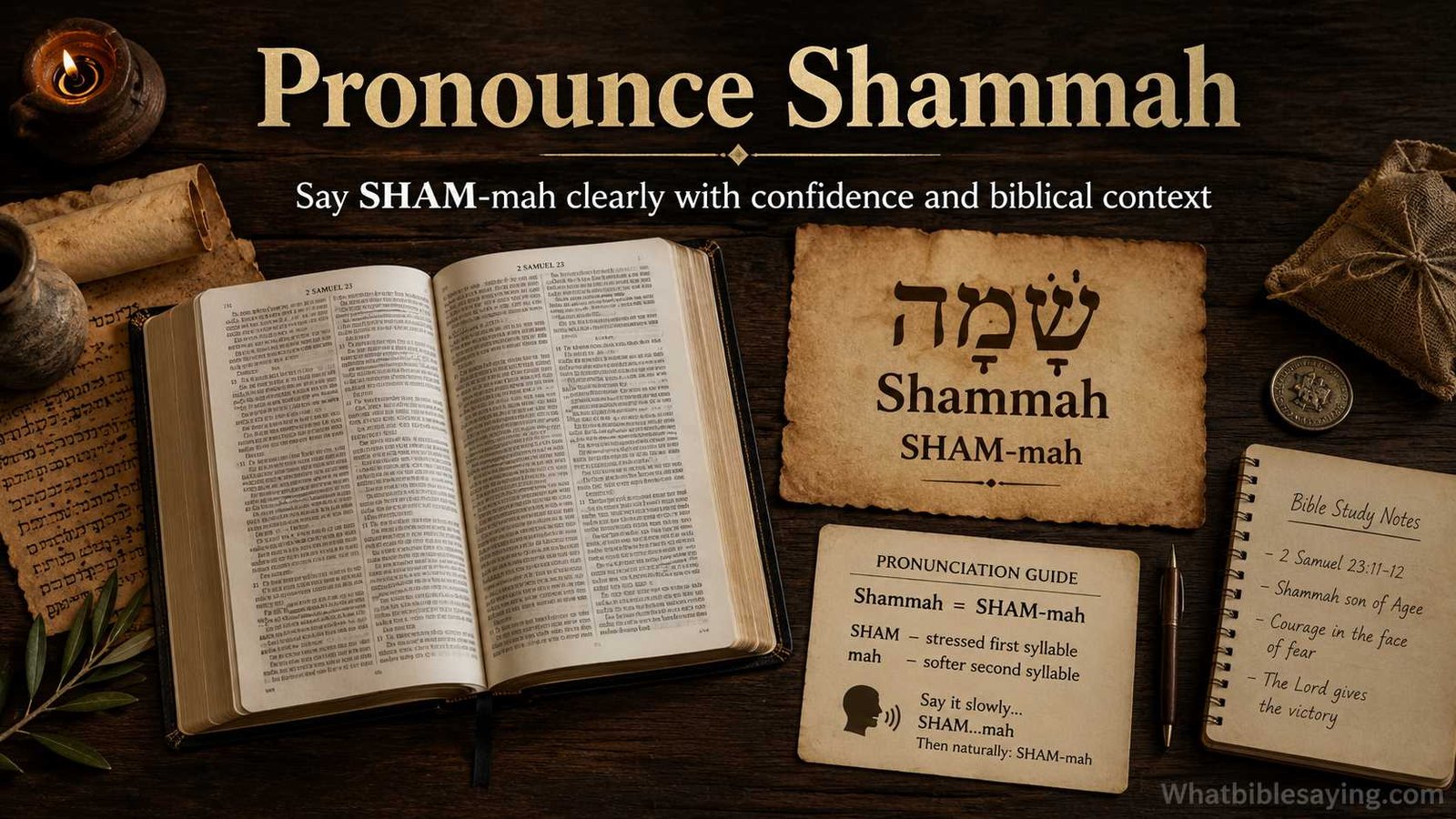
 If you have reached the name Shammah while reading the Old Testament, you may have stopped for a moment and wondered how to say it.
For most English Bible readers, Shammah is pronounced SHAM-uh.
You can break it into two simple parts:
SHAM + uh = SHAM-uh
The stress falls mainly on the first syllable. Some Bible and Hebrew study resources represent the second syllable more fully as SHAM-mah or give the phonetic spelling sham-maw’. These forms reflect slightly different ways of representing the Hebrew name in English. BibleHub’s Strong’s entry gives the Hebrew spelling שַׁמָּה, transliterates it as Shammah, and provides the pronunciation SHAM-mah. English pronunciation guides commonly simplify that to SHAM-uh.
So if you are reading Scripture aloud, saying SHAM-uh is a clear and natural English pronunciation.
But Shammah is more than a difficult Bible name. Several people in Scripture carried this name, including one of Jesse’s sons and a courageous warrior who served David. Learning who these men were can turn a pronunciation question into a helpful Bible study.
How To Pronounce Shammah In The Bible: A Simple Sound Guide
The easiest way to pronounce Shammah is to divide the name into two syllables.
| Part | How to Say It | Helpful Sound |
|---|---|---|
| Sham | SHAM | Rhymes with ham |
| mah/uh | uh or mah | A short, softer ending |
| Shammah | SHAM-uh | Stress the first syllable |
Say it slowly first:
SHAM…uh
Then say it at normal speed:
SHAM-uh
You do not need to make the double “m” unusually long. Just let the first syllable sound clear and strong.
A common English pronunciation resource gives the IPA pronunciation approximately as /ʃæmə/ in American English, which also supports the familiar SHAM-uh pronunciation.
Why Do Some Guides Say SHAM-mah or sham-maw’?
This difference is not as serious as it may look.
Biblical names came into English from ancient languages, mainly Hebrew, Aramaic, and Greek. Transliteration tries to represent sounds from one writing system with the letters of another language. That does not always produce one perfectly identical English pronunciation.
Strong’s lexical material gives sham-maw’ as a phonetic form while BibleHub’s pronunciation guide displays SHAM-mah. Other English pronunciation resources use SHAM-uh.
For normal English Bible reading, therefore, this is a helpful rule:
Say Shammah as SHAM-uh.
If you are studying biblical Hebrew, you may hear a pronunciation closer to the Hebrew form. That does not mean your ordinary English Bible pronunciation is wrong.
This is worth remembering when learning how to pronounce Bible names. Ancient names may sound slightly different depending on the speaker’s language, accent, translation tradition, and method of transliteration.
Who Is Shammah In The Bible?
An important detail is often missed when people first search for Shammah:
There is more than one Shammah in the Bible.
The Hebrew name appears in connection with an Edomite and several Israelites. Strong’s lexical entry describes Shammah as the name of an Edomite and multiple Israelites, while Bible dictionaries identify several individuals who carried the name.
That means we should not combine every reference to Shammah into the story of one man.
Here are the main biblical appearances.
| Shammah | Biblical References | Who He Was |
|---|---|---|
| Shammah descended from Esau | Genesis 36:13, 17; 1 Chronicles 1:37 | Son of Reuel and an Edomite chief |
| Shammah son of Jesse | 1 Samuel 16:9; 17:13 | David’s older brother |
| Shammah son of Agee | 2 Samuel 23:11–12 | One of David’s mighty warriors |
| Shammah the Harodite | 2 Samuel 23:25 | Another warrior associated with David |
| Shammah the Hararite | 2 Samuel 23:33 | A name appearing in David’s warrior list |
The Hebrew concordance indexes Shammah in Genesis, 1 Samuel, 2 Samuel, and 1 Chronicles. Some parallel passages use variant forms such as Shammoth, which is one reason careful Bible study helps when following ancient names across different books.
Let’s look at the best-known examples.
Shammah The Son Of Jesse And Brother Of David
One Shammah was a son of Jesse of Bethlehem.
He appears during one of the most important moments in David’s early life.
In 1 Samuel 16, God sends the prophet Samuel to Jesse’s family because one of Jesse’s sons will become king. Samuel first sees Eliab and thinks he may be God’s chosen man, but God has another plan.
Jesse then presents his sons before Samuel.
First Samuel 16:9 specifically says that Jesse brought Shammah before Samuel, but Samuel understood that the Lord had not chosen him.
Eventually David, the youngest son who had been caring for the sheep, is brought in and anointed.
Shammah appears again in 1 Samuel 17.
When Israel’s army faces the Philistines and Goliath, Jesse’s three oldest sons are serving with Saul. They are named as Eliab, Abinadab, and Shammah.
So this Shammah was:
- Jesse’s son
- David’s older brother
- one of Jesse’s three oldest sons
- present with Israel’s forces during the conflict in which David faced Goliath
That context makes the name easier to remember.
Instead of seeing Shammah as a random word in a genealogy, we see him as a member of David’s family during a major period in Israel’s history.
Interestingly, parallel biblical passages sometimes use forms such as Shimea or Shimeah for this son of Jesse. Bible dictionaries connect these forms with the same person.
This is another good example of why names can look slightly different when we move from one biblical passage to another.
How To Pronounce Shammah In The Bible When Reading About David’s Mighty Men
Another Shammah has a much more detailed story.
Second Samuel 23 introduces Shammah son of Agee the Hararite, one of the famous warriors associated with David.
His story takes only a few verses, but it is memorable.
The Philistines had gathered for battle in an area containing a field of lentils. Israel’s troops fled, but Shammah did not abandon the field.
He stood his ground.
He defended it.
He fought the Philistines.
Most importantly, Scripture does not present the victory merely as the achievement of a brave soldier. Second Samuel 23:12 says that the Lord brought about a great victory.
That final detail matters.
Shammah showed courage, but the biblical writer gives the ultimate credit to God.
Shammah’s Field Of Lentils
It may seem strange that Scripture mentions the crop growing in the field.
Why would anyone care that it contained lentils?
The detail makes the scene concrete.
This was not an abstract battlefield. It was ordinary ground producing ordinary food. The Philistines had advanced, the Israelites had fled, and Shammah remained.
The text does not tell us everything he thought or felt. We should not invent motives that Scripture does not provide.
What the passage does tell us is enough.
He took his position in the field, defended it, defeated the attackers, and the Lord gave a great victory.
When studying Bible characters, this distinction is important.
A good reader asks:
What does Scripture actually say?
That is better than filling every silence in a story with our imagination.
What Does The Name Shammah Mean?
The meaning of Shammah deserves some care because reference works do not always use the same English word.
Strong’s connects the personal name שַׁמָּה with a Hebrew word associated with desolation. Older Bible-name dictionaries have offered meanings such as loss, desolation, astonishment, or desert.
For that reason, it is better not to insist that only one English gloss perfectly captures every part of the name’s history.
A safe summary is:
Shammah is an ancient Hebrew personal name associated in traditional lexicons with ideas such as desolation or waste.
That is different from saying that every man named Shammah had a life characterized by desolation.
A name’s possible etymology does not automatically tell us a person’s character, destiny, or spiritual condition.
This is especially important when learning how to study the Bible carefully.
Biblical names can be meaningful, but we should not create hidden messages that the biblical text itself never gives.
Is Shammah The Same As Jehovah-Shammah?
This question causes understandable confusion because many Christians have heard the expression Jehovah-Shammah.
The personal name Shammah discussed above should not simply be equated with Jehovah-Shammah.
Jehovah-Shammah comes from Ezekiel 48:35. At the end of Ezekiel’s vision, the city receives a name meaning:
The LORD is there.
The Hebrew expression traditionally transliterated YHWH Shammah or Jehovah-Shammah uses shammah in the sense of there. BibleHub’s lexical entry for the expression identifies its meaning as “The LORD is there.”
The personal name Shammah, however, is indexed separately in Hebrew lexicons as Strong’s H8048.
So remember the difference:
| Expression | Meaning or Use |
|---|---|
| Shammah | A personal name carried by several men in Scripture |
| YHWH/Jehovah-Shammah | “The LORD is there,” from Ezekiel 48:35 |
The English spelling can make them appear more closely connected than they should be treated in a word study.
Checking the original-language entries helps us avoid building a Bible lesson on a similarity that exists mainly in English spelling.
How To Pronounce Shammah In The Bible During Public Reading
It can feel uncomfortable to reach an unfamiliar name when reading Scripture aloud at church, in a Bible study group, or with your family.
You may know the passage well and still wonder whether everyone will notice if you pronounce one name differently.
A simple process can help.
1. Divide The Name Into Syllables
For Shammah:
SHAM + uh
2. Identify The Main Stress
Put the stronger sound on:
SHAM
Then soften the ending.
3. Practice The Whole Phrase
Do not practice only the isolated name.
Try:
Shammah son of Agee
Then:
Shammah son of Jesse
The name becomes easier when you hear it within the sentence where it belongs.
4. Read The Verse Before Reading Publicly
If you know an unfamiliar biblical name is coming, read the passage aloud once or twice beforehand.
This takes only a minute and can make public reading much smoother.
5. Do Not Become Anxious About Small Accent Differences
English-speaking Christians live across the United States, Canada, the United Kingdom, Australia, New Zealand, Africa, Asia, and many other regions.
Accents differ.
Even familiar biblical names may sound somewhat different from one place to another.
The goal is clear, respectful reading, not performing ancient Hebrew perfectly.
Knowing how to read the Bible correctly involves much more than pronouncing every name exactly the same way another speaker does. We also need to understand context, recognize different kinds of biblical writing, and pay attention to what the passage is actually saying.
Learning Bible Names Can Improve The Way You Read Scripture
Names are easy to skip.
We see a genealogy or a long list of warriors and think, “I will never remember these people.”
But biblical names often connect different parts of Scripture.
Shammah is a good example.
Searching for this one name takes us into:
- the family of Esau
- the chiefs of Edom
- Jesse’s household
- Samuel’s search for Israel’s next king
- David and Goliath
- David’s mighty warriors
- Israel’s conflicts with the Philistines
Suddenly, one unfamiliar name becomes a doorway into several parts of biblical history.
This is one reason learning how to look up Bible verses and compare references can make Scripture easier to understand.
Suppose you encounter Shammah in 1 Samuel 16:9.
Instead of stopping with that verse, you can search for his name elsewhere.
You soon find him again in 1 Samuel 17:13.
Now you know he is one of David’s older brothers.
But when you reach Shammah son of Agee in 2 Samuel 23, you notice that the father’s name is different. That warns you that you may be reading about a different person.
Small observations like this protect us from confusing Bible characters.
A Simple Way To Study A Biblical Name
When you meet an unfamiliar person in Scripture, try this five-step method.
Read The Surrounding Verses
Do not begin with a dictionary definition.
Begin with the Bible passage.
Ask what is happening around the person.
Write Down Identifying Details
Look for:
- father’s name
- mother’s name
- hometown
- tribe
- occupation
- king or ruler during the person’s lifetime
- relatives
- important events
These details can separate two people who share the same name.
Find Other Biblical References
Use your Bible’s concordance, search function, or cross-references.
For Shammah, this quickly reveals that the name occurs in different family and military settings.
Compare Parallel Passages
Samuel, Kings, and Chronicles sometimes describe related people and events using slightly different spellings or details.
For example, the warrior called Shammah in 2 Samuel 23:25 has a corresponding form Shammoth in 1 Chronicles 11:27. The NET Bible specifically notes the spelling variation between the parallel passages.
Use Dictionaries And Lexicons After Reading The Text
Lexicons can help with Hebrew spelling, pronunciation, and possible etymology.
But they should support the biblical passage rather than replace it.
That simple habit is useful whether you are learning how to study the Bible for yourself or trying to understand one difficult Old Testament name.
Does Perfect Bible Pronunciation Matter?
Pronunciation matters because words communicate meaning.
If you teach Scripture, read publicly, or discuss Bible characters with others, learning common pronunciations helps people understand whom you mean.
But there is also room for grace.
The Bible contains names from languages most English speakers did not grow up speaking. Even serious Bible students sometimes discover that they have pronounced a name differently for years.
That should lead to learning, not embarrassment.
You can correct a pronunciation and keep reading.
The deeper goal is understanding Scripture faithfully.
A person may pronounce every Hebrew name beautifully yet ignore the message of the passage. Another reader may stumble over several ancient names but listen carefully to God’s Word and seek to understand it.
Pronunciation is a useful skill.
Faithful reading is the greater goal.
If biblical names often slow you down, a broader guide on how to read the Bible for beginners can help you develop confidence one book and one passage at a time.
What Shammah’s Story Teaches Us About Reading The Bible Carefully
The answer to how to pronounce Shammah in the Bible is simple:
SHAM-uh is the common English pronunciation.
Some Hebrew-oriented resources represent it as SHAM-mah or sham-maw’, so small differences between pronunciation guides are normal.
But knowing how to say the name gives us only the beginning of its story.
Scripture introduces more than one man named Shammah. One belonged to the family line of Esau. Another was David’s older brother. Another, Shammah son of Agee, became known for standing his ground against the Philistines when others fled.
And in that warrior’s story, Scripture directs our attention beyond human bravery.
Shammah stood in the field, but the Lord brought about the victory.
That is a good reminder for every Bible reader.
Slow down when a name seems difficult.
Learn how to say it.
Find out who the person was.
Read the verses around the name.
Follow the cross-references.
Then look for what the biblical writer wants you to see.
Sometimes a name that first seems like an obstacle becomes the very thing that makes us read more carefully.
As you continue growing in Scripture, our guides on How To Study Your Bible Kay Arthur and How To Read The Bible Michael Youssef can help you move from simply recognizing biblical words to reading passages in their historical and literary context. Those approaches emphasize careful observation, context, understanding, and thoughtful application.
Learning Shammah may begin with two syllables:
SHAM-uh.
But good Bible study never has to end with pronunciation. Every name belongs somewhere in the larger biblical story, and taking time to understand that story helps Scripture become clearer, richer, and easier to remember.

Dr. Rachel is very smart and knows a lot about the Bible. He helps us understand the Bible better by talking about the old texts in a simple way.