 If you are writing an essay, assignment, Bible study, sermon note, or research paper, you may wonder how to cite a verse from the Bible correctly.
The simplest Bible reference looks like this:
John 3:16
That reference has three parts:
John is the name of the Bible book.
3 is the chapter.
16 is the verse.
For everyday Christian writing, that may be all you need. Academic writing is different. MLA, APA, and Chicago each have their own rules for identifying the Bible translation, edition, and passage.
The good news is that Bible citation becomes much easier once you understand one basic principle: Scripture is usually located by book, chapter, and verse, not by page number.
A passage may appear on page 1,120 in one Bible and page 894 in another, but John 3:16 remains John 3:16.
How To Cite A Verse From The Bible In Simple Writing
For Bible studies, devotionals, church materials, personal notes, and many informal Christian articles, the usual approach is simply to write the name of the biblical book followed by the chapter and verse.
For example:
Genesis 1:1
Psalm 23:1
Matthew 5:9
John 3:16
Romans 8:28
If you are quoting several consecutive verses, use a range:
Romans 8:28–30
If you are referring to one chapter rather than one specific verse, you can simply write:
Psalm 23
This system makes Scripture easy to find regardless of the Bible edition someone owns.
Understanding Book, Chapter, And Verse
Consider this reference:
Philippians 4:6–7
Philippians is the Bible book.
The number 4 identifies the chapter.
The numbers 6–7 identify the verses.
So a reader can open almost any standard Bible translation, go to Philippians chapter 4, and find verses 6 and 7.
That is one reason knowing how to find and understand Bible references is useful when learning how to read the Bible correctly.
Instead of searching through hundreds of pages, you have an exact location.
How To Cite A Verse From The Bible In MLA Style
MLA style is widely used in humanities subjects such as English, literature, and religious studies.
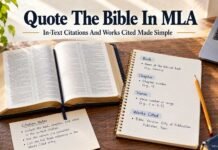
In current MLA guidance, Scripture is cited by identifying the Bible edition and then giving the biblical book, chapter, and verse. Purdue OWL’s MLA guidance says that the first parenthetical Bible citation should make clear which Bible edition is being used, followed by the book, chapter, and verse. Later citations using the same edition can normally be shortened to the book, chapter, and verse.
A first citation might look like this:
(New International Version, John 3:16)
If you have already made clear which Bible you are using, a later reference could simply identify the passage:
(Rom. 8:28)
MLA also allows commonly recognized abbreviations for biblical books.
For example:
Genesis may become Gen.
Romans may become Rom.
Revelation may become Rev.
The important thing is consistency.
MLA Bible Citation In A Sentence
Suppose you were discussing trust in God.
You might write:
Jesus teaches that God loved the world deeply enough to give his Son (New International Version, John 3:16).
Once the translation has already been established, a later sentence might use a shorter citation:
Paul reminds believers that God can work through difficult circumstances (Rom. 8:28).
The exact punctuation and abbreviation style should follow the MLA rules required by your school or instructor.
MLA Works Cited Entry For The Bible
MLA generally treats a published Bible edition as a source that can appear in the Works Cited list. The MLA Style Center says scriptural writings should be entered according to the normal MLA source template, including the title, edition or version details, publisher, and publication information when applicable.
For example:
The Bible. Authorized King James Version, Oxford UP, 1998.
Purdue OWL provides this same type of structure for Bible editions in MLA Works Cited entries.
If your Bible names a translator, editor, special edition, or publisher, check the title page and copyright page rather than guessing.
That small step makes your citation much more reliable.
How To Cite A Verse From The Bible In APA Style
APA style is commonly used in psychology, education, social sciences, and other academic fields.
APA works differently from MLA, so you should not simply copy an MLA Bible citation into an APA paper.
One helpful rule is that when a source does not use stable page numbers, APA permits another logical locator. Purdue OWL specifically notes that older religious works can use identifiers such as verse numbers instead of page numbers.
So instead of trying to locate a Bible passage by page, identify its biblical location.
A practical citation can include:
Bible version + publication year + book, chapter, and verse
For example, depending on the edition being used:
(New International Version, 2011, John 3:16)
The exact year should come from the Bible edition you actually consulted.
Do not simply copy a year from an example online if you used another edition.
Why The Bible Version Matters In APA
Different English Bible translations may express the same underlying passage with slightly different wording.
For example, you might use:
KJV — King James Version
NKJV — New King James Version
NIV — New International Version
ESV — English Standard Version
NRSV — New Revised Standard Version
The biblical location remains the same, but the exact wording may differ.
Identifying the version helps your reader understand where your quotation came from.
This is especially important in academic writing where the exact words you quote may be part of your argument.
APA Reference List And Bible Editions
Your course or institution may require you to identify the specific edition consulted in the reference list, especially when you are treating a modern Bible translation as a published work.
General APA book-reference rules include the publication year, title, edition information when applicable, and publisher.
Because religious texts are handled somewhat differently from ordinary authored books, always follow your instructor’s APA requirements when they provide specific guidance.
The safest rule is simple: document the actual Bible edition you used, not a generic Bible.
How To Cite A Verse From An Online Bible
Many people now read Scripture through websites and Bible apps rather than printed Bibles.
The basic principle does not change.
You still identify the passage by book, chapter, and verse.
What may change is the source information connected to the Bible edition.
Suppose you read John 3:16 in an online NIV Bible.
Your citation should make clear that the wording came from the NIV rather than simply saying “Bible.”
If you are creating a formal reference entry for an online source, the website or digital publication details may also become relevant.
MLA guidance for online scriptural texts explains that you do not normally need a separate Works Cited entry for every individual chapter when multiple passages come from the same online Bible source.
In APA, electronic-source rules also allow URLs for online works when appropriate.
Before submitting academic work, check whether your instructor wants the Bible edition cited as a book, online work, or religious text.
How To Cite A Verse From The Bible In Chicago Style
Chicago style is frequently used in history, theology, biblical studies, and humanities research.
Its treatment of Bible passages is refreshingly straightforward.
The Chicago Manual of Style explains that biblical passages should normally be identified by book, chapter, and verse rather than page number. It also recommends making clear which Bible version you are using.
A Chicago-style biblical reference may therefore look like this:
Genesis 3:1
or:
John 3:16
If the translation has already been identified elsewhere in your paper, you do not need to repeat unnecessary information every time.
Why Chicago Does Not Depend On Bible Page Numbers
Imagine two people sitting beside each other in church.
One has a compact NIV Bible.
The other has a large-print KJV Bible.
A passage on page 942 in the first Bible could appear hundreds of pages away in the second.
But both readers can locate:
Romans 8:28
That is why chapter-and-verse references are more dependable than page numbers for Scripture.
Chicago explicitly recognizes this principle.
Bible Verse Citation Examples At A Glance
Here is a simple comparison.
| Citation style | Typical information needed | Example idea |
|---|---|---|
| MLA | Bible edition, book, chapter, verse | NIV, John 3:16 |
| APA | Bible version, edition/year, biblical location | NIV, 2011, John 3:16 |
| Chicago | Bible version when needed, book, chapter, verse | John 3:16 |
| Informal Bible study | Book, chapter, verse | John 3:16 |
These examples show the general pattern, but schools and publishers may have their own requirements.
If your teacher gives you a style guide, follow that guide first.
How To Quote A Bible Verse In An Essay
Knowing how to cite a verse from the Bible is only part of the job. You also need to introduce the verse naturally.
Avoid dropping a Bible quotation into a paragraph without explanation.
Instead of writing:
“Blessed are the peacemakers.”
You could write something like:
In the Sermon on the Mount, Jesus calls peacemakers blessed (Matt. 5:9).
Or, if you need the direct wording, introduce the quotation in a complete sentence and then give the citation required by your style guide.
The important point is context.
A Bible quotation should support what you are saying rather than replace your explanation.
Read The Passage Around The Verse
One of the most useful habits when learning how to study the Bible is reading beyond the single verse you plan to quote.
Suppose you want to cite:
Philippians 4:13
Read Philippians 4:10–14 as well.
That wider passage helps you see what Paul is discussing.
A verse reference tells you where a sentence is located. Context helps you understand what that sentence means.
This matters in academic writing, sermons, devotionals, and personal Bible study alike.
Should You Write John 3:16 Or John 3.16?
Most modern English writing uses a colon between the chapter and verse:
John 3:16
That is the format most readers immediately recognize.
Some academic styles or older conventions may use slightly different punctuation in certain contexts.
For example, some MLA examples have historically used a period between chapter and verse, while current MLA ninth-edition examples shown by Purdue use a colon.
The safest approach is to follow the citation guide required for your assignment.
For normal Christian writing and everyday Bible references, John 3:16 is clear and widely understood.
Do You Need To Name The Bible Version Every Time?
Usually, no.
But you should identify the translation clearly enough that your reader knows which wording you quoted.
In MLA, for example, the first Bible citation can identify the specific edition, while later citations using that same edition may normally give only the book, chapter, and verse.
A similar practical principle works in ordinary Christian writing.
You might write at the beginning:
Scripture quotations are from the New International Version.
After that, you can usually cite passages simply as:
John 3:16
Romans 8:28
Philippians 4:6–7
If you switch translations, make that clear.
Otherwise, readers may assume all quotations come from the same version.
Do You Use Page Numbers When Citing The Bible?
Usually, no.
Use:
Book + chapter + verse
instead.
For example:
Genesis 1:1
not:
Bible, page 3
Page numbers vary between Bible editions, print sizes, study Bibles, publishers, and digital formats.
Chicago specifically recommends biblical book, chapter, and verse rather than page numbers for this reason.
APA also permits verse numbers as logical location identifiers for religious works that do not depend on conventional pagination.
Common Mistakes When Citing Bible Verses
A few errors appear again and again.
Using Only A Page Number
Writing something like:
The Bible, p. 642
does not help a reader who owns a different edition.
Use the biblical reference instead:
Isaiah 40:31
Forgetting The Translation
If you quote exact wording, identify the translation somewhere in your paper.
The KJV, NIV, ESV, NRSV, and other translations do not always use exactly the same English wording.
Mixing Citation Styles
Do not start an essay using MLA formatting and suddenly use APA conventions halfway through.
Choose the style required by your teacher or institution and remain consistent.
Confusing Chapter And Verse
In:
Romans 12:2
12 is the chapter.
2 is the verse.
In:
Romans 12:1–2
the citation refers to chapter 12, verses 1 through 2.
Quoting Without Context
A technically correct citation does not guarantee a correct interpretation.
Always read the verses around the passage before deciding what the verse means.
That is one of the foundations of learning how to read the Bible correctly.
How Correct References Help You Study The Bible
Bible citations are not only academic tools.
They also make Bible study easier.
If someone tells you:
“God works all things together for good,”
you may remember the idea but not know exactly where it comes from.
A reference gives you the location:
Romans 8:28
Now you can open Romans, read chapter 8, look at verse 28, and then study the verses around it.
That changes Bible reading from isolated quotations into careful study.
Use References To Compare Translations
A Bible reference also makes it easy to compare translations.
You can read John 1:1 in several versions and notice how translators express the same Greek text in slightly different English wording.
You can then study commentaries, cross-references, and surrounding passages.
This is much more useful than memorizing isolated sentences without knowing where they appear.
Write References In Your Notes
When taking Bible-study notes, always record the passage reference beside your observation.
Instead of writing:
“God gives wisdom.”
Write:
“God gives wisdom — James 1:5.”
Months later, you will know exactly where the idea came from.
This simple habit can greatly improve how you study the Bible.
How Do You Cite John 3:16?
For ordinary Christian writing:
John 3:16
In a formal academic paper, identify the Bible translation or edition according to the citation style you are required to use.
For MLA, the first citation should identify the Bible edition and biblical location.
For Chicago, identify the version somewhere in your paper and cite the biblical location by book, chapter, and verse.
For APA, use the version or edition information your assignment requires and identify the passage using its stable biblical locator.
Do Bible Verses Need Quotation Marks?
If you reproduce a short Bible passage word for word inside your own sentence, quotation marks are normally appropriate.
If you are only referring to or paraphrasing the passage, quotation marks are not needed.
For example:
Jesus teaches that peacemakers are blessed (Matt. 5:9).
That is a paraphrase.
But if you reproduce the exact words of your chosen translation, treat them as a direct quotation according to the citation style you are using.
Longer quotations may require block-quotation formatting instead of quotation marks.
Do You Italicize The Bible?
When referring generally to the Bible as Scripture, the word Bible is normally not italicized.
When you are referring to the title of a specific published Bible edition in a formal citation, the title may be italicized according to the citation style.
MLA specifically distinguishes between general references to scriptural works and titles of published editions.
For example:
The Bible contains both the Old and New Testaments.
But a formal MLA Works Cited entry might begin with an italicized title of a specific edition.
How Do You Cite The King James Version?
First identify the King James Version as the translation you actually used.
Then provide the biblical location.
For example:
John 3:16, KJV
In a formal MLA Works Cited list, Purdue gives this example structure:
The Bible. Authorized King James Version, Oxford UP, 1998.
If you own a different KJV edition, use the publication information from that edition rather than copying this example automatically.
What If You Are Using Several Bible Translations?
Sometimes an essay compares the wording of several translations.
In that case, label each translation clearly.
For example:
John 1:1, KJV
John 1:1, NIV
John 1:1, ESV
Then readers can see which wording belongs to which translation.
This is especially useful when discussing translation choices, biblical languages, interpretation, or the history of English Bibles.
How To Read The Bible Correctly When Quoting It
Correct citation helps readers find a verse.
Correct reading helps them understand it.
Before using a Bible verse to support an argument, ask a few simple questions.
Who is speaking?
Who is being addressed?
What happens before this verse?
What happens after it?
What biblical book is this?
Is the passage poetry, history, prophecy, wisdom literature, a letter, or another literary form?
These questions protect us from turning Scripture into disconnected slogans.
For example, a sentence from Proverbs should be read as wisdom literature. A sentence from one of Paul’s letters should be read within the argument of that letter. A verse from Psalms should be understood within its poetic setting.
Good citation and good interpretation work together.
Keeping Scripture Clear And Easy To Find
Learning how to cite a verse from the Bible is simpler than it first appears.
Start with the basic biblical location:
Book + chapter + verse
For ordinary writing:
John 3:16
may be enough.
For academic writing, identify the Bible translation or edition and then follow the rules of MLA, APA, Chicago, or whatever style your instructor requires.
Remember three simple principles.
Use chapter and verse rather than relying on page numbers.
Identify the translation when the exact wording matters.
And always read the verse in its surrounding context before quoting it.
A citation is more than a piece of academic punctuation. It is a signpost. It allows another person to open Scripture, find the same passage, read it for themselves, and examine the words in context.
That is valuable whether you are writing a university paper, preparing a Bible study, or simply learning how to read the Bible with greater care.

Dr. Rachel is very smart and knows a lot about the Bible. He helps us understand the Bible better by talking about the old texts in a simple way.