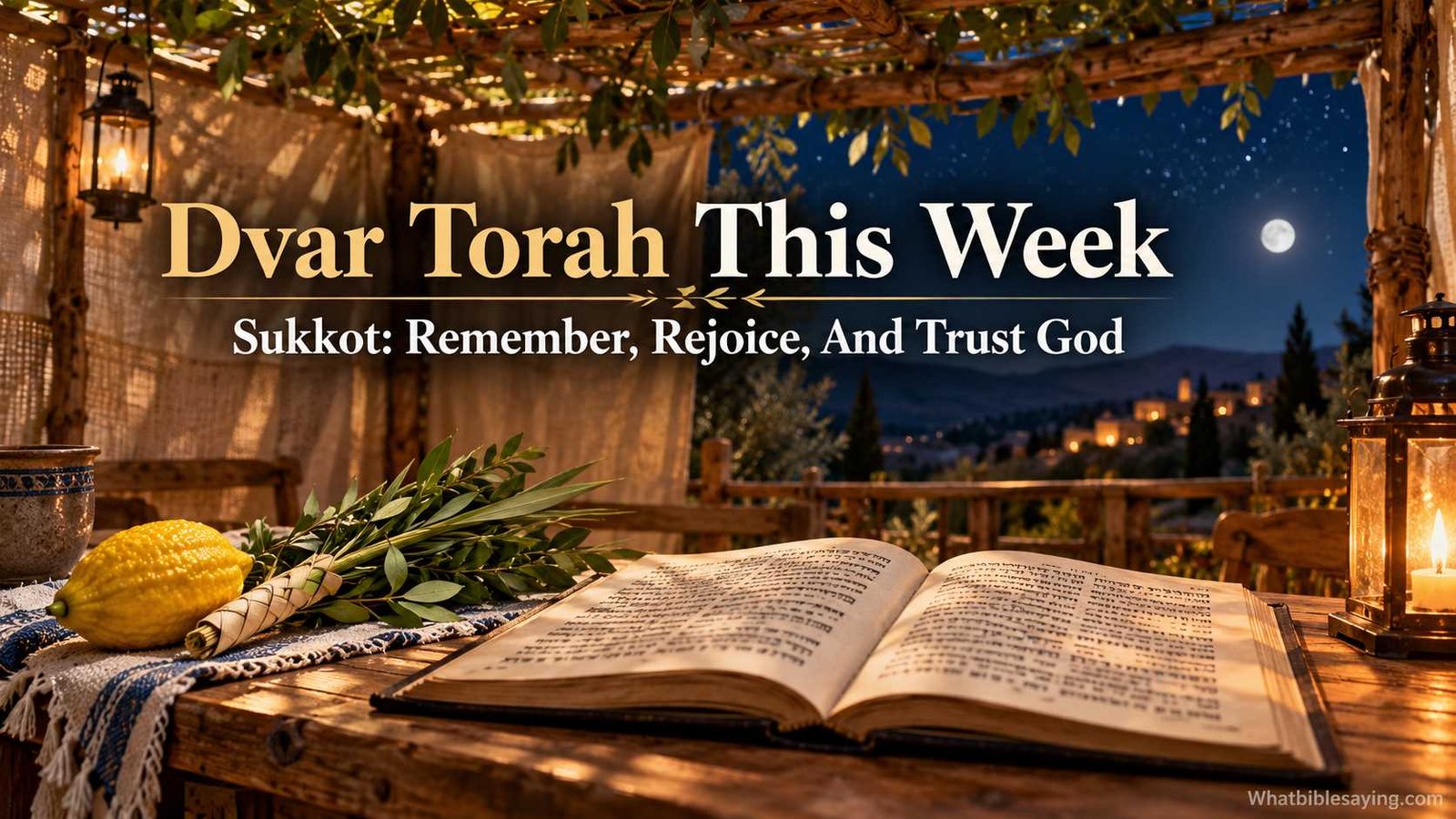
 If you are searching for the Dvar Torah this week, Saturday, September 26, 2026 is different from an ordinary Shabbat. It is the first day of Sukkot, so a special festival Torah reading takes the place of the regular weekly portion.
The Torah reading is Leviticus 22:26–23:44, followed by Numbers 29:12–16 as the Maftir reading. The Haftarah is Zechariah 14:1–21. September 26, 2026 corresponds to 15 Tishrei 5787, the first day of Sukkot.
At the heart of this week’s reading is a simple but powerful lesson: life is fragile, possessions are temporary, and remembering God’s provision can teach us to live with gratitude rather than fear.
A Dvar Torah is more than a summary of a Bible passage. The expression literally means a “word of Torah.” It is a short teaching or reflection that begins with a sacred text and draws out a meaningful lesson for life. A Dvar Torah often focuses on the weekly Torah portion or the special reading appointed for a Jewish festival.
This week, Sukkot gives us plenty to think about.
What Is the Dvar Torah This Week?
The main Torah reading for the first day of Sukkot covers a large section of Leviticus dealing with sacred times.
Leviticus 23 describes the appointed festivals of Israel, including the Sabbath, Passover, the Feast of Unleavened Bread, the Feast of Weeks, the Day of Trumpets, the Day of Atonement, and finally Sukkot, also called the Feast of Booths or Feast of Tabernacles.
The section concerning Sukkot appears in Leviticus 23:33–44.
God tells the Israelites to celebrate the festival for seven days and to live in temporary shelters, or booths, during that period. The command is tied directly to memory: later generations are to remember how God caused Israel to dwell in booths when He brought them out of Egypt.
That makes Sukkot unusual.
Israel is commanded not only to remember something with words but to remember it physically. Families leave the security of their normal houses and spend time in structures that feel less permanent.
That experience creates the central question for our Dvar Torah this week:
Why would God connect joy with a temporary shelter?
The answer can teach us something important about gratitude, security, and trust.
A Short Dvar Torah This Week From Sukkot
Most of us naturally feel safer when life seems permanent.
We want a solid house, enough savings, predictable plans, good health, reliable relationships, and some idea of what tomorrow will bring.
None of these desires is wrong.
But Sukkot interrupts the idea that these things alone can make us secure.
For several days, the sukkah becomes a visible reminder that human life has always contained uncertainty. Israel experienced this clearly in the wilderness. The people traveled without permanent homes. They depended on God for food, direction, protection, and survival.
Generations later, after Israelites lived in towns and houses, they were still commanded to remember those wilderness years.
Prosperity was not supposed to erase dependence.
That may be one of the most beautiful lessons of Sukkot.
God Asks His People to Remember
Biblical faith repeatedly looks backward in order to live wisely in the present.
Israel is told to remember deliverance from Egypt, remember God’s covenant, remember His commandments, and teach these truths to the next generation.
Sukkot turns remembrance into an experience.
A person could sit inside a permanent house and say, “God cared for our ancestors in the wilderness.”
But sitting beneath the branches of a sukkah makes that truth feel different.
The walls are lighter.
The roof is temporary.
The outdoor air is closer.
The structure itself says, “Human security is not absolute.”
Yet Sukkot is not mainly a festival of fear.
It is a festival of joy.
That combination is important.
Joy Does Not Require Perfect Security
Leviticus 23 connects the Feast of Booths with rejoicing before God.
That might seem surprising.
We often tell ourselves that we will finally relax when everything is settled.
When the bills are paid.
When the children are doing well.
When our health improves.
When our future is certain.
When our plans finally work.
Sukkot challenges that way of thinking.
A person can rejoice even while sitting inside a temporary shelter.
Why?
Because biblical joy is not always based on having complete control.
It can grow from remembering who has provided for us.
The Israelites could look back and say, “The wilderness was difficult, but we were not abandoned.”
That does not mean every difficult situation will end in the way we hope. Scripture never gives us permission to pretend that suffering is painless.
Instead, remembrance gives us perspective.
The God who was present in yesterday’s wilderness is not forgotten when tomorrow remains uncertain.
Gratitude Grows When We Remember Dependence
A permanent home can quietly create the illusion that we built everything ourselves.
Sukkot breaks that illusion.
Food, shelter, strength, family, community, and even another day of life are gifts we do not completely control.
Gratitude becomes deeper when we recognize that.
There is a difference between enjoying something and assuming we deserve it.
Sukkot teaches people to receive life’s blessings with open hands.
You can be thankful for your home without believing your home can protect you from every danger.
You can plan carefully for tomorrow without believing you control tomorrow.
You can work hard while still recognizing that not every blessing is the result of your own strength.
Temporary things can point us toward lasting truths.
Torah Meaning in Hebrew
Understanding the word Torah helps us understand what a Dvar Torah actually is.
The Hebrew word torah can mean instruction, teaching, or direction. In its most familiar sense, “the Torah” refers to the Five Books of Moses:
Genesis
Exodus
Leviticus
Numbers
Deuteronomy
These five books form the first section of the Hebrew Bible, or Tanakh. Jewish usage can also employ the word Torah more broadly for Jewish teaching and tradition.
This is why simply translating Torah as “law” can sometimes give readers too narrow an impression.
Law is certainly part of Torah. The Five Books contain commandments, legal material, and covenant obligations.
But they also contain creation, family stories, poetry, promises, journeys, failures, worship, sacrifice, and God’s dealings with His people.
“Instruction” often captures this broader sense well.
Torah is teaching that directs a person toward a way of life.
This also explains the phrase Dvar Torah. A Dvar Torah takes something from that teaching and asks:
What does this text show us?
Why is this detail here?
What question does it raise?
How might this teaching shape the way we live?
Jewish Torah study has a long tradition of asking such questions rather than assuming every passage has only one obvious lesson.
Readers also sometimes ask is the Torah and the Bible the same or is the Torah the first five books of the Bible. The simplest answer is that the Torah is the first five books of the Hebrew Bible. The complete Tanakh also includes the Prophets and Writings. Christians commonly call this larger collection the Old Testament, although Christian and Jewish arrangements and traditions are not identical.
How the Weekly Torah Reading Cycle Works
The Torah is divided into 54 weekly portions, commonly called parashot in the plural or parashah in the singular. These portions allow communities to move through the Torah in an annual reading cycle.
Normally, searching for a “Dvar Torah this week” means finding the current weekly parashah.
But festivals can change the normal schedule.
That is exactly what happens on September 26, 2026.
Because the day is Sukkot, the synagogue reading is the special festival reading rather than an ordinary sequential parashah. Both the Diaspora and Israel schedules list Leviticus 22:26–23:44 and Numbers 29:12–16, with Zechariah 14:1–21 as the Haftarah.
Several terms help make the reading cycle easier to understand.
Parashah means the assigned Torah portion.
Haftarah refers to a selected reading from the Prophets connected with a Sabbath or festival.
Aliyah refers to a segment of the Torah reading and also to the honor of being called up for that portion of the public reading.
Dvar Torah is a teaching or reflection built around Torah or another relevant Jewish text.
That means the Torah reading and the Dvar Torah are not the same thing.
The reading is the sacred text being read.
The Dvar Torah is the reflection on that text.
Why Sukkot Is the Focus This Week
Sukkot is one of the major biblical pilgrimage festivals.
Leviticus 23 instructs Israel to observe the festival beginning on the fifteenth day of the seventh month.
The Hebrew word sukkah refers to a booth or temporary shelter. Sukkot is the plural form.
The shelters recall Israel’s wilderness experience after the Exodus.
This gives the festival both historical and spiritual meaning.
It remembers God’s care.
It teaches humility.
It celebrates harvest.
It creates community.
And it asks people to rejoice.
For the Dvar Torah this week, these themes belong together.
We should not separate gratitude from memory.
We should not separate joy from dependence.
We should not separate material blessing from responsibility toward God and others.
The wilderness taught Israel that life could not be controlled.
The harvest taught Israel that abundance was real.
Sukkot holds both truths at once.
There are seasons of uncertainty.
There are also seasons of plenty.
Both can teach us to remember God.
Torah and Talmud Difference in Simple Words
Another common question connected with Torah study is the Torah and Talmud difference.
They are not the same thing.
| Torah | Talmud |
|---|---|
| In its narrow sense, the Five Books of Moses | A major collection of rabbinic discussion and teaching |
| Genesis through Deuteronomy | Built around the Mishnah and Gemara |
| Part of the Hebrew Bible | Rabbinic literature developed after the biblical period |
| Contains narrative, commandments, poetry, and covenant teaching | Discusses law, interpretation, practice, ethics, and many other subjects |
| Publicly read from Torah scrolls | Primarily studied as rabbinic text |
The Talmud is composed of the Mishnah and Gemara and preserves discussions involving many rabbis across different periods. It is central to rabbinic Jewish learning and law.
There is one important detail.
The word Torah can sometimes be used more broadly than simply the Five Books of Moses. In Jewish tradition, people may speak about Written Torah and Oral Torah or even use “Torah” as a broad term for Jewish sacred learning.
So when discussing the difference between Talmud and Torah, context matters.
If Torah means the Five Books of Moses, the distinction is very clear.
If Torah is being used broadly for Jewish teaching, the Talmud may itself be discussed within the larger world of Torah learning.
What Does the Haftarah Add This Week?
The Haftarah for the first day of Sukkot is Zechariah 14:1–21.
Zechariah’s passage gives Sukkot a wider prophetic setting.
The chapter looks toward a dramatic future involving Jerusalem and the nations, and Sukkot appears within that vision.
Readers should be careful here.
Prophetic literature has produced many different interpretations across Jewish and Christian traditions. A responsible Dvar Torah does not need to force every prophetic image into a modern headline.
Instead, we can notice the biblical connection itself.
Sukkot is not presented only as a memory of the past.
The prophetic reading also gives it a forward-looking dimension.
Memory and hope meet in the same festival.
That is another reason Sukkot carries such rich spiritual meaning.
Messianic Torah Reading for Today
People searching for a Messianic Torah reading for today may encounter a slightly different format.
Messianic Jewish congregations often follow the Jewish Torah-reading cycle but may also add passages from the New Testament.
This is different from standard Jewish synagogue practice.
It is therefore important not to present a Messianic reading list as though it represents Judaism as a whole.
The safest approach is to check the schedule followed by the specific congregation or ministry you attend.
The Torah portion itself may match the traditional Sukkot reading, while additional readings reflect a Messianic interpretation.
For Christian readers interested in the Jewish background of Scripture, this distinction matters. Respect begins with allowing Jewish traditions to describe themselves rather than blending different traditions together without explanation.
Bar Mitzvah Reading Torah and the Weekly Portion
The phrase bar mitzvah reading Torah often appears because the weekly Torah reading plays an important role in many bar mitzvah celebrations.
A boy traditionally becomes a bar mitzvah at age thirteen. Customs surrounding the synagogue service vary between Jewish communities.
A young person may receive an aliyah, chant part of the Torah reading, chant the Haftarah, lead portions of the service, or present a Dvar Torah. The exact responsibilities depend on the congregation and its customs.
The Dvar Torah can become especially meaningful because it asks the young person to do more than pronounce words correctly.
It asks them to wrestle with the text.
What does this passage mean?
What question does it raise?
What can I learn from it?
What might it mean for the person I am becoming?
My Jewish Learning describes the Dvar Torah as a lesson or interpretation of a text and notes that it can be delivered by clergy or laypeople. It is also commonly connected with the weekly portion.
A bar or bat mitzvah Dvar Torah therefore represents more than public speaking.
It represents participation in a continuing tradition of study.
How to Prepare Your Own Dvar Torah This Week
You do not need to be a professional scholar to prepare a thoughtful Dvar Torah.
Start with the text.
For Sukkot this week, read Leviticus 23:33–44 several times.
Then follow a simple process.
1. Notice Something That Makes You Curious
Perhaps you wonder why people are commanded to leave permanent houses for temporary booths.
Maybe you notice how often joy appears around the festival.
Maybe you wonder why remembering the Exodus still matters generations later.
A good Dvar Torah often begins with a real question.
2. Stay Close to the Passage
Do not rush toward a clever application.
First ask what the passage actually says.
Who is speaking?
Who is listening?
What command is given?
What reason does the text provide?
What words or ideas repeat?
Good reflection grows from careful reading.
3. Compare Related Scriptures
If the theme is remembrance, look at other places where Israel is commanded to remember.
If the theme is God’s provision, examine wilderness passages.
If the theme is rejoicing, notice how joy appears in other festival instructions.
Scripture can help explain Scripture.
4. Read More Than One Commentary
Jewish interpretation is rich and diverse.
One teacher may emphasize historical memory.
Another may emphasize harvest gratitude.
Another may discuss vulnerability.
Another may focus on hospitality, community, or joy.
A good Dvar Torah does not need to pretend there is only one possible lesson. Guidance on preparing a Dvar Torah likewise encourages readers to explore multiple possible answers rather than assuming every question has one solution.
5. Choose One Clear Idea
Do not try to explain everything about Sukkot.
A five-minute message about one meaningful idea is often stronger than thirty minutes of disconnected observations.
For this week, the central idea might simply be:
The sukkah teaches us to receive temporary blessings with lasting gratitude.
That is enough.
6. Connect the Text With Real Life
Perhaps you have experienced a season when plans changed suddenly.
Perhaps you moved.
Lost a job.
Faced illness.
Watched children leave home.
Experienced success and realized success did not remove uncertainty.
You do not need a dramatic story.
The strongest application is often ordinary and honest.
7. End With a Question Worth Carrying Home
For example:
What blessing in my life have I begun to treat as permanent rather than as a gift?
That question keeps the Dvar Torah alive after the teaching ends.
What People Often Ask About This Week’s Torah Reading
What does Dvar Torah mean?
A Dvar Torah literally means a “word of Torah.” It normally refers to a lesson, teaching, or short reflection based on Torah or another Jewish sacred text.
What is the Torah reading for September 26, 2026?
September 26, 2026 is the first day of Sukkot, 15 Tishrei 5787. The Torah reading is Leviticus 22:26–23:44 and Numbers 29:12–16. The Haftarah is Zechariah 14:1–21.
What does Torah mean in Hebrew?
The Hebrew word Torah means instruction, teaching, or direction. In its common proper-name sense, it refers to the Five Books of Moses.
Are the Torah and Talmud the same?
No. In the narrow sense, Torah refers to the Five Books of Moses. The Talmud is a later body of rabbinic teaching and discussion composed of the Mishnah and Gemara.
Is the Torah the same as the Bible?
Not exactly. The Torah is the first five books of the Hebrew Bible. The full Tanakh also contains the Prophets and Writings.
Does a bar mitzvah read the whole Torah portion?
Not necessarily. Customs differ between communities. A young person may chant part of the Torah portion, receive an aliyah, chant the Haftarah, lead prayers, or give a Dvar Torah.
Why is there a festival reading instead of a normal weekly portion?
Jewish festivals have special Torah readings connected with the meaning and commandments of the holiday. Since September 26, 2026 is the first day of Sukkot, the festival reading is used.
What Sukkot Teaches Us About Lasting Trust
The Dvar Torah this week begins with something temporary.
A booth.
Branches overhead.
Walls that will soon come down.
Yet the lesson can remain long after the sukkah disappears.
The Israelites were not commanded to remember the wilderness because hardship itself was good. They were commanded to remember that they had lived through a time when everything felt uncertain and yet they were sustained.
That memory could protect them from another danger: believing that permanent houses, successful harvests, and material abundance made them completely self-sufficient.
We need that reminder too.
Most things we hold in our hands are temporary.
Homes change.
Jobs change.
Bodies age.
Children grow.
Plans move.
Seasons begin and end.
Sukkot does not tell us to reject these gifts. It teaches us to enjoy them with gratitude.
There is a deep difference.
You can enjoy a blessing without worshiping its permanence.
You can prepare for tomorrow without pretending you control it.
You can value your home while remembering that a building is not the deepest source of your security.
You can rejoice even when life still contains uncertainty.
That is why the image of the sukkah remains so powerful.
Its walls may be temporary, but the memory it carries is enduring.
For anyone searching for a Dvar Torah this week, that may be the message worth carrying with us:
Remember what you have received.
Rejoice in what you have today.
Hold your blessings with gratitude.
And do not confuse temporary security with lasting trust.
Dr. Rachel is very smart and knows a lot about the Bible. He helps us understand the Bible better by talking about the old texts in a simple way.