 Quoting the Bible in a school or college paper can feel confusing at first. A Bible verse has a book name, chapter, and verse number, while MLA citations often use authors and page numbers. So how do the two fit together?
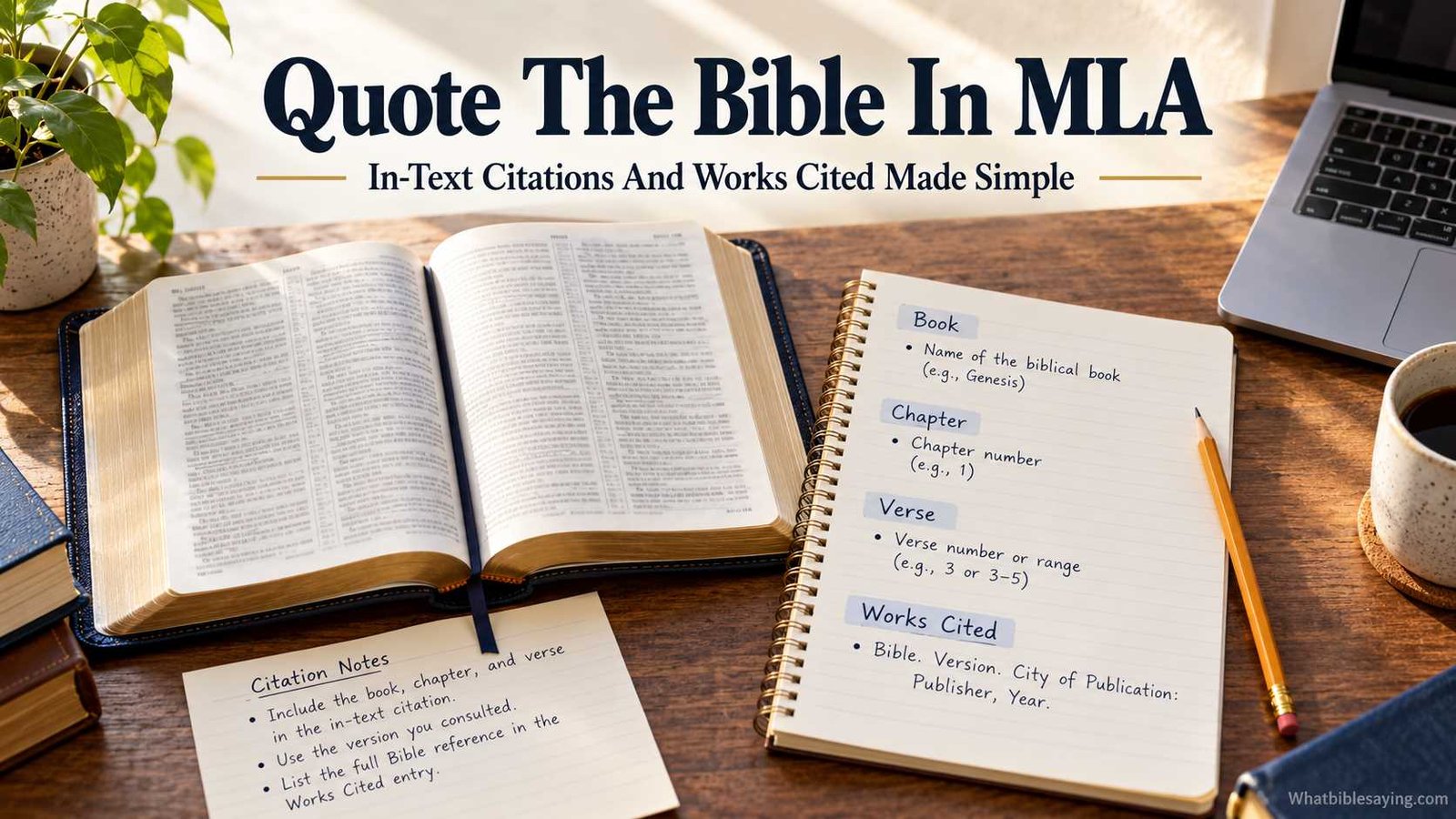
The basic rule is simple: when you quote the Bible in MLA format, identify the Bible edition or translation you used and cite the passage by book, chapter, and verse. You should also include the Bible edition in your Works Cited list.
For example, a first citation might look like this:
Jesus teaches that love for others is central to discipleship (New International Version, John 13:34).
After you have clearly established which Bible translation you are using, later references can usually be shortened:
Paul also describes love as patient and kind (1 Cor. 13:4).
MLA’s current ninth-edition guidance specifically treats Scripture according to its natural divisions, such as book, chapter, and verse, rather than relying only on page numbers.
Here is how to do it correctly in different situations.
How To Quote The Bible In MLA Format in an Essay
When you quote Scripture in an essay, you normally need three pieces of information:
- The Bible edition or translation, especially when you first introduce it.
- The biblical book.
- The chapter and verse or verse range.
This matters because different Bible translations may use different wording even though they refer to the same passage.
Consider John 3:16. The meaning is closely related across major English translations, but the exact wording may differ. If your paper quotes the wording of the King James Version, your reader needs to know that you did not quote the NIV, NLT, ESV, or another translation.
Purdue OWL’s current MLA guidance says that the first parenthetical Bible citation should make clear which Bible is being used, followed by the book, chapter, and verse. Later citations using the same edition may give only the book, chapter, and verse.
A short Bible quotation
A short quotation can be placed inside your normal sentence using quotation marks.
For example:
Jesus tells His disciples to love one another, giving them a clear pattern for Christian relationships (New International Version, John 13:34).
If you already named the translation in your sentence, you do not need to repeat unnecessary information.
For example:
In the New International Version, Jesus commands His followers to love one another (John 13:34).
The important point is clarity. Your reader should be able to identify the translation and find the passage.
A longer Bible quotation
If you quote a long passage, MLA’s normal block-quotation rules apply.
Instead of surrounding the entire passage with quotation marks, set the quotation apart from the main paragraph according to MLA formatting. Your citation comes after the quotation.
Do not turn every Bible quotation into a block quote. For most essays, quoting only the words directly needed for your argument is clearer and easier to read.
Quoting several verses
If your quotation covers several consecutive verses, give the full verse range.
For example:
(Rom. 8:28-30)
or, depending on the MLA convention required by your instructor:
(Rom. 8.28-30)
You may notice an important difference here. Purdue OWL’s current MLA 9 material displays Bible references with a colon between chapter and verse, such as Ezek. 1:5-10. Some MLA Style Center examples have used periods, such as Gen. 1.22.
For a class paper, follow the format required by your teacher, university, or assigned MLA guide and use it consistently throughout the paper.
How To Write an MLA In-Text Citation for the Bible
An MLA Bible citation is slightly different from a citation for an ordinary novel.
If you quote a novel, you might cite the author’s surname and page:
(Smith 42)
That method is not normally the best way to identify Scripture because Bible pagination varies widely among editions.
John 3:16 can appear on one page in a compact Bible, another page in a study Bible, and another location in an electronic Bible.
Book, chapter, and verse provide a much more stable way to find a passage.
The MLA Style Center’s current ninth-edition guidance confirms that Scripture can be cited according to book, chapter, and verse.
Your first Bible citation
Your first quotation should establish which edition or translation you are using.
A simple example could look like this:
The psalmist declares his trust in God’s guidance (King James Version, Ps. 23:1).
If the title of the edition appears as the first element of your Works Cited entry, your parenthetical citation should make a clear connection to that entry.
Later citations from the same Bible
Once readers know which translation you are using, you generally do not need to repeat its full name after every verse.
A later reference might simply be:
(Phil. 4:6-7)
This keeps the paper readable without leaving the source unclear. Purdue OWL specifically shows this shortened approach for later references from the same Bible edition.
What if you use two translations?
Suppose you compare the King James Version with the New International Version.
Now the translation matters every time the wording could otherwise be unclear.
You might write:
The King James Version uses one wording for the passage (KJV, Matt. 5:9), while the New International Version expresses the same verse in slightly different modern English (NIV, Matt. 5:9).
Define abbreviations before relying on them throughout a formal paper.
The goal is not simply to make the citation shorter. The goal is to make it impossible for readers to confuse one source with another.
How To Quote The Bible In MLA Format Using the KJV
The King James Version is frequently used in literature, history, theology, and Bible studies.
If you quote the KJV, cite the specific edition you actually used.
A common Works Cited example given by Purdue OWL is:
The Bible. Authorized King James Version, Oxford UP, 1998.
Purdue identifies the version after the title and then gives the publisher and publication year.
A first in-text reference could therefore identify the edition and passage:
(Authorized King James Version, Matt. 5:9)
After the edition is established, a later reference might simply be:
(Rom. 12:2)
Do not automatically copy the Oxford 1998 Works Cited example if that is not the Bible you used.
Look at your Bible’s title page and publication information. Your own edition may have another publisher, publication year, editor, study-note contributor, or title.
MLA citations should describe the source you actually consulted.
How To Quote The Bible In MLA Format Using the NIV
The same principle applies to the New International Version.
You should not create a citation simply by writing:
The NIV Bible.
Instead, inspect the particular edition you used.
Look for details such as:
- exact published title
- version or translation
- publisher
- year of publication
- editor or other contributor, if relevant
- website or app, if you used a digital edition
Your in-text citation could identify the New International Version when you first quote it:
(New International Version, John 1:1)
If the translation has already been clearly established, a later citation can focus on the biblical location:
(John 3:16)
This is especially important when discussing what Bible translation should I use for a research paper. MLA does not normally choose your Bible translation for you. MLA tells you how to document the source you actually use.
Your professor, school, church course, or assignment may require a particular translation.
MLA Works Cited Format for the Bible
The Bible should normally appear in your Works Cited list when you have quoted, paraphrased, or otherwise used it as a source.
MLA treats a published Bible edition much like another published source. The title of the particular published edition is generally italicized, and information about the version, editor, publisher, and date is included when applicable.
A general pattern is:
Title of Bible. Version, Publisher, Year.
For example:
The Bible. Authorized King James Version, Oxford UP, 1998.
If an editor is important to the edition, MLA may include that person as another contributor.
The MLA Style Center gives this kind of example for a published scriptural edition:
The New Jerusalem Bible. General editor, Henry Wansbrough, Doubleday, 1985.
Here is the basic distinction:
| Bible source | Information to record |
|---|---|
| Print Bible | Title, version, publisher, year |
| Study Bible | Title, version, relevant editor/contributor, publisher, year |
| Online Bible | Edition or translation plus website/container and URL where appropriate |
| Bible app | Translation plus relevant app/container information |
| PDF Bible | Bibliographic details of the Bible edition represented by the PDF |
MLA 9 uses a flexible system of core elements and containers instead of requiring one rigid formula for every possible source.
That is why identifying the source you actually used matters so much.
How To Cite a King James Bible PDF Format Source
Students sometimes search for a King James Bible PDF format and then wonder what to place in Works Cited.
Here is what matters: PDF describes the file format. King James Version describes the Bible translation.
They are not the same kind of information.
Suppose you downloaded a PDF reproduction of a published KJV Bible. Look inside the PDF for the title page and copyright or publication information.
If it identifies a published edition, use those bibliographic details.
For example, your citation structure might be:
Title of Bible. King James Version, Publisher, Year.
If the PDF is hosted on a website and the website is important for locating the exact edition you consulted, the site may function as a container and may need to be represented in the citation.
Do not cite a file merely as:
King James Bible PDF.
That tells the reader almost nothing about the edition.
Also avoid downloading Scripture files from questionable websites when reliable publisher, library, Bible society, or established Bible platforms are available.
How To Cite an NIV Bible PDF Format Source
The same rule applies when using an NIV Bible PDF format source.
First determine:
What edition is this?
Who published it?
What year was it published?
Where did the PDF come from?
Does the PDF reproduce a recognized published edition?
If those details are missing, the file may be a poor academic source.
Your MLA citation should document the edition, not merely its filename.
For example, a filename such as:
niv-bible.pdf
is not enough information for a responsible Works Cited entry.
A useful way to remember the difference is:
NIV tells you the translation. PDF tells you the digital format. MLA needs enough publication information to identify the actual source.
How To Cite an Online Bible in MLA
Many students no longer use a printed Bible for every assignment. They read Scripture through websites.
That is acceptable, but the citation should reflect the online source actually consulted.
An online Bible citation may contain information such as:
Title or Bible edition. Version, Website Name, Publisher or sponsoring organization where applicable, URL.
The exact elements depend on the website and edition.
Do not simply copy a printed-Bible citation if you actually quoted wording from a digital source whose edition differs.
MLA has also addressed a useful question: if each Bible chapter appears on a separate webpage, do you need a separate Works Cited entry for every chapter?
Generally, no. When multiple biblical passages come from the same overall website and readers can navigate the source normally, a separate Works Cited entry for every chapter is not necessary.
This means that if your paper quotes Genesis, Psalms, Matthew, and Romans from the same online Bible edition, you usually do not need four separate Works Cited entries simply because each chapter has its own webpage.
How To Cite a Bible App in MLA
Bible apps create another common citation question.
One app may contain dozens of Bible translations. If you simply cite the app name, readers may not know which translation produced the wording you quoted.
The MLA Style Center has specifically discussed Bible apps containing multiple translations. One approach is to identify the translation in your prose. Another is to identify the translation in the Works Cited entry.
Imagine that you are comparing the KJV and another translation in the same Bible app.
Your sentence should make that comparison clear:
The King James Version uses one expression in Matthew 7:7, while another translation renders the wording differently.
Your Works Cited entry can then document the app or digital container in a way that allows readers to understand where the translations were accessed.
One caution is important: the MLA Style Center page about multi-translation Bible apps was originally written for MLA’s eighth edition and now directs users to the ninth-edition handbook for current guidance.
So use the underlying principle, but follow MLA 9 when preparing a current academic paper.
What Bible Translation Should I Use for an MLA Paper?
Students sometimes assume there must be an official MLA Bible translation.
There is not one universal MLA translation that everyone must use.
The question what Bible translation should I use depends on your assignment.
Your professor may request:
- King James Version
- New International Version
- New Revised Standard Version
- New American Standard Bible
- English Standard Version
- another approved translation
A literature class may use the KJV because of its historical influence on English writing. A theology course may prefer another translation. A comparative assignment might require two or more versions.
MLA’s concern is documentation.
Whichever translation you use, identify it accurately and cite the edition you actually consulted.
If your teacher has specified a translation, follow that instruction even if you personally read another Bible version for devotional purposes.
Should Bible Verses Use Page Numbers in MLA?
Usually, book, chapter, and verse are more useful than Bible page numbers.
Why?
Because Bible page numbers are not stable across editions.
Genesis 1 may appear on page 1 in one Bible and much later in another because of introductions, notes, maps, commentary, type size, or study material.
MLA’s ninth-edition Scripture guidance specifically recognizes book, chapter, and verse as meaningful divisions for citation.
For this reason, a reference such as:
(John 3:16)
is much more useful for finding Scripture than:
(p. 1,246)
If a digital work provides device-specific location numbers that can change from one device to another, MLA also advises against treating unstable location numbers like stable pagination.
Common MLA Bible Citation Mistakes
Bible citations are not difficult once you understand the pattern, but several mistakes appear again and again.
Citing only “The Bible”
There are many Bible editions and translations.
A reader needs to know which one supplied the wording you quoted.
Giving only a page number
Use the biblical book, chapter, and verse when identifying Scripture passages.
Forgetting Works Cited
Your in-text reference identifies the passage. Your Works Cited entry identifies the edition or source.
They work together.
Switching translations without saying so
If one quotation comes from the KJV and another from the NIV, identify the change.
Otherwise, readers may think the wording differences came from you rather than from different translations.
Copying somebody else’s Bible citation
A citation found online may describe an Oxford edition from 1998 while the Bible on your desk was published by another company in another year.
Cite your source, not somebody else’s source.
Treating PDF as a translation
PDF is a file type.
KJV, NIV, NRSV, ESV, and similar labels identify translations or versions.
Mixing MLA and APA
APA, Chicago, Turabian, and MLA do not always format Bible citations in the same way.
If your assignment requires MLA, use MLA consistently.
Trusting a citation generator without checking it
Automatic citation tools can be convenient, but they can misunderstand editions, contributors, online containers, or unusual religious texts.
Check the result against current MLA guidance before submitting your paper.
Quick MLA Bible Citation Examples
Here is a simple reference chart.
| Situation | Example approach |
|---|---|
| First citation from a Bible | (New International Version, John 3:16) |
| Later citation, same edition | (Rom. 8:28) |
| Several verses | (Matt. 5:3-10) |
| KJV Works Cited example | The Bible. Authorized King James Version, Oxford UP, 1998. |
| Different translations | Identify each translation clearly |
| PDF Bible | Cite the underlying edition and relevant digital source |
| Online Bible | Cite the Bible edition/version and website/container as applicable |
| Bible app | Identify the translation and relevant app/container information |
Remember that the punctuation used between chapter and verse may be presented differently in different MLA-related examples. Purdue’s current MLA 9 guide uses a colon, while older MLA Style Center examples have used periods. Follow your instructor’s required convention and remain consistent.
Do You Italicize the Bible in MLA?
There is an important distinction.
When you speak generally about the Bible as Scripture, you normally do not italicize the word.
For example:
Christians read the Bible as sacred Scripture.
But when you refer to the title of a specific published edition, that published title is treated as a work title and may be italicized.
For example:
The New Jerusalem Bible
The MLA Style Center explicitly distinguishes general references to Scripture from references to specific published editions.
Do You Put the Bible in Works Cited?
If you quoted or used a particular Bible edition as a source in your research paper, include that source in your Works Cited list.
The citation allows a reader to identify the exact edition behind your quotations.
Your Works Cited page itself should follow normal MLA formatting. Purdue notes that it should appear on a separate page, be double-spaced, use hanging indents, and alphabetize entries according to the first element of each citation.
Do You Cite the Bible Every Time You Quote It?
Yes, the reader should be able to identify the source of each quotation.
That does not mean repeating a long Bible title after every sentence.
Establish the edition clearly in your first citation. If later quotations come from the same edition and there is no chance of confusion, the biblical book, chapter, and verse can usually carry the later reference.
For example:
First reference:
(New International Version, Eph. 2:8-9)
Later reference:
(Rom. 5:8)
If you switch translations, make that change clear.
How Do You Cite Two Bible Translations?
Comparing translations is common in Bible study and academic writing.
You might compare how the KJV and NIV translate the same Greek or Hebrew passage.
In that situation, make each translation identifiable in your prose or citation.
For example:
The King James Version uses older English wording in the passage, while the New International Version uses more contemporary language.
Then cite each corresponding passage so that readers can tell which translation is being discussed.
Your Works Cited list should also contain the editions you actually consulted.
This becomes especially important in papers about which Bible translation is the most accurate, because your argument may depend on precise differences in wording.
A Simple Way to Remember MLA Bible Citations
If all these rules feel like a lot, remember three ideas:
Name the Bible edition. Identify the passage. Document the source you actually used.
The first quotation establishes the translation or edition. The biblical book, chapter, and verse tell readers where the passage appears. The Works Cited entry tells them exactly which published or digital Bible supplied the wording.
That is the heart of how to quote the Bible in MLA format.
You do not need to make the citation complicated. You simply need to make it clear and traceable.
And that principle fits Bible study itself. When we quote Scripture, accuracy matters. Taking the time to identify the words carefully shows respect both for your reader and for the biblical text you are discussing.

Dr. Rachel is very smart and knows a lot about the Bible. He helps us understand the Bible better by talking about the old texts in a simple way.