

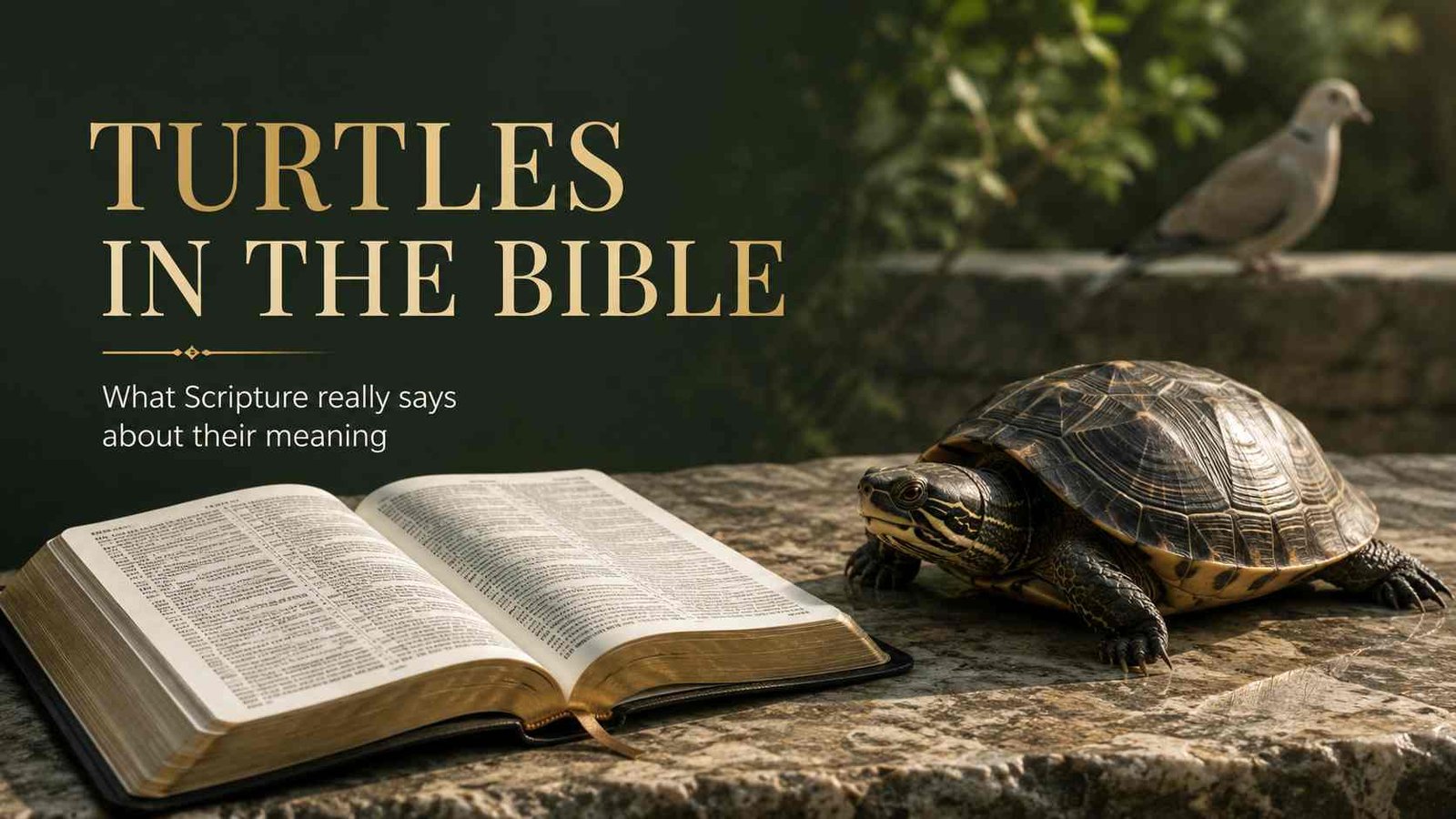
 If you have ever seen a turtle and wondered whether God placed a special spiritual meaning behind it, you are not alone. Many people search for what does a turtle symbolize in the Bible because turtles are often connected with patience, protection, wisdom, and long life.
But the biblical answer needs a little care.
The Bible does not clearly teach that the modern turtle is a symbol of patience, prosperity, wisdom, protection, or good fortune. In fact, many Bible passages that appear to mention a “turtle,” especially in older English translations, are actually talking about a turtledove, which is a bird.
That difference matters.
A turtle can certainly remind a Christian of patience, steady faith, endurance, or protection. These can be meaningful personal reflections. Yet we should not say that Scripture gives the turtle those meanings when the Bible itself does not.
Here is the simplest answer:
The Bible does not give the modern turtle a fixed spiritual symbolism. In several older Bible passages, the word “turtle” means turtledove. Christian ideas about turtles representing patience, endurance, or protection are devotional comparisons rather than direct biblical teachings.
Understanding that difference helps us enjoy God’s creation without adding meanings to Scripture that are not actually there.
What Does a Turtle Symbolize in the Bible According to Scripture?
When we ask what does a turtle symbolize in the Bible, we should begin with what Scripture actually says.
The surprising answer is that the shelled animal we normally call a turtle today has almost no clear symbolic role in the Bible.
You may find websites or devotional discussions saying that turtles represent:
- patience
- wisdom
- long life
- protection
- perseverance
- peace
- fertility
- stability
- good luck
Some of these ideas make sense when we think about the natural behavior of turtles. A turtle moves slowly. Its shell provides protection. Some species can live for many years. These qualities make the animal a useful picture of endurance or patience.
But there is an important difference between saying:
“A turtle reminds me to be patient.”
and saying:
“The Bible says turtles symbolize patience.”
The first is a personal reflection. The second claims something about Scripture.
The Bible does teach patience. It teaches perseverance. It teaches us to trust God as our refuge. But it does not use the modern turtle as the established symbol for these truths.
That is why biblical symbolism must always begin with the biblical text itself.
Biblical Symbolism Is Defined by Context
Some animals have clear figurative meanings in Scripture because biblical writers actually use them that way.
Jesus, for example, sometimes used sheep when speaking about people who needed a shepherd. Wolves could picture dangerous or deceptive people. The dove appears in important biblical scenes, including the baptism of Jesus.
These meanings come from the passages themselves.
That is different from assigning a spiritual meaning to an animal because of its natural behavior.
This distinction is useful when studying other questions such as What Does a Wolf Symbolize in the Bible or What Do Crows Symbolize in the Bible. We should first ask how Scripture uses the animal before deciding what it means spiritually.
With turtles, that careful approach reveals something interesting: one of the biggest sources of confusion is actually an old English word.
Why Does the King James Bible Mention “Turtle”?
Readers of the King James Version may be surprised to find passages that seem to mention turtles.
Song of Solomon 2:12 is a famous example. In older KJV wording, the verse says:
“The flowers appear on the earth; the time of the singing of birds is come, and the voice of the turtle is heard in our land.”
A modern reader may imagine a turtle making a sound among the flowers.
That is not what the passage means.
The Hebrew word here is tor, and it means turtledove. Modern Bible translations therefore commonly say “turtledove” rather than simply “turtle.” The Hebrew term תּוֹר is identified lexically as a turtledove and occurs repeatedly in passages involving birds and sacrifices.
So the “voice of the turtle” in Song of Solomon is the call of a bird.
This changes how we understand the passage.
Song of Solomon 2 describes flowers appearing, birds singing, and the arrival of a new season. The turtledove belongs naturally in this springtime scene.
It is not describing a reptile.
The Hebrew Word Tor Means Turtledove
The biblical Hebrew word is:
תּוֹר — tor
It is used for a turtledove.
Strong’s Hebrew concordance lists the word fourteen times, including Genesis 15:9, several passages in Leviticus, Psalm 74:19, Song of Solomon 2:12, and Jeremiah 8:7.
This becomes especially important when reading older translations.
For example, Leviticus 12:8 in the KJV says that a woman who could not bring a lamb could bring:
“two turtles, or two young pigeons”
Once again, these were not reptiles.
They were two turtledoves.
Modern translations make the meaning much clearer by using “turtledoves” or simply “doves.”
This is also why a study of What Does a Dove Symbolize in the Bible is much more closely connected with these passages than modern turtle symbolism is.
Where Are “Turtles” Mentioned in the Bible?
The Hebrew word tor appears in several parts of the Old Testament.
These include:
| Scripture | Meaning in Context |
|---|---|
| Genesis 15:9 | A turtledove used with Abram’s offering |
| Leviticus 1:14 | Turtledoves permitted as offerings |
| Leviticus 5:7 | Two turtledoves or pigeons could be brought |
| Leviticus 12:8 | Two turtledoves permitted when a lamb could not be afforded |
| Psalm 74:19 | Turtledove used poetically |
| Song of Solomon 2:12 | The sound of a turtledove in the land |
| Jeremiah 8:7 | The turtledove appears among migratory birds |
The Hebrew concordance confirms that tor refers to a turtledove throughout these occurrences.
That means several verses sometimes used to support “turtle symbolism” are really bird passages.
This is why checking the original language can be so helpful.
A single English word may have changed in common usage during the centuries since an older Bible translation was produced.
What About the “Tortoise” in Leviticus 11:29?
There is another verse that deserves attention.
Leviticus 11:29 lists animals regarded as unclean under Israel’s dietary laws. The King James Version includes a creature translated as “tortoise.”
However, this passage uses a different Hebrew word:
צָב — tsav or ṣāḇ
It is not the Hebrew tor used for the turtledove.
The exact identification of this ancient animal term has been translated differently. Many modern translations describe the creature as a large lizard or great lizard, while some older translations use “tortoise.” The Hebrew text analysis of Leviticus 11:29 likewise identifies the term in that verse as a large lizard.
Because of this translation uncertainty, Leviticus 11:29 is not a strong basis for building a spiritual meaning of turtles.
The passage is giving Israel instructions about clean and unclean creatures. It is not teaching that the animal represents patience, wisdom, evil, luck, or any other spiritual idea.
What Does a Turtle Mean in Hebrew?
The question what does a turtle mean in Hebrew can be confusing because several different issues become mixed together.
Biblical Hebrew and modern English do not always divide animal names in exactly the same way. We therefore need to ask which Hebrew word appears in a particular verse.
The two terms most important to this discussion are:
Tor: The Turtledove
Tor — תּוֹר
This word refers to the turtledove.
It appears in sacrificial passages and in poetic passages such as Song of Solomon 2:12. It is the source behind several places where an older English Bible may use “turtle.”
Tsav: The Creature in Leviticus 11:29
Tsav — צָב
This word appears in Leviticus 11:29.
The KJV renders it “tortoise,” while many modern versions understand the creature as a kind of large lizard.
So we should be careful with the statement that “turtle means this in Hebrew.”
There is no single biblical Hebrew word that allows us to say that turtles represent one spiritual idea throughout Scripture.
The context must decide the meaning.
What Do Turtles Symbolize in Christianity?
Although Scripture does not establish a fixed symbolism for turtles, Christians sometimes use the animal as a devotional illustration.
There is nothing wrong with noticing something in creation and allowing it to remind you of a biblical truth.
Jesus Himself often drew attention to ordinary parts of creation. He spoke about birds, flowers, seeds, sheep, vines, trees, and fields.
The important thing is to distinguish an illustration from an interpretation.
A turtle may illustrate patience for us. That does not mean God declared the turtle to be the biblical symbol of patience.
With that distinction in mind, several Christian reflections can be useful.
Patience and Steady Faith
A turtle rarely appears hurried.
Its slow, steady movement naturally makes people think about patience.
Scripture places great value on patience and endurance. Romans 12:12 encourages believers to be patient in trouble. James 1 teaches that testing can produce perseverance.
A Christian seeing a turtle might therefore think:
“I do not have to rush ahead of God. I can continue faithfully, one step at a time.”
That can be a beautiful reflection.
But the spiritual lesson comes from Scripture, not from a secret meaning hidden inside the turtle.
Perseverance Through Difficult Seasons
Turtles are also commonly associated with steady progress.
Life with God is sometimes like that.
We may want immediate answers, immediate healing, immediate success, or immediate change. Yet many important parts of faith develop slowly.
Character grows over time.
Wisdom develops through experience.
Prayer may require persistence.
Relationships often need patience.
A turtle can therefore become a simple visual reminder that slow progress is still progress.
Hebrews 12:1 tells believers to run with endurance the race set before them. The Bible’s message is perseverance. The turtle is simply an illustration that may help us remember it.
Protection and Trust in God
A turtle’s shell naturally draws attention to protection.
For that reason, some Christian reflections connect turtles with safety or spiritual protection.
Again, Scripture does not make this connection directly.
Instead, the Bible repeatedly describes God Himself as the true source of refuge.
Psalm 18:2 calls the Lord a rock, fortress, deliverer, and shield.
Psalm 91 speaks about dwelling under God’s protection.
So if a turtle’s shell reminds you of safety, the strongest biblical lesson is not that the turtle has protective spiritual power.
It is that God is our refuge.
The creature points our thoughts toward the Creator.
Long Life and Wisdom
Some turtle species are known for long lives, which is why many cultures associate turtles with longevity and wisdom.
The Bible values wisdom and honors faithful old age, but it does not identify the turtle as the biblical symbol of either one.
A Christian may admire an old turtle and reflect on the beauty of a long, faithful life.
But longevity symbolism should not be presented as a biblical doctrine.
This same care is useful when studying popular questions such as What Does a Rabbit Symbolize in the Bible or What Do Hummingbirds Symbolize in the Bible. Something can have a popular spiritual meaning without that meaning coming directly from Scripture.
The Biblical Meaning of the Turtledove Is More Important
Once we separate turtles from turtledoves, the biblical picture becomes much clearer.
Turtledoves really do appear throughout Scripture.
They were familiar birds in the ancient biblical world. They appear in worship, poetry, sacrifice, and even the story surrounding the childhood of Jesus.
Turtledoves Were Used as Offerings
Leviticus allows turtledoves to be brought in several kinds of offerings.
Leviticus 1:14 mentions turtledoves or young pigeons as possible burnt offerings.
Leviticus 5:7 provides birds as an offering when a person could not afford a lamb.
Leviticus 12:8 similarly permits two turtledoves or pigeons when a woman could not afford the larger offering after childbirth.
This shows something beautiful about the Law.
Worship was not designed only for wealthy people.
There were provisions for people with fewer resources.
Mary, Joseph, and the Turtledoves
The turtledove appears again when Mary and Joseph bring Jesus to Jerusalem.
Luke 2:24 says they offered:
“a pair of turtledoves, or two young pigeons.”
This wording reflects the offering described in the Law.
Because Leviticus 12:8 allowed this offering when a lamb was beyond a family’s means, many readers understand Luke’s detail as showing the humble economic circumstances surrounding Jesus’ early life.
That is much more meaningful biblically than trying to find a hidden message in the modern turtle.
The passage connects Jesus’ family with obedience, humility, worship, and the Law of Moses.
Turtledoves, Spring, and Love
Song of Solomon gives us another beautiful picture.
In Song of Solomon 2:12, flowers are appearing, singing is heard, and the voice of the turtledove announces the life of a new season. Modern translations clearly identify the bird as a turtledove.
Here the bird belongs to an atmosphere of beauty, love, renewal, and spring.
This does not mean every turtledove in Scripture always symbolizes renewal. Biblical symbols are shaped by context.
Still, the image is peaceful and full of life.
It is also another reason why readers interested in this subject may enjoy studying What Does a Dove Symbolize in the Bible.
What Is the Spiritual Meaning of a Turtle?
When people ask about the spiritual meaning of a turtle, they may mean several different things.
That is where confusion often begins.
A useful way to separate the ideas is this:
| Type of Meaning | What We Can Say |
|---|---|
| Biblical meaning | Scripture gives no fixed symbolism to the modern turtle |
| Christian reflection | A turtle may remind someone of patience, endurance, or protection |
| Cultural symbolism | Different cultures may connect turtles with longevity, wisdom, fertility, luck, or creation |
| Omen or fortune-telling | Scripture does not teach believers to predict events from seeing turtles |
Keeping these categories separate protects us from turning personal ideas into biblical doctrine.
Suppose you see a turtle while going through a difficult season.
You might think about patience.
You might remember that God is with you even when progress feels slow.
You might pray for endurance.
Those responses can be spiritually healthy because they bring your attention back to biblical truth.
But it would be different to say:
“A turtle crossed my path, so God is promising that money is coming.”
Or:
“I saw three turtles, so something bad will happen.”
Scripture gives us no basis for conclusions like these.
Is a Turtle a Good or Bad Omen?
Biblically, a turtle is neither a good omen nor a bad omen.
Seeing one does not automatically predict:
- good luck
- financial success
- pregnancy
- marriage
- death
- danger
- spiritual attack
- a coming blessing
- a coming disaster
The Bible does not tell Christians to read animals as a system for predicting future events.
In fact, Scripture warns Israel against divination and interpreting omens. Deuteronomy 18:10 specifically includes practices such as divination, fortune-telling, and interpreting omens among things God’s people were not to follow.
That does not mean we cannot notice God’s beauty in creation.
It means creation should not become a fortune-telling system.
There is a big difference.
A bird singing outside your window may remind you of God’s care.
A rainbow may remind you of God’s covenant with Noah because Scripture itself gives that sign a biblical context.
A turtle may remind you to slow down and be patient.
But seeing an animal does not give us permission to invent a prediction about the future.
What If You Keep Seeing Turtles?
Some people become especially curious when they see the same animal repeatedly.
Perhaps turtles appear in your yard, on walks, in dreams, in photographs, or at unexpected moments.
It is natural to notice patterns.
But the Bible does not teach that repeated turtle sightings contain a coded spiritual message.
Sometimes there is also a very ordinary explanation. You may live near turtle habitat. The season may make turtles more active. You may simply notice them more once they have caught your attention.
If seeing turtles leads you to think about patience, faithfulness, or God’s creation, you can receive that moment with gratitude.
You might pray:
“Lord, help me walk faithfully even when progress seems slow.”
That prayer rests on biblical truth.
You do not need to believe that the turtle itself carries supernatural power or predicts your future.
Is a Turtle a Good or Bad Spiritual Symbol in Christianity?
The animal itself is not morally good or evil.
A turtle is part of creation.
Scripture does not portray turtles as demonic creatures, evil spirits, cursed animals, or secret messengers of darkness.
Nor does Scripture promise that turtles bring blessings or luck.
This is worth emphasizing because animal symbolism can easily become superstition.
Christians do not need to fear ordinary creatures.
We can appreciate them.
We can learn about them.
We can allow their characteristics to remind us of biblical virtues.
But our faith rests in God, not in signs attached to animals.
The same principle applies when discussing What Do Hawks Symbolize in the Bible, What Do Crows Symbolize in the Bible, and many other animal questions.
Ask first:
What does Scripture actually say?
Then ask:
What am I personally learning from this creature?
Keeping those questions separate helps us remain both thoughtful and faithful.
What Turtle Symbolism Can Teach Us Without Going Beyond Scripture
There is still something valuable about reflecting on turtles.
We simply need to use careful language.
Instead of saying:
“The Bible says a turtle symbolizes patience.”
We can say:
“A turtle can remind Christians of the biblical virtue of patience.”
Instead of saying:
“A turtle’s shell is a biblical symbol of God’s protection.”
We can say:
“A turtle’s shell may remind us that Scripture describes God as our refuge and shield.”
Instead of saying:
“Seeing a turtle means God is sending good luck.”
We can say:
“Seeing a turtle can become a quiet moment to appreciate God’s creation and remember His faithfulness.”
That small change in wording makes a big difference.
It allows Scripture to speak for itself.
It also allows us to enjoy symbolism without turning symbolism into doctrine.
A turtle may remind you to move patiently.
It may remind you that strength does not always look fast or dramatic.
It may remind you to keep going when life feels slow.
It may even remind you to seek refuge in God when you feel exposed or afraid.
These are good reflections because they point us toward truths that Scripture clearly teaches.
The turtle does not create those truths.
God’s Word does.
What This Teaches Us About Reading Biblical Symbols Carefully
So, what does a turtle symbolize in the Bible?
The most accurate answer is simpler than many popular spiritual explanations.
The Bible does not assign the modern turtle a specific symbolic meaning.
Patience, longevity, protection, wisdom, perseverance, and stability may all be useful Christian reflections inspired by the animal’s natural characteristics. But they should not be presented as meanings directly established by Scripture.
The word “turtle” in some older Bible passages creates additional confusion because it often refers to a turtledove.
The Hebrew word tor means turtledove, which is why modern translations describe a turtledove in passages such as Song of Solomon 2:12 and the sacrificial laws.
Leviticus 11:29 is different. The KJV’s “tortoise” comes from another Hebrew term that many modern translations understand as a large lizard. That verse gives dietary instructions rather than spiritual symbolism.
And if you are wondering whether seeing a turtle is a good or bad omen, Scripture gives us another clear principle: God’s people are not called to interpret omens or use signs to predict the future.
There is no reason to fear a turtle.
There is also no reason to treat one as a promise of luck.
Instead, receive creation as creation.
Watch it. Appreciate it. Learn from it.
If a slow-moving turtle reminds you to wait patiently on God, let that thought lead you back to Scripture. If its protective shell reminds you of God’s care, remember the Psalms that call Him our refuge and shield.
That is a healthy way to use symbolism.
Dr. Rachel is very smart and knows a lot about the Bible. He helps us understand the Bible better by talking about the old texts in a simple way.