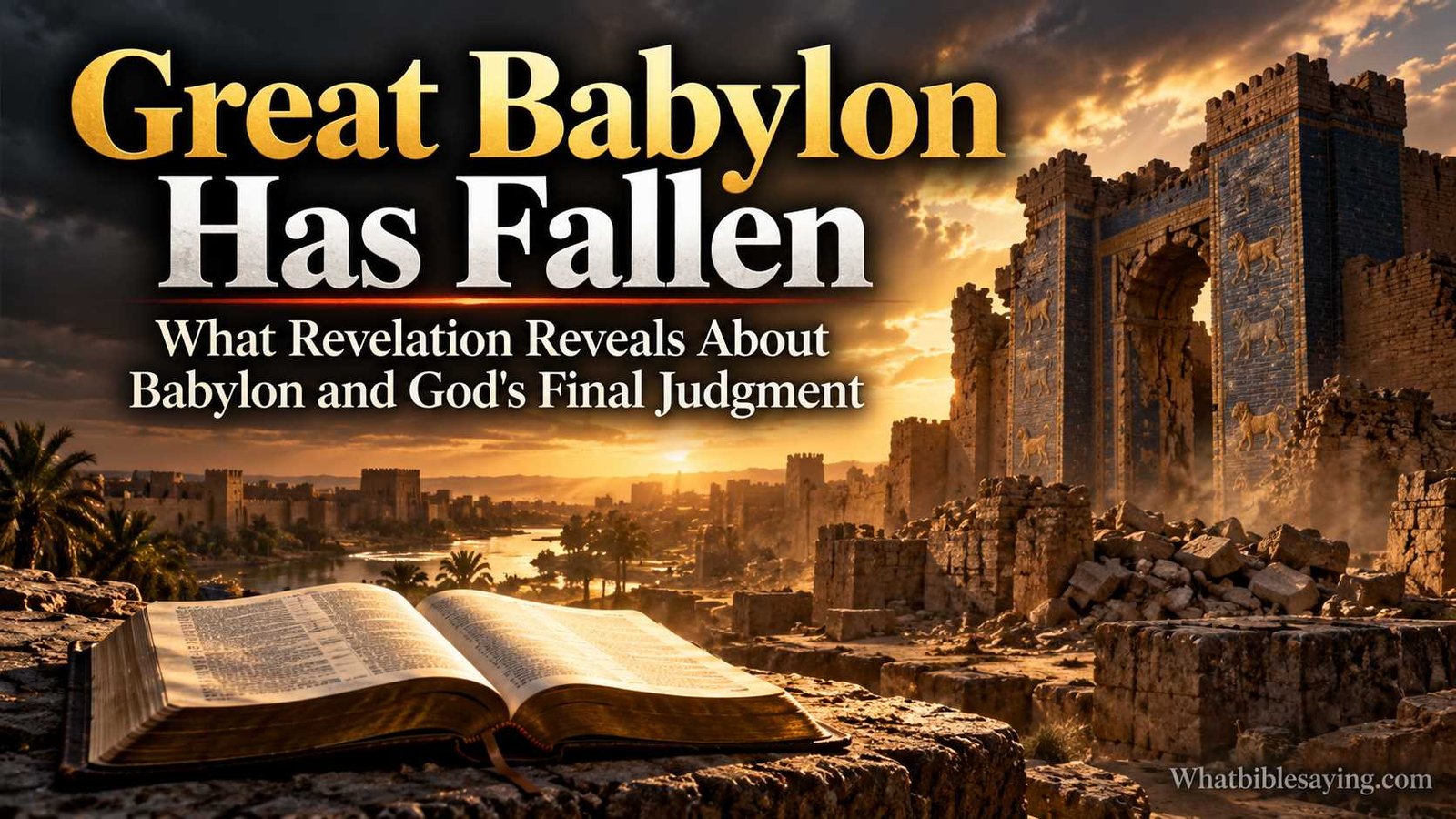
 The words “Great Babylon has fallen” are among the most powerful announcements in the Book of Revelation. They describe the downfall of something that once appeared wealthy, influential, and almost impossible to defeat.
But what exactly is Babylon the Great? Is it the ancient city mentioned in the Old Testament, the Roman Empire, a future world power, or a symbol of humanity’s rebellion against God?
The Bible gives us important clues.
In Revelation 18:2, an angel announces:
“Babylon the great is fallen, is fallen” — Revelation 18:2 (KJV)
This announcement is not simply about buildings collapsing or an empire losing political power. Revelation connects Babylon with pride, injustice, spiritual unfaithfulness, persecution, and a way of life that places wealth and human authority above God.
The central meaning is that no earthly power built upon evil can escape God’s judgment. Babylon represents a system that opposes God’s ways, although Christians differ over its precise historical and prophetic identity.
To understand this prophecy, we need to look at the real city of Babylon, the words of the Old Testament prophets, and the visions recorded in Revelation 14, 17, and 18.
The story may appear frightening at first. Yet its deeper message offers hope: evil will not rule forever, and God’s justice will ultimately prevail.
Where Does the Bible Say Great Babylon Has Fallen?
The announcement of Babylon’s fall appears in several important passages. Revelation repeats words that were already familiar from the Old Testament.
This connection matters because Revelation often uses earlier biblical events and images to explain its visions.
Isaiah 21:9: The First Announcement
The prophet Isaiah describes the downfall of Babylon with these words:
“Babylon is fallen, is fallen” — Isaiah 21:9 (KJV)
Isaiah’s message concerns Babylon as a historical power. The wider passage presents a watchman announcing that the city has fallen and that the images of its gods have been broken.
Babylon was known for its religious temples, royal buildings, and powerful rulers. Its people worshipped several gods, including Marduk, an important deity in Babylonian religion.
The prophetic announcement challenges the belief that these gods or Babylon’s military strength could guarantee its safety.
The message is clear: a kingdom may appear powerful, but that does not place it beyond judgment.
Jeremiah 51:8: Babylon’s Sudden Downfall
Jeremiah also announces judgment against Babylon.
In Jeremiah 51:8, the prophet describes Babylon as suddenly fallen and destroyed.
Chapters 50 and 51 contain a wider series of judgments against Babylon. They also speak about God’s concern for His people and His opposition to violence and oppression.
Babylon had conquered Judah, destroyed Jerusalem’s temple, and carried many people into exile. Its fall was therefore closely connected with the suffering and future restoration of God’s people.
For further historical context, read what the Bible says about the Israelites.
Revelation 14:8 and Revelation 18:2
In Revelation 14:8, another angel announces that Babylon has fallen. Revelation 18:2 repeats the message in a dramatic vision of judgment.
The repeated wording shows that John is drawing on the language of the earlier prophets.
However, Revelation expands the picture. Babylon is now associated with kings, nations, merchants, persecution, and widespread moral corruption.
The text does not provide a modern map or name a present-day country as Babylon the Great.
Instead, it presents a prophetic picture that readers must understand within the whole message of Revelation.
The repetition of “fallen” also gives the announcement special force. What seems secure from a human viewpoint is not secure against God’s judgment.
Where Is Biblical Babylon Located?
Before discussing Mystery Babylon, it helps to understand the original city.
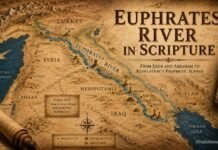
Historical Babylon was located in Mesopotamia, in what is now Iraq, approximately 85 kilometres south of Baghdad.
It developed near the Euphrates River, one of the major waterways of the ancient Near East.
Babylon became an important centre of government, religion, architecture, and learning. Its history includes several powerful rulers, but it reached particular importance during the Neo-Babylonian Empire.
Babylon Under King Nebuchadnezzar II
King Nebuchadnezzar II ruled Babylon from approximately 605 to 562 BC.
He is especially important in biblical history because Babylon conquered Jerusalem during his reign.
In 587/586 BC, Babylonian forces destroyed the First Temple and Jerusalem suffered a devastating defeat. Many Judeans were taken into exile.
The Book of Daniel also places several well-known biblical stories within the Babylonian setting.
These include Daniel’s service at the royal court, the account of the golden image in Daniel 3, and Nebuchadnezzar’s experience of pride and humiliation in Daniel 4.
Together, these passages show the tension between earthly royal authority and faithfulness to God.
Nebuchadnezzar’s kingdom possessed wealth and military strength. Yet Daniel 4 teaches that even a powerful ruler remains accountable to the Most High.
When Did Ancient Babylon Fall?
Babylon came under Persian control in 539 BC when Cyrus II, commonly called Cyrus the Great, conquered the city.
Daniel 5 describes the end of Belshazzar’s rule and the transfer of power to the Medes and Persians.
The biblical account presents this transition as judgment against arrogance and the misuse of sacred things.
Historically, Babylon did not disappear overnight. The city continued to exist under later rulers, although its political importance gradually declined.
Its ruins remain in Iraq today.
The archaeological site was added to the UNESCO World Heritage List in 2019, confirming its great historical importance.
This distinction is essential: the fall of historical Babylon is a documented ancient event, while the Babylon described in Revelation is a prophetic symbol whose full interpretation remains debated.
What Is Mystery Babylon in Revelation 17?
Revelation 17 introduces a striking image.
John sees a woman sitting on a scarlet-coloured beast. She wears purple and scarlet clothing and is decorated with gold, precious stones, and pearls.
She holds a golden cup. Her appearance suggests wealth and splendour, but the contents of the cup reveal moral corruption.
Revelation 17:5 identifies her with the words:
“Mystery, Babylon The Great” — Revelation 17:5 (KJV)
Modern Bible translations arrange the wording differently. Some present “mystery” as an explanation of the symbolic name rather than as its first word.
Either way, the passage invites readers to understand more than a literal woman.
Revelation 17:18 explains that the woman represents a great city exercising authority over earthly kings.
This means the imagery has a political and social dimension as well as a spiritual one.
Why Is Babylon Described as a Woman?
The Bible sometimes describes cities or nations as women.
For example, Jerusalem is pictured using feminine language in several prophetic passages. Such descriptions are a literary way of speaking about a community, its relationships, and its conduct.
The woman in Revelation 17 is therefore not a statement about the character of women.
She is a symbolic representation of a powerful city or system.
Her expensive clothing reveals her outward splendour. Her relationship with rulers shows political influence. Her golden cup illustrates corruption hidden beneath an attractive appearance.
There is an important lesson here.
Something can look successful, beautiful, and desirable while concealing serious wrongdoing.
The same principle appears elsewhere in Scripture when prophets challenge religious hypocrisy and injustice.
What Do the Seven Heads and Ten Horns Mean?
The beast in Revelation 17 has seven heads and ten horns.
Revelation 17:9 connects the seven heads with seven mountains on which the woman sits. The following verses also connect them with kings.
Revelation 17:12 describes the ten horns as ten kings who receive authority for a limited period.
These symbols have produced many interpretations.
One major historical interpretation connects the seven mountains with Rome, traditionally known as a city associated with seven hills.
Other readers understand the heads and horns as symbols of successive kingdoms, political authorities, or a future alliance of rulers.
The passage clearly concerns power and its opposition to God. It does not, however, provide an uncontested identification of every king or kingdom.
A careful reader should resist turning every number into a prediction about a modern politician or government.
Why Is Babylon Connected With Persecution?
Revelation 17:6 describes the woman as responsible for the blood of God’s people and witnesses to Jesus.
This disturbing image shows that Babylon is not condemned merely for being wealthy or influential.
The vision also associates her with violence against faithful believers.
Throughout biblical history, God’s people sometimes faced pressure from rulers who demanded loyalty that conflicted with obedience to God.
Revelation encourages suffering Christians to remember that their persecutors do not possess unlimited power.
God sees injustice, even when earthly institutions appear to ignore it.
Great Babylon Has Fallen: What Does Her Fall Represent?
Revelation 18 describes Babylon’s downfall through several scenes.
Kings mourn her destruction. Merchants grieve because their profitable trade has ended. Sailors and those involved in commerce stand at a distance as they witness the loss of a wealthy city.
The chapter is filled with the language of business, riches, luxury, and sudden loss.
This is significant.
Babylon represents more than a single person’s private sins. Her wrongdoing affects political leadership, economic relationships, religious loyalty, and the treatment of human beings.
Pride That Refuses to Recognize God
Revelation 18:7 portrays Babylon as confident that she will never experience sorrow.
Her attitude resembles the pride of ancient rulers who believed their position made them untouchable.
The problem is not confidence itself.
It is confidence that refuses to recognise moral responsibility or dependence upon God.
Proverbs 16:18 teaches that pride comes before destruction.
Babylon’s downfall illustrates that warning on a grand scale.
Wealth Without Justice
Revelation 18 contains a long description of valuable merchandise, including gold, silver, precious stones, fine clothing, food, and other luxury goods.
Most disturbing is the reference in Revelation 18:13 to enslaved human beings.
This detail matters because the chapter does not condemn ordinary work or honest trade.
It exposes an economic world where luxury and profit exist alongside exploitation.
Wealth becomes dangerous when people value possessions more than human dignity.
Consider a business that earns enormous profits while treating workers as disposable. Outwardly, it might appear successful. Morally, something is deeply wrong.
Babylon’s story asks whether success can truly be called good when it depends upon injustice.
Spiritual Unfaithfulness
Revelation also describes Babylon’s corrupting influence through the imagery of drunkenness and sexual immorality.
In biblical prophecy, such language can represent unfaithfulness to God, idolatry, and destructive alliances.
It should not be reduced to a description of sexual behaviour alone.
The broader concern is misplaced worship and loyalty.
When rulers, societies, or individuals treat wealth and power as their highest good, they risk giving created things the devotion that belongs to God.
Why Is Babylon’s Destruction So Sudden?
Revelation 18 repeatedly emphasises the speed of Babylon’s judgment.
The chapter presents a once-great city losing its power within an astonishingly short time.
This language communicates the sudden collapse of something that appeared secure.
Christians interpret the timing differently. Some understand it as imagery of decisive divine judgment, while others expect a future catastrophic event.
The passage itself does not give readers permission to calculate a date.
Its message is that earthly greatness is temporary when separated from righteousness.
Does Babylon the Great Represent Rome or a Future Kingdom?
This is one of the most discussed questions in Christian interpretations of Revelation.
There are several major approaches, and understanding them helps readers avoid confusing interpretation with certainty.
The Historical Roman Empire Interpretation
Many biblical scholars connect Babylon the Great with imperial Rome.
There are strong historical reasons for this view.
Revelation was addressed to Christian communities living under Roman imperial authority. Rome exercised extensive political influence, supported forms of emperor worship, and was closely connected with trade throughout the Mediterranean world.
The seven mountains mentioned in Revelation 17:9 are often associated with Rome’s famous seven hills.
Revelation 17:18 also describes a great city ruling over earthly kings, language that fits Rome’s imperial power in John’s world.
Scholar Giancarlo Biguzzi, writing in the journal Biblica, examines the Rome interpretation alongside an alternative identification with Jerusalem. His study concludes that the Roman interpretation better fits the wider structure of Revelation.
This is a well-established scholarly reading, although it is not accepted by every Christian interpreter.
The Future Kingdom Interpretation
Some Christians understand Babylon the Great as a future political, economic, or religious centre that will exist shortly before God’s final judgment.
Within this approach, interpretations differ.
Some anticipate a literal rebuilt city of Babylon. Others expect a future centre of world power that carries Babylon’s symbolic name.
Readers who follow this interpretation often connect Revelation 17–18 with prophetic passages in Daniel and other parts of Revelation.
However, Scripture does not explicitly identify a modern capital, organisation, or nation as the certain future Babylon.
For similar questions about how Christians interpret future prophetic events, see what the Bible says about the temple being rebuilt.
Babylon as a Wider Symbol of Human Rebellion
Another interpretation sees Babylon as an image of corrupt human civilisation whenever it places power, wealth, and false worship above God.
This reading does not necessarily deny the historical connection with Rome.
Instead, it recognises that the same patterns can appear in different times and places.
An empire can rise and fall, but pride, exploitation, and spiritual deception can continue.
Babylon then becomes a warning to every generation.
These approaches are not always completely separate. A reader may see Rome as John’s immediate historical reference while also recognising a wider warning about human societies.
The safest conclusion is to hold firmly to what the text clearly teaches while remaining humble about disputed details.
Is the Great Serpent Connected to Mystery Babylon?
The Book of Revelation also describes a great dragon or ancient serpent.
Revelation 12:9 directly identifies this figure as the devil, or Satan.
The passage describes the serpent as a deceiver who leads the world astray.
This connects with Revelation’s wider theme of deception, opposition to God, and the struggle between good and evil.
However, the great serpent and Babylon the Great are not the same figure in the text.
The serpent is identified as Satan, while Babylon is represented as a woman and great city in Revelation 17.
Both belong to Revelation’s portrayal of evil, but each symbol has its own role.
Revelation also shows that evil powers are not ultimately victorious.
In Revelation 17:14, the Lamb overcomes those who oppose Him. Christians understand the Lamb as Jesus Christ, whose victory stands at the centre of the book’s message.
Are Fallen Angels Aliens According to the Bible?
Some modern theories connect fallen angels with extraterrestrials, unidentified flying objects, or beings from other planets.
The Bible does not establish those connections.
Revelation 12:9 describes Satan and his angels being cast down. Jude 6 and 2 Peter 2:4 also refer to angels who sinned or abandoned their proper place.
These passages belong to biblical teaching about spiritual beings and divine judgment.
They do not describe spacecraft, alien planets, or extraterrestrial civilisations.
The Bible’s silence on those subjects should not be turned into evidence for sensational claims.
Anyone interested in the broader subject can read what the Bible says about life on other planets and space.
When interpreting Revelation, the most reliable approach is to begin with the explanations Scripture provides rather than adding imagined details.
Why Is God’s Greatness Important in Babylon’s Fall?
Babylon’s downfall teaches something important about the greatness of God.
Psalm 145:3 declares:
“Great is the LORD, and greatly to be praised” — Psalm 145:3 (KJV)
The psalm celebrates God’s greatness as something beyond complete human understanding.
Earthly kingdoms are different.
They may last for centuries, build remarkable cities, and influence millions of people. Yet their strength is never unlimited.
Revelation 18:8 specifically speaks of the strength of the Lord God who judges Babylon.
This creates a deliberate contrast.
Babylon trusts in wealth, power, and apparent security. God acts with authority that no earthly kingdom can overrule.
For Christians, divine greatness is not simply about the ability to destroy evil.
God’s greatness also includes His justice, faithfulness, mercy, and care for those who suffer.
That is why the announcement of Babylon’s fall can bring comfort to people who have experienced oppression.
It says that wrongdoing does not have the final word.
God’s judgment is not presented as permission for believers to take personal revenge. Romans 12:19 teaches Christians to leave vengeance to God rather than repay evil with evil.
The proper response to God’s greatness is therefore humility, trust, and a commitment to righteousness.
Great Babylon Has Fallen: What Should Christians Learn Today?
The message of Babylon is not limited to ancient history or debates about future events.
Revelation also speaks directly to the way believers live.
In Revelation 18:4, a heavenly voice calls God’s people to separate themselves from Babylon’s sins.
The words are an invitation to examine spiritual loyalty.
They remind Christians that it is possible to live within a society without accepting everything that society celebrates.
Choose Faithfulness Over Popularity
People often feel pressure to follow what everyone else is doing.
At school, at work, and even within families, standing for honesty can sometimes be difficult.
Revelation reminds believers that popularity is not the same as goodness.
Babylon appears attractive and successful, yet the vision exposes what lies beneath that appearance.
Faithfulness means allowing God’s teachings to shape our choices, even when doing so costs us something.
For example, a student who refuses to cheat may lose an easy opportunity for a better grade. An employee who speaks truthfully may face criticism.
These decisions may seem small compared with the visions in Revelation.
Yet they reflect the same question: what deserves our loyalty?
Do Not Allow Money to Become Your Master
The merchants in Revelation 18 mourn the loss of Babylon’s wealth.
Their reaction shows how deeply their lives are tied to the city’s prosperity.
Jesus offers a related warning in Matthew 6:24 when He teaches that people cannot serve both God and money as competing masters.
Money can provide food, shelter, education, and opportunities to help others. Scripture does not condemn these ordinary uses.
The danger comes when gaining wealth becomes more important than honesty, compassion, or obedience to God.
A person can own little and still be greedy. Another may possess considerable resources and use them generously.
The deeper question is not simply how much we have.
It is what controls our hearts.
Refuse to Benefit From Injustice
Babylon’s trade included the exploitation of human beings.
That detail challenges readers to think beyond personal success.
Do our choices respect the dignity of others? Are we willing to ignore suffering when we benefit from it? Do we treat vulnerable people as valuable?
These are questions Christians can ask without claiming that every modern business or government is Babylon.
Revelation encourages moral discernment rather than reckless accusations.
The teachings of Jesus offer a positive direction: love our neighbours, care for those in need, and treat others as we would wish to be treated.
Recognise the Danger of Repeated Wrongdoing
One of Babylon’s great problems is that evil has become normal.
Revelation 18:5 portrays her sins as having accumulated before God.
The warning invites personal reflection.
A harmful habit may begin with one dishonest decision. If repeated and excused, it can gradually shape a person’s character.
The Bible calls people to repentance rather than hopelessness.
For a closer look at this theme, read what the Bible says about repeated sin and repentance.
God’s patience should not be mistaken for approval of wrongdoing. At the same time, the biblical invitation to turn away from sin is a message of mercy.
Read Prophecy With Humility Instead of Fear
Revelation contains dragons, beasts, angels, trumpets, and scenes of judgment.
These images naturally raise questions.
Yet not every news headline is a fulfilled prophecy, and not every international crisis identifies a particular figure from Revelation.
Christians have proposed many different timelines throughout history.
Jesus warns in Matthew 24:36 that the precise day and hour are not known to human beings.
Instead of trying to predict every detail, believers can focus on the responsibilities Scripture makes clear.
We are called to love God, care for others, remain watchful, and live faithfully.
Prophecy should lead to thoughtful trust and obedience, not constant panic.
Why the Fall of Babylon Still Gives Believers Hope
Revelation does not end with the destruction of Babylon.
That is one of the most important things to remember.
After the visions of judgment, the book moves toward the defeat of evil, the victory of Christ, and the promise of a renewed creation.
Revelation 21 describes a new heaven and a new earth.
John sees the New Jerusalem coming down from God. The vision speaks of God’s presence among His people and the end of death, sorrow, crying, and pain.
Notice the contrast between the two cities.
Babylon represents a world shaped by pride, exploitation, and opposition to God.
The New Jerusalem represents God’s promised dwelling with His people, where suffering and evil will no longer rule.
One city falls. Another is revealed in glory.
The contrast is not primarily about architecture. It is about two different ways of life and two different sources of hope.
Babylon’s splendour depends upon power and possessions that can disappear.
The hope of the New Jerusalem rests upon God’s faithfulness.
You can study this promise more deeply in our commentary on Revelation 21 and the New Jerusalem.
For someone who feels troubled by injustice, this message offers comfort.
You may see powerful people acting without compassion. You may wonder why wrongdoing continues or why innocent people suffer.
Revelation does not answer every question about the timing of God’s judgment.
But it does declare that evil is not eternal.
God has not forgotten those who suffer, and the Christian hope is not built upon the strength of earthly kingdoms.
Great Babylon has fallen is therefore more than an announcement of destruction. It is a reminder that pride cannot defeat God’s purpose, injustice cannot escape His judgment, and worldly power cannot replace His authority.
The same book that announces Babylon’s downfall ends with the promise that God will make all things new.
That is where Revelation directs our hope.
Not toward fear of an uncertain future, but toward the faithfulness of God and the victory of Jesus Christ.
Dr. Rachel is very smart and knows a lot about the Bible. He helps us understand the Bible better by talking about the old texts in a simple way.