
 The Euphrates River is one of the most important rivers mentioned in the Bible. It appears near the beginning of Scripture in Genesis, plays a part in God’s covenant with Abraham, marks an important geographical boundary in the Old Testament, and appears again in the book of Revelation.
So, where is the Euphrates River in the Bible?
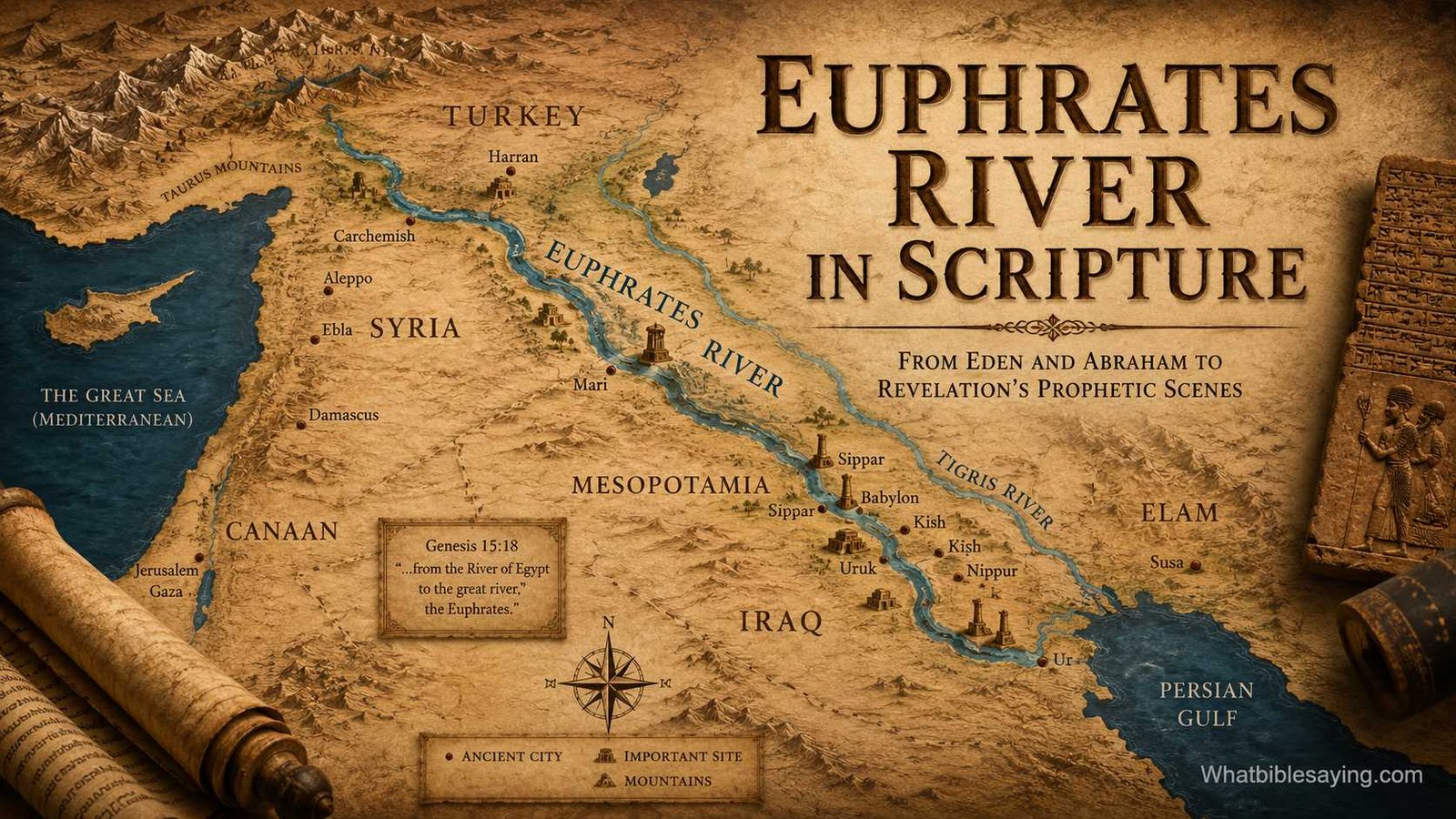
The Euphrates is a real river in the Middle East. Today, it begins in eastern Turkey, flows through Syria and Iraq, and eventually joins the Tigris River system before its waters reach the Persian Gulf. Ancient people knew it as one of the great rivers of Mesopotamia. The Bible repeatedly refers to this same geographical region.
Genesis 2:14 gives us the first biblical mention of the Euphrates. It is named as one of four rivers connected with the Garden of Eden. Later, Genesis 15:18 calls it “the great river” when God speaks to Abram about the land promised to his descendants.
That makes the Euphrates more than a name on an ancient map. It connects several major parts of Bible history.
Where Is The Euphrates River In The Bible Today?
If you look at a modern map, you can still find the Euphrates.
Its waters begin in the highlands of eastern Turkey. Two major headwaters, the Murat and Karasu, come together to form the river. From Turkey, the Euphrates crosses into Syria and then continues southeast into Iraq.
Farther south in Iraq, it becomes part of the great Tigris-Euphrates river system whose waters eventually reach the Persian Gulf.
The journey can be pictured simply:
Eastern Turkey → Syria → Iraq → Tigris-Euphrates system → Persian Gulf
The river has been important for thousands of years because much of the surrounding region is dry. A dependable river meant water for people, crops, animals, towns, and trade.
The Food and Agriculture Organization notes that the Euphrates comes into Syria from Turkey and then continues toward Iraq. Historical and biblical reference works also describe it as one of the great rivers of Western Asia.
Why Mesopotamia Matters to Bible History
The Euphrates and Tigris are strongly connected with Mesopotamia.
The word Mesopotamia is commonly understood as referring to the land between the rivers. Much of ancient Mesopotamia lay in areas that are now part of Iraq, Syria, and Turkey.
This region became home to some of the ancient world’s best-known civilizations and cities.
Babylon, for example, was closely connected with the Euphrates. Other ancient settlements grew along or near the river because water made farming and city life possible. Bible Gateway’s Encyclopedia of the Bible lists ancient cities including Babylon, Uruk, Ur, Sippar, and others in the Euphrates region.
Understanding this geography helps us understand Bible history more clearly. Biblical people were not moving through an imaginary landscape. Many places, rivers, kingdoms, and regions named in Scripture belonged to the real ancient Near Eastern world.
That is one reason studying [where does the Bible take place] can make many Old Testament stories easier to picture.
Where Is The Euphrates River First Mentioned In The Bible?
The first mention comes surprisingly early.
Genesis 2 describes the Garden of Eden and a river flowing from Eden. The account then names four rivers or river branches.
Genesis 2:14 identifies the third as the Tigris and the fourth as the Euphrates.
This means the Euphrates appears in only the second chapter of the Bible.
That has led generations of readers to wonder whether the modern Euphrates can help us discover the exact location of Eden.
The Euphrates and the Garden of Eden
Genesis connects Eden with four rivers:
- Pishon
- Gihon
- Tigris
- Euphrates
Two names, the Tigris and Euphrates, are still familiar geographical names today.
The other two are much more difficult to identify.
Because of this, many proposed locations for Eden have been placed somewhere within or near ancient Mesopotamia. Yet we need to be careful.
The Bible does not give us enough information to point to a modern spot on a map and say with certainty, “The Garden of Eden was exactly here.”
The river systems may also have changed greatly over long periods of time. Ancient waterways can shift, disappear, divide, or follow different courses.
Modern researchers have proposed several theories about Eden’s geographical setting, especially around Mesopotamia, but no single location has been demonstrated beyond dispute.
So the safest biblical answer is simple:
Genesis associates Eden with the Euphrates and Tigris, but the exact location of Eden remains uncertain.
Readers wanting to study that question more deeply may also find [where was Eden located in the Bible] helpful.
What About Havilah?
Genesis also says that the Pishon flowed around the land of Havilah.
Havilah has attracted many theories because Genesis connects the area with gold and other valuable materials. Yet its exact location is also debated.
This is another place where biblical study benefits from humility. Scripture gives us real geographical names, but it does not always give enough details to match every ancient place with a modern location.
See also [where was Havilah in the Bible] for a closer look at that question.
Why Was the Euphrates Important in God’s Covenant With Abraham?
The Euphrates appears again in one of the most important covenant passages in Genesis.
Genesis 15 records God’s covenant with Abram, later called Abraham.
In Genesis 15:18, God speaks of land extending to:
“the great river, the Euphrates”
This description makes the Euphrates an important geographical marker in the covenant.
Notice that Scripture does not simply call it a river. It calls it the great river.
For ancient readers, the name needed little explanation. The Euphrates was enormous in cultural and geographical importance.
The Euphrates as a Biblical Boundary
The river appears again when Scripture describes the extent of territory connected with Israel.
Deuteronomy 11:24 describes territory stretching from the wilderness and Lebanon toward the Euphrates and the western sea, understood as the Mediterranean.
Joshua 1:4 gives another similar description, naming:
- the wilderness
- Lebanon
- the great river Euphrates
- the land of the Hittites
- the Great Sea toward the west
These passages show how important rivers were as geographical markers.
Today, we often describe national boundaries by lines on maps. Ancient people commonly used mountains, deserts, seas, and rivers.
The Euphrates was easy to recognize. It formed a natural landmark on the eastern side of the wider biblical world.
Understanding [where was Canaan in the Bible] can make these boundary passages even clearer.
Where Is The Euphrates River In Bible History?
The Euphrates does not appear only in the Eden story or in descriptions of Israel’s boundaries.
It also helps us understand Abraham’s background and the wider world of the Old Testament.
Abraham Came From Beyond the Euphrates
Joshua 24 looks back over Israel’s history.
Joshua tells the people that their ancestors, including Terah, Abraham’s father, once lived “beyond the Euphrates River.” He then describes God taking Abraham from that region and leading him into Canaan.
This is a powerful detail.
Before Abraham became the great figure of faith remembered by generations, he came from a family living beyond the Euphrates in a world where other gods were worshiped.
God called him out.
God led him.
God gave him promises.
The geography makes Abraham’s story feel more concrete. His journey involved leaving one region and moving into another land.
The Euphrates stood within that larger story of movement, calling, and covenant.
Babylon and the Euphrates
The Euphrates also belonged to the world of Babylon.
Ancient Babylon stood along the Euphrates in Mesopotamia. The river helped make agriculture and city life possible throughout the region.
Babylon later became one of the most important kingdoms in Old Testament history, especially when the Babylonian Empire conquered Judah and Jerusalem and carried many people into exile.
This means that when we study [where was Babylon located in the Bible], we are again studying the world shaped by the Euphrates River.
The river connects geography with some of the Bible’s largest historical movements.
Why Ancient Civilizations Needed the River
Imagine living in a hot, dry land thousands of years ago.
You cannot turn on a tap.
There are no water trucks, electric pumps, or modern irrigation networks.
A great river changes everything.
It provides water for drinking. It waters crops. It supports animals. It makes settlement possible. It creates routes for movement and trade.
This helps explain why so many ancient cities developed around river valleys.
The Euphrates was not simply beautiful scenery. For many communities, it was essential to life.
Important Euphrates River Bible Verses
The Euphrates appears in different biblical settings. Looking at several passages together helps us see its importance.
| Bible Passage | What It Says About the Euphrates |
|---|---|
| Genesis 2:14 | Names the Euphrates among the rivers connected with Eden |
| Genesis 15:18 | Calls it the great river in God’s covenant with Abram |
| Deuteronomy 1:7 | Uses the Euphrates in a territorial description |
| Deuteronomy 11:24 | Names it as an important boundary |
| Joshua 1:4 | Calls it the great river while describing territory |
| Joshua 24:2–3 | Places Abraham’s ancestors beyond the Euphrates |
| Revelation 9:14 | Places four bound angels at the great Euphrates |
| Revelation 16:12 | Describes the sixth bowl being poured on the Euphrates |
These references stretch from Genesis to Revelation.
That alone tells us how deeply the river is woven into the biblical landscape.
Where Is The Euphrates River In Revelation?
The Euphrates takes on another role near the end of the Bible.
The book of Revelation contains visions filled with signs, judgments, angels, kingdoms, numbers, and symbolic images.
Two passages specifically name the Euphrates.
The Euphrates in Revelation 9:14
Revelation 9 describes the sounding of the sixth trumpet.
A voice tells the sixth angel to release four angels who are bound at the great river Euphrates.
The passage then moves into a frightening vision of judgment.
For readers familiar with Old Testament history, the Euphrates would have carried powerful associations. Great empires had risen beyond it. Armies had come from the east and northeast. The river stood near the edge of the biblical lands familiar to Israel.
Revelation uses that historically meaningful location within its much larger prophetic vision.
The Euphrates in Revelation 16:12
The river appears again during the sixth bowl judgment.
Revelation 16:12 says the sixth angel pours his bowl on the great Euphrates and its water is dried up to prepare a way for kings from the east.
This passage has inspired many interpretations.
Some readers understand it mainly as a future literal event. Others emphasize Revelation’s symbolic and apocalyptic language. Christian traditions differ over how the details should be interpreted and when they are fulfilled.
What can we say with confidence?
We can say what the text actually says:
- The river named is the Euphrates.
- It appears during the sixth bowl.
- Its waters are described as being dried up.
- A way is prepared for kings from the east.
- The scene belongs to a larger vision of divine judgment.
We should be cautious about going beyond those points.
Does the Euphrates Drying Up Today Fulfill Revelation?
Modern news sometimes reports low water levels, drought, dams, or changing flow in the Euphrates. These reports can quickly lead to claims that Revelation 16 is being fulfilled before our eyes.
That conclusion requires more caution than many social-media posts show.
The Euphrates has experienced major changes because of drought, irrigation, dams, and water use. Modern water management in Turkey, Syria, and Iraq has significantly affected parts of the river system.
But a modern decline in river flow does not, by itself, prove that Revelation 16:12 has been fulfilled.
The biblical passage belongs to a larger apocalyptic scene. Responsible Bible reading asks us to study that whole context rather than match every headline to a prophecy.
Faith does not require us to force Scripture into today’s news.
Historical Facts About The Bible and the Euphrates
Several historical facts about the Bible become clearer when we understand the Euphrates.
1. The Euphrates Is a Real River
It is not an invented biblical location.
People can identify and map the river today. It flows through modern Turkey, Syria, and Iraq.
2. It Was Central to Ancient Mesopotamia
Together with the Tigris, the Euphrates helped shape one of the great cultural regions of the ancient world.
Cities, farms, kingdoms, and trade networks developed around these rivers.
3. The Bible Mentions It From Genesis to Revelation
Few geographical features span such a wide section of Scripture.
The Euphrates is present near the Bible’s beginning and near its end.
4. Abraham’s Family Was Connected With the Region Beyond It
Joshua 24 remembers Abraham’s ancestors as living beyond the Euphrates before God led Abraham toward Canaan.
5. Scripture Uses It as a Boundary
Genesis, Deuteronomy, and Joshua all use the Euphrates when describing land or territorial limits.
6. Babylon Belonged to the Euphrates World
The river ran through the Mesopotamian world where Babylon became a great political and cultural center.
These are useful facts about the Bible because they remind us that Scripture often speaks about identifiable lands, rivers, cities, and kingdoms.
Biblical geography does not answer every question about faith, but it helps us see the physical setting in which many biblical events are described.
Can You See the Biblical Euphrates River Today?
Yes.
The Euphrates still flows today.
Someone traveling through parts of Turkey, Syria, or Iraq can see the modern river. Of course, the landscape is not exactly as it was in Abraham’s time or during the ancient kingdoms.
Thousands of years have passed.
Cities have risen and disappeared. River channels have changed. Dams have been built. Irrigation systems have altered water flow. Political borders now divide lands that ancient people understood very differently.
Still, standing beside the Euphrates today means standing beside a river whose name has been known for thousands of years.
That is remarkable.
Is Today’s Euphrates Exactly the Same River Mentioned in Genesis?
The name clearly refers to the ancient Euphrates known throughout the Near East, but saying the modern river follows exactly the same channel it followed throughout all biblical periods would go too far.
Rivers naturally change over time.
Their channels move. Floods reshape land. Human engineering redirects water.
So it is better to say that the modern Euphrates is the continuing river system known by that ancient name, while recognizing that its exact course has changed through history.
What the Euphrates Helps Us Understand About the Bible
Biblical geography can make Scripture feel less distant.
Think about the sequence connected with this one river:
Eden → Abraham → Canaan → Israel’s boundaries → Mesopotamia → Babylon → Revelation
The same river name touches all of these subjects.
In Genesis, it appears in the world of creation.
In Abraham’s story, it appears in covenant and geography.
In Deuteronomy and Joshua, it helps describe territory.
In Israel’s wider history, it belongs to the world of powerful Mesopotamian kingdoms.
In Revelation, it becomes part of a prophetic vision.
That is why the question where is the Euphrates River in the Bible leads to much more than a map.
It opens a window into the geographical world of Scripture.
Does the Bible Give a Spiritual Meaning to the Euphrates?
Readers sometimes ask whether the Euphrates has one fixed symbolic meaning throughout Scripture.
The Bible does not give us a simple statement such as, “The Euphrates always symbolizes this.”
Its role changes with context.
In Genesis 2, it is a river associated with Eden.
In Genesis 15, it marks the reach of promised land.
In Joshua, it serves as a geographical boundary and connects with Abraham’s ancestral world.
In Revelation, it appears within scenes of judgment.
So we should avoid forcing one symbolic meaning onto every reference.
Good Bible study asks first:
What does this passage say here?
Context matters.
The same river can serve different purposes in different books of Scripture.
What This Ancient River Reminds Us About God’s Story
The Euphrates has flowed through human history for thousands of years. Empires rose beside it. Cities depended on it. Generations lived, worked, traveled, fought, and farmed along its banks.
The Bible places this river within an even larger story.
It appears in Genesis when Scripture speaks about Eden. It appears when God makes His covenant with Abraham. It appears in the geographical world surrounding Israel. And it appears again in Revelation’s vision of things still greater than human kingdoms.
Knowing where the Euphrates River is in the Bible helps us see that Scripture often speaks from real landscapes.
There were rivers.
There were deserts.
There were cities and roads.
There were kingdoms on opposite sides of those waters.
The Euphrates reminds us that Bible history took place in a world of recognizable geography, even when some ancient locations remain uncertain.
It also teaches us something about how carefully Scripture should be read. We can confidently affirm what the text tells us. We can study history and geography to understand its setting. But where Scripture leaves questions unanswered, wisdom allows us to say, “We do not know for certain.”
That kind of humility does not weaken faith.
It helps us read the Bible with greater care.
For further study, consider reading [where was Eden located in the Bible] and [where was Babylon located in the Bible]. Both topics help reveal how the lands and rivers of the ancient Near East shaped the world we encounter throughout Scripture.

Dr. Rachel is very smart and knows a lot about the Bible. He helps us understand the Bible better by talking about the old texts in a simple way.