
If you have ever wondered, “Is no meat on Friday in the Bible?”, the simple answer is no. The Bible does not contain a command telling every Christian to avoid meat on Friday.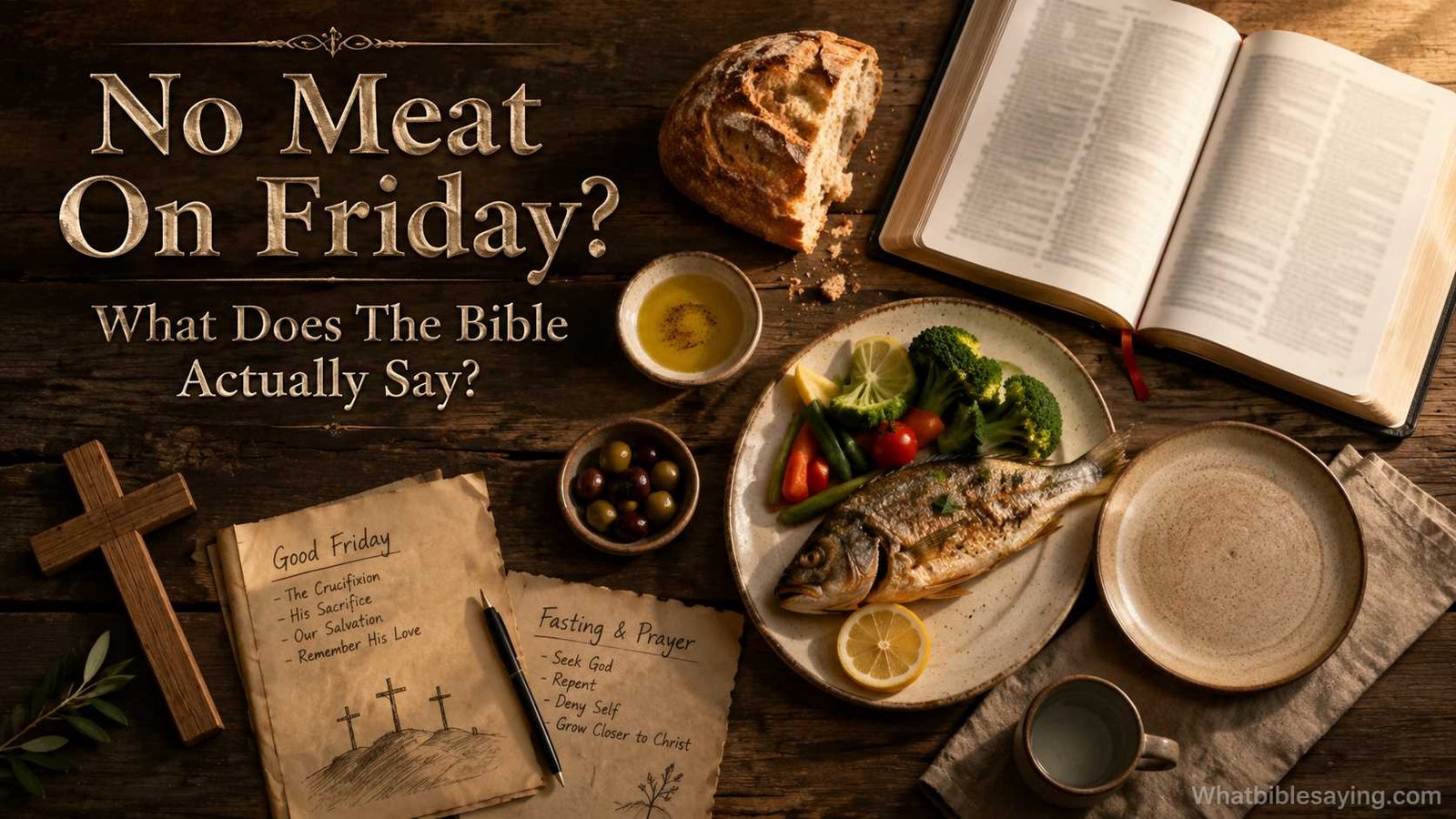
Scripture does teach fasting, self-denial, prayer, repentance, and respect for another believer’s conscience. But the specific practice of avoiding meat on Friday developed as a Christian penitential tradition, especially in the Catholic Church, in remembrance of Jesus Christ’s death.
That distinction matters. Meat is not presented in the New Testament as sinful simply because it is eaten on a Friday. At the same time, Christians who abstain from meat as an act of prayer and devotion can have a meaningful spiritual reason for doing so.
Here is the basic difference:
| Question | Biblical Answer |
|---|---|
| Does the Bible command Christians not to eat meat every Friday? | No |
| Does the Bible teach fasting? | Yes |
| Can Christians voluntarily give up food for spiritual reasons? | Yes |
| Is Friday connected with Jesus’ crucifixion? | Yes |
| Is Friday meat abstinence an important Catholic practice? | Yes |
| Does Scripture say meat itself becomes sinful on Friday? | No |
Understanding these differences helps us respect both Scripture and Christian traditions without confusing one with the other.
Is No Meat on Friday in the Bible a Direct Command?
There is no Bible verse that says, “Do not eat meat on Friday.”
You will find detailed food laws in the Old Testament. You will also find fasting throughout both the Old and New Testaments. But you will not find a biblical law that requires all followers of Jesus to avoid meat specifically because the day is Friday.
This means that when someone asks is not eating meat on Fridays in the Bible, we need to separate three different things:
- Biblical dietary laws given to ancient Israel
- Biblical teachings about fasting and self-denial
- Later Christian practices of Friday penance
They are related, but they are not the same.
Does the Bible Ever Tell People Not to Eat Certain Foods?
Yes. The Old Testament contains dietary laws, especially in Leviticus 11 and Deuteronomy 14.
Ancient Israel was taught to distinguish between foods considered clean and unclean under the Mosaic covenant. Pork, for example, was among the foods Israelites were not permitted to eat.
These laws belonged to a much larger covenant system that shaped Israel’s worship, ceremonies, community life, and identity.
For readers also studying basic Bible structure, the number of books in the Old Testament differs according to Christian tradition. Protestant Bibles normally count 39 Old Testament books, Catholic Bibles contain 46, and Orthodox canons include additional texts. Yet the major Old Testament passages concerning Israel’s food laws are found in the same core books, especially Leviticus and Deuteronomy.
The important point for our question is that these Old Testament dietary laws do not say, “No meat on Friday.”
They address which foods Israel could eat, not a weekly Christian Friday abstinence.
What Changes in the New Testament?
The New Testament places food in a different setting.
Mark 7 records Jesus teaching that external food does not make a person’s heart morally unclean. Romans 14 likewise discusses Christians who held different convictions about food and particular days. Paul urges believers not to turn such differences into reasons for judging one another.
This does not mean that fasting or voluntary abstinence is wrong. Far from it.
It means there is a difference between saying:
“I will give up this food to seek God.”
and saying:
“This food is spiritually evil in itself.”
Christian fasting belongs to the first idea.
Why Do Some Christians Eat No Meat on Friday?
The practice is connected with the death of Jesus.
The Gospels describe Jesus’ crucifixion occurring on the Jewish Preparation Day, immediately before the Sabbath. Mark 15:42 specifically explains Preparation Day as the day before the Sabbath. Luke 23:54 and John 19:31 confirm the same setting. This is the biblical foundation behind the Christian remembrance of Christ’s death on Friday.
For many Christians, especially Catholics, Friday therefore became a day of penance and remembrance.
Giving up meat is meant to be a small act of self-denial that directs the heart toward the much greater sacrifice of Christ.
That is why the spiritual meaning of the practice is more important than the menu itself.
A plate without meat has little spiritual value if there is no prayer, repentance, love, gratitude, or remembrance of Christ behind it.
Is No Meat on Friday in the Bible or a Catholic Tradition?
It is more accurate to describe Friday abstinence from meat as a Church discipline rooted in biblical principles of fasting and penance, rather than as a direct Bible command.
Current Catholic canon law names Fridays throughout the year as penitential days. It also directs abstinence from meat or another food according to rules established by bishops’ conferences. The same canon law allows bishops’ conferences to determine how fasting and abstinence are observed and whether other forms of penance may substitute in certain circumstances.
This is an important distinction.
The Catholic Church is not teaching that beef, chicken, or another meat somehow becomes spiritually dirty when Friday arrives.
The practice is penitential.
Something ordinary is voluntarily surrendered as a reminder of Christ’s sacrifice.
What About Catholics in the United States?
For Latin Catholics in the United States, the current USCCB guidance states that Ash Wednesday and Good Friday are obligatory days of fasting and abstinence, while Fridays during Lent are obligatory days of abstinence from meat. The abstinence rule applies from age 14.
Outside Lent, the U.S. bishops continue to encourage Friday as a day of self-denial and penance, with abstinence from meat given an important place, although the older requirement to abstain from meat as the sole required Friday practice was changed in the United States.
Rules can differ according to country and Christian tradition, so Catholics should follow the guidance of their own bishops and local Church.
That is another reason a simple statement like “Christians cannot eat meat on Friday” is misleading.
Not all Christians follow the same discipline.
Why Is Friday Connected With Jesus’ Death?
To understand the tradition, we need to look beyond food and toward the cross.
Jesus was arrested after the Last Supper. He was questioned, brought before Roman governor Pontius Pilate, sentenced to crucifixion, taken to Golgotha, crucified, and buried before the Sabbath began.
The Gospel writers repeatedly identify the burial day as Preparation Day, the day before the Sabbath.
Christians later came to remember this day in a special way.
That remembrance reaches its strongest expression on Good Friday, when Christians throughout the world reflect on Christ’s suffering and death.
A Simple Timeline of Good Friday
A basic timeline of Good Friday from the Gospel accounts can be understood like this:
| Event | Main Bible References |
|---|---|
| Jesus is brought before Pilate | Matthew 27; Mark 15; Luke 23; John 18 |
| Jesus is sentenced | Matthew 27:24–26; John 19:13–16 |
| Jesus is led to crucifixion | Matthew 27:31–33; Luke 23:26–33 |
| Jesus is crucified | Mark 15:22–25; Luke 23:33 |
| Darkness comes over the land | Matthew 27:45; Mark 15:33 |
| Jesus dies | Matthew 27:50; Luke 23:46; John 19:30 |
| His body is taken down | John 19:31–38 |
| Jesus is placed in the tomb | Matthew 27:57–61; Mark 15:42–47 |
The exact hour-by-hour arrangement involves details from several Gospel accounts, but the central truth is clear: Jesus suffered and died before the Sabbath began.
This helps explain what Good Friday represents in the Bible. It is not mainly about giving up meat. It is about remembering Christ crucified.
What Does Good Friday Mean in the Bible?
The words Good Friday do not appear as the formal name of a biblical feast in Scripture.
The events remembered on Good Friday, however, are among the central events of the New Testament.
Jesus’ crucifixion appears in all four Gospels:
- Matthew 27
- Mark 15
- Luke 23
- John 19
Christians call the day “Good” not because crucifixion was pleasant or because suffering itself was good. The name points toward the saving significance Christians see in Christ’s death and the hope that follows in His resurrection.
So when someone asks what does Good Friday mean in the Bible, the best place to begin is not with dietary rules.
Begin at the cross.
Friday abstinence developed as one way some Christians remember that sacrifice.
Is No Meat on Friday in the Bible During Lent?
The answer remains the same: Scripture does not contain a verse commanding Christians to avoid meat on Lenten Fridays.
But Lent and Friday abstinence are closely connected within several historic Christian traditions.
For Catholics in the United States, Fridays during Lent are obligatory days of meat abstinence, and Good Friday includes both fasting and abstinence.
Lent itself is understood as a season of prayer, fasting, almsgiving, repentance, and preparation for Easter. The USCCB describes it as a 40-day season focused on these practices and preparation for celebrating Christ’s resurrection.
Is Lent in the Bible?
The formal Christian season called Lent is not named in the Bible.
You will not open Matthew, Romans, or another biblical book and find a command saying Christians must observe a season called Lent each year.
Yet many themes associated with Lent are deeply biblical:
- Jesus fasted in the wilderness.
- God’s people practiced repentance.
- Believers prayed intensely.
- People gave to those in need.
- Fasting accompanied important spiritual moments.
- Jesus taught His followers how to fast.
So if the question is “Does the Bible talk about Lent?”, the answer needs some care.
The Bible does not describe the later liturgical season by that name, but it certainly contains the spiritual practices that Christians associate with Lent.
What Did Jesus Teach About Fasting?
Jesus clearly recognized fasting as a spiritual practice.
In Matthew 6:16–18, He speaks about what His followers should do when they fast. His concern is not creating a performance for other people. He teaches them to fast sincerely before God rather than making themselves look miserable so others will admire their devotion.
That tells us something important about Friday abstinence too.
A person could avoid meat every Friday and still miss the point.
Suppose someone spends Friday carefully checking every food label but spends the same day angry, proud, cruel, dishonest, or unwilling to forgive.
Has simply avoiding meat fulfilled the deeper biblical purpose of penance?
Scripture repeatedly turns our attention toward the heart.
Fasting should draw us toward God.
Self-denial should produce humility.
Prayer should deepen love.
Repentance should lead toward changed behavior.
Fasting Is More Than Changing Your Menu
Biblical fasting is not a diet plan.
It is a spiritual act.
Throughout Scripture, fasting appears in settings involving prayer, grief, repentance, seeking God’s help, preparation, or serious devotion.
Isaiah 58 gives a particularly strong warning against empty religious fasting. God challenges people whose outward fasting is not matched by justice, compassion, and care for others.
That lesson remains powerful.
Giving up steak while ignoring a hungry neighbor misses something essential.
A meaningful fast should turn our attention toward God and, ideally, make us more sensitive to other people.
Does Eating Meat on Friday Become a Sin?
From the standpoint of Scripture alone, meat does not become inherently sinful because the calendar says Friday.
Romans 14 is especially helpful here.
Paul describes Christians with different convictions about food and days. Some regard one day differently from another. Some eat; others abstain. His emphasis is that both should act sincerely before the Lord and give thanks to God.
Later in the same chapter, Paul moves the discussion toward love. Christian freedom should never become an excuse to despise another believer or deliberately wound someone’s conscience.
There are therefore two mistakes we should avoid.
One is saying:
“Everyone who eats meat on Friday is disobeying the Bible.”
Scripture does not say that.
The other is saying:
“Anyone who abstains from meat is following a pointless man-made practice.”
That is also too simplistic. A believer may abstain sincerely as an act of prayer, penance, discipline, and remembrance of Christ.
What If My Church Requires Abstinence?
Here the question becomes different.
For a Catholic who is bound by the discipline of the Church, the issue is not that meat itself is evil. The issue concerns faithfully observing the spiritual discipline that applies to that believer.
Catholic canon law specifically distinguishes the penitential practice of abstinence from the idea that the food itself is morally unclean. It also gives bishops’ conferences authority to specify how Friday penance is practiced.
So it is wise to understand the actual teaching of your Christian tradition rather than relying on something heard from a friend or seen on social media.
Can Christians Voluntarily Give Up Meat?
Certainly.
A Christian may decide to abstain from meat even when no church rule requires it.
Someone might say:
“Every Friday I will eat a simple meal, remember Christ’s sacrifice, pray for people who are suffering, and give the money I save to someone in need.”
Nothing about that practice conflicts with the biblical call to self-control, generosity, prayer, and devotion.
The danger comes when a spiritual discipline becomes a source of pride.
If I begin thinking, “God must love me more because I ate fish while that person ate chicken,” I have lost the spirit of humble devotion.
The purpose of a fast is not to win a spiritual competition.
It is to seek God.
Are Christians Supposed to Eat Meat According to the Bible?
The Bible permits eating meat. It does not command every Christian to eat meat, nor does it require Christians to become vegetarian.
The New Testament repeatedly gives believers freedom concerning ordinary foods while emphasizing thanksgiving, conscience, love, and avoiding idolatry. Romans 14 and 1 Corinthians 10 are especially important passages on these questions.
That means the question sometimes searched as “are we supposed to eat meat Bible” cannot be answered simply with yes or no.
You may eat meat.
You may also choose not to eat meat.
A temporary decision to give it up for prayer does not mean you believe meat is evil.
Paul’s words in Romans 14 provide a healthy balance: believers should not allow food to become a reason for tearing one another down.
Why Fish Is Often Eaten Instead of Meat on Friday
This is where many people become confused.
They wonder: “If the point is not eating meat, why is fish allowed?”
The answer comes from how abstinence has traditionally classified meat within Catholic discipline, not from a Bible verse saying fish is spiritually different on Friday.
Current U.S. Catholic guidance distinguishes the flesh of land animals and birds from fish and certain other aquatic animals for purposes of Lenten abstinence.
But the USCCB also makes an important spiritual point: replacing an ordinary meat meal with an extravagant seafood feast can miss the penitential purpose of abstinence.
That observation gets us back to the heart of the matter.
The goal is not clever rule-following.
It is self-denial and remembrance.
A very expensive lobster dinner may technically avoid meat under the rule, but it may not feel much like sacrifice.
Is Friday Fasting the Same as Friday Abstinence?
No.
These words are often used as though they mean the same thing, but they have different meanings.
Abstinence means giving up a particular kind of food, such as meat.
Fasting normally means reducing the amount of food eaten.
In current U.S. Catholic practice, Ash Wednesday and Good Friday are days of both fasting and abstinence for those to whom the rules apply, while the other Fridays of Lent require abstinence from meat.
In broader Christian practice, fasting can take several forms.
Some people skip a meal.
Some eat very simply.
Some abstain from certain foods.
The Bible does not give Christians one universal menu for every fast.
Instead, biblical emphasis falls repeatedly on sincerity before God.
What Romans 14 Teaches About Food and Special Days
Few passages speak more directly to the spirit Christians need when discussing food traditions than Romans 14.
The Roman church contained believers with different backgrounds and convictions. Food and sacred days could easily become causes of division.
Paul does not tell believers to mock one another.
He calls them toward faith, gratitude, conscience, peace, and love.
Romans 14:5–6 acknowledges that one believer may regard a day as special while another does not. It also speaks directly about one person eating and another abstaining, with both acting in relation to the Lord.
This does not settle every question of church authority or discipline, but it gives Christians a beautiful attitude for handling differences.
If another Christian abstains from meat on Friday as an act of devotion, you do not need to ridicule that person.
If another Christian eats meat on Friday because their tradition does not require abstinence, you do not need to assume that person loves Christ less.
Our food choices should not become weapons.
What the “Fear No Evil” Bible Verse Can Teach Us on Good Friday
The familiar “fear no evil” Bible verse comes from Psalm 23:4.
The psalm describes walking through a dark valley without surrendering to fear because God is present.
Psalm 23 is not a command about Friday food, and we should not pretend that it is.
Yet its message fits naturally with Christian reflection on Christ’s passion.
Good Friday brings us face to face with suffering, betrayal, injustice, death, and grief. The cross looks like a place of darkness.
Still, Christian hope does not end at the tomb.
Psalm 23 reminds us that darkness does not mean God has disappeared.
For someone fasting or abstaining on Friday, that can become a helpful prayer:
“Lord, as I remember Christ’s suffering, teach me to trust You even in the darkest valley.”
Then the meal becomes more than a rule.
It becomes a reminder.
How Good Friday Points Beyond the Food on Our Plate
It is easy to spend more time debating Friday dinner than thinking about why Friday matters.
The Gospel story keeps pulling us back to Jesus.
He is betrayed.
He is abandoned.
He stands before Pilate.
He carries the suffering of crucifixion.
He dies.
He is placed in the tomb before the Sabbath.
That is why Christian Friday traditions developed.
The meat is not the center.
Christ is.
If giving up meat helps you remember His sacrifice, pray more deeply, repent sincerely, or become more generous, the practice can carry real spiritual meaning.
If you do not belong to a Christian tradition that practices Friday abstinence, you can still learn from the biblical principle behind self-denial.
Perhaps your Friday remembrance takes another form.
You might spend extra time in prayer.
You might simplify a meal.
You might give money to someone in need.
You might read one of the Gospel accounts of the crucifixion.
You might forgive someone.
You might sit quietly before God and remember what the cross means.
The outward practice can differ.
The heart should turn toward God.
Is No Meat on Friday in the Bible? The Answer to Remember
So, is no meat on Friday in the Bible?
No. There is no biblical command requiring every Christian to avoid meat simply because it is Friday.
The Bible does, however, teach fasting, prayer, repentance, self-control, and voluntary self-denial. The New Testament also teaches Christians to handle disagreements over foods and special days with gratitude and love rather than judgment.
Friday became especially important in Christian tradition because Jesus was crucified before the Sabbath, on the day the Gospels identify as Preparation Day.
Within Catholic tradition, Friday is treated as a penitential day, and meat abstinence has a specific place in that discipline. Current rules depend partly on the applicable bishops’ conference, while U.S. Catholics are required to abstain from meat on Fridays during Lent and to fast and abstain on Good Friday.
For Christians outside that tradition, Scripture does not require Friday meat abstinence as a universal law.
That leaves us with a better question than simply, “Can I eat this?”
Ask:
Does what I am doing turn my heart toward God?
Remembering Christ Matters More Than the Menu
Christian faith is not ultimately about whether there is chicken, beef, fish, or vegetables on your Friday plate.
The deeper story is the cross.
Fasting can help us remember.
Abstinence can teach self-control.
A simple meal can create space for prayer.
Giving something up can remind us that faith involves more than satisfying every desire.
But none of these practices should make us proud or judgmental.
Jesus’ teaching on fasting points us toward quiet sincerity before God. Paul’s teaching about food points us toward gratitude and peace with one another.
So whether you observe Friday abstinence as part of your Christian tradition or do not follow that particular practice, keep your attention on what the day is meant to remember.
Christ’s sacrifice is greater than the food we give up.
And a spiritual discipline has done its best work when it leaves us more prayerful, more humble, more thankful, and more loving than we were before.
Dr. Rachel is very smart and knows a lot about the Bible. He helps us understand the Bible better by talking about the old texts in a simple way.