
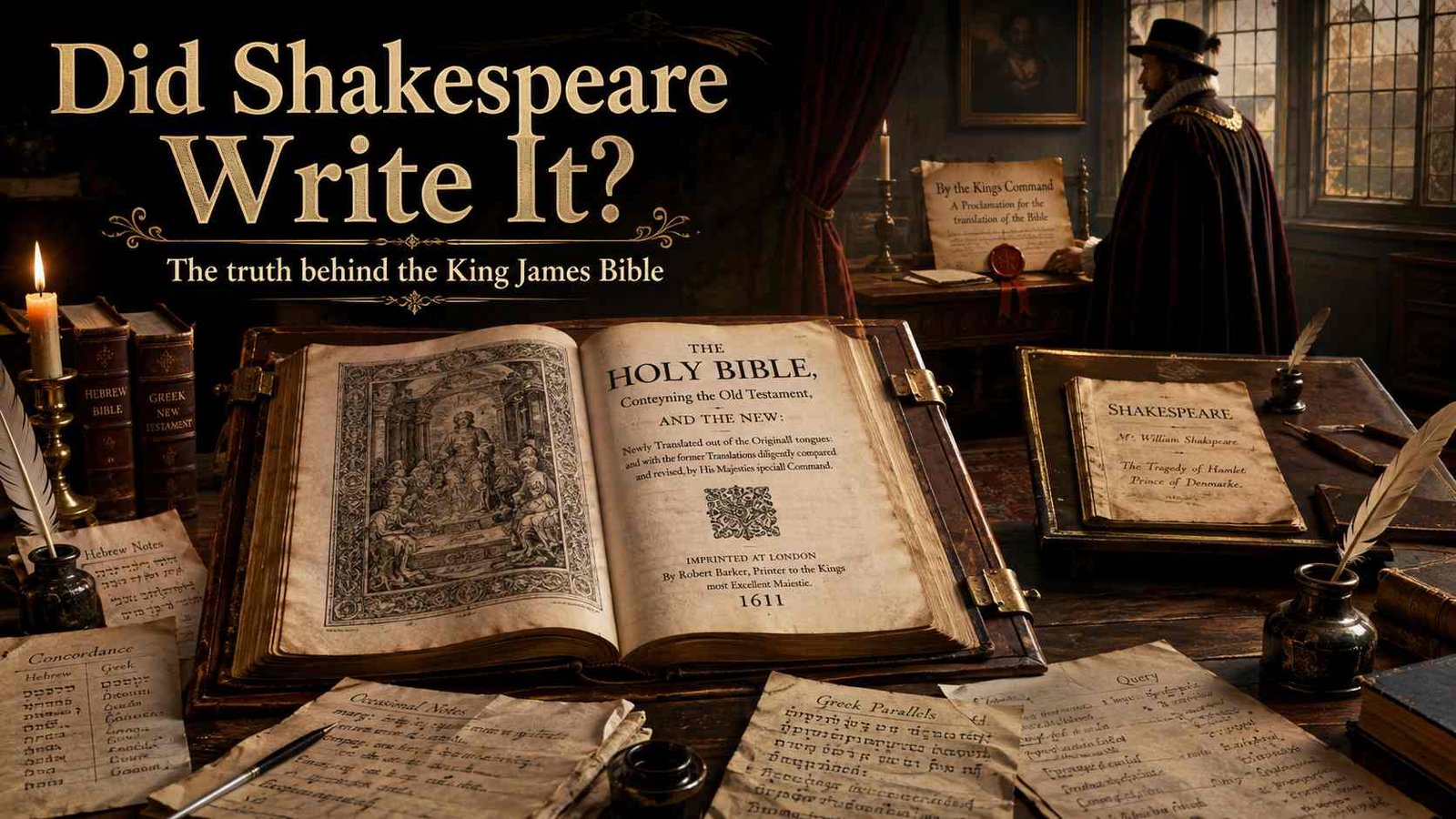
 William Shakespeare and the King James Bible came from the same remarkable period of English history. Both changed the English language. Both are still read more than four centuries later. And both were connected, in different ways, to King James I.
That has led to an intriguing question: Did Shakespeare write the King James Version of the Bible?
The historical answer is no. There is no reliable evidence that William Shakespeare wrote, translated, or edited the King James Bible. The Bible published in 1611 was produced by teams of highly educated biblical scholars who worked with Hebrew, Greek, Latin, and earlier English Bible translations. The Folger Shakespeare Library specifically describes Shakespeare’s supposed role in the translation as a later myth rather than documented history.
Shakespeare did, however, have a real connection to King James. His acting company came under the king’s royal patronage and became known as the King’s Men. That genuine relationship may be one reason later generations found it tempting to connect Shakespeare with the king’s Bible as well.
The real history is even more interesting than the legend.
Who Wrote the King James Bible: Shakespeare or Biblical Scholars?
The King James Bible was not written by one person.
It was a large translation project involving scholars organized into several groups. King James I approved the project after the Hampton Court Conference of 1604, where church leaders and Puritan representatives discussed religious issues facing England.
John Rainolds, also spelled Reynolds in some historical records, was president of Corpus Christi College, Oxford. During the conference, he proposed that a new English translation of the Bible should be prepared.
King James liked the idea.
That decision began the project that eventually produced the Bible commonly called the King James Version, or KJV, in 1611.
Historical sources sometimes give two different numbers for the translators.
The Library of Congress describes a committee of 54 translators commissioned for the project. Other historical accounts commonly say that 47 scholars actually participated in or completed the translation work. These figures do not necessarily contradict one another. A larger number appears to have been appointed, while a smaller number were ultimately active in completing the work.
The translators were divided into six companies working at:
- Westminster
- Cambridge
- Oxford
Different companies were assigned different portions of Scripture.
These were not ordinary writers hired to make the Bible sound beautiful. They were learned churchmen and scholars chosen largely because of their knowledge of biblical languages and theology.
William Shakespeare is not named among these translation companies.
Did Shakespeare Write the King James Version of the Bible?
No historical document has established Shakespeare as one of the translators of the King James Bible.
That matters because considerable information survives about the translation project. We know the names of many scholars involved. Lists of the translation companies survive. Rules for the translators survive. Letters concerning the project survive. Even a few materials connected with the actual translation process have survived.
Yet Shakespeare does not appear as a KJV translator in this evidence.
The Folger Shakespeare Library’s Manifold Greatness project, produced in connection with Oxford’s Bodleian Library, directly addresses the claim. It says there is no real evidence that Shakespeare participated in translating the Bible and describes the supposed connection as a myth.
This is especially significant because the Folger specializes in Shakespeare and holds one of the world’s great collections relating to him and his age.
Shakespeare certainly possessed an extraordinary command of English. But literary brilliance alone would not have qualified someone for the translation companies.
The KJV translators needed specialized knowledge of ancient languages. The Folger notes that the translators were exceptionally knowledgeable in those languages and that almost all were clergymen.
Shakespeare was a playwright, poet, actor, and shareholder in a theatrical company. His profession was very different.
So when someone asks who translated the King James Bible, Shakespeare should not be included in the documented list.
Why Do People Think Shakespeare Wrote the King James Bible?
The most famous reason involves Psalm 46.
It is one of those historical stories that sounds so clever that people naturally want it to be true.
Here is the basic claim.
Shakespeare was about 46 years old when the King James Bible was nearing completion. People noticed that in Psalm 46 of the KJV, the 46th word from the beginning was said to be shake, while the 46th word from the end was associated with spear.
Put them together:
Shake + spear = Shakespeare.
Some versions of the story say Shakespeare deliberately placed his name inside Psalm 46 as a secret signature.
It makes a fascinating piece of literary trivia.
But fascinating is not the same as historical.
The Psalm 46 “Shake” and “Spear” Story
The Folger Shakespeare Library explains that this supposed code appears to have been noticed around the turn of the twentieth century, almost three centuries after the KJV was created.
There is no surviving document from Shakespeare, King James, the translators, or anyone else involved in the translation saying that Shakespeare worked on Psalm 46.
There is also no record of anyone in Shakespeare’s own lifetime noticing such a secret signature.
That is a major problem for the theory.
The Folger therefore treats the Psalm 46 connection as an imaginative word-counting exercise rather than evidence that Shakespeare translated Scripture.
Another problem is that translators of the KJV did not begin with a blank page.
They worked from the biblical languages while also consulting and revising earlier English translations. An annotated copy of the Bishops’ Bible, for example, survives from the translation process. The translators were instructed to use the Bishops’ Bible as their base English text.
So finding an interesting English word pattern in the finished KJV does not prove that Shakespeare created it.
It is an entertaining coincidence.
It is not an author’s signature.
Who Actually Translated the King James Bible?
The translators included some of the most learned church scholars in England.
One important figure was Lancelot Andrewes, who led the First Westminster Company. Andrewes was a respected churchman and scholar with deep linguistic knowledge.
The Cambridge University Library records six translating companies and identifies Andrewes as leader of the First Westminster Company. Other translators included men such as John Bois, Samuel Ward, Andrew Downes, Laurence Chaderton, William Barlow, and John Rainolds.
The work was divided among the companies.
Some translated parts of the Old Testament. Others handled portions of the New Testament or the Apocrypha included in the 1611 edition.
For example, the First Westminster Company worked on the opening books of the Old Testament. The First Cambridge Company was assigned another section of the Old Testament, while the Second Cambridge Company worked on part of the Apocrypha.
This division helps us understand why asking who wrote the KJV Bible can be slightly misleading.
The scholars were primarily translators and revisers, not authors of the biblical books.
Christians believe the biblical writings themselves came from much earlier prophets, apostles, and other biblical authors. The seventeenth-century scholars were creating an English translation of those ancient texts.
They were not creating a new Bible story.
How the King James Translators Worked
The KJV project was surprisingly organized for its time.
After the Hampton Court Conference, rules for translation were distributed along with lists of scholars assigned to the six companies. Cambridge University Library preserves evidence relating to these instructions and the organization of the project.
One important principle was continuity.
The translators were not ordered to throw away everything that English Christians had already been reading. They used the Bishops’ Bible as an official starting point while comparing its wording with the biblical languages and other translations.
This helps answer another common question: Is the King James Bible the original Bible?
No.
The Bible existed many centuries before 1611.
The Old Testament books came from ancient Hebrew and some Aramaic traditions. The New Testament was written in Greek. Christian communities had used many Bible manuscripts and translations long before King James was born.
The KJV was an important English translation, not the original Bible.
The translators also benefited from the work of earlier English translators, especially William Tyndale. Tyndale’s English New Testament appeared almost a century before the KJV and had a major influence on later English Bibles. Historical accounts note that much of Tyndale’s wording passed through later translations and eventually into the King James Bible.
The result was therefore a combination of careful scholarship, revision, comparison, and group review.
That is quite different from the idea of Shakespeare sitting alone with a quill and rewriting Scripture.
Did King James Write the Bible Himself?
No.
This is another common misunderstanding caused by the name King James Bible.
King James I supported and authorized the translation project, but he did not personally translate the biblical text.
Cambridge University Library states clearly that although the rules and procedures reflected the king’s wishes, James took no part in the translation itself.
King James was actually an accomplished writer.
He wrote about kingship, theology, Scripture, political authority, tobacco, and witchcraft. So the idea that a learned king might participate in a major literary or theological work is not impossible in itself.
But the historical evidence says he did not translate the KJV.
His role was closer to that of a royal sponsor and organizer.
The translation carried his name because it was produced during his reign with his support.
So if you encounter the question Did King James change the Bible?, it is important to distinguish authorization from translation.
James influenced the rules and circumstances surrounding the project. He did not sit down and personally rewrite the Bible.
Why Was the King James Bible Written?
The answer begins with religious disagreement in England.
When James became king of England in 1603, English Christians did not all use the same English Bible in the same setting.
The Bishops’ Bible had official church standing, while the Geneva Bible was very popular, especially among many Protestants and Puritans.
The Geneva Bible included extensive notes. Some of those notes could be read as challenging strong royal authority, something King James did not appreciate.
Then came the Hampton Court Conference in January 1604.
The meeting dealt with several disagreements involving the Church of England and Puritan reformers. John Rainolds proposed a new translation, and James quickly became interested in the idea.
The goal was not simply to make English sound more poetic.
The new translation could provide a Bible suitable for public church use while avoiding some of the controversial explanatory notes connected with the Geneva Bible.
Translation began after the conference and continued for several years.
The completed Bible was printed by Robert Barker, the king’s printer, in 1611. Cambridge University Library notes that the exact publication date and original print run are not known.
That is the basic answer to why the King James Bible was written.
Religious concerns, biblical scholarship, church unity, royal interests, and the desire for a carefully reviewed English translation all played a part.
Who Was the King James Bible Written For?
Despite its name, the King James Bible was not written as King James’s personal Bible.
Its purpose was much wider.
The original 1611 title page described the translation as appointed to be read in churches. Cambridge’s historical material notes that this wording is important when considering exactly how the translation gained its authority.
That means ordinary worshippers hearing Scripture in English were an important audience.
It was intended to serve public Christian worship within the Church of England.
Over time, however, its audience became much larger.
The KJV crossed denominational and national borders. It became deeply influential among English-speaking Christians and eventually became one of the most famous Bible translations in history. The Library of Congress records its publication in 1611 and its intended role in replacing the widely used Geneva translation.
So the name can be misleading.
It was the Bible associated with King James’s translation project, not a Bible written merely for King James.
Did Shakespeare Work for King James?
Here we finally reach a connection that is historically real.
Yes, although saying Shakespeare simply “worked for King James” needs explanation.
Shakespeare was a member and shareholder of the acting company known as the Lord Chamberlain’s Men.
When James VI of Scotland became James I of England in 1603, Shakespeare’s company gained royal patronage and became the King’s Men.
An extraordinary piece of documentary evidence survives.
A royal warrant dated May 18, 1603 authorized Shakespeare and his companions to perform plays throughout the kingdom under royal patronage. Shakespeare Documented, a Folger project involving major archives, identifies the original record in The National Archives in the United Kingdom.
That document gives us something the Bible theory does not have: direct historical evidence.
Shakespeare really was connected professionally with James.
His company could perform for the public but also appeared before the royal court.
The Shakespeare Birthplace Trust likewise records that the Lord Chamberlain’s Men gained the patronage of James in 1603 and became the King’s Men.
This distinction is essential:
Shakespeare was one of the king’s players. He was not one of the king’s Bible translators.
Did Shakespeare Support King James?
This question is harder to answer with a simple yes or no.
Shakespeare certainly benefited professionally from James’s patronage.
The King’s Men occupied an important position in English theatre, and court performances brought prestige as well as financial rewards.
Shakespeare also wrote plays during James’s reign that seem sensitive to subjects important to the Jacobean court.
Macbeth is the most famous example.
Scholars have long noticed connections between Macbeth and concerns associated with King James, including Scotland, kingship, royal succession, and witchcraft. Shakespeare scholars have also argued that parts of the play would have appealed to the king and his court.
But we should be careful.
Professional patronage does not prove that Shakespeare personally supported every political or religious opinion held by James.
Shakespeare did not leave us a modern political interview explaining exactly what he thought about the king’s policies.
His plays can praise royal order in one scene and raise uncomfortable questions about kingship in another.
So the safest historical answer is:
Shakespeare had a close professional connection to the Jacobean royal court and benefited from King James’s patronage, but we cannot confidently turn that fact into a complete statement about Shakespeare’s private political beliefs.
That answer may be less dramatic than saying Shakespeare was a devoted supporter of James.
But it respects the evidence.
Did Shakespeare and the KJV Influence Each Other?
This question needs similar caution.
Shakespeare and the King James Bible belong to almost exactly the same cultural world.
Shakespeare lived from 1564 to 1616.
The KJV project began after the 1604 Hampton Court Conference and the Bible appeared in 1611.
Shakespeare was therefore alive throughout the translation period.
But being alive at the same time is not evidence of collaboration.
The two works do share something important: the English language of early seventeenth-century England.
Both are famous today for memorable language.
Yet we should not assume that similarities in rhythm or vocabulary mean Shakespeare secretly shaped the Bible.
The KJV translators were themselves educated writers and speakers. Men such as Lancelot Andrewes had remarkable sensitivity to language. Cambridge University Library notes the richness of Andrewes’s language and its relationship to the linguistic world of the King James Bible.
The Bible also drew on a long tradition of English translation before Shakespeare’s greatest plays appeared.
William Tyndale, the Geneva Bible translators, the Bishops’ Bible translators, and others had already helped form the English biblical language inherited by the KJV translators.
So Shakespeare and the KJV are better understood as two great products of a rich period in English culture, rather than one being secretly responsible for the other.
Why the Shakespeare Story Remains So Popular
There is something irresistible about secret codes.
People enjoy discovering unexpected patterns, especially when those patterns connect two famous historical figures.
William Shakespeare is one of the most famous writers in English.
The King James Bible is one of the most famous works of English prose.
King James was connected to both.
Place those three facts together, add the Psalm 46 word-counting story, and a legend almost creates itself.
The Folger’s explanation is helpful here. It suggests that later generations came to regard Shakespeare as England’s greatest writer while also treating the King James Bible as a supreme achievement of English prose. That made people wonder whether Shakespeare must somehow have helped create it.
But history cannot be built from what seems poetic.
It must be built from evidence.
We have evidence identifying Shakespeare as a playwright, actor, shareholder, and member of the King’s Men.
We have evidence identifying scholars associated with the six Bible translation companies.
What we do not have is reliable evidence placing Shakespeare inside those translation companies.
That difference settles the main question.
Was Shakespeare More Qualified Than the Actual Translators?
Shakespeare was unquestionably gifted with English words.
His plays show an astonishing ability to use imagery, rhythm, humor, argument, emotion, and memorable phrases.
But Bible translation requires a different type of expertise.
Imagine that you wanted an ancient Hebrew document translated today.
A brilliant novelist might improve the English style, but you would first want people who understood ancient Hebrew, grammar, historical usage, manuscript traditions, and the cultural world behind the document.
The King James translation committees were built around that kind of scholarship.
The Folger notes that the translators were chosen for their expertise in ancient languages. Cambridge records show organized companies working under specific translation rules.
This does not make Shakespeare less brilliant.
It simply means his brilliance belonged mainly to another field.
A gifted playwright does not automatically become a biblical-language scholar, just as a gifted biblical scholar does not automatically become Shakespeare.
Was the King James Bible Completely New?
No.
This point helps us understand the translation more accurately.
The KJV translators inherited centuries of biblical transmission and decades of English Bible translation.
The Bishops’ Bible served as their official English base text. The translators also worked with the original-language texts and benefited from earlier English translations.
William Tyndale’s influence is especially important.
Long before the KJV appeared, Tyndale had translated the New Testament from Greek into English. His work deeply influenced later English Bibles, which in turn shaped the King James Version.
That means the question is the King James Bible the original has a simple answer.
No English translation from 1611 could be the original form of biblical books written many centuries earlier.
For Christians who love the KJV, that does not reduce its importance.
A translation can be treasured without being the first Bible ever written.
Its importance comes from its translation history, its influence, and the generations of believers who have read Scripture through its words.
A Simple Timeline Clears Up the Confusion
The dates make the story easier to understand.
| Date | What Happened |
|---|---|
| 1564 | William Shakespeare was born |
| 1603 | James VI of Scotland became James I of England |
| 1603 | Shakespeare’s company came under James’s patronage |
| January 1604 | Hampton Court Conference took place |
| 1604 | Plans and rules for the new Bible translation were organized |
| 1604–1611 | Translation and review work continued |
| 1611 | The King James Bible was printed |
| 1616 | Shakespeare died |
The timeline proves that Shakespeare was alive during the KJV project.
But that is all the timeline proves.
Many writers, scholars, ministers, actors, politicians, and printers were living in England at the same time. To identify someone as a translator, we need more than overlapping dates.
We need evidence of participation.
For Shakespeare, that evidence has not been found.
What the Historical Record Allows Us to Say
So, who wrote the King James Bible, Shakespeare or someone else?
The historical record gives us a clear answer.
William Shakespeare did not write the King James Bible, and there is no credible evidence that he served as one of its translators.
The KJV grew from a translation project approved by King James I after the Hampton Court Conference in 1604. Teams of learned scholars worked in six companies at Westminster, Oxford, and Cambridge. A larger group was initially appointed, while about 47 scholars are commonly credited with carrying out the completed translation work. The Bible appeared in print in 1611.
King James did not translate it himself either. He encouraged the project and influenced its organization, but Cambridge’s historical record makes clear that he took no part in actually translating the biblical text.
Shakespeare’s connection with James was real but different.
His theatrical company received royal patronage and became the King’s Men. A surviving royal warrant from 1603 directly documents Shakespeare and his companions performing under that patronage.
The famous Psalm 46 “shake” and “spear” theory remains a clever story. It is fun to notice, but it does not overturn the documentary record. The Folger Shakespeare Library describes Shakespeare’s supposed participation in the KJV as a myth unsupported by real historical evidence.
Perhaps the truth gives us something more valuable than the legend.
Shakespeare did not need to write the King James Bible for both works to matter.
The playwright and the translators lived in an extraordinary age of English writing. Shakespeare gave the world Hamlet, King Lear, Macbeth, and many other works. The KJV translators gave generations of English-speaking Christians a Bible whose language became deeply rooted in worship, preaching, literature, and everyday speech.
Their paths crossed through the reign of the same king.
Their achievements were different.
And both left marks on the English language that can still be felt centuries later.

Dr. Rachel is very smart and knows a lot about the Bible. He helps us understand the Bible better by talking about the old texts in a simple way.