
 The Bible gives us truth for every part of life. It speaks to us when we are confident and when we are afraid. It helps us when we need peace, strength, direction, forgiveness, or a fresh desire to serve God.
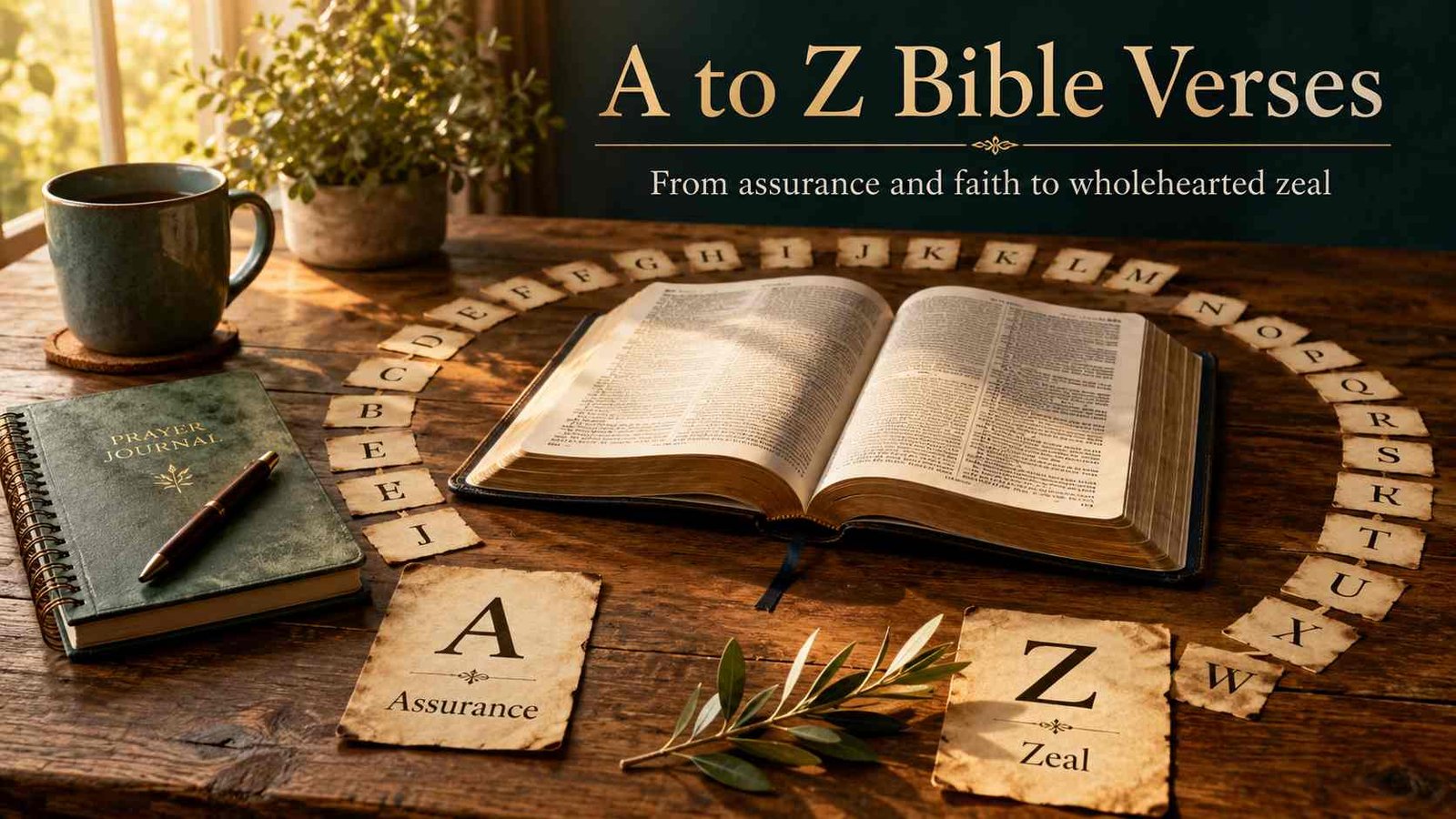
This guide to A to Z Bible Verses: Insights from Assurance to Zeal uses the alphabet as a simple way to remember important biblical truths. The Bible itself is not arranged from A to Z, of course. This is simply a devotional tool that can help children, adults, families, and Bible study groups remember Scripture more easily.
We will begin with assurance and move through faith, grace, hope, peace, salvation, trust, victory, worship, and finally zeal.
Some days you may need only one of these verses. On another day, you may want to slowly read through the whole list.
Either way, the goal is the same: to keep God’s Word close to your heart.
A to Z Bible Verses About Assurance, Belief, and Faith
A Is for Assurance — 1 John 5:11–13
Assurance means having confidence in something that is dependable.
For Christians, one of the greatest forms of assurance is knowing where salvation comes from.
In 1 John 5:11–13, John explains that God has given eternal life and that this life is found in His Son. He writes so believers may know that they have eternal life.
That is an important word: know.
Our feelings can change from morning to evening. We may feel strong in faith one day and weak the next. Biblical assurance is not built only on emotion. It rests on God’s promise and on Jesus Christ.
If you are searching for Bible verses about assurance of salvation, this is one of the clearest passages to begin with.
Assurance does not mean we become careless about our spiritual lives. Instead, confidence in God’s grace should draw us closer to Him with gratitude.
B Is for Belief — Mark 9:23–24
Belief is at the heart of Christian faith, but the Bible does not pretend that believers never struggle with doubt.
In Mark 9, a desperate father came to Jesus seeking help for his son. He believed, yet he also recognized the weakness of his faith.
His response was deeply human: he believed and asked Jesus to help his unbelief.
That should encourage us.
You do not need to hide your questions from God. Bring them to Him.
Faith can grow even while we are admitting where we are weak.
C Is for Creation — Genesis 1:1
The Bible opens with God.
Genesis 1:1 tells us that God created the heavens and the earth.
Before the stories of Abraham, Moses, David, the prophets, and the apostles, Scripture begins by showing us the Creator.
This truth changes how we see the world.
Creation belongs to God. Our lives belong to God. The abilities and opportunities we have are gifts from Him.
Looking at creation can remind us that our God is greater than the problems we face.
D Is for Devotion — Luke 9:23
Jesus taught that following Him involves daily commitment.
Devotion is more than thinking about God when life becomes difficult. It means choosing to follow Christ again and again.
Luke 9:23 speaks about denying ourselves, taking up our cross daily, and following Jesus.
Christian devotion is not always dramatic. Sometimes it looks very ordinary.
It may mean forgiving someone.
It may mean praying when you are tired.
It may mean telling the truth when lying would be easier.
It may simply mean choosing God’s way when nobody else is watching.
E Is for Encouragement — 1 Thessalonians 5:11
Everyone needs encouragement.
Some people around you may be carrying struggles that you cannot see.
That is why Paul tells Christians in 1 Thessalonians 5:11 to encourage one another and build each other up.
Your words can carry great weight.
A kind sentence may strengthen someone who feels discouraged. A prayer may remind a hurting person that they are not forgotten. A Bible verse shared with love may bring hope at the right moment.
Christian encouragement should never be empty flattery. It points people toward God’s truth and grace.
F Is for Faith — Hebrews 11:1
Hebrews 11 is one of the Bible’s great chapters about faith.
Faith means trusting God even when we cannot yet see everything clearly.
Hebrews 11:1 connects faith with confidence in what we hope for and conviction concerning what we do not see.
That does not mean biblical faith is blind optimism.
Faith has an object.
We trust God because of who He is.
When you study what the Bible says about faith, you repeatedly find people who trusted God while facing uncertainty. Abraham traveled without knowing the full path ahead. Moses obeyed God despite danger. Many others continued believing even through hardship.
Faith does not always remove uncertainty.
It teaches us whom to trust within it.
A to Z Bible Verses About Grace, Hope, and Love
G Is for Grace — Ephesians 2:8–9
Grace is one of the most beautiful words in the Christian faith.
Ephesians 2:8–9 teaches that salvation is by grace through faith. It is God’s gift, not something we can earn by boasting about our own works.
This keeps us humble.
We do not come to God saying, “Look how good I have been.”
We come depending on His mercy.
Grace does not mean good works are unimportant. The next verse, Ephesians 2:10, speaks about believers being created in Christ for good works.
The order matters.
We are not trying to earn God’s grace. We live faithfully because His grace has changed us.
H Is for Hope — Romans 15:13
Biblical hope is stronger than wishful thinking.
Romans 15:13 connects hope with trusting God, joy, peace, and the power of the Holy Spirit.
There may be seasons when you cannot see how a situation will improve.
Hope does not require you to pretend everything is easy.
It reminds you that God remains faithful even when your circumstances are difficult.
If you are studying what the Bible says about hope, remember that Christian hope points beyond temporary circumstances. It ultimately rests in God.
I Is for Integrity — Proverbs 10:9
Integrity means living honestly and consistently.
Proverbs 10:9 teaches that the person who walks with integrity walks securely.
Integrity matters when people are watching, but it matters even more when they are not.
A person of integrity tries to make the same faithful choices in private that they would make in public.
This includes honesty with money, relationships, promises, work, family, and speech.
We will not live perfectly.
But we can live sincerely, confess mistakes, make things right, and keep growing.
J Is for Joy — Philippians 4:4
Paul tells believers in Philippians 4:4 to rejoice in the Lord.
That instruction becomes even more meaningful when we remember that Christian joy is not based only on comfortable circumstances.
Joy and happiness are related, but they are not always identical.
You may experience grief and still know that God is faithful.
You may cry and still have hope.
Christian joy grows from knowing the Lord remains present, good, and worthy of trust.
K Is for Kindness — Ephesians 4:32
Ephesians 4:32 calls believers to kindness, compassion, and forgiveness.
Kindness often looks small from the outside.
Listening can be kindness.
Being patient can be kindness.
Helping someone quietly can be kindness.
Choosing not to answer an insult with another insult can also be kindness.
Kindness does not mean ignoring wrongdoing. It means that even when difficult issues must be addressed, we do not have to become cruel.
L Is for Love — 1 Corinthians 13:13
Faith, hope, and love are all important, but Paul says the greatest of these is love.
Biblical love is more than emotion.
First Corinthians 13 describes love as patient and kind. It does not celebrate wrongdoing but rejoices with truth.
Real love therefore has both tenderness and truth.
Jesus taught His followers to love God and love their neighbors. He even taught them to love their enemies.
That kind of love is difficult.
We need God’s help to live it.
A to Z Bible Verses About Mercy, Peace, and Righteousness
M Is for Mercy — Lamentations 3:22–23
Lamentations was written in a setting filled with sorrow, yet right in the middle of grief comes a powerful reminder of God’s compassion.
God’s mercies are new every morning.
That does not mean yesterday’s pain never happened.
It means yesterday does not exhaust God’s mercy.
You can wake up after failure and seek Him again.
You can come to God after a difficult week.
You can confess sin and ask for help.
His compassion is not limited by the weakness that surprised you yesterday.
N Is for New Life — 2 Corinthians 5:17
Paul teaches that anyone who is in Christ is a new creation.
Christianity is not simply about adding religious habits to an unchanged life.
Christ begins transforming us from within.
Old patterns may not disappear overnight. Growth can take time.
But the direction changes.
We begin learning new ways to think, speak, forgive, serve, and love.
New life means that your past does not have to control your future.
O Is for Obedience — John 14:15
Jesus connects love with obedience.
That reminds us that loving Christ is more than speaking warmly about Him.
Love affects the way we live.
Biblical obedience is not an attempt to purchase God’s love. It is a response to the One we love.
A child who trusts a good parent learns that wise instructions are given for a reason.
In a greater way, Christians learn to trust God’s wisdom even when obedience is difficult.
P Is for Peace — Philippians 4:6–7
Philippians 4:6–7 is one of the most comforting passages for anyone looking for peace and assurance Bible verses.
Paul tells believers to bring their concerns to God through prayer and thanksgiving. He then speaks about the peace of God guarding their hearts and minds in Christ Jesus.
Notice that prayer does not begin with pretending there is nothing to worry about.
We bring the concern to God.
We name what troubles us.
We ask for His help.
Then we trust Him with what we cannot control.
Biblical peace does not always mean the storm immediately disappears.
Sometimes God’s peace meets us while the storm is still around us.
Q Is for Quietness — Psalm 46:10
Psalm 46:10 includes the familiar call to be still and know that He is God.
We often need this reminder.
Our lives can become filled with noise: messages, deadlines, arguments, news, worries, plans, and endless thoughts.
Being still before God gives us space to remember who He is.
This does not mean Christians should avoid responsibility.
It means we should not live as though everything depends entirely on us.
God is God.
We are not.
There is peace in remembering that.
R Is for Righteousness — Matthew 6:33
Jesus tells His followers to seek first God’s kingdom and His righteousness.
We spend much of life seeking things.
We seek security.
We seek money.
We seek approval.
We seek comfort.
We seek answers.
Jesus teaches us to place God’s kingdom first.
When our priorities are shaped by Him, other decisions become clearer.
Righteousness means wanting what is right in God’s sight, not merely what is convenient for us.
A to Z Bible Verses About Salvation, Trust, and Victory
S Is for Salvation — Acts 4:12
Acts 4:12 places salvation clearly in Jesus Christ.
For Christians, salvation is not simply self-improvement.
It is rescue.
Sin separates human beings from God, but the gospel announces that God has acted through Jesus Christ.
This is why Bible verses about assurance of salvation ultimately bring us back to Christ rather than to our own spiritual performance.
First John 5:11–13 is especially important here. John explains that eternal life is found in God’s Son and tells believers that they may know they have eternal life.
That confidence should lead to gratitude rather than pride.
We are saved by God’s grace.
T Is for Trust — Proverbs 3:5–6
Proverbs 3 teaches us to trust in the Lord with all our heart instead of leaning only on our own understanding.
That is easier to say than to live.
We like explanations.
We like knowing what will happen next.
We want the full map before taking the first step.
God sometimes gives direction one step at a time.
Trust does not mean refusing to think wisely. Scripture itself values wisdom.
It means recognizing that our understanding is limited while God’s is not.
U Is for Unity — Ephesians 4:3
Paul encourages Christians to preserve the unity of the Spirit through the bond of peace.
Unity does not mean every Christian will agree about every secondary question.
Christians come from different nations, cultures, churches, and traditions.
Yet believers are called to treat one another as members of Christ’s body.
Unity requires humility.
It also requires patience.
Sometimes preserving peace means listening before speaking.
V Is for Victory — 1 Corinthians 15:57
Paul gives thanks to God for victory through Jesus Christ.
When people search for Bible verses on assurance of victory, it is important to understand what biblical victory means.
It does not promise that Christians will win every argument, avoid every sickness, become wealthy, or escape hardship.
The great victory of the Christian faith is Christ’s triumph over sin and death.
First Corinthians 15 speaks especially about resurrection. Death does not have the final word.
There is another form of victory worth remembering.
First Corinthians 10:13 teaches that temptation is not unique to us and that God is faithful. He provides a way to endure temptation.
So when temptation comes, we are not forced to surrender.
God remains faithful.
Bible Verses on Assurance of Answered Prayer
Many believers also search for Bible verses on assurance of answered prayer.
Jesus encouraged His disciples to pray. John 16:24 speaks about asking and receiving so that joy may be full.
But Scripture also teaches us how to understand confidence in prayer.
First John 5:14–15 says believers can approach God with confidence when asking according to His will.
That phrase matters.
Prayer is not a way of forcing God to approve every plan we make.
Prayer is relationship.
We speak with our Father.
We ask.
We thank Him.
We confess.
We listen through His Word.
We submit our desires to His wisdom.
Sometimes God gives what we requested.
Sometimes the answer comes differently.
Sometimes we must wait.
Sometimes, looking back years later, we may even thank God that a particular request was not answered in the way we originally wanted.
Our assurance is not that we control the answer.
Our assurance is that God hears us and remains wise, loving, and faithful.
When studying what the Bible teaches about prayer, this balance is important.
A to Z Bible Verses About Worship, Yearning, and Zeal
W Is for Worship — John 4:23–24
Jesus taught that true worshipers worship the Father in spirit and truth.
Worship is much bigger than singing.
Music can be worship, but worship also includes obedience, gratitude, prayer, generosity, service, and surrender.
Worship says, in effect, “God, You are worthy.”
It turns our attention away from ourselves and toward Him.
X Is for eXamine — 2 Corinthians 13:5
There are very few natural English Bible themes beginning with X, so we can use eXamine as a memory tool.
Second Corinthians 13:5 encourages believers to examine themselves.
Healthy self-examination is not constant fear.
It is an honest look at our spiritual lives.
Are we growing?
Is there something we need to confess?
Have we become bitter?
Are we neglecting prayer?
Have we stopped forgiving someone?
Self-examination should lead us toward Christ, not toward hopelessness.
Y Is for Yearning — Psalm 42:1
Psalm 42 compares longing for God with a deer longing for flowing water.
It gives us a picture of spiritual desire.
We all desire many things.
Some are necessary. Others are temporary.
But the deepest need of the human heart cannot be satisfied by possessions, popularity, or entertainment.
We were made to know God.
A healthy Christian life includes a growing desire for Him.
Z Is for Zeal — Romans 12:11
Romans 12:11 gives one of the clearest Bible verses about being zealous for God.
Paul tells believers not to become lacking in diligence but to remain spiritually fervent while serving the Lord.
Zeal means more than excitement.
Excitement can disappear quickly.
Biblical zeal has endurance.
It moves a person toward faithful service.
It says, “God has loved me, so I want my life to honor Him.”
What Is Zeal in the Bible?
If you ask what is zeal in the Bible, think of strong and active devotion.
Zeal is an eager desire that produces action.
A zealous Christian does not merely talk about caring for people. He serves.
She does not merely say prayer is important. She prays.
A zealous believer does not simply admire Scripture. He wants to obey it.
Yet the Bible also shows us that zeal must be guided by truth.
Romans 10:2 speaks about people who had zeal for God but lacked proper knowledge.
That gives us an important warning.
Passion by itself is not enough.
A person can be very sincere and still be mistaken.
Biblical zeal needs truth.
It needs wisdom.
It needs love.
And it needs humility.
The goal is not to become loud, aggressive, or spiritually competitive.
The goal is to become deeply devoted to God.
Bible Verses About Being Zealous for God
Several passages help us understand godly zeal.
Romans 12:11 connects zeal with spiritual fervor and serving the Lord.
Titus 2:14 describes God’s people as eager or zealous for good works.
Revelation 3:19 connects zeal with repentance.
Psalm 69:9 describes an intense concern for God’s house.
John 2:17 applies the language of Psalm 69 to Jesus after He cleansed the temple.
Together, these verses show that godly zeal is not meaningless energy.
It cares about God’s honor.
It produces good works.
It responds to correction.
And it serves faithfully.
What Does “Zeal for Your House Has Consumed Me” Mean?
People sometimes search for the phrase zeal for the Lord has consumed me.
The biblical wording is slightly different.
Psalm 69:9 says:
“The zeal of thine house hath eaten me up.”
In John 2:17, Jesus’ disciples remembered this Scripture after He drove merchants and money changers from the temple area.
Jesus cared deeply about the honor of His Father’s house.
His zeal was not selfish anger.
He was concerned that something intended for worship had been treated wrongly.
This passage teaches us something valuable about spiritual zeal.
Godly passion should be centered on God’s honor rather than our ego.
Sometimes people become passionate because they want to win arguments.
Jesus’ example points us toward something greater: devotion to the Father.
A Prayer for Zeal to Serve God
There is no single verse titled “prayer for zeal to serve God,” but Romans 12:11–12 gives us wonderful language for such a prayer. It speaks about spiritual fervor, serving the Lord, hope, patience in trouble, and faithfulness in prayer.
You might pray:
Lord, give me a willing heart to serve You. When I become tired or distracted, renew my spiritual desire. Help me to love what is good, serve others faithfully, remain patient in difficulty, and continue in prayer. Keep my zeal rooted in truth, love, humility, and obedience. May my life honor You. Amen.
You do not need impressive words when you pray.
God already knows your heart.
Speak honestly.
Ask Him to renew your desire for Him.
Peace and Assurance Bible Verses for Difficult Days
There are days when assurance feels especially important.
A medical problem may appear.
A relationship may become painful.
Money may be short.
A child may be struggling.
A decision may be unclear.
During those moments, Scripture gives us truths to hold onto.
Philippians 4:6–7
Bring your concerns to God in prayer and remember that His peace can guard your heart and mind.
Romans 15:13
God is described as the God of hope, and Paul connects trusting Him with joy and peace.
John 14:27
Jesus speaks about giving His followers peace that is different from what the world gives.
Isaiah 26:3
This passage connects steadfast trust in God with peace.
Psalm 46:10
Be still and remember that God is God.
These peace and assurance Bible verses do not promise that faithful people will never suffer.
The Bible is much more realistic than that.
Jesus Himself told His disciples they would face trouble.
Biblical peace is not the absence of every problem.
It is the presence of confidence in God while problems are still real.
When you need a verse in the Bible for strength, you may find that strength comes not from pretending to be fearless but from placing your fear into God’s hands.
How to Use These A to Z Bible Verses in Daily Life
You do not need a complicated Bible study system to benefit from these verses.
Start simply.
Read One Letter Each Morning
Choose one letter each day.
Read the verse slowly.
Ask yourself:
What does this teach me about God?
What does it show me about my life?
Is there something I should believe, change, confess, or practice today?
Twenty-six letters can give you nearly a month of devotional reading.
Use Them for Scripture Memory
Children and adults can both use the alphabet method for memorizing verses.
You might place one letter and verse on a card.
Read it several times during the day.
Try saying the reference without looking.
Then repeat it the next morning before learning another.
Do not worry about speed.
Remembering one verse well is better than rushing through ten and forgetting them all.
Turn Each Theme Into Prayer
A can become a prayer for assurance.
F can become a prayer for stronger faith.
H can become a prayer for hope.
P can become a prayer for peace.
T can become a prayer for trust.
Z can become a prayer for renewed zeal.
This helps Scripture shape the way you pray instead of prayer becoming only a list of requests.
Share a Verse With Someone Else
If someone you know is discouraged, do not feel that you must solve every problem.
Sometimes the best gift is your presence.
Listen.
Pray.
Then, when appropriate, share a passage that genuinely fits what they are facing.
Scripture should be offered with compassion, not used as a quick way to dismiss someone’s pain.
Keep a Simple Bible Journal
Write the letter at the top of the page.
Then write the theme and Bible reference.
For example:
P — Peace — Philippians 4:6–7
Underneath, write one sentence about what you learned.
Then add one short prayer.
You may be surprised how meaningful those pages become over time.
From Assurance to Zeal, Keep God’s Word Close
A to Z Bible Verses: Insights from Assurance to Zeal reminds us just how many parts of life Scripture touches.
We need assurance when we doubt.
We need belief when questions come.
We need grace when we fail.
We need hope when life feels dark.
We need mercy when we have sinned.
We need peace when our minds are troubled.
We need salvation because we cannot rescue ourselves.
We need trust when we cannot see the road ahead.
We need victory when temptation comes.
And we need zeal when our spiritual lives become tired or cold.
The alphabet itself is only a tool.
God’s Word is the treasure.
You do not have to master the whole Bible in one day. Read faithfully. Ask questions. Pray over what you read. Keep learning.
Some verses will comfort you immediately. Others may challenge you. Some will become more meaningful after years of walking with God.
Keep coming back.
Keep seeking.
Keep trusting.

Reverend James has spent years studying and teaching the Bible. With warmth and wisdom, he shares deep truths in a way that’s clear, simple, and easy to understand.