
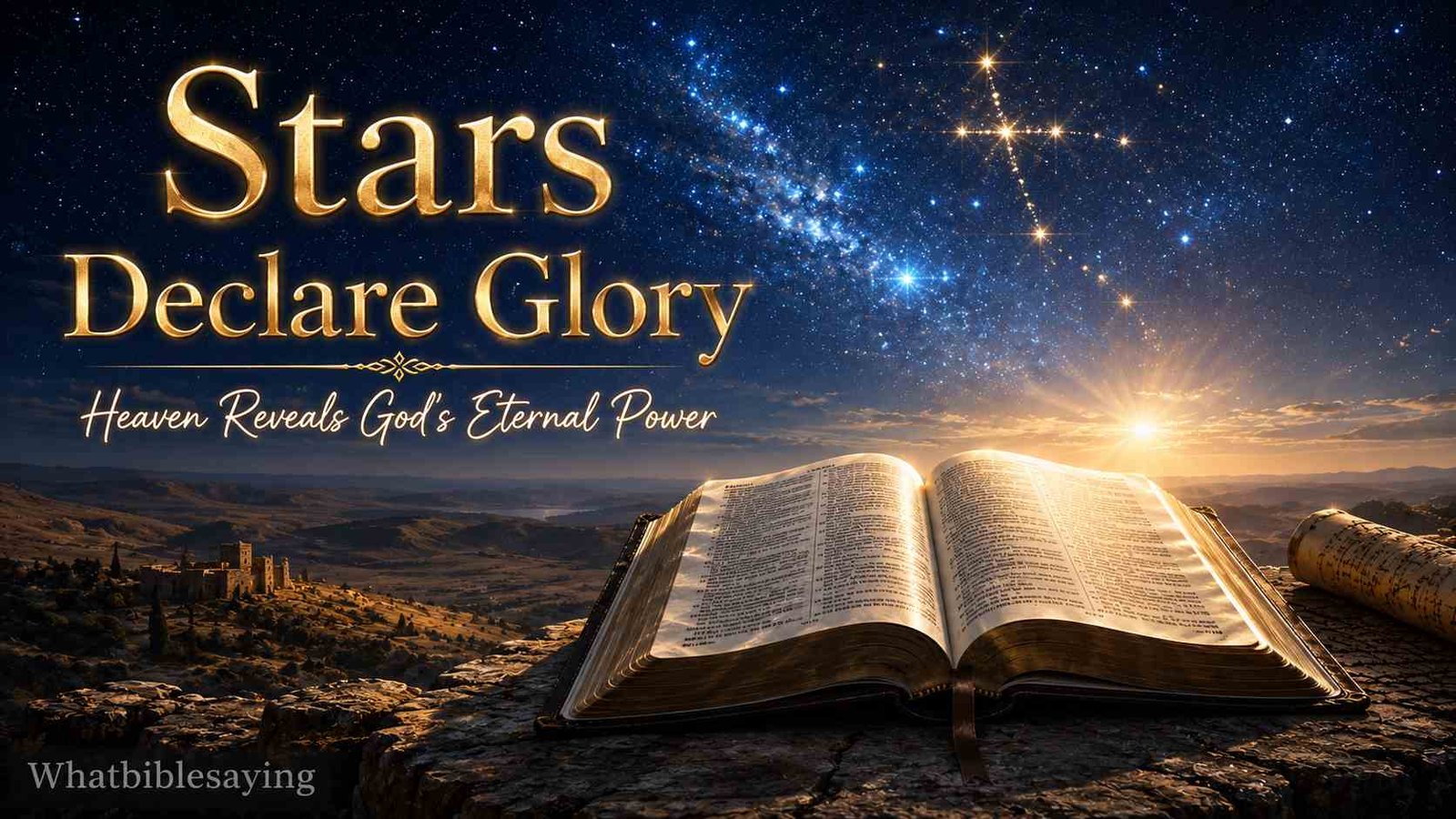
 On a clear night, stars can make us feel very small. Yet at the same time, they remind us that God’s creation is far bigger and more beautiful than we can fully understand. The Bible speaks about stars many times. Some verses describe real stars shining in the heavens. Other passages use stars as symbols of hope, angels, nations, leaders, or God’s promises.
From the first pages of Genesis to the final chapters of Revelation, stars appear throughout Scripture. Abraham looked at the stars when God promised him countless descendants. Wise men followed a star to find the newborn Jesus. Revelation describes stars in heaven connected to churches and spiritual messages. The Bible never treats stars as objects to worship. Instead, they point people back to the greatness of God.
Many people ask questions like: What does Jesus say about stars? What do stars represent spiritually? Who are the seven stars in Revelation? What are the eleven stars in Joseph’s dream? These are meaningful questions because biblical symbols often carry deep lessons for our faith and daily lives.
The Bible also connects stars with light, guidance, wisdom, and eternity. Daniel 12:3 says:
“Those who lead many to righteousness, like the stars forever and ever.”
That verse alone shows how God uses stars as a picture of lasting faithfulness and heavenly glory.
When we read about stars in Scripture, we are not only learning about the sky above us. We are learning about God Himself. The heavens reveal His creativity, His order, His promises, and His power.
Why Stars Matter in the Bible
In ancient times, people depended on the stars far more than we do today. Travelers used them for direction. Farmers watched the skies to understand seasons. Sailors navigated oceans by the stars. Because of this, stars naturally became powerful symbols in biblical writing.
The very beginning of the Bible mentions them. Genesis 1:16 says God made “the greater light” to rule the day and “the lesser light” to rule the night. Then it adds something simple but powerful:
“He also made the stars.”
That short sentence carries enormous meaning. The stars that seem endless to human eyes were created by God with ease. Psalm 147:4 says:
“He determines the number of the stars and calls them each by name.”
Think about that for a moment. Human beings still cannot count all the stars in the universe, yet God knows every one of them.
The Bible often uses the heavens to help people understand the greatness of God. Psalm 19:1 says:
“The heavens declare the glory of God.”
Stars remind us that God’s wisdom goes beyond human understanding. They also remind us that His creation is orderly, purposeful, and sustained by His power.
This connects beautifully with other biblical themes about the heavens and creation. Just as many believers wonder what the Bible says about planets or what light represents in Scripture, stars also point toward God’s authority over the universe.
Throughout the Old Testament, stars were never meant to replace God. In fact, Israel was repeatedly warned not to worship heavenly bodies. Deuteronomy 4:19 cautions people not to bow down to the sun, moon, or stars. The Creator alone deserves worship, not His creation.
That distinction matters today as well. The Bible honors stars as signs of God’s handiwork, not as powers controlling human destiny.
What Does Jesus Say About Stars?
Jesus mentioned stars several times during His earthly ministry. Sometimes He spoke about them literally. Other times He used them symbolically while teaching about the future and the kingdom of God.
One important passage appears in Matthew 24:29. Jesus describes dramatic heavenly signs connected with the end times:
“The stars will fall from the sky, and the heavenly bodies will be shaken.”
This imagery shows the greatness of God’s final authority. Even the stars, which seem permanent and untouchable, remain under God’s control.
Jesus also used star imagery in Revelation. One of the most beautiful titles He gives Himself is found in Revelation 22:16:
“I am the Root and the Offspring of David, and the bright Morning Star.”
This title carries hope, kingship, and light. In ancient times, the morning star appeared just before sunrise. It announced that darkness was ending and a new day was coming. Jesus used this picture to show that He brings eternal hope and salvation.
Jesus as the Bright Morning Star
The phrase “Morning Star” carries deep meaning throughout Scripture. In the darkness before dawn, the morning star shines brightly. Spiritually, Jesus becomes that light for a broken world.
Many believers connect this image to guidance and hope. Just as travelers once followed stars across deserts and seas, Christians look to Christ for direction in life.
The story of the wise men also connects stars to Jesus. Matthew 2 describes a special star that guided them to Bethlehem. This was not ordinary astronomy. It was a divine sign announcing the birth of the Savior.
That moment showed several important truths:
- God can use creation to reveal His plans.
- Jesus came for all nations, not only Israel.
- Heavenly signs in Scripture often point people toward God’s truth.
The star over Bethlehem remains one of the most recognized symbols in Christianity because it represents divine guidance leading people to Christ.
What Does a Star Represent in the Bible?
Stars carry several meanings in Scripture depending on the context. The Bible uses them both literally and symbolically.
Here are some of the most common biblical meanings connected to stars:
| Symbol | Biblical Meaning |
|---|---|
| Guidance | God leading His people |
| Promise | God’s covenant with Abraham |
| Light | Truth, faith, righteousness |
| Angels | Heavenly messengers |
| Authority | Kings, leaders, nations |
| Eternity | God’s everlasting power |
One of the strongest symbolic meanings is hope. Stars shine brightest during darkness. In the same way, God often gives hope during difficult seasons.
Stars as Signs of God’s Promise to Abraham
One of the most famous passages about stars appears in Genesis 15:5. God tells Abraham:
“Look up at the sky and count the stars—if indeed you can count them. So shall your offspring be.”
At that moment, Abraham had no children. Humanly speaking, God’s promise seemed impossible. Yet the stars became a visible reminder of God’s faithfulness.
Every night sky reminded Abraham that God keeps His word.
This promise later connected directly to Israel and eventually to Jesus Christ. Through Abraham’s descendants, God would bless the nations of the earth.
The image of countless stars also teaches us something about faith. Abraham believed before he saw the promise fulfilled. Sometimes God asks us to trust Him the same way.
Stars as Symbols of Light and Faithfulness
The Bible frequently connects stars with spiritual light. Philippians 2:15 says believers should shine:
“Like stars in the sky.”
Christians are called to reflect God’s truth in a dark world. This does not mean perfection. It means living faithfully, showing kindness, truth, humility, and love.
Daniel 12:3 also connects righteousness with stars:
“Those who are wise will shine like the brightness of the heavens.”
This imagery encourages believers to live with eternal purpose.
Many people also connect stars with comfort during suffering. Looking at the night sky reminds us that God’s promises remain steady even when life feels uncertain.
That same theme appears in many biblical teachings about hope, faith, and trusting God during difficult times.
Who Are the Seven Stars in Christianity?
One of the most discussed star symbols appears in Revelation chapter 1. John sees Jesus holding seven stars in His right hand.
Revelation 1:20 explains their meaning:
“The seven stars are the angels of the seven churches.”
Scholars generally understand these stars as heavenly messengers or spiritual representatives connected to the seven churches in Asia Minor.
The seven churches were:
- Ephesus
- Smyrna
- Pergamum
- Thyatira
- Sardis
- Philadelphia
- Laodicea
Each church received encouragement, correction, warnings, and promises from Christ.
The image of Jesus holding the stars is deeply comforting. It shows His authority and care over His people. The churches faced persecution, fear, compromise, and spiritual struggles, yet Christ remained present among them.
The Meaning of the Seven Churches
The number seven often symbolizes completeness in the Bible. Because of this, many Christians believe the seven churches also represent the wider church across history.
Each church reflected different spiritual conditions:
| Church | Main Spiritual Lesson |
|---|---|
| Ephesus | Return to first love |
| Smyrna | Stay faithful during suffering |
| Pergamum | Resist compromise |
| Thyatira | Reject false teaching |
| Sardis | Wake up spiritually |
| Philadelphia | Remain faithful |
| Laodicea | Avoid spiritual lukewarmness |
The seven stars remind believers that Christ sees His church clearly. He encourages faithfulness while calling His people toward repentance and truth.
What Are the 11 Stars in the Bible?
The eleven stars appear in one of Joseph’s dreams in Genesis 37:9. Joseph tells his family:
“The sun and moon and eleven stars were bowing down to me.”
This dream deeply upset Joseph’s brothers because the symbolism was obvious.
The eleven stars represented Joseph’s eleven brothers.
The sun and moon represented his father Jacob and mother figure within the family. The dream pointed toward a future moment when Joseph’s family would bow before him during a famine in Egypt.
At first, Joseph’s brothers reacted with anger and jealousy. They could not imagine Joseph becoming a leader over them. Eventually, they sold him into slavery.
Yet years later, God fulfilled the dream exactly as promised.
Why Joseph’s Dream Was Important
Joseph’s story teaches several spiritual lessons:
- God’s plans continue even through suffering.
- Jealousy can damage relationships.
- Faithfulness during hardship matters.
- God can turn evil intentions into good.
Stars in Joseph’s dream symbolized people, authority, and future destiny.
This is one reason biblical symbolism matters so much. Stars are not always literal objects in Scripture. Sometimes they represent spiritual truths, nations, leaders, or heavenly realities.
Joseph’s life also reminds us that God often works quietly over long periods of time. The dream was given years before its fulfillment.
Many believers today still find encouragement in Joseph’s story because it speaks to patience, trust, and God’s unseen purpose.
Stars and God’s Power Over Creation
The Bible repeatedly uses stars to show God’s unmatched power.
Isaiah 40:26 says:
“Lift up your eyes and look to the heavens: Who created all these? He who brings out the starry host one by one.”
Ancient people often feared the stars or believed heavenly bodies controlled human fate. The Bible strongly rejects that idea. Instead, Scripture teaches that God rules over the stars.
This matters when discussing astrology or fortune-telling. While the Bible acknowledges the beauty and order of the heavens, it never encourages people to seek spiritual guidance from zodiac signs or star predictions.
True wisdom comes from God alone.
Jeremiah 33:22 compares the stars to something beyond human counting:
“As the stars of the sky cannot be counted…”
Again, the focus remains on God’s greatness, not human power.
Even modern science continues discovering new galaxies and stars. Yet long before telescopes existed, the Bible already described the heavens as vast beyond human ability to measure fully.
That does not mean the Bible is a science textbook. But it does show a deep awareness of God’s magnificent creation.
Many readers who explore questions about the heavens, planets, or the meaning of light in Scripture often discover the same central truth: creation points back to the Creator.
Stars in Prophecy and the End Times
Stars also appear in biblical prophecy. Both the Old Testament prophets and Jesus Himself described heavenly signs connected to future events.
Joel 2:10 says:
“The stars no longer shine.”
Revelation also contains imagery about stars falling from heaven.
These passages often symbolize judgment, shaking of earthly powers, or dramatic spiritual events. Biblical prophecy frequently uses cosmic language to communicate the seriousness of God’s actions.
Still, even in judgment passages, stars remind us that God remains sovereign over all creation.
Nothing in heaven or earth exists outside His authority.
This theme appears throughout Revelation where Christ is shown ruling over history, nations, angels, and the future itself.
What This Teaches Us About Faith and Hope
When we look at stars through the lens of Scripture, we begin seeing more than distant lights in the sky.
We see reminders.
Reminders of God’s promises to Abraham.
Reminders of Jesus guiding people like the Morning Star.
Reminders that darkness never lasts forever.
Reminders that God knows every star by name and still cares personally about human lives.
The Bible uses stars to point our hearts upward. They remind us that creation is not random. God made the heavens with wisdom and purpose.
Sometimes life feels uncertain. People carry grief, fear, loneliness, and questions about the future. Yet the same God who placed stars in the sky also walks beside His people.
Psalm 8 captures this feeling beautifully:
“When I consider your heavens, the work of your fingers, the moon and the stars… what is mankind that you are mindful of them?”
That verse combines wonder with comfort. God’s universe is vast, yet He still remembers us.
The next time you look into the night sky, remember that the Bible sees stars as signs of God’s glory, faithfulness, order, and hope. They shine quietly above the earth night after night, pointing toward the Creator who never changes.

Reverend James has spent years studying and teaching the Bible. With warmth and wisdom, he shares deep truths in a way that’s clear, simple, and easy to understand.