
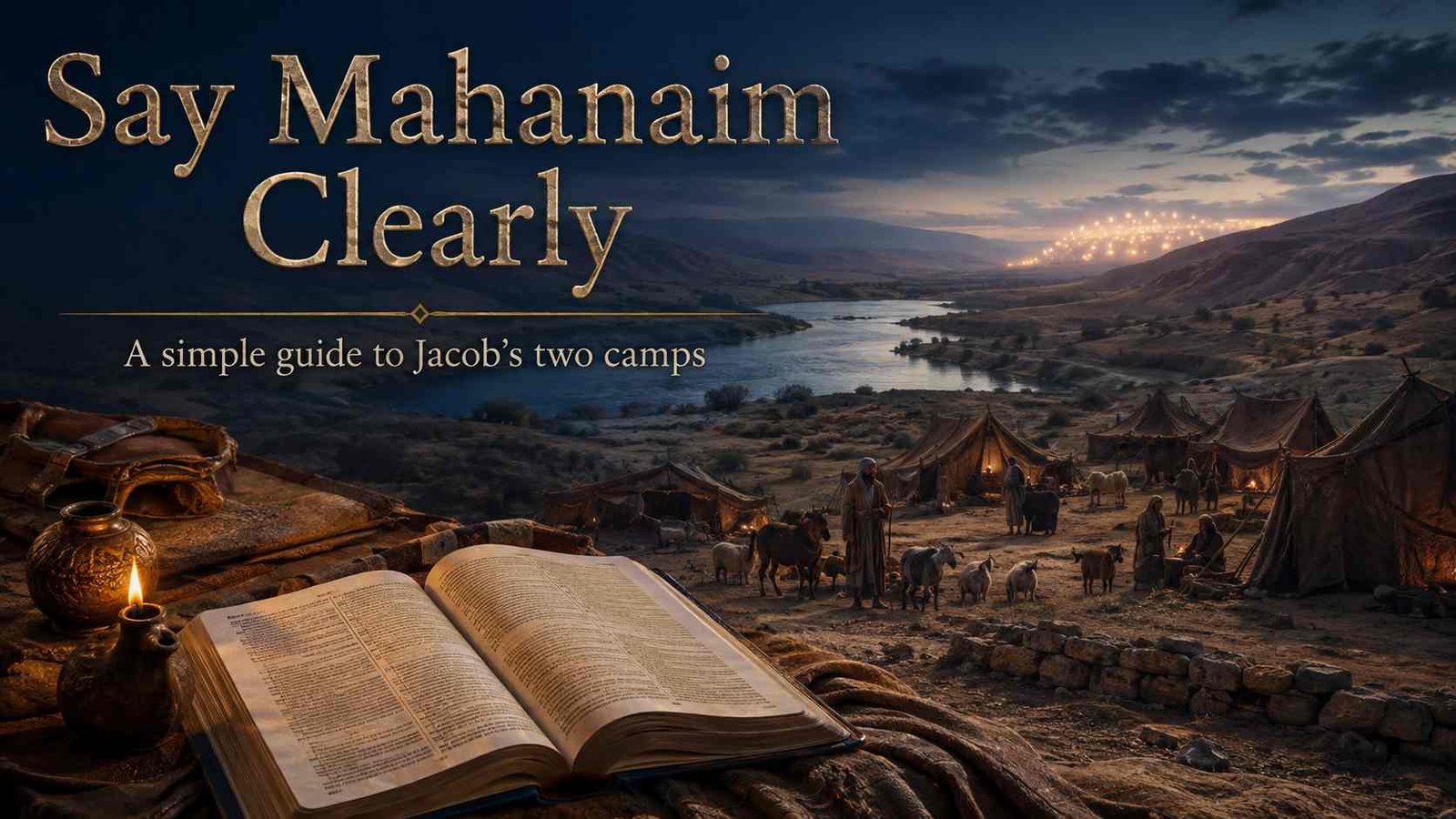
 If you have reached Genesis 32 and stopped at the word Mahanaim, you are not alone. Biblical place names can look difficult at first, especially when they come from ancient Hebrew.
A simple way to pronounce Mahanaim in the Bible is:
mah-hah-NAH-eem
Say it slowly at first:
mah – hah – NAH – eem
Then put the sounds together: mah-hah-NAH-eem.
Bible pronunciation guides commonly use this English-friendly pronunciation, while Hebrew-based resources may give a form closer to Machanayim, pronounced with a stronger kh sound.
Mahanaim is much more than a difficult Bible word, however. Its name means two camps or double camp, and it comes from a remarkable moment in Jacob’s life when the angels of God met him.
Genesis 32:2 says that after Jacob saw the angels, he recognized the place as God’s camp and named it Mahanaim.
Understanding the name, its pronunciation, and its story makes this unusual biblical word much easier to remember.
How to Pronounce Mahanaim in the Bible Step by Step
The easiest English pronunciation is:
mah-hah-NAH-eem
Here is a simple breakdown:
| Part | Say It Like |
|---|---|
| Ma | mah |
| ha | hah |
| na | NAH |
| im | eem |
| Full word | mah-hah-NAH-eem |
The main stress falls around the NAH sound.
Try saying it three times:
mah-hah-NAH-eem
mah-hah-NAH-eem
mah-hah-NAH-eem
Once you stop looking at the entire word and begin reading it in smaller parts, it becomes much easier.
BibleSpeak gives the pronunciation as mah-hah-NAH-eem, which is a practical form for English-speaking Bible readers.
This is a useful lesson when learning how to pronounce Bible names generally. Long biblical words often become simple when you divide them into syllables.
Mahanaim Pronunciation in Hebrew
There is another pronunciation you may hear when listening to someone who is trying to stay closer to the Hebrew form.
The Hebrew name is commonly transliterated as Machanayim or Mahanaim.
BibleHub gives the form Machanayim and represents its pronunciation as approximately:
makh-an-ah-yim
The kh sound does not have an exact match in normal English. It is made farther back in the throat than the English letter h. Because English readers often simplify Hebrew sounds, different Bible teachers and pronunciation resources may sound slightly different when saying Mahanaim.
That difference should not worry you.
If you say mah-hah-NAH-eem, another Christian says mah-hah-NAY-im, and someone studying Hebrew uses Machanayim, all may be referring to the same biblical place.
Pronunciation traditions can vary when Hebrew names enter English.
The important thing is to recognize the name and understand the story behind it.
An Easy Way to Remember Mahanaim
A good way to remember the pronunciation is to connect the sound with the meaning.
Think:
Mahanaim = two camps
Then repeat:
mah-hah-NAH-eem — two camps
This links the pronunciation directly with Genesis 32.
When you remember Jacob’s camp and the mysterious camp of God, the unusual name becomes much easier to recognize.
What Does Mahanaim Mean in the Bible?
The biblical name Mahanaim means two camps, double camp, or, in some older Bible language, two hosts.
BibleHub’s Hebrew lexicon describes Machanayim as a double camp. Translation notes on Genesis 32 similarly explain the name as two camps or twin camps.
The name is connected with the Hebrew word for a camp or encampment.
This meaning is important because Jacob had just encountered angels when he gave the place its name.
Genesis 32 begins:
Jacob continued on his journey, and the angels of God met him.
When Jacob saw them, he recognized what he described as God’s camp. He then called the place Mahanaim. Genesis 32:2 directly connects the name with this encounter.
Here is the basic idea:
| Biblical Term | Simple Meaning |
|---|---|
| Mahanaim | Two camps |
| Machanayim | Hebrew/transliterated form |
| Camp | A group staying or gathered in one place |
| God’s camp | The angelic company Jacob encountered |
The name therefore reminds the reader that Jacob’s journey included more than the people, animals, servants, and possessions he could see.
There was also a heavenly presence.
Why Did Jacob Name Mahanaim?
To understand why Jacob named Mahanaim, we need to look at what was happening in his life.
Jacob had spent years living with his uncle Laban. By Genesis 31, he had left Laban and was traveling back toward the land connected with his family.
But returning home created another serious problem.
His brother Esau was there.
Years earlier, Jacob had received the blessing associated with Esau, and the relationship between the brothers had become deeply troubled. Jacob knew that meeting Esau again could be dangerous.
Genesis 32 places Jacob between two stressful experiences. Laban was now behind him, while Esau was ahead.
Then something unexpected happened.
The angels of God met him.
Jacob responded by saying that this was God’s camp, and he named the place Mahanaim.
The name appears to preserve the memory of that encounter.
That makes Mahanaim an important place in the story of who Jacob is in the Bible. Jacob was not simply traveling from one geographical location to another. He was moving through a period of fear, family conflict, spiritual encounters, and personal change.
Soon after Mahanaim, Genesis 32 records another major event in Jacob’s life: his mysterious nighttime wrestling encounter, after which the name Israel becomes central to his story.
Mahanaim therefore stands near one of the great turning points in Jacob’s life.
Were There Really Two Camps at Mahanaim?
This question is more interesting than it may first appear.
Mahanaim means two camps, but Genesis 32:2 does not directly tell us exactly which two camps Jacob had in mind.
A common explanation is:
Jacob’s camp + God’s angelic camp = two camps
This interpretation makes sense in the immediate setting. Jacob had his household and possessions with him, and then he encountered what he called God’s camp.
The NET Bible’s notes say the name apparently means two camps and suggest that the two may have been God’s camp and Jacob’s camp. BibleHub also presents this as a possible explanation.
But we should distinguish between what the Bible states and what interpreters infer.
Genesis does not say:
“The first camp was Jacob’s and the second was the angels’ camp.”
It simply tells us that Jacob saw the angels, called what he saw God’s camp, and named the place Mahanaim.
BibleRef therefore gives a careful explanation: the name means two camps, but exactly what the two camps refer to is not completely clear.
There is another interesting detail.
Only a few verses later, Jacob becomes afraid when he hears that Esau is approaching with four hundred men. He then divides his people, flocks, herds, and camels into two camps. His plan is that if Esau attacks one group, perhaps the other group can escape.
Translation commentary on Genesis 32 notes this connection while also acknowledging that the reason for the original place-name is not stated with complete precision.
So there are two related ideas in Genesis 32:
- Jacob encounters God’s camp and names the place Mahanaim, meaning two camps.
- Jacob later divides his own company into two camps because he fears Esau.
We do not need to force the passage to say more than it says.
Sometimes careful Bible study means being comfortable with a small amount of uncertainty.
How to Pronounce Mahanaim in the Bible’s Genesis Story
Now that we know the background, try reading the name again:
Mahanaim: mah-hah-NAH-eem
Imagine Jacob traveling with his family and possessions.
He has just left a difficult situation involving Laban. He knows Esau is somewhere ahead. He does not yet know how their meeting will end.
Then God’s angels meet him.
Jacob says, in effect, this is God’s camp.
And the location receives the name:
Mahanaim — two camps.
The story itself gives the pronunciation something to attach to in your memory.
Genesis 32 also contains several other names that readers sometimes find difficult, including Esau, Seir, Edom, Jabbok, and Peniel.
For example, readers learning how to pronounce Jabbok in the Bible often discover it while studying the same chapter. Jacob later crosses the Jabbok and experiences his famous nighttime struggle.
Learning these names within their stories works much better than memorizing sounds alone.
A Bible name is rarely just a collection of strange letters. It often represents a person, place, event, or memory.
Mahanaim is a perfect example.
Where Was Mahanaim Located?
Mahanaim was located east of the Jordan River, in the Transjordan area associated with Gilead and the Jabbok region.
Bible dictionaries connect Mahanaim with the area near the Jabbok and beyond the Jordan. Its exact location in modern geography is uncertain, although several ancient sites have been proposed.
For most readers, the important geographical point is simple:
Mahanaim was on the eastern side of the Jordan, in the region connected with Gilead.
That helps explain why the place appears again in later Old Testament history.
Joshua associates Mahanaim with the territory in this eastern region, and later biblical references show that it became more than the place where Jacob once encountered angels.
If you are studying where Gilead is in the Bible, Mahanaim is one of the places worth noticing.
Its location also makes sense within Jacob’s return journey as he traveled toward his meeting with Esau.
Mahanaim After the Time of Jacob
Many readers remember Mahanaim only because of Genesis 32.
Yet the town appears again hundreds of years later in Israel’s story.
The name that began with Jacob became attached to a significant settlement.
Mahanaim and Ish-bosheth
After the death of King Saul, Israel entered a difficult political period.
David was recognized as king by the tribe of Judah, but Saul’s son Ish-bosheth was supported by Abner, the commander of Saul’s army.
According to 2 Samuel 2:8, Abner brought Ish-bosheth to Mahanaim and established him there.
Mahanaim therefore became an important political center during the struggle that followed Saul’s death. Bible dictionaries identify it as the place from which Ish-bosheth ruled while David was based at Hebron.
This is a fascinating change.
For Jacob, Mahanaim had been a place connected with angels and God’s camp.
Generations later, it became connected with kings, armies, and national conflict.
David Finds Refuge at Mahanaim
Mahanaim appears again during another painful moment in Israel’s history.
This time, King David was fleeing from his son Absalom.
Absalom’s rebellion forced David to leave Jerusalem, and 2 Samuel 17:24 records David arriving at Mahanaim. The town then became an important base for him during the conflict.
The biblical story later places David at Mahanaim when news reaches him about the battle and Absalom’s death.
This gives Mahanaim an unusual history.
It appears at moments when major biblical figures are under pressure:
Jacob approaching Esau.
Ish-bosheth during a divided kingdom.
David fleeing from Absalom.
We should be careful not to invent a spiritual rule from these events. The Bible does not say that Mahanaim always represents protection during crisis.
Still, its repeated appearance during uncertain moments makes its history memorable.
How Do You Pronounce This Biblical Word Correctly?
People often search, How do you pronounce this word biblical? because Bible names were not originally English words.
That is important to remember.
Most Old Testament names reached English readers through ancient Hebrew, later translation traditions, and English Bible conventions. As a result, an English church pronunciation does not always sound exactly like a reconstructed or modern Hebrew pronunciation.
Mahanaim shows this clearly.
For normal English Bible reading:
mah-hah-NAH-eem
is easy to recognize and is specifically used by Bible pronunciation resources.
A Hebrew-oriented pronunciation may sound closer to:
makh-an-ah-yim
BibleHub reflects this form through the transliteration Machanayim.
Neither difference should become a source of anxiety when you read Scripture aloud.
You are reading a name that has crossed languages.
If you want to improve your pronunciation of difficult Bible words, four simple habits help:
1. Break the name into syllables
Do not attack a long name all at once.
Mahanaim becomes:
mah + hah + NAH + eem
This method also works with many longer Bible names.
2. Listen to the name aloud
Written pronunciation guides help, but hearing the word can make it easier to remember.
Different speakers may sound slightly different. That is normal with ancient biblical names.
3. Learn what the name means
Meaning creates memory.
If you remember:
Mahanaim = two camps
you are more likely to remember both the word and its biblical setting.
4. Read the surrounding Bible passage
Names become easier when they belong to a story.
Mahanaim is easier to remember when you connect it with Jacob, God’s angels, Esau, Jabbok, and Genesis 32.
This is one of the best approaches for anyone learning how to pronounce Bible names.
Why Mahanaim Matters in Jacob’s Story
Jacob’s life contains many named places.
Some of those names are connected with defining moments.
Bethel is linked with Jacob’s vision of the stairway reaching toward heaven.
Peniel is connected with the mysterious struggle in Genesis 32 and Jacob’s statement about seeing God face to face.
Mahanaim stands between important moments in his journey.
Jacob is returning home, but he is afraid.
His past is catching up with him in the person of Esau.
Before Jacob knows how the meeting will end, the angels of God appear.
Genesis does not give us many details about the appearance. It does not tell us how many angels Jacob saw or exactly what they looked like. Enduring Word likewise notes that the text does not fully explain how this encounter occurred.
What Scripture does tell us is enough:
Jacob recognized them as belonging to God.
He called the place God’s camp.
He named it Mahanaim.
That is why the meaning two camps matters.
The name preserved a memory.
Jacob was surrounded by earthly concerns. He had family concerns, safety concerns, and unfinished conflict with his brother.
Yet there was more happening than Jacob’s visible circumstances alone could show.
What Mahanaim Teaches Us About God’s Presence
We should always be careful when turning a biblical place-name into a spiritual lesson.
Mahanaim does not promise that Christians will physically see angels whenever they face fear. Genesis 32 describes a specific event in Jacob’s life.
Yet the story still gives readers something meaningful to consider.
Jacob was moving toward uncertainty when God’s angels met him.
He had not yet solved his problem with Esau.
He did not yet know whether his brother would welcome him or attack him.
His circumstances were still difficult.
Yet God’s presence was not dependent on Jacob first getting everything under control.
That is a powerful detail.
Sometimes we imagine that God’s care will become clear only after a problem disappears. Jacob’s story shows something different. The angelic encounter came before the feared meeting with Esau had been resolved.
Mahanaim therefore reminds us to notice God’s presence even during unfinished stories.
Faith does not always mean knowing exactly what will happen next.
Sometimes faith means continuing forward while trusting the God who already sees what lies ahead.
For Jacob, the road continued beyond Mahanaim.
There would be fear.
There would be prayer.
There would be wrestling.
There would eventually be a meeting with Esau that unfolded differently from the disaster Jacob feared.
Mahanaim was one moment in that larger journey.
Why Did Jacob Name Mahanaim Instead of Simply Moving On?
Names often carry memory in biblical narratives.
Jacob could have encountered the angels and continued traveling without marking the place.
Instead, he named it.
The name turned an experience into something that could be remembered.
Every time the word Mahanaim was spoken, the meaning two camps remained attached to the place.
That pattern appears elsewhere in Jacob’s life as well. Important encounters are often associated with named locations.
This tells us something about how biblical narratives preserve memory.
Places are not always included merely to tell readers where someone traveled. Sometimes geography becomes part of the story’s message.
Mahanaim is one of those places.
Its name carries the memory of Jacob seeing what he identified as God’s camp.
Later generations would know Mahanaim as a town.
Kings would use it.
Armies would gather around it.
David would seek safety there.
But behind all that later history stood an older story:
A traveler named Jacob was returning home.
The angels of God met him.
And he called the place Mahanaim.
Remembering How to Pronounce Mahanaim in the Bible
So, how do you pronounce Mahanaim in the Bible?
The easiest English pronunciation is:
mah-hah-NAH-eem
If you are studying the Hebrew form, you may also encounter:
Machanayim — makh-an-ah-yim
Both forms point to the same biblical name. English pronunciation traditions simply handle the ancient Hebrew sounds differently.
And what does Mahanaim mean?
Two camps or double camp.
Why did Jacob name Mahanaim?
Genesis 32:1–2 tells us that the angels of God met Jacob during his journey. Jacob recognized what he called God’s camp and named the place Mahanaim. A common interpretation sees the name’s two camps as Jacob’s company and God’s angelic company, though Scripture does not explicitly define the two camps in those exact words.
That careful distinction matters.
Bible study is strongest when we confidently affirm what Scripture clearly says while remaining humble about details the text leaves open.
The next time you reach Genesis 32, you no longer need to hesitate over this unusual name.
Say it slowly:
mah-hah-NAH-eem.
Then remember what stands behind the word:
Dr. Rachel is very smart and knows a lot about the Bible. He helps us understand the Bible better by talking about the old texts in a simple way.