

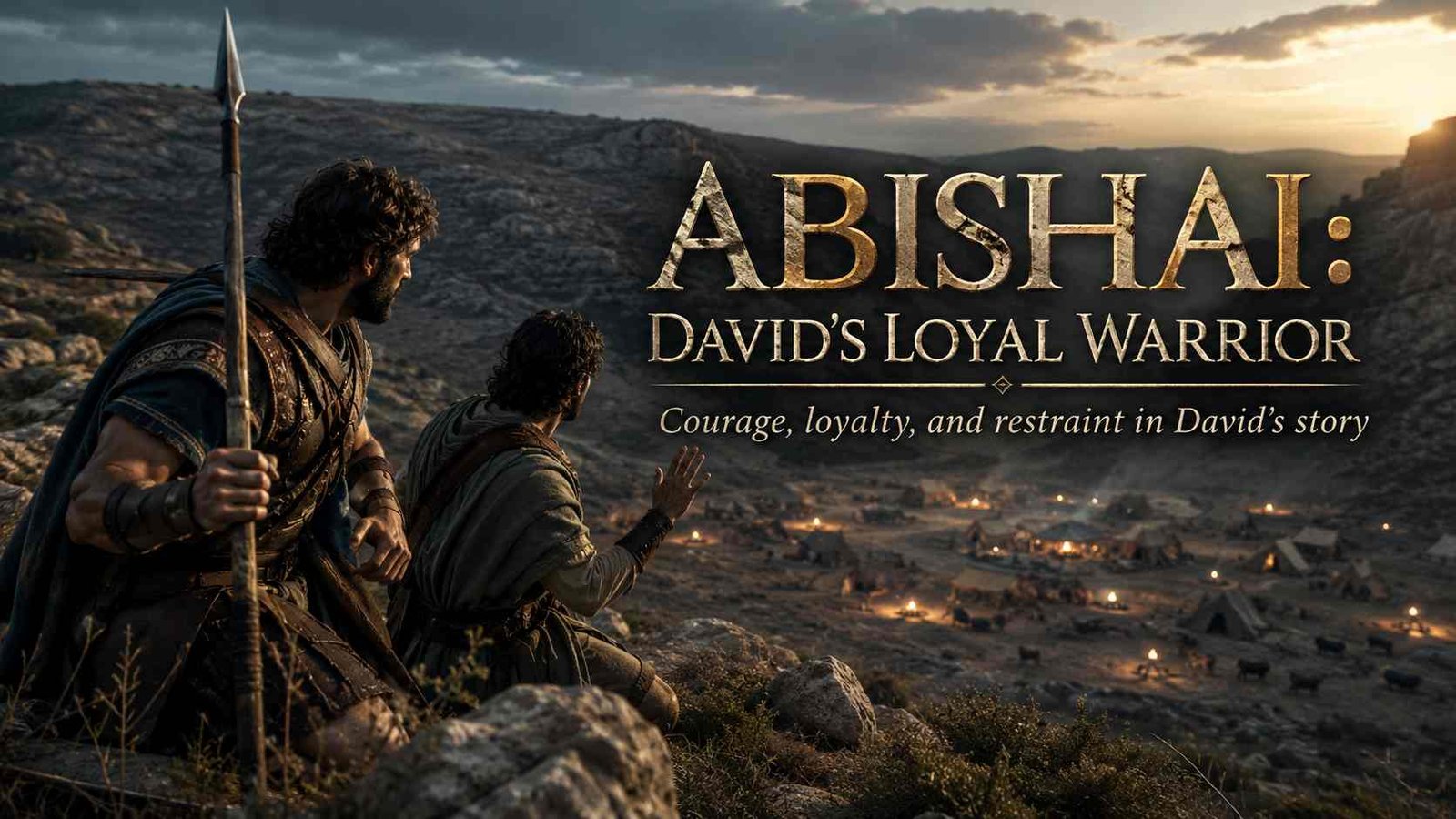
 Abishai in the Bible was a brave warrior, military commander, and loyal supporter of King David. He was the son of Zeruiah, David’s sister, which made him David’s nephew. His brothers were Joab and Asahel, two other important men in David’s story.
Abishai appears mainly in 1 Samuel, 2 Samuel, and 1 Chronicles. He fought in major battles, commanded part of David’s army, protected David from his enemies, and once saved David’s life.
Yet Abishai was not simply a fearless Bible hero.
He could also be impulsive. More than once, he wanted to kill someone he believed had dishonored or threatened David. David sometimes had to stop him.
That makes Abishai especially interesting. His story shows us courage and loyalty, but it also teaches that strength needs wisdom, patience, and self-control.
Who Is Abishai in the Bible and What Was His Family Background?
Abishai belonged to one of the most important military families around King David.
First Chronicles 2:16 names the three sons of Zeruiah as:
- Abishai
- Joab
- Asahel
Zeruiah was David’s sister, so these three warriors were David’s nephews.
Joab became the best known of the brothers because he served as commander of David’s army. Asahel was known for his speed and died during the conflict between David’s supporters and the house of Saul.
Abishai often stood beside Joab in battle.
If you are studying David’s military leaders, it helps to also understand who is Joab in the Bible and who was Zeruiah in the Bible, because the actions of this family affect many chapters of 2 Samuel.
Interestingly, the exact meaning of the name Abishai is uncertain. Different explanations have been suggested, but the Bible Gateway Encyclopedia of the Bible notes that the Hebrew meaning cannot be stated with confidence.
That is worth remembering because some popular explanations give one meaning as though it were certain.
What Is the Story of Abishai in the Bible?
The story of Abishai is spread across several events rather than one single chapter.
His life is closely connected with David’s years as a fugitive, David’s reign as king, civil conflict within Israel, and Israel’s wars against surrounding enemies.
Some of the most important events involving Abishai are found in:
| Bible Passage | What Abishai Does |
|---|---|
| 1 Samuel 26 | Goes with David into Saul’s camp |
| 2 Samuel 3 | Is connected with Joab in Abner’s death |
| 2 Samuel 10 | Commands troops against the Ammonites |
| 2 Samuel 16 | Wants Shimei killed for cursing David |
| 2 Samuel 18 | Commands one-third of David’s army |
| 2 Samuel 19 | Again wants Shimei punished |
| 2 Samuel 20 | Is ordered to pursue Sheba |
| 2 Samuel 21 | Saves David’s life |
| 2 Samuel 23 | Is honored among David’s great warriors |
| 1 Chronicles 18 | Is credited with a major victory over Edom |
Together, these passages show a man who was brave, dependable, fierce, and deeply loyal to David.
They also reveal his weakness: Abishai could move very quickly from loyalty to violence.
Abishai Goes With David Into Saul’s Camp
One of the clearest pictures of Abishai’s personality appears in 1 Samuel 26.
At this point, Saul was still king of Israel. David had already been chosen for a future role, but Saul viewed David as a threat and was pursuing him.
David discovered where Saul and his soldiers were camped.
He then asked who would go down into the camp with him.
Abishai answered immediately that he would go.
That short response tells us something about him. Abishai was willing to enter a dangerous situation beside David when others could have stayed behind.
David and Abishai entered the camp at night.
Saul was sleeping, and his spear was stuck in the ground near his head. His commander Abner and the soldiers were sleeping around him.
To Abishai, the situation seemed obvious.
Saul had hunted David. Now Saul was helpless.
Abishai believed God had placed David’s enemy into his hands. He offered to kill Saul with the spear and said one strike would be enough.
But David saw the situation differently.
What Did David Say to Abishai?
David told Abishai not to destroy Saul.
His reason was important: Saul was still the Lord’s anointed king.
David refused to take Saul’s life into his own hands. Instead, he trusted that Saul’s future and judgment belonged to God.
David and Abishai took Saul’s spear and water container and left the camp without killing him.
This scene gives us one of the strongest lessons in Abishai’s story.
Just because we have the power to do something does not mean we should do it.
Abishai saw an opportunity.
David thought about obedience.
Abishai saw an enemy.
David remembered God’s authority.
Abishai wanted immediate action.
David was willing to wait.
There are moments in life when anger makes a certain response feel justified. We may believe someone deserves our harsh words, revenge, or punishment.
Abishai reminds us that courage without restraint can lead us in the wrong direction.
For more background on this event, the story becomes clearer when we understand who was King Saul in the Bible and why the relationship between Saul and David had become so dangerous.
Who Is Abishai in 2nd Samuel?
Abishai becomes an even more important figure in 2 Samuel.
He is no longer simply the man who followed David into Saul’s camp. We see him functioning as an experienced military leader.
He fights David’s enemies, receives important commands, leads soldiers, stands beside Joab, and protects the king.
Second Samuel also shows the difficult side of Abishai.
His loyalty to David was strong, but he sometimes wanted to solve problems through force.
David repeatedly had to place limits on that instinct.
That contrast is one reason Abishai feels so human. The Bible does not hide his courage, but it does not hide his faults either.
Abishai and Joab Take Revenge for Asahel
To understand one of the darker parts of Abishai’s story, we need to remember what happened to his brother Asahel.
During conflict between David’s supporters and the supporters of Saul’s house, Asahel pursued Abner.
Abner warned him to stop.
Asahel continued chasing him, and Abner killed him.
The death created deep anger within the family.
Later, Abner began moving toward peace with David. David received him and sent him away safely.
Joab, however, brought Abner back and killed him.
Second Samuel 3:30 states that Joab and Abishai were responsible for Abner’s death because Abner had killed their brother Asahel at Gibeon. The immediate narrative particularly describes Joab carrying out the fatal attack, while verse 30 connects both brothers with the revenge.
David did not celebrate Abner’s death.
Instead, he mourned him publicly.
This event exposes an important weakness in Abishai and Joab.
Family loyalty had turned into revenge.
Their grief was understandable. Their brother had died.
But revenge created more bloodshed.
This side of Abishai’s story keeps us from turning him into a perfect hero. Scripture shows real people with real strengths and real failures.
Abishai Becomes One of David’s Trusted Commanders
Whatever his faults, Abishai clearly earned considerable military responsibility.
David and Joab trusted him with soldiers during serious national threats.
Fighting the Ammonites
In 2 Samuel 10, Israel faced enemies on more than one side.
Joab divided the forces.
He personally led selected troops against the Arameans, while he placed the remaining army under Abishai to face the Ammonites. Joab told his brother that each group should come to the other’s help if necessary.
The arrangement shows that Abishai was not simply an ordinary soldier.
He was trusted to command men in a difficult battle.
When the Arameans fled from Joab, the Ammonites also withdrew before Abishai.
Fighting During Absalom’s Rebellion
Years later, David faced an even more painful conflict.
His own son Absalom rebelled against him.
When David organized his forces, he divided the army into three major groups.
One-third was commanded by Joab.
One-third was commanded by Ittai the Gittite.
And one-third was placed under Abishai.
Again, the responsibility given to Abishai tells us how highly he was trusted as a military leader.
This was not a minor battle. David’s throne and the stability of the kingdom were at stake.
Pursuing Sheba Son of Bikri
Another rebellion followed.
A man named Sheba son of Bikri led people away from David.
David considered the threat serious.
In 2 Samuel 20:6, David personally ordered Abishai to take his men and pursue Sheba before the rebel could reach fortified cities and become harder to defeat.
That command again demonstrates Abishai’s standing.
When urgent military action was needed, David trusted him.
The same part of David’s story also involves Amasa, so readers studying these events may find who was Amasa in the Bible helpful for understanding the wider conflict.
Why Did Abishai Want to Kill Shimei?
Not all of Abishai’s confrontations happened on a battlefield.
One of the most revealing happened while David was fleeing from Absalom.
A man named Shimei came out and cursed David.
He also threw stones and accused David of wrongdoing.
Abishai was furious.
His response was predictable by this point in the story: he wanted permission to kill the man.
David refused.
Rather than answering Shimei’s insults with immediate violence, David accepted the humiliation and left judgment with God.
Later, the situation changed.
Absalom’s rebellion ended, and David returned as king.
Shimei came to meet David and admitted that he had sinned.
Once again, Abishai wanted him executed because he had cursed the Lord’s anointed.
Once again, David refused.
David declared that Shimei would not die that day.
Notice the pattern.
When Saul was helpless, Abishai wanted Saul killed.
David stopped him.
When Shimei cursed David, Abishai wanted Shimei killed.
David stopped him.
When Shimei returned asking for mercy, Abishai still wanted punishment.
David again stopped him.
Abishai’s loyalty was real.
But David repeatedly taught him that loyalty does not make every angry response right.
Loyalty Without Restraint Can Become Dangerous
This may be the most practical lesson from Abishai’s life.
Loyalty is normally a good quality.
We want friends who stand beside us.
We want family members who defend us.
We respect people who remain faithful during difficult times.
Abishai certainly had that kind of loyalty.
When David needed someone to enter Saul’s camp, Abishai went.
When David needed soldiers commanded, Abishai led them.
When David was threatened in battle, Abishai defended him.
The problem was not that Abishai cared too much about David.
The problem was that his loyalty could move faster than his wisdom.
Sometimes love says, “I will defend you.”
Wisdom must still ask, “What is the right way to defend you?”
That distinction matters in our lives too.
We may become angry when someone hurts a person we love. We may want to answer immediately.
Abishai’s story reminds us that faithful strength includes knowing when to act and when to stop.
How Did Abishai Save David’s Life?
One of Abishai’s finest moments comes in 2 Samuel 21.
Israel was again fighting the Philistines.
David went into battle, but he became exhausted.
A Philistine warrior named Ishbi-Benob, described as one of the descendants of Rapha, intended to kill David.
David was in serious danger.
Abishai came to his aid.
He attacked the Philistine and killed him, saving David from the threat. After this incident, David’s men insisted that the king should no longer go with them into battle because his life was too important to Israel.
Here we see Abishai’s strength used in its best form.
He was not acting out of revenge.
He was protecting someone in immediate danger.
He saw David in trouble and stepped in.
The same fearless personality that sometimes needed restraint was now exactly what the situation required.
This helps us see Abishai fairly.
A strong personality is not necessarily bad.
Boldness is not bad.
Courage is not bad.
The question is how those qualities are used.
Was Abishai One of David’s Mighty Men?
Abishai held an honored place among David’s elite warriors.
Second Samuel 23 and 1 Chronicles 11 describe the men often called David’s mighty warriors or David’s mighty men.
Abishai is singled out for an extraordinary military achievement: he wielded his spear against three hundred men and gained a great reputation among David’s warriors.
There is a small translation issue worth knowing.
Different Bible translations describe his exact position as chief of the Three or chief of the Thirty. The underlying textual wording has led translators and scholars to handle the title differently.
We do not need to solve that textual question to understand the main point.
The biblical writers clearly present Abishai as an exceptional and highly honored warrior.
He was more than Joab’s brother.
He had a reputation of his own.
Abishai’s Victory Over the Edomites
First Chronicles records another major military achievement.
First Chronicles 18:12 specifically credits Abishai son of Zeruiah with striking down 18,000 Edomites in the Valley of Salt. The following verse describes Edom coming under David’s rule and places the victory within the larger success of David’s kingdom.
Again, the emphasis is not simply on a battle statistic.
The verse strengthens the biblical picture of Abishai as an important military figure during David’s reign.
He was present when David was hiding from Saul.
He remained important when David became king.
He commanded troops during national wars.
He fought during internal rebellions.
And he protected David personally.
Few supporting characters remain connected to David across so many different crises.
Abishai and Abishag Are Not the Same Person
Because their names look similar, Abishai and Abishag are sometimes confused.
They are completely different people.
| Person | Identity | Connection to David |
|---|---|---|
| Abishai | Son of Zeruiah and military warrior | David’s nephew, supporter, and commander |
| Abishag | Young woman from Shunem | Cared for David in his old age |
Abishai appears largely in Samuel and Chronicles as a warrior.
Abishag appears at the beginning of 1 Kings.
Remembering that difference can prevent a lot of confusion.
What Did Abishag Do for David?
When King David became very old, he struggled to keep warm.
His attendants searched for a young woman who could care for him and help keep him warm.
They found Abishag the Shunammite.
First Kings 1:1–4 says that she attended David, cared for him, and lay beside him to keep him warm. The passage also specifically states that David did not have sexual relations with her.
Later, after David’s death, Adonijah asked to marry Abishag.
Bathsheba took the request to Solomon. Solomon treated Adonijah’s request as connected with a claim to the kingdom, and Adonijah was put to death.
That later event belongs to the story of who was Adonijah in the Bible, not to the life of Abishai.
So the simple distinction is:
Abishai was David’s warrior nephew. Abishag was the woman who cared for the elderly David.
What Kind of Man Was Abishai?
When all the passages are placed together, several qualities stand out.
Abishai Was Courageous
Fear rarely seems to stop him.
He entered Saul’s camp with David.
He fought Israel’s enemies.
He commanded troops.
He faced danger when David’s life was threatened.
His courage is one of the clearest features of his character.
Abishai Was Loyal
Few people appear as consistently ready to defend David.
Abishai stayed connected to David through danger, war, rebellion, and political trouble.
Even his worst impulses often came from a desire to defend his king.
Abishai Was a Capable Leader
David did not give major military responsibilities to him by accident.
Abishai commanded troops against the Ammonites, led one-third of David’s army during Absalom’s rebellion, and received the order to pursue Sheba.
That repeated trust tells us he was an experienced commander.
Abishai Was Protective
Perhaps the best example is his rescue of David from Ishbi-Benob.
When David became exhausted and his life was threatened, Abishai acted.
His strength became a shield for another person.
Abishai Could Be Quick-Tempered
His instinct was often to remove an enemy immediately.
Saul should die.
Shimei should die.
Shimei should still die when he returned.
This pattern helps explain why David sometimes spoke sharply to the sons of Zeruiah.
Abishai Was Imperfect
His connection with the killing of Abner is especially serious.
The Bible does not ask readers to approve everything Abishai did merely because he served David.
That honesty is part of the power of biblical history.
Scripture can show us admirable qualities in a person while also showing us actions that were deeply wrong.
What Can We Learn From Abishai in the Bible?
Abishai lived thousands of years ago in circumstances very different from ours.
Yet his character raises questions that still matter.
Courage Needs Wisdom
Courage is valuable, but courage alone does not tell us what is right.
Abishai was brave enough to enter Saul’s camp.
But David had the wisdom to leave Saul alive.
Sometimes the harder act of courage is restraint.
It may take more strength to walk away from an argument than to win it.
It may take more strength to forgive than to retaliate.
It may take more strength to wait than to act immediately.
Loyalty Should Not Become Blind Anger
Abishai cared deeply about David.
That was admirable.
Yet he sometimes treated anyone who insulted David as though that person needed to die.
Our world is different, but the heart problem can look familiar.
Someone attacks our friend.
Someone insults our family.
Someone speaks unfairly about a person we respect.
Anger rises quickly.
Abishai’s story asks us to place wisdom between the feeling and the response.
Strength Should Protect Others
Abishai gives us a beautiful example of this when he saves David.
Biblical strength is not simply about defeating an opponent.
Strength can serve.
Strength can protect.
Strength can stand beside someone who is tired.
Strength can step forward when another person cannot defend himself.
That kind of strength blesses people rather than frightening them.
Revenge Is Different From Justice
The death of Abner shows what happens when grief and revenge become mixed.
Abishai and Joab had lost Asahel.
Their pain was real.
But Scripture does not hide the destructive result of their revenge. Second Samuel directly connects the brothers with Abner’s death, while also showing David mourning Abner.
Pain does not automatically make revenge right.
That lesson is as important now as it was in David’s day.
Faithful People Still Need Correction
Abishai could be loyal and wrong at the same time.
He could be brave and impulsive.
He could protect David in one scene and need David to restrain him in another.
That is a useful reminder for all of us.
Being faithful does not mean we never need correction.
Being gifted does not mean every instinct is trustworthy.
Being strong does not mean we always know the best response.
Sometimes wise people in our lives see something we do not.
What Did David Teach Abishai?
David probably taught Abishai many things through years of leadership and battle, but one lesson appears repeatedly in their recorded conversations:
Not every enemy must be answered with immediate force.
David would not let Abishai kill Saul.
David would not let him kill Shimei when Shimei cursed him.
David again rejected Abishai’s call for Shimei’s death when the kingdom was restored.
David himself was far from perfect. Scripture records his own serious sins and failures.
Yet in these moments, David understood something Abishai struggled to accept.
There is a time to fight, and there is a time to show restraint.
Abishai was excellent at the first.
He needed help with the second.
Why Abishai Still Matters to Bible Readers
Abishai never became king.
He did not write a biblical book.
He was not a prophet.
Yet his life deserves attention because he stood close to some of the most important events in David’s story.
He was there when Saul was vulnerable.
He fought beside David’s forces as the kingdom grew.
He experienced family loss.
He became involved in revenge.
He led soldiers during national conflict.
He remained loyal when rebellion threatened David’s throne.
And when David became weary in battle, Abishai came to his rescue.
His story is not neat.
That is what makes it useful.
Abishai shows us that a person can have impressive gifts and still need spiritual maturity. Courage needs wisdom. Loyalty needs restraint. Strength needs a righteous purpose.
Perhaps the simplest way to remember him is this:
Abishai knew how to fight for David, but David sometimes had to teach Abishai when not to fight.
That truth reaches far beyond an ancient battlefield.
We all have strengths. Some people are bold. Some are protective. Some respond quickly when they see something wrong.
Those qualities can become wonderful gifts when they are guided by wisdom.
Abishai’s life reminds us not merely to ask, “Am I strong enough to act?”
We should also ask, “Is this the right thing to do?”
That is where strength becomes mature.
And that is one of the lasting lessons we can learn from who Abishai is in the Bible.

Dr. Rachel is very smart and knows a lot about the Bible. He helps us understand the Bible better by talking about the old texts in a simple way.