
 The resurrection of Jesus Christ stands at the heart of the Christian faith. It is the moment Christians believe death was defeated, God’s promise was fulfilled, and a new hope was given to humanity. But one question continues to interest Bible readers: When did Jesus resurrect?
According to the New Testament, Jesus rose from the dead on the third day after His crucifixion. The four Gospels tell us that His empty tomb was discovered early on the first day of the week, which we call Sunday. This is why Christians celebrate Easter Sunday, also known as Resurrection Sunday.
Yet the Bible does not tell us the exact hour Jesus rose. It also does not provide a modern calendar date. Some historians suggest that the crucifixion happened in AD 30 or AD 33, but the precise year remains debated.
Understanding the resurrection means looking at more than one morning. We need to consider the crucifixion, the Jewish Sabbath, the Passover festival, and the way people counted days in biblical times.
These details help explain why Christians say Jesus rose on the third day and why the resurrection remains central to the message of salvation.
When Did Jesus Resurrect According to the Bible?
Jesus resurrected on the third day after His death, and His tomb was found empty early on Sunday morning. This is the clearest answer provided by the Gospel accounts.
Matthew 28:5–6 records the angel’s announcement to the women who came to Jesus’ tomb:
Fear not ye: for I know that ye seek Jesus, which was crucified. He is not here: for he is risen, as he said.
Matthew 28:5–6, King James Version (KJV)
The message was simple but extraordinary. Jesus, who had been crucified and buried, was no longer in the tomb.
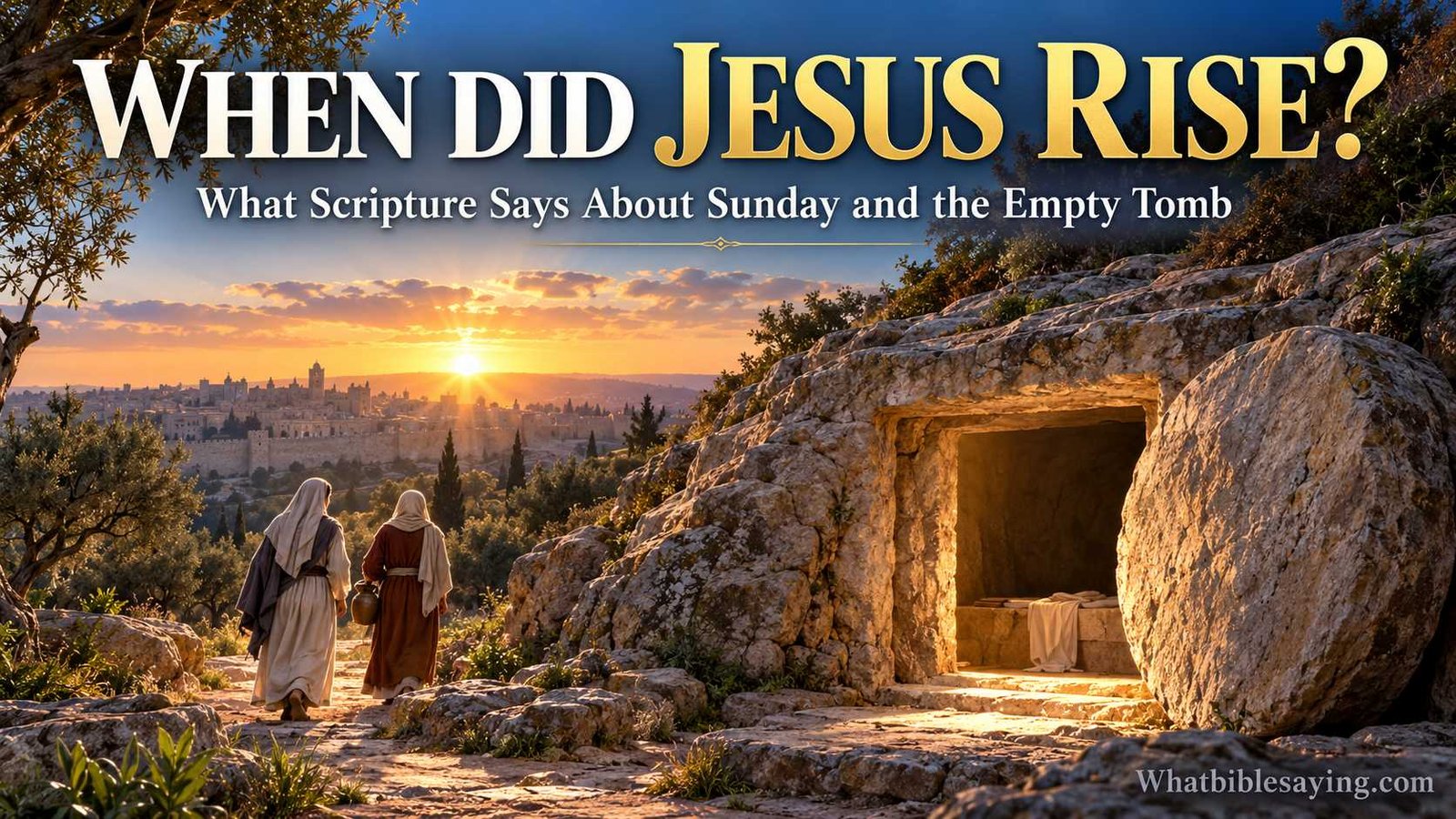
Matthew explains that Mary Magdalene and the other Mary went to the tomb as the first day of the week was beginning. Mark 16:2 places the women’s visit just after sunrise, while John 20:1 says Mary Magdalene arrived while it was still dark.
These descriptions focus on the early morning discovery, though the Gospel writers provide different details about the visitors and events.
What the Four Gospels Say About the Resurrection
| Gospel | Bible Reference | What It Records |
|---|---|---|
| Matthew | Matthew 28:1–10 | Women visit after the Sabbath, find the tomb empty, and receive the news that Jesus has risen |
| Mark | Mark 16:1–8 | Mary Magdalene, Mary the mother of James, and Salome visit the tomb early Sunday |
| Luke | Luke 24:1–12 | Women find the stone removed and hear that Jesus has risen on the third day |
| John | John 20:1–18 | Mary Magdalene discovers the open tomb and later encounters the risen Jesus |
The accounts share an important point: Jesus had already risen by the time His followers discovered the empty tomb.
None of these passages describes the precise moment when Jesus returned to life. The women did not watch Him rise. Instead, they found the stone moved and heard the announcement of His resurrection.
This distinction matters. Sunday morning is the clearly recorded time of the discovery, not a precisely documented hour of the resurrection itself.
The Gospels also show that the first witnesses did not immediately understand everything. Mary Magdalene initially thought someone had taken Jesus’ body. Others reacted with fear, surprise, and uncertainty.
Their understanding developed through the message at the tomb and their reported encounters with the risen Christ.
When Did Jesus Rise From the Dead After His Crucifixion?
The traditional Christian timeline places Jesus’ crucifixion on Friday, His burial before sunset, and the discovery of His resurrection on Sunday morning.
This understanding comes from reading the Gospel accounts together, especially Luke 23–24 and John 19–20.
The Friday-to-Sunday Resurrection Timeline
| Day | Biblical Event | Scripture |
|---|---|---|
| Friday | Jesus is crucified, dies, and is buried before the Sabbath | Mark 15:25–47 |
| Saturday | The Sabbath is observed, and Jesus remains in the tomb according to the traditional timeline | Luke 23:56 |
| Sunday | The women discover the empty tomb and learn that Jesus has risen | Luke 24:1–7 |
Luke 23:54 explains that Jesus’ burial took place as the Sabbath was approaching. The women who had followed Him then rested according to the commandment.
When the Sabbath ended, they returned to the tomb with burial spices.
Instead of finding Jesus’ body, they discovered that the stone had been rolled away.
The heavenly messengers reminded them that Jesus had spoken about being crucified and rising on the third day.
For a fuller look at the events leading up to the resurrection, see our Holy Week Timeline Chart.
Why Is Sunday Called the Third Day?
This question often confuses modern readers.
If Jesus died on Friday and the empty tomb was discovered on Sunday, how can Sunday be the third day?
The answer involves a way of counting days often called inclusive reckoning.
In ancient Jewish and other Mediterranean settings, people could count the first and last days of an event even when only part of those days had passed.
Using the traditional Friday-to-Sunday chronology:
- Friday was the first day.
- Saturday was the second day.
- Sunday was the third day.
This explains why the New Testament repeatedly refers to Jesus rising on the third day.
It also helps to remember that Jewish days were commonly counted from sunset to sunset rather than midnight to midnight.
Jesus’ burial before the Sabbath, followed by the women’s visit after the Sabbath, fits the traditional understanding of the Gospel timeline.
What About Three Days and Three Nights?
Matthew 12:40 contains another expression that raises questions.
Jesus compares His coming death and resurrection to Jonah’s experience, describing three days and three nights.
Some readers understand this as requiring three complete nights and therefore suggest that Jesus was crucified on Wednesday or Thursday rather than Friday.
Others understand the expression as a biblical way of describing a period that includes parts of three days, consistent with the more frequent phrase on the third day.
Matthew 16:21, Luke 9:22, and 1 Corinthians 15:4 all use third-day language.
These interpretations are not identical, and Christians have discussed them for centuries. The traditional Friday-to-Sunday chronology remains widely followed, but the exact timing of every event is not settled by a single passage.
The central message of the New Testament is clear: Jesus died, was buried, and was raised, just as His followers proclaimed.
When Did Jesus Resurrect? Can We Know the Exact Date?
The Bible does not provide an exact resurrection date using the calendar followed by most of the world today.
It tells us that Jesus died during the time of Pontius Pilate and around the Jewish Passover festival.
However, the Gospel writers were not using the modern Gregorian calendar. Their accounts connect events with Jewish religious observances and Roman political authorities.
As a result, historians must examine several kinds of evidence to estimate the year of Jesus’ death.
These include the Gospel narratives, the period of Pontius Pilate’s governorship, the Jewish festival calendar, and ancient historical records.
Was Jesus Resurrected in AD 30 or AD 33?
Two often-discussed years for Jesus’ crucifixion are AD 30 and AD 33.
The resurrection would have followed shortly afterward in the same year.
Some scholars favor AD 30, while others argue for AD 33. These conclusions depend on how historical and calendar evidence is interpreted.
New Testament scholar Helen K. Bond, writing in New Testament Studies, examines the preference for April 7, AD 30, as the crucifixion date. She also argues that the available evidence does not allow the precise date to be recovered with certainty.
This is an important distinction for Bible readers.
A proposed historical date is not the same as a date explicitly given in Scripture.
Christians do not need to agree on an exact year to understand what the New Testament teaches about the resurrection.
Why Does Easter Fall on Different Dates Each Year?
Easter Sunday does not fall on the same calendar date every year.
In Western Christianity, Easter is ordinarily celebrated on the first Sunday after the ecclesiastical full moon occurring on or after March 21.
Eastern Orthodox churches often celebrate Easter on another date because their calculations and calendar traditions differ.
These celebrations remember the same central event: the resurrection of Jesus.
The date of the annual celebration should not be confused with the historical date on which Jesus rose.
The Bible records the resurrection in connection with Passover, but it does not give a fixed Gregorian date.
Did Jesus Die on Passover or Before Passover?
Passover is essential to understanding the timing of Jesus’ death.
It was an annual Jewish festival remembering how God delivered the Israelites from slavery in Egypt.
Exodus 12 describes the first Passover, when Israelite families followed God’s instructions before their departure from Egypt.
Passover became a lasting reminder of deliverance and God’s covenant faithfulness.
During Jesus’ earthly ministry, Jewish families continued to celebrate the festival.
The events surrounding His final meal, arrest, crucifixion, and burial occurred in this Passover setting.
What Is the Connection Between Jesus and the Passover Lamb?
In Exodus 12, the Israelites were instructed to sacrifice a lamb as part of the first Passover observance.
The New Testament later uses Passover imagery to explain Jesus’ sacrificial death.
In 1 Corinthians 5:7, Paul identifies Christ with the Passover sacrifice.
John 1:29 also presents Jesus as the Lamb of God.
For Christians, this connection expresses the belief that Jesus’ death brings forgiveness and deliverance from sin.
The Passover lamb and the crucifixion are not identical historical events. Rather, New Testament writers connect them to explain the meaning of Christ’s sacrifice.
Why Do the Gospel Passover Timelines Differ?
The Gospel accounts do not present every Passover detail in exactly the same way.
Matthew 26:17–19, along with Mark 14 and Luke 22, describes preparations for the Last Supper in connection with the Passover meal.
John 19:14, however, describes Jesus’ trial as taking place on the preparation day for Passover.
John 19:31 also mentions a particularly important Sabbath approaching after the crucifixion.
Scholars have offered several explanations for these differences.
Some suggest that the Gospel writers used festival terminology differently. Others examine possible variations in calendar practices or understand John as presenting a distinct chronology.
There is no single explanation accepted by all scholars.
The responsible approach is to recognize the differences without forcing every detail into an unsupported timeline.
All four Gospels connect Jesus’ final days with the Passover season.
That is the historical setting readers can identify with confidence.
For more background, our guide to what month Nisan is in the Bible explains the Jewish month associated with Passover and why its dates change on the modern calendar.
What Did Jesus Say About the Sabbath?
The Sabbath has an important place in the resurrection story because it separates Jesus’ burial from the discovery of the empty tomb.
In Jewish tradition, the weekly Sabbath begins at sunset on Friday and continues until sunset on Saturday.
It is a day set apart for rest and worship, rooted in the commandments given to Israel.
During His ministry, Jesus often taught about the true purpose of the Sabbath.
In Mark 2:27, He explained that the Sabbath was made for humanity’s benefit, rather than people existing simply to serve Sabbath regulations.
In the following verse, He described the Son of Man as Lord of the Sabbath.
Jesus’ teaching emphasized that acts of mercy and human need should not be forgotten in religious observance.
Matthew 12:9–13, for example, describes Jesus healing a man with a withered hand on the Sabbath.
How Did the Sabbath Affect Jesus’ Burial?
The coming Sabbath created urgency after Jesus’ death.
According to Luke 23:50–56, Joseph of Arimathea asked for Jesus’ body and placed it in a tomb.
The burial was completed as the Sabbath was approaching.
The women observed where Jesus had been placed. They prepared burial spices and then rested during the Sabbath.
When the Sabbath had passed, they returned.
This helps explain the time gap between the crucifixion and the women’s visit.
Their return was part of their care for Jesus’ body. They were not expecting to discover that He had risen.
Did Jesus Rise on Saturday or Sunday?
The Gospel accounts identify the first day of the week as the time when the empty tomb was discovered.
That day corresponds to Sunday.
However, none of the four Gospels provides the precise moment of resurrection.
Because the first day of the Jewish week began at sunset on Saturday, the exact clock-time question cannot be answered solely from the women’s early-morning visit.
The traditional Christian confession is that Jesus rose on the third day, Sunday. The biblical accounts establish that He had risen before the tomb was discovered that morning.
Why Do Christians Worship on Sunday?
Sunday became an important day for Christian gatherings because of its connection with the resurrection.
Acts 20:7 describes believers coming together on the first day of the week to break bread.
Over time, many Christian communities developed regular Sunday worship practices.
Christian traditions differ in how they understand the relationship between Sunday worship and the biblical Sabbath.
Some Christians observe Saturday as the Sabbath. Others emphasize Sunday as the Lord’s Day.
These differences do not change the Gospel accounts of the empty tomb being discovered on the first day of the week.
Bible Verses About Jesus and His Resurrection
The resurrection is not mentioned only in the final chapters of the Gospels.
It appears throughout the New Testament as a central part of the Christian message.
The following Bible verses about Jesus explain what His resurrection means for faith, forgiveness, and eternal life.
| Bible Verse | Main Teaching |
|---|---|
| Matthew 28:6 | Jesus has risen as He said He would |
| Luke 24:6–7 | Jesus’ resurrection fulfills His earlier words |
| John 11:25–26 | Jesus presents Himself as the resurrection and the life |
| Acts 2:24 | Peter proclaims that God raised Jesus from death |
| Romans 6:4 | Christ’s resurrection is connected with new life for believers |
| 1 Corinthians 15:3–4 | Jesus died, was buried, and rose on the third day |
| 1 Peter 1:3 | The resurrection of Jesus brings living hope |
1 Corinthians 15:3–4: Jesus Rose on the Third Day
One of the clearest New Testament statements about the timing of the resurrection comes from the apostle Paul.
In 1 Corinthians 15:3–4, Paul summarizes the Christian message: Christ died for sins, was buried, and rose on the third day according to the Scriptures.
Paul then lists appearances of the risen Jesus to Peter, the apostles, and other witnesses.
This shows that the resurrection was part of Christian proclamation well before the end of the first century.
Paul does not provide a precise calendar date.
Instead, he explains why Jesus’ death and resurrection matter for salvation.
John 11:25–26: Jesus Is the Resurrection and the Life
Before His own crucifixion, Jesus spoke to Martha after the death of her brother Lazarus.
In John 11:25, Jesus identifies Himself as the resurrection and the life.
The setting is important.
Martha was grieving. Her brother had died, and she was struggling with sorrow.
Jesus did not ignore her pain. He spoke about the hope of life through Him.
For Christians, these words gain even greater meaning in light of Jesus’ own resurrection.
Romans 6:4: Walking in Newness of Life
Paul connects the resurrection with the way Christians should live.
Romans 6:4 teaches that believers are called to walk in newness of life because Christ was raised from the dead.
The verse is not merely about a future hope.
It also encourages a changed life in the present.
Forgiveness, humility, obedience, and love become part of the Christian response to the risen Christ.
The resurrection is therefore both an event Christians believe happened and a truth that shapes how they seek to live.
Who Discovered That Jesus Had Risen?
The Gospel accounts give an important place to women who followed Jesus.
Mary Magdalene appears in all four accounts of the empty tomb.
Matthew also mentions another Mary. Mark names Mary the mother of James and Salome. Luke includes Joanna, Mary the mother of James, and other women.
The accounts differ in their lists and order of events, but they agree that women were among the earliest people to discover the empty tomb.
Mary Magdalene at the Empty Tomb
John 20 tells the story from Mary Magdalene’s perspective.
She went to the tomb early in the morning and saw that the stone had been removed.
At first, she thought someone had taken Jesus’ body.
She went to tell Peter and another disciple, who ran to the tomb and found the burial cloths.
Mary later remained near the tomb, weeping.
John 20:14–16 describes Jesus appearing to her, although she did not recognize Him immediately.
When He spoke her name, she recognized Him.
It is a deeply personal moment within the resurrection story.
Mary’s sorrow gives way to recognition and joy.
She then shared the news with the disciples.
What Happened to Peter and the Other Disciples?
Peter and the other disciples did not all respond with immediate understanding.
Luke 24:11 says the women’s report initially seemed unbelievable to the apostles.
John 20 describes Peter and another disciple visiting the empty tomb.
Later, the risen Jesus appeared to His followers.
Luke 24:36–43 describes an appearance in which the disciples were frightened and thought they were seeing a spirit.
Jesus showed them His hands and feet and ate food in their presence.
The passage presents the resurrection as more than a spiritual memory or an idea that Jesus’ teaching continued.
It describes Jesus as alive and present with His followers.
What Happened on the Road to Emmaus?
Luke 24:13–35 tells another memorable resurrection story.
Two followers were walking from Jerusalem toward Emmaus.
They were discussing the events surrounding Jesus’ death.
A stranger joined them and began speaking about the Scriptures.
They did not recognize that the stranger was Jesus.
Later, while sharing a meal, they recognized Him.
Their sadness and confusion turned into excitement, and they returned to Jerusalem to tell the others what had happened.
This account shows how the resurrection transformed the understanding of Jesus’ followers.
They had believed His death meant the loss of their hope.
Instead, they came to believe that His suffering and resurrection were part of God’s saving purpose.
Why Jesus’ Resurrection Still Matters Today
The question of when Jesus resurrected is important, but the New Testament gives even greater attention to why He rose.
For Christians, the resurrection is not simply the ending of a remarkable story.
It is central to their understanding of Jesus’ identity and God’s promise of salvation.
The Resurrection Confirms the Christian Message
In 1 Corinthians 15:14, Paul explains that the Christian message would lose its foundation if Christ had not been raised.
His argument is direct.
The resurrection is not presented as an optional addition to Christian belief.
It stands at the center of the Gospel.
Christians believe that Jesus’ resurrection confirms His victory over death and gives meaning to the message of forgiveness and eternal life.
The Resurrection Brings Hope in Times of Loss
Death and grief affect every family.
Even people with strong faith experience sadness when someone they love dies.
The resurrection does not teach that grief is wrong.
Jesus Himself wept at the death of Lazarus in John 11:35.
Christian hope does not require people to pretend that suffering is easy.
Instead, it offers the belief that death does not have the final word.
First Peter 1:3 connects the resurrection of Jesus with a living hope.
That hope can give believers courage during illness, loss, uncertainty, and difficult seasons of life.
The Resurrection Calls Believers to a Changed Life
The message of Easter also reaches into everyday choices.
A person may struggle with guilt over past mistakes. Another may find it difficult to forgive someone who caused pain. Someone else may be searching for a new beginning.
The New Testament connects the resurrection with repentance, forgiveness, and a new way of living.
Romans 6:4 speaks about walking in newness of life.
That does not mean every problem disappears when a person becomes a Christian.
It means that faith in Christ can shape how a person responds to difficulties.
A renewed life may be seen in patience toward family members, honesty at work, kindness toward strangers, or the courage to seek forgiveness.
These actions do not replace the resurrection message.
They are ways believers seek to respond to it.
Common Questions About When Jesus Rose From the Dead
Did Jesus Resurrect at Sunrise?
The Bible does not say that Jesus rose at the exact moment of sunrise.
The Gospels describe people discovering the empty tomb early in the morning. Jesus had already risen when they arrived.
Sunrise is closely associated with Easter because of those early-morning accounts, but it is not a recorded resurrection time.
How Many Hours Was Jesus in the Tomb?
The New Testament does not provide enough information to calculate an exact number of hours.
Under the traditional Friday-to-Sunday timeline, Jesus was buried late Friday and the empty tomb was discovered early Sunday.
That period includes parts of three calendar days.
Other proposed crucifixion chronologies produce different estimates, so a precise number should not be presented as biblical certainty.
Did Jesus Predict His Resurrection?
Yes. The Gospels record Jesus telling His disciples that He would suffer, be killed, and rise again.
Matthew 16:21, Mark 9:31, and Luke 9:22 are important examples.
Luke 24:6–7 also records the women being reminded of Jesus’ earlier words.
Did Jesus Rise From the Dead Before Anyone Saw Him?
According to the Gospel accounts, yes.
By the time the women arrived, the tomb was already empty.
The narratives do not describe a human witness observing the exact moment of resurrection.
They describe the empty tomb, the announcement that Jesus had risen, and later appearances of the risen Christ.
Is Easter Sunday the Actual Anniversary of Jesus’ Resurrection?
Easter Sunday commemorates the resurrection, but its annual date is calculated through the Christian calendar rather than identified as a historically certain anniversary.
The exact historical date remains unknown.
Christians celebrate the event even though the original calendar date cannot be established with certainty.
The Third Day That Changed Everything
So, when did Jesus resurrect?
The New Testament teaches that Jesus rose from the dead on the third day after His crucifixion. His tomb was discovered empty early on Sunday, the first day of the week. The exact moment and modern calendar date are not given in Scripture.
That answer brings together what the four Gospels clearly tell us while leaving room for genuine historical questions.
The story of the resurrection begins with grief.
Jesus had been crucified. His followers were frightened. The women who came to His tomb expected to find His body.
Instead, they discovered that the tomb was empty.
Their confusion became a message of hope that Christians have shared for nearly two thousand years.
For believers, the resurrection means that suffering does not have to be the end of the story. It points toward forgiveness, new life, and the promise of life beyond death.
The date matters because it helps us understand the Bible. But the meaning matters even more because it speaks to the hope at the center of Christian faith.
To read the complete account in context, see Where in the Bible Is the Easter Story? For the events leading directly to Jesus’ arrest and crucifixion, read What Happened on Holy Thursday in the Bible?
The Gospel message remains the same: Jesus was crucified, buried, and raised on the third day. For Christians, that is the foundation of resurrection hope.

Dr. Rachel is very smart and knows a lot about the Bible. He helps us understand the Bible better by talking about the old texts in a simple way.