

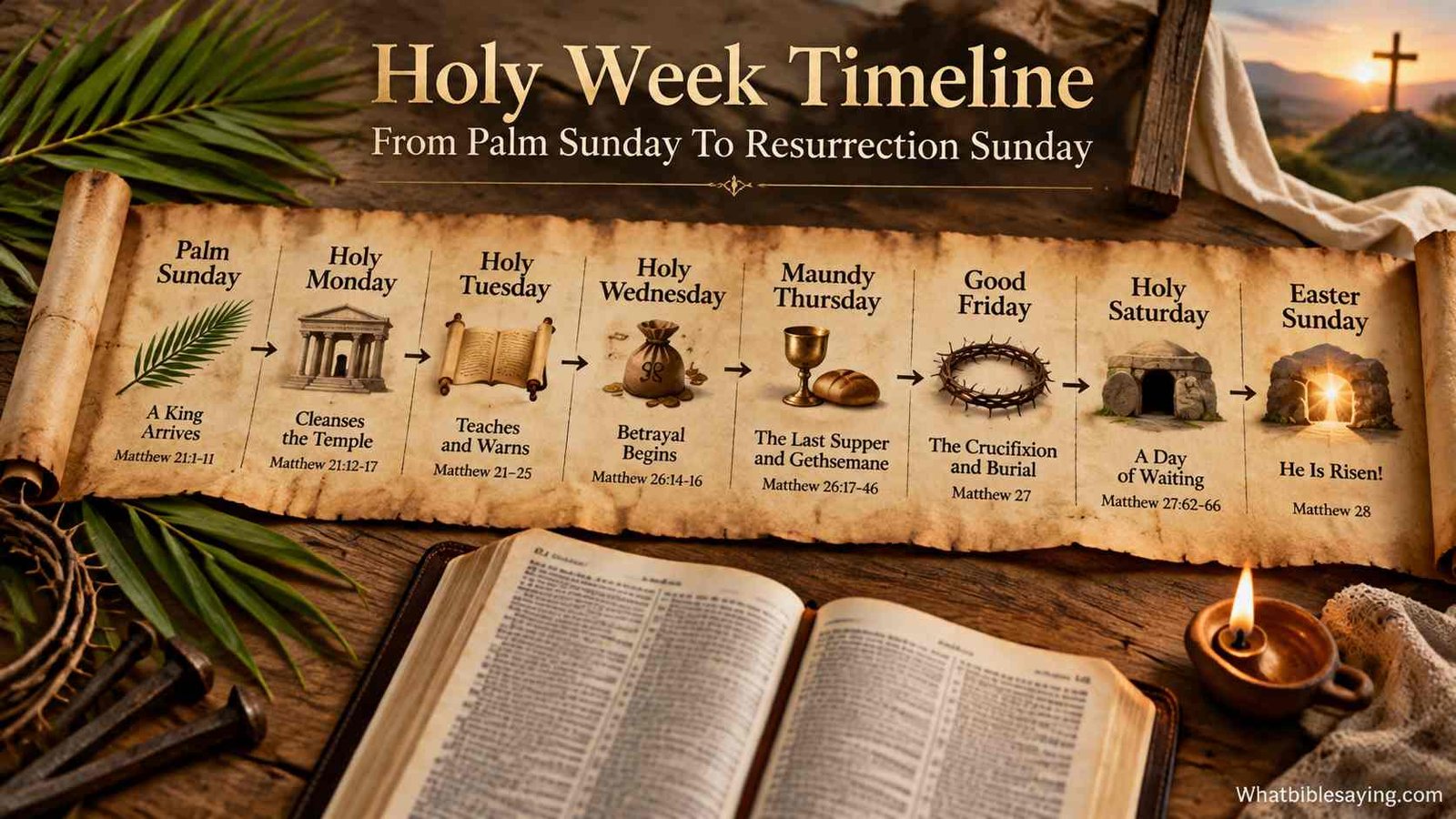
 Holy Week is the most important week in the Christian calendar because it remembers the final days of Jesus Christ’s earthly ministry, His suffering, death, burial, and resurrection. A holy week timeline chart helps readers follow these events in order and understand how each day connects to God’s plan of salvation.
The story begins with Jesus entering Jerusalem as crowds welcomed Him as King and ends with the empty tomb and the announcement that He had risen. The Gospels of Matthew, Mark, Luke, and John provide the main accounts of these events, with each Gospel highlighting different details about Jesus’ final journey.
Many Christians use a timeline of Holy Week during Easter preparation because it creates a clear path through Scripture. Instead of reading isolated passages, believers can see the complete picture of Jesus’ final week, from Palm Sunday to Resurrection Sunday.
While churches may organize some details differently, the main events remain consistent: Jesus’ arrival in Jerusalem, His teaching, the Last Supper, His crucifixion, and His victory over death.
What Is Holy Week In The Bible?
The Bible does not use the exact phrase “Holy Week,” but it records the events that Christians remember during this period. The week is also called Passion Week because it focuses on the suffering and sacrifice of Jesus.
The final week begins with Jesus’ Triumphal Entry into Jerusalem:
“Blessed is the King who comes in the name of the Lord.” (Luke 19:38)
Jesus entered Jerusalem riding on a donkey, fulfilling the prophecy from Zechariah 9:9. The crowds placed palm branches on the road and praised Him, recognizing Him as the promised Messiah.
However, the same week that began with celebration ended with the cross. This contrast reveals an important truth about Jesus’ mission. He did not come only to receive honor from people. He came to give His life for the salvation of humanity.
Holy Week Timeline Chart
The following chart gives a simple overview of the major events from Palm Sunday to Easter Sunday.
| Day | Event | Bible References | Meaning |
|---|---|---|---|
| Palm Sunday | Jesus enters Jerusalem | Matthew 21:1-11, Mark 11:1-11, John 12:12-19 | Jesus is revealed as the promised King |
| Holy Monday | Jesus cleanses the temple | Matthew 21:12-17, Mark 11:15-19 | Jesus calls people back to true worship |
| Holy Tuesday | Jesus teaches in Jerusalem | Matthew 21-25, Mark 12-13 | Jesus prepares His followers and teaches truth |
| Holy Wednesday | Judas betrays Jesus | Matthew 26:14-16 | The events leading to the cross begin |
| Maundy Thursday | Last Supper and Gethsemane | Matthew 26:17-46, John 13 | Jesus demonstrates love and prepares for sacrifice |
| Good Friday | Crucifixion and burial | Matthew 27, John 18-19 | Jesus gives His life for the forgiveness of sins |
| Holy Saturday | Jesus rests in the tomb | Matthew 27:57-66 | A day of waiting and sorrow |
| Easter Sunday | Resurrection of Jesus | Matthew 28, John 20 | Jesus defeats death and brings eternal hope |
Palm Sunday Jesus Enters Jerusalem As King
Palm Sunday begins the Holy Week timeline chart with a moment of celebration. Jesus traveled to Jerusalem during the Passover season, and large crowds gathered to welcome Him.
According to Matthew 21, Jesus entered the city riding on a donkey. This was significant because kings usually entered cities in ways that displayed power and victory. Jesus entered with humility, showing that His kingdom was different from earthly kingdoms.
The people shouted “Hosanna,” which means “save us” or “please save.” They expected God’s deliverance, but many did not understand that Jesus came to bring a deeper rescue from sin.
Palm Sunday reminds believers that Jesus is both King and Savior.
A related study on what does Palm Sunday mean in the Bible helps explain why this event remains central to Christian worship today.
Holy Monday Jesus Cleanses The Temple
After entering Jerusalem, Jesus went to the temple. There He saw people using a place of worship for dishonest business practices.
Jesus overturned tables and said:
“My house will be called a house of prayer.” (Matthew 21:13)
This action was not simply about removing sellers. It was a powerful statement about holiness and true worship.
Holy Monday teaches that God desires sincere hearts. Religious activity without genuine faith does not honor Him. Jesus challenged people to examine whether their worship was focused on God or personal gain.
For Bible study groups, Holy Monday is a meaningful time to reflect on the condition of our own hearts and our relationship with God.
Holy Tuesday Jesus Teaches In Jerusalem
Holy Tuesday focuses on Jesus’ teaching ministry. During this day, Jesus answered questions from religious leaders, taught about God’s kingdom, and prepared His disciples for what was coming.
One of His most important teachings was about loving God and loving others.
Jesus said the greatest commandment was:
“Love the Lord your God with all your heart and with all your soul and with all your mind.”
Holy Tuesday shows the wisdom and authority of Jesus. He was not only preparing for suffering; He was continuing to reveal God’s truth.
This day is especially useful when creating a holy week scripture reading plan because it provides many passages for personal reflection and family Bible study.
Holy Wednesday Judas Betrays Jesus
Holy Wednesday is sometimes called Spy Wednesday because it remembers Judas Iscariot’s decision to betray Jesus.
Matthew 26 tells us that Judas went to the chief priests and agreed to hand Jesus over for thirty pieces of silver.
This moment shows the seriousness of human choices. Judas was one of Jesus’ closest followers, yet he turned away from Him.
However, the betrayal did not surprise Jesus. Throughout the Gospels, Jesus knew the cross was part of God’s redemptive plan.
Holy Wednesday encourages believers to examine their own faithfulness and remember the importance of staying close to Christ.
Maundy Thursday The Last Supper And Jesus’ Love
Maundy Thursday is one of the most meaningful days in the Holy Week timeline chart.
The word “Maundy” comes from the Latin word meaning commandment. It refers to Jesus’ command:
“Love one another. As I have loved you.” (John 13:34)
On this night, Jesus shared the Passover meal with His disciples. During the meal, He introduced the practice of remembering His sacrifice through bread and the cup.
Jesus also washed His disciples’ feet. This was a powerful picture of humility because foot washing was usually performed by servants.
Jesus showed that true leadership is not about power. It is about serving others.
Later that night, Jesus prayed in the Garden of Gethsemane before His arrest. He experienced deep sorrow but remained obedient to the Father’s will.
Good Friday The Cross Of Jesus
Good Friday is the darkest day in the Holy Week timeline.
Jesus was arrested, questioned, sentenced, and crucified. The Gospel accounts describe His suffering and His final moments on the cross.
One of Jesus’ final statements was:
“It is finished.” (John 19:30)
These words did not mean failure. They meant completion. Jesus had completed the work He came to do.
The cross represents God’s love, mercy, and forgiveness. Christians believe Jesus willingly gave His life so humanity could be reconciled with God.
Those who want deeper study can explore what does Good Friday mean in the Bible and where is the crucifixion in the Bible to understand the significance of this event.
Holy Saturday Waiting In Hope
Holy Saturday is often overlooked, but it has an important place in the timeline of Holy Week.
Jesus’ body remained in the tomb, and His followers experienced grief and uncertainty. The disciples who had followed Jesus for years suddenly faced confusion and fear.
This day reminds believers that waiting is sometimes part of faith.
Many people experience their own “Holy Saturday” moments when they are waiting for answers, healing, or direction. The silence does not mean God has stopped working.
Easter Sunday The Resurrection Of Jesus
The Holy Week timeline reaches its greatest moment on Easter Sunday.
After the Sabbath, women went to the tomb and discovered that Jesus was no longer there. The angel announced:
“He is not here; he has risen.” (Matthew 28:6)
The resurrection changed everything.
Without the resurrection, the cross would only represent tragedy. Because Jesus rose, Christians believe death was defeated and new life became possible.
Easter Sunday is the foundation of Christian hope. It declares that God’s power is greater than sin, suffering, and death.
A related study on what does Easter Sunday mean in the Bible can help explain why this day remains the center of Christian faith.
A Simple Holy Week Scripture Reading Plan
A personal reading schedule can make Holy Week more meaningful. Here is a simple plan:
Palm Sunday
- Matthew 21:1-11
- John 12:12-19
Holy Monday
- Matthew 21:12-17
- Mark 11:15-19
Holy Tuesday
- Matthew 22:34-40
- John 12:20-36
Holy Wednesday
- Matthew 26:14-16
- Luke 22:1-6
Maundy Thursday
- Luke 22:7-20
- John 13:1-17
Good Friday
- John 18-19
Holy Saturday
- Matthew 27:57-66
Easter Sunday
- Matthew 28:1-10
- John 20:1-18
When reading different Bible versions, some readers use a Bible translation comparison chart PDF to compare wording between translations. This can be helpful, especially when studying familiar passages and looking at how translators communicate meaning.
Why The Holy Week Timeline Matters For Christians
The Holy Week timeline chart is more than a historical schedule. It reveals the heart of Christianity.
Each day teaches something important:
- Palm Sunday shows Jesus as King.
- Holy Monday shows the importance of pure worship.
- Holy Tuesday shows His wisdom.
- Holy Wednesday shows the seriousness of betrayal.
- Maundy Thursday shows servant love.
- Good Friday shows sacrifice.
- Holy Saturday shows faithful waiting.
- Easter Sunday shows victory.
The journey from Jerusalem to the empty tomb reminds believers that God’s plan often includes difficult seasons before the celebration comes.
What This Teaches Us About Faith
Holy Week invites us to slow down and remember what Jesus has done.
The crowds welcomed Him. The disciples struggled. Judas betrayed Him. The religious leaders rejected Him. The cross brought suffering. The tomb brought silence.
But the story did not end there.
The resurrection reminds every believer that God can bring hope from hopeless situations. The same Jesus who walked toward the cross with love and obedience is the risen Savior who offers forgiveness and new life today.
A holy week timeline chart helps us see the complete journey, but faith comes from knowing the One at the center of that journey: Jesus Christ.

Dr. Rachel is very smart and knows a lot about the Bible. He helps us understand the Bible better by talking about the old texts in a simple way.