

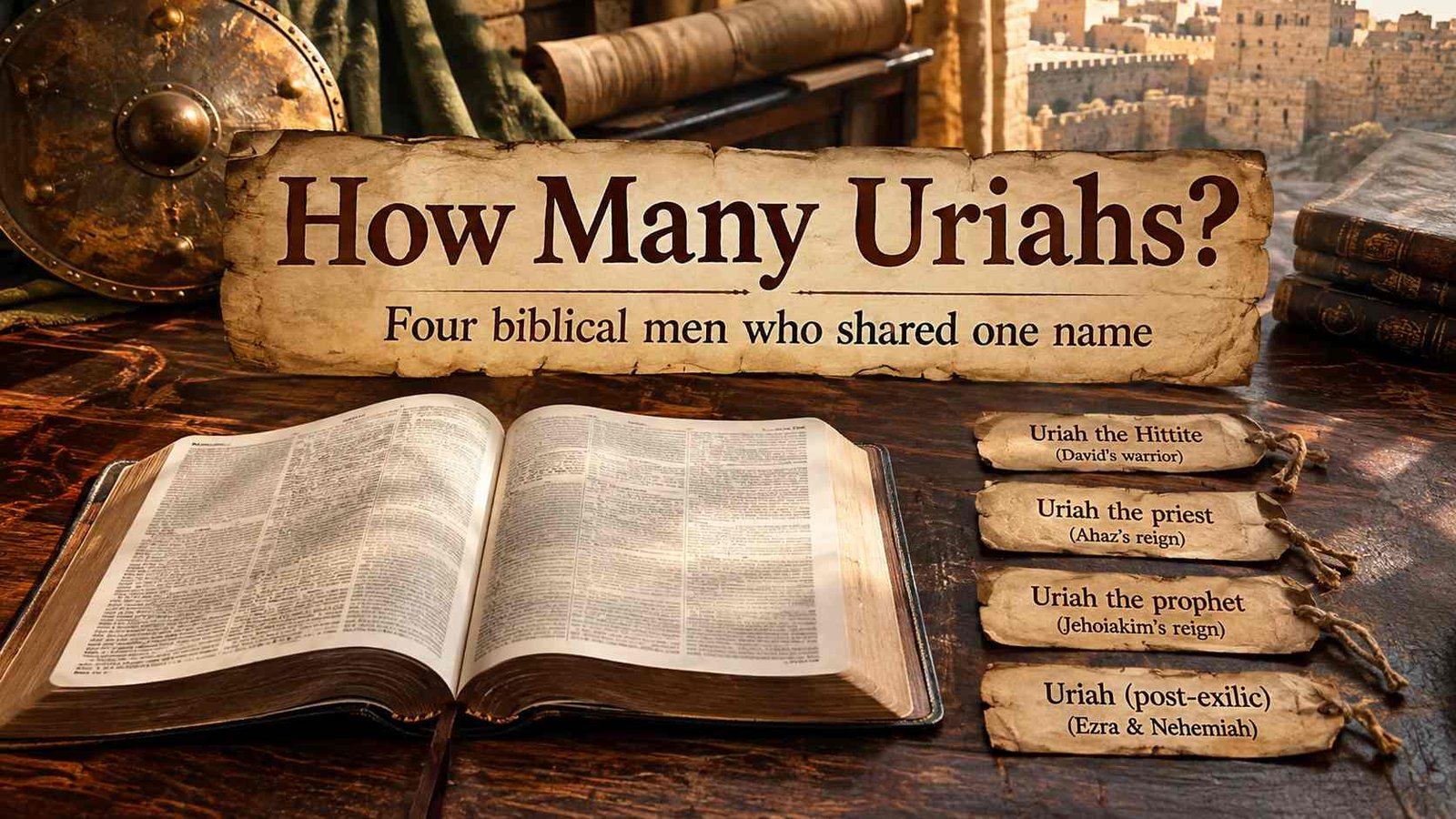
 If you have been reading through Samuel, Kings, Jeremiah, Ezra, or Nehemiah, you may have noticed the name Uriah more than once. That can make things confusing. Is every Uriah the same man, or were there several people with this name?
The simplest answer is that there are four distinct people commonly identified as Uriah in the Bible.
These are:
- Uriah the Hittite, the husband of Bathsheba
- Uriah the priest who lived during King Ahaz’s reign
- Uriah the prophet who was killed during King Jehoiakim’s reign
- Uriah the priest connected with Ezra and Nehemiah
Some Bible dictionaries appear to list five or even six Uriah entries. This happens because certain passages are listed separately before scholars decide whether they refer to the same person. Standard Hebrew reference material and Encyclopaedia Judaica group the biblical references into four main individuals.
The best-known of them is certainly Uriah the Hittite. His painful story is connected with King David and Bathsheba. Yet the other men named Uriah also lived during important moments in Israel’s history.
Understanding who they were helps us read Scripture more carefully.
How Many Uriahs Are in the Bible?
There are four commonly recognized biblical people named Uriah.
Here is a simple overview:
| Uriah | Who He Was | Main Bible References |
|---|---|---|
| Uriah the Hittite | Soldier and husband of Bathsheba | 2 Samuel 11; 2 Samuel 23:39; 1 Chronicles 11:41 |
| Uriah the priest | Priest during King Ahaz’s reign | Isaiah 8:2; 2 Kings 16:10–16 |
| Uriah the prophet | Prophet during King Jehoiakim’s reign | Jeremiah 26:20–23 |
| Uriah of the post-exilic period | Priest connected with Meremoth, Ezra, and Nehemiah | Ezra 8:33; Nehemiah 3:4, 21; Nehemiah 8:4 |
This four-person classification is supported by Hebrew lexical material that groups the references into Uriah the Hittite, the priest under Ahaz, a priest from the time of Nehemiah, and the prophet killed under Jehoiakim.
This is similar to other repeated names in Scripture. There are several men named Simon, several people called Mary, and more than one biblical person named James.
That is why questions such as how many Marys are in the Bible, how many Peters are in the Bible, and how many Simons are in the Bible often require more than simply searching for a name.
Biblical writers normally help us identify people by giving us another detail. They may mention a person’s father, hometown, occupation, king, tribe, or title.
The same method helps us distinguish the different Uriahs.
Why Do Some Sources Give a Different Number?
You may find a Bible dictionary that seems to give five or six Uriahs.
That does not necessarily mean one source is right and another is wrong.
Bible Gateway’s Encyclopedia of the Bible, for example, places Uriah references under six numbered entries. But it says that the priest in Isaiah 8:2 and the chief priest in 2 Kings 16 were probably the same man. It also separates Uriah the father of Meremoth from the Uriah who stood beside Ezra.
Other reference works combine these post-exilic references as well.
Encyclopaedia Judaica directly describes Uriah as the name of four biblical figures and groups the Ezra and Nehemiah passages under one priest from the time of Nehemiah.
So if someone asks, How many Uriahs are in the Bible?, four is the clearest general answer.
The small difference among dictionaries comes from how uncertain or related references are classified, not from a contradiction in the biblical text.
Uriah the Hittite Is the Best-Known Uriah in the Bible
When most Christians hear the name Uriah, they think of Uriah the Hittite.
His story appears mainly in 2 Samuel 11 and 12.
Uriah was married to Bathsheba and served in King David’s army. He was not simply an unknown soldier. Second Samuel 23:39 lists him among David’s mighty men, a special group of distinguished warriors. First Chronicles 11:41 also identifies Uriah the Hittite among David’s warriors.
His story takes a tragic turn when David remains in Jerusalem while his army is fighting.
David sees Bathsheba, learns that she is Uriah’s wife, and sleeps with her. Bathsheba later tells David that she is pregnant.
David then brings Uriah home from the battlefield.
His apparent plan is to have Uriah spend time with Bathsheba so that the pregnancy might appear to be Uriah’s.
But Uriah refuses to enjoy the comfort of his home while the ark, Israel’s soldiers, and his fellow warriors are still in the field.
His sense of duty becomes one of the most striking parts of the story.
David tries again, but Uriah still does not return home to his wife.
David then sends him back to the army carrying a letter for Joab, the military commander.
Tragically, that letter contains instructions that lead to Uriah’s death. Joab places Uriah where the fighting is fierce, and Uriah dies in battle. The account is recorded directly in 2 Samuel 11.
After a period of mourning, David takes Bathsheba as his wife.
But the matter is not hidden from God.
In 2 Samuel 12, the prophet Nathan confronts David. David eventually acknowledges his sin.
The story is not written to make David appear perfect. In fact, it does the opposite. Scripture openly records one of the darkest failures in his life.
That honesty is one reason Uriah remains important.
Uriah Was One of David’s Mighty Men
It is easy to remember Uriah only as Bathsheba’s husband, but the Bible gives him another important identity.
He was one of David’s mighty men.
Second Samuel 23 contains a list of famous warriors associated with David. Uriah appears at the end of that list.
This means he was more than a background character in David’s story. He had served the kingdom and apparently earned recognition as a warrior.
That makes David’s treatment of him even more painful.
Uriah was serving David while David was arranging his death.
The story gives readers a serious picture of what can happen when one wrong choice is followed by attempts to hide it.
David’s first sin led to deception. Deception led to manipulation. Finally, the attempt to cover everything resulted in Uriah’s death.
Yet Scripture also records David’s later repentance rather than hiding his guilt.
Uriah Is Remembered in Matthew’s Gospel
Uriah’s name reaches all the way into the New Testament.
Matthew 1:6, in the genealogy of Jesus Christ, refers to David becoming the father of Solomon through the wife of Uriah.
Matthew could simply have moved from David to Solomon. Instead, the genealogy preserves the memory of Uriah in this part of the family story. Bible reference sources likewise note Uriah’s appearance in Christ’s genealogy.
This is a small detail, but it carries weight.
The Bible does not erase painful human history from the story of redemption.
Broken choices, injustice, repentance, mercy, and God’s purposes can all appear within the same family history.
The Second Uriah in the Bible Was a Priest
Another Uriah lived centuries later during the reign of King Ahaz of Judah.
This Uriah was a priest.
He appears prominently in 2 Kings 16.
King Ahaz traveled to Damascus, where he saw an altar that impressed him. He sent a drawing and detailed plan of this altar to Uriah the priest in Jerusalem.
Uriah built an altar according to the king’s instructions before Ahaz returned from Damascus. Second Kings 16 describes Ahaz directing changes in how the altar and Temple furnishings were used, and Uriah carried out the king’s commands.
This Uriah therefore lived in a very different world from Uriah the Hittite.
One was a warrior serving David.
The other was a priest serving during the troubled reign of Ahaz.
Is This the Uriah Mentioned in Isaiah 8:2?
Isaiah 8:2 mentions a man called Uriah the priest as one of the reliable witnesses connected with Isaiah’s prophetic sign.
Most Bible reference works identify this priest with the Uriah found in 2 Kings 16.
Bible Gateway’s encyclopedia lists the Isaiah reference separately but says the chief priest serving under Ahaz was probably identical with that man. Brown-Driver-Briggs likewise groups Isaiah 8:2 and 2 Kings 16 under the same priest.
This is one reason simply counting every appearance of the name can produce the wrong number of people.
Two passages may mention Uriah, but both can refer to the same man.
Historical setting helps us make the connection.
Both references belong to the time of King Ahaz.
Another Uriah in the Bible Was a Prophet
The third Uriah takes us into the time of the prophet Jeremiah.
His story is brief, but it is powerful.
Jeremiah 26:20–23 tells us about Uriah son of Shemaiah, who came from Kiriath-jearim.
Uriah was a prophet.
He spoke in the name of the Lord and delivered a warning against Jerusalem and the land similar to Jeremiah’s message.
King Jehoiakim heard about his preaching and wanted him killed.
Uriah became afraid and fled to Egypt.
But leaving Judah did not save him.
Jehoiakim sent men to Egypt, including Elnathan son of Achbor. They brought Uriah back to Judah, where the king had him killed.
It is one of the Bible’s shorter stories about a prophet, but it shows how dangerous prophetic ministry could be.
Uriah and Jeremiah Preached Similar Messages
Jeremiah 26 specifically connects Uriah’s message with Jeremiah’s.
Both warned Judah.
Both spoke difficult words.
Both faced opposition.
Yet their earthly outcomes were different.
Jeremiah survived this particular crisis. Uriah did not.
Scripture does not tell us that Uriah’s death meant his ministry had failed. Neither does it say that Jeremiah survived because he had greater faith.
The passage simply records what happened.
That is important.
Faithfulness in the Bible is not always followed by immediate safety or earthly success.
Many biblical prophets faced rejection because they spoke messages people did not want to hear.
Uriah belongs to that difficult history.
The Fourth Uriah in the Bible Appears in Ezra and Nehemiah
The final commonly recognized Uriah belongs to the period after the Babylonian exile.
His name appears in connection with the priest Meremoth.
Ezra 8:33 identifies Meremoth as the son of Uriah when silver, gold, and sacred objects brought to Jerusalem were weighed at the house of God.
Nehemiah 3:4 and 3:21 again identify Meremoth as the son of Uriah while describing work on Jerusalem’s wall.
Nehemiah 8:4 also names a man called Uriah among those standing beside Ezra as he read the Law publicly.
Brown-Driver-Briggs and Encyclopaedia Judaica group these passages under a priest named Uriah from the time of Nehemiah.
This Uriah is much less famous than Uriah the Hittite.
We are given very little personal information about him.
Yet his family appears during one of the most important rebuilding periods in Israel’s history.
Jerusalem had suffered destruction and exile. Now the community was rebuilding its city and restoring public attention to God’s Law.
Was the Uriah Beside Ezra the Same Person?
This is where the counting question becomes difficult.
Nehemiah 8:4 names a Uriah standing beside Ezra while Ezra reads the Law.
Is this the same Uriah who was Meremoth’s father?
Some reference works say yes or group the passages together. Others keep the two entries separate because Scripture does not explicitly state that they are the same person.
That explains the difference between saying there were four Uriahs and saying there may have been five.
If the Uriah associated with Meremoth and the Uriah beside Ezra were different men, the total could rise to five.
If they were the same man, the total remains four.
Because established reference works commonly group them together, four is the best simple answer, while acknowledging the uncertainty is more accurate than pretending the issue does not exist.
This kind of detail is useful whenever we study how many people are mentioned in the Bible or investigate repeated biblical names.
A name count is not always the same as a person count.
What Does the Bible Name Uriah Mean?
The Hebrew name Uriah is commonly written as Uriyyah and contains the divine element Yah, a shortened form connected with the name of God.
Traditional Hebrew dictionaries give meanings such as:
- Yahweh is my light
- My light is Yah
- Flame of Yah
- The Lord is my light
Brown-Driver-Briggs gives the possibilities flame of Yah or my light is Yah, while other Bible dictionaries commonly express the meaning as the Lord is my light.
So when someone asks, What does the Bible name Uriah mean?, a good simple answer is:
Uriah means “Yahweh is my light” or “the Lord is my light.”
There is some scholarly discussion about the deeper historical origin of Uriah the Hittite’s personal name, so we should not claim that every detail of its origin is beyond debate. Encyclopaedia Judaica notes alternative proposals concerning the name’s ancient background.
For ordinary Bible study, however, “Yahweh is my light” remains the standard traditional explanation.
Why Is Uriah Sometimes Written Urijah?
Readers of different Bible translations may encounter both Uriah and Urijah.
They are not necessarily different names.
Older English translations, including the King James Version in several passages, use Urijah where many newer translations use Uriah.
The Hebrew forms are closely related, including the fuller form Uriyyahu in Jeremiah’s account of the prophet. Reference works therefore treat Uriah and Urijah as forms of the same biblical name.
This spelling difference is another reason Bible name studies can become confusing.
If you search only for “Uriah” in one English translation, you may miss a person written as “Urijah” in another.
Where to Find Uriah in the Bible
If you want to study all four men for yourself, these are the main places to begin.
Uriah the Hittite
Read:
2 Samuel 11
This is the main account involving David, Bathsheba, and Uriah.
2 Samuel 12
Nathan confronts David after Uriah’s death.
2 Samuel 23:39
Uriah appears among David’s mighty warriors.
1 Chronicles 11:41
Uriah is again named among David’s mighty men.
Matthew 1:6
Uriah is remembered in the genealogy of Jesus through the reference to David and Uriah’s wife.
Uriah the Priest Under Ahaz
Read:
Isaiah 8:2
2 Kings 16:10–16
These passages show Uriah during the reign of King Ahaz.
Uriah the Prophet
Read:
Jeremiah 26:20–23
These four verses contain almost everything Scripture directly tells us about Uriah son of Shemaiah.
Uriah in Ezra and Nehemiah
Read:
Ezra 8:33
Nehemiah 3:4
Nehemiah 3:21
Nehemiah 8:4
These passages belong to the post-exilic period when Jerusalem’s worship and community life were being restored. Reference works commonly group these references under the later priestly Uriah, though the identification in Nehemiah 8:4 is not equally certain in every dictionary.
What Name Was Mentioned 7,000 Times in the Bible?
This question often appears beside searches about biblical names.
The answer usually intended is YHWH, the personal divine name represented by four Hebrew letters and commonly called the Tetragrammaton.
Saying it appears exactly 7,000 times is an approximation.
According to the Society for Old Testament Study, YHWH occurs about 6,877 times in 5,815 verses in the Hebrew Bible as represented in Biblia Hebraica Stuttgartensia, a standard scholarly Hebrew edition.
So “around 7,000 times” is reasonable as a rounded statement, but 6,877 is a more precise count for that Hebrew text.
Many English readers do not see “YHWH” thousands of times because English Bible translations commonly represent the divine name as LORD, usually printed in capital letters.
It is also important not to confuse YHWH with the personal name Uriah.
The connection is linguistic.
The ending Yah in Uriah belongs to a shortened divine element related to God’s name. That is why the traditional meaning of Uriah can be expressed as “Yahweh is my light.”
What the Different Uriahs Help Us Notice in Scripture
At first, asking How Many Uriah In The Bible? may seem like a simple counting question.
But it leads us into several periods of biblical history.
Uriah the Hittite takes us to the reign of David.
Uriah the priest takes us to the reign of Ahaz.
Uriah the prophet takes us to the troubled days of Jehoiakim and Jeremiah.
The later Uriah takes us into the restored community of Ezra and Nehemiah.
Four men.
One name.
Very different stories.
The repeated name also reminds us to read the Bible slowly.
A familiar name does not always mean a familiar person. Scripture contains many repeated names, which is why studying questions such as how many Marys are in the Bible, how many Peters are in the Bible, how many Simons are in the Bible, and how many Philips are in the Bible can reveal details we easily overlook.
Pay attention to fathers, cities, occupations, kings, and historical settings. Those small details often tell you exactly whom the biblical writer means.
And among all the Uriahs, the story of Uriah the Hittite leaves perhaps the strongest impression.
He was a loyal warrior who suffered because of another man’s sin. Yet Scripture did not erase his name.
He remained among David’s mighty men.
He remained part of the story told in Samuel.
And centuries later, his name was still remembered when Matthew introduced the family line leading to Jesus.
That is a quiet but powerful detail.
People whom history might easily forget are not always forgotten in Scripture.

Dr. Rachel is very smart and knows a lot about the Bible. He helps us understand the Bible better by talking about the old texts in a simple way.