
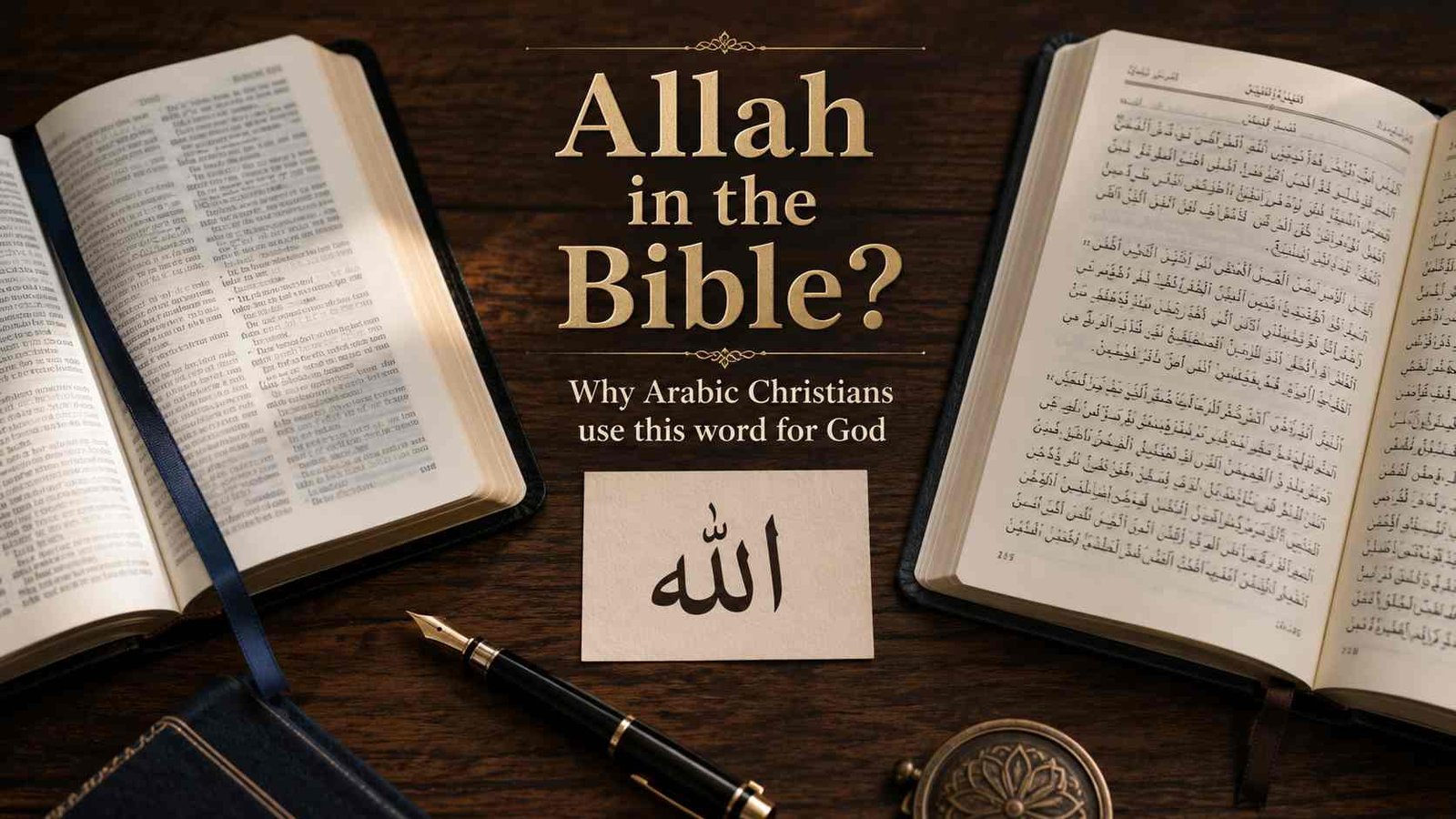
 Yes, the word Allah appears in Arabic translations of the Holy Bible. Arabic-speaking Christians have used Allah as their word for God for centuries.
But there is an important detail.
The Bible was not originally written in Arabic. Most of the Old Testament was written in Hebrew, with some parts in Aramaic. The New Testament was written in Greek. Because of this, the Arabic word Allah does not appear as an Arabic word in the original biblical manuscripts.
So the clearest answer is:
Allah is found in Arabic Bibles as the Arabic word for God, but the original Hebrew, Aramaic, and Greek texts do not contain the Arabic word Allah.
This does not mean that Islam is directly mentioned in the Bible. It also does not prove that Muhammad is named in Scripture. Those are different questions, and each needs to be studied in its own biblical and historical context.
Understanding this difference helps Christians speak about the subject with both truth and respect.
Is Allah Mentioned in the Holy Bible’s Original Languages?
To understand the question, we first need to know how the Bible came to us.
The Bible is a collection of books written over many centuries. Its writers lived in different places and historical periods. They did not write the Bible in modern English or Arabic.
The main biblical languages were:
| Part of the Bible | Main Original Language |
|---|---|
| Old Testament | Hebrew |
| Parts of Daniel and Ezra | Aramaic |
| New Testament | Greek |
When the Bible was later translated into Arabic, translators naturally used Arabic words to communicate the meaning of the original text.
That is where Allah enters the picture.
An Arabic Christian reading Genesis 1:1 may read the Arabic word Allah where an English Christian reads the word God.
The person is not necessarily reading a different story. The language is different.
Hebrew Words for God
Several Hebrew words are used for God in the Old Testament.
One of the best known is Elohim.
Genesis 1:1 says that in the beginning, God created the heavens and the earth. The Hebrew word translated as God in that verse is Elohim.
An Arabic Bible translates the same idea using Allah.
An English Bible normally says God.
This simple example shows why language matters.
Three readers may see three different words:
- Hebrew: Elohim
- Arabic: Allah
- English: God
Yet all three words may appear in translations of the same biblical verse.
Readers who want to study this further may also find Who Is Elohim in the Bible helpful, especially when comparing biblical names and titles for God.
Another related question is What’s God’s Name in the Bible. The Bible uses several names and titles for God, and they do not all have exactly the same purpose.
What About Aramaic?
Aramaic is another Semitic language connected with the biblical world.
Parts of Ezra and Daniel were written in Aramaic. Aramaic was also widely spoken in the region during the time of Jesus.
Because Arabic, Hebrew, and Aramaic belong to related language families, some words can sound similar.
That sometimes leads people online to make claims based only on similar sounds.
But similar-sounding words are not enough to prove that two religious ideas are identical.
A careful Bible reader asks:
What does the word mean in its sentence?
Who is speaking?
What is the historical setting?
How is the word used elsewhere?
These questions protect us from building large teachings on a small similarity between two languages.
Where Is Allah Mentioned in the Holy Bible in Arabic?
If you open an Arabic Bible, you do not need to search very far to find Allah.
The word is used where English translations commonly use God.
Genesis 1:1 is one of the clearest examples.
In English, the verse begins with God creating the heavens and the earth.
In Arabic Christian translations, Allah is used for God.
This means the answer to the question Is there any mention of Allah in the Bible? depends partly on what a person means by “the Bible.”
If they mean:
“Does an Arabic translation of the Bible use the word Allah?”
The answer is yes.
If they mean:
“Was the Arabic word Allah written in the original Hebrew and Greek manuscripts?”
The answer is no.
The distinction is simple, but it solves much of the confusion.
Why Arab Christians Say Allah
Many English speakers hear the word Allah and immediately think only of Islam.
That is understandable because the word is strongly associated with Islam in English-speaking countries.
But Arabic works differently.
Arabic-speaking Christians also use Allah when speaking about God.
They may use the word in prayer, worship, Bible reading, preaching, and everyday conversation.
In the same way, Christians speaking Spanish say Dios. French-speaking Christians say Dieu. English-speaking Christians say God.
The language changes.
The Christian belief does not become Islamic simply because the Christian is speaking Arabic.
This is one reason Christians should be careful before saying, “Allah is not in the Bible.”
That statement can be misleading.
The Arabic word is certainly found in Arabic Bibles. The better question is what Christians and Muslims believe about the God they describe using that word.
Is Allah Mentioned in the Holy Bible as the God of Islam?
This question moves from language into theology.
Arabic-speaking Christians and Muslims both use the word Allah, but Christianity and Islam do not teach exactly the same things about God.
Christian faith is centered on what the Bible reveals about God through the Father, the Son, and the Holy Spirit.
Christians confess Jesus Christ as the Son of God and place His death and resurrection at the center of salvation.
Islam strongly affirms one God, but Islamic teaching rejects several central Christian beliefs about Jesus and the Trinity.
So it is possible for two religious groups to use the same word while giving different answers to major theological questions.
Think of the word God in English.
Many people use the word God, yet they may not believe the same things about Him.
The word by itself does not settle the whole question.
For Christians, the safest approach is to let Scripture explain God’s character.
The Bible describes God as Creator, holy, just, loving, merciful, faithful, and eternal. The New Testament also presents Jesus in a unique relationship with the Father and repeatedly speaks of the Holy Spirit.
Therefore, when Christians ask what Christianity says about Allah, it is helpful to separate two ideas:
Language: Allah is the normal Arabic word used for God, including by many Christians.
Doctrine: Christianity and Islam differ on important teachings about God’s nature, Jesus Christ, revelation, sin, and salvation.
Recognizing the first point does not require a Christian to ignore the second.
Is There Any Mention of Islam in the Bible?
The religion known today as Islam is not directly named in the Bible.
This is not surprising historically.
The New Testament books were written centuries before the rise of Islam in the seventh century AD.
The biblical writers therefore do not speak about Islam as a later organized religion by that name.
This is an important fact because many internet discussions take biblical people, nations, or prophecies and immediately label them Islamic.
That goes beyond what the text itself says.
The Bible should first be read in its own setting.
If you want a wider study of this subject, see What Does the Bible Say About Islam.
Abraham, Hagar, and Ishmael
One biblical family often discussed in conversations about Islam is the family of Abraham.
Genesis tells us about Abraham, Sarah, Hagar, Isaac, and Ishmael.
Hagar was Sarah’s servant. She gave birth to Ishmael, Abraham’s son.
God saw Hagar in her distress and gave promises concerning Ishmael’s future. Genesis also says that Ishmael became the father of twelve rulers and that his descendants became numerous.
These are genuine biblical statements.
However, Scripture itself does not say, “Ishmael founded Islam.”
That conclusion comes from later historical and religious traditions, not directly from Genesis.
For that reason, Christians should avoid forcing later events into every verse about Ishmael.
We can recognize that Ishmael became important in later Arab and Islamic tradition while still reading Genesis according to what Genesis actually says.
That is a healthier way to study Scripture.
Is Anyone Named Muhammad in the Bible?
Another common question is whether Muhammad is named in the Holy Bible.
The straightforward answer is:
The Bible does not plainly introduce a biblical person whose personal name is Muhammad.
Standard Christian Bible translations do not contain a prophet or character named Muhammad.
However, some Muslim writers believe certain Bible passages predict Muhammad.
Christians have traditionally understood those passages differently.
This is where careful reading becomes very important.
We should neither mock another religion’s interpretation nor present an interpretation as an obvious biblical fact when the passage itself does not clearly say it.
Does Deuteronomy 18:18 Predict Muhammad?
Deuteronomy 18 contains a promise about a prophet like Moses.
Because Moses was a great prophet and lawgiver, this passage has received much attention.
Some Muslim interpreters believe the promised prophet points to Muhammad. They compare parts of Muhammad’s life with the life of Moses.
Christian readers usually understand the passage differently.
The surrounding context is addressed to Israel. Deuteronomy speaks about a prophet arising from among the people and calls Israel to listen to God’s true prophets rather than follow forbidden spiritual practices.
The New Testament also applies the passage to Jesus.
In Acts 3, Peter refers to the prophet like Moses while preaching about Jesus Christ.
For that reason, traditional Christian interpretation sees Jesus as the fullest fulfillment of this promise.
The key point is that the name Muhammad does not appear in Deuteronomy 18.
The debate concerns interpretation, not an explicit naming.
Does Song of Songs 5:16 Contain Muhammad’s Name?
Song of Songs 5:16 is another verse frequently discussed online.
Some people point to a Hebrew word in this verse because its sound resembles the name Muhammad.
This can look impressive if the reader does not know Hebrew.
But the passage is a love poem.
The woman is describing the man she loves. The Hebrew term in question functions as a descriptive word connected with things that are desirable, delightful, or lovely.
English Bible translations therefore use wording such as “lovely,” “desirable,” or a similar description.
The text does not introduce a future prophet named Muhammad.
Sound similarity by itself is not enough to turn a common Hebrew word into a personal name.
Languages often contain words that sound alike by coincidence or because they share older language roots.
Context still decides how the word is functioning.
This is a useful rule far beyond this one verse:
Never build a major biblical claim on pronunciation alone. Read the whole sentence and passage.
Did Jesus Predict Muhammad as the Comforter?
Jesus’ teaching about the Comforter, Helper, or Advocate in John’s Gospel is also sometimes connected with Muhammad.
In John 14, Jesus promises that another Advocate will come to His disciples.
Some Muslim interpreters have argued that this promised figure refers to Muhammad.
But John 14:26 gives a direct identification.
Jesus refers to the Advocate as the Holy Spirit.
The surrounding chapters also describe this promised Helper as being with Christ’s followers, teaching them, reminding them of Jesus’ words, and bearing witness concerning Christ.
For Christian readers, the identification within the passage itself is decisive.
The Comforter is the Holy Spirit, not a later human prophet.
Again, the respectful way to explain this is not to pretend the Muslim interpretation has never existed. It has.
But the Christian reading rests on the wording and context of John’s Gospel itself.
For a fuller discussion, see What the Bible Says About Muhammad.
What Does Christianity Say About Allah?
Christianity does not teach that speaking the Arabic language is wrong.
If an Arab Christian calls God Allah, that Christian is simply using Arabic.
The deeper Christian question is not, “Which language did you use?”
It is, “What do you believe about God?”
Christian Scripture teaches that God created all things.
Genesis begins with God as Creator.
The prophets speak of His holiness, justice, mercy, and faithfulness.
Jesus teaches His disciples to know God as Father.
The New Testament presents Jesus as the Son and speaks of the work of the Holy Spirit.
Christians therefore understand God through the full biblical story.
The Bible’s message reaches its center in Jesus Christ.
John’s Gospel begins by describing the Word as existing with God and sharing in God’s divine identity. The Gospel then says that the Word became flesh.
The Christian confession about Jesus is one of the greatest differences between Christianity and Islam.
Islam honors Jesus as an important prophet and Messiah in its own sense, but it does not accept the Christian belief that Jesus is the divine Son who died and rose for humanity’s salvation.
So Christians and Muslims can both say Allah in Arabic while meaning different things at crucial points.
That is why arguments about the word alone rarely solve the deeper question.
The real discussion concerns who God has revealed Himself to be.
Do Christians and Muslims Worship the Same God?
This question has produced disagreement even among Christian thinkers.
Some Christians emphasize that Christianity and Islam both claim to speak about the one Creator associated with Abraham.
Others emphasize the serious differences between Christian and Islamic teaching about God’s nature and argue that these differences are too important to overlook.
A careful article does not need to force this complex debate into a one-line answer.
What can be said clearly is this:
Christians and Muslims both speak about one Creator.
Arabic speakers from both faiths may use the word Allah.
Yet Christianity and Islam disagree deeply about the Trinity, Jesus Christ, the cross, salvation, and divine revelation.
Christians should therefore avoid two extremes.
One extreme says, “They use the same word, so all beliefs must be the same.”
They are not.
The other says, “Only Muslims can ever use the word Allah.”
That is also historically and linguistically inaccurate because Arabic-speaking Christians use the word too.
Truth is clearer when we allow both facts to stand.
Bible and Quran: Shared People but Different Teachings
The Bible and the Quran contain some familiar names.
Both traditions speak about people such as:
- Adam
- Noah
- Abraham
- Moses
- David
- Mary
- Jesus
But similar names do not mean the two books tell exactly the same story or teach the same theology.
There are major differences in how these figures are presented.
The Bible is a collection of writings produced over many centuries. Christianity divides it into the Old and New Testaments.
The Quran appeared later in history and is the central scripture of Islam.
Christians do not accept the Quran as part of the biblical canon.
Muslims, meanwhile, believe the Quran is God’s final revelation and often understand earlier revelation through Islamic teaching.
This creates real differences between the two faiths.
Readers who want to compare them carefully may find What Is the Difference Between the Bible and the Quran helpful.
A related historical question is Which Is Older, the Quran or the Bible. The biblical writings are earlier, while the Quran belongs to the seventh century AD.
Understanding dates helps us avoid claiming that a later religious term must have been explicitly present in a much earlier biblical document.
Why the Word Allah Causes So Much Confusion
Much of the confusion comes from the way English speakers encounter the word.
In English-language news, books, and public discussion, Allah is usually heard in an Islamic setting.
Many people therefore assume that Allah is a special personal name belonging only to Islam.
But words often work differently across languages.
If you walked into an Arabic-speaking Christian church, heard someone praying to Allah, and assumed you had entered a mosque, you could easily misunderstand what was happening.
The person may be confessing Christian beliefs and reading an Arabic Christian Bible.
This does not mean Christian and Muslim theology are the same.
It simply shows why translation matters.
The same problem can happen with biblical Hebrew.
Readers sometimes see the word Elohim and assume it must refer to a completely different being from the English word God.
But English translators use God because that is the normal English word that communicates the meaning in many passages.
Translation carries meaning from one language into another.
A translated word does not have to sound like the original word.
Does the Bible Use One Single Name for God?
No. The Bible uses several names, titles, and descriptions for God.
Depending on the passage, readers encounter terms connected with ideas such as:
- God
- Lord
- Most High
- Almighty
- Creator
- Father
- King
- Shepherd
The Hebrew name represented by the letters YHWH also has a unique place in the Old Testament.
English translations often represent this name with LORD in capital letters.
This variety teaches us something important.
Biblical faith is not built around the sound of one English word.
It is built around the God revealed through Scripture.
Christians therefore do not need to fear the existence of different language words for God.
They need to ask whether the teaching attached to those words agrees with biblical revelation.
Is Allah Another Name for the Biblical God?
From a language point of view, Allah is simply the Arabic word used for God.
That is why Christian Arabic Bibles use it.
From a theological point of view, the answer needs more care.
A Christian using the word Allah may mean the God revealed in the Bible: Father, Son, and Holy Spirit.
A Muslim using the same word understands God according to Islamic teaching.
The vocabulary overlaps.
The theology does not fully overlap.
A similar thing can happen with the word Jesus.
Christians and Muslims both speak about Jesus, but their beliefs about Him are not the same.
Christians worship Jesus as Lord and confess His crucifixion and resurrection.
Islam honors Jesus but interprets His identity and mission differently.
Sharing a name does not remove doctrinal differences.
The same principle helps explain the word Allah.
What the Word Allah Teaches Us About Reading Scripture Carefully
The question “Is Allah mentioned in the Holy Bible?” sounds simple, but it opens the door to a valuable lesson about Bible study.
Words need context.
Translations need context.
History needs context.
If we ignore those things, we can make Scripture say more than it actually says.
The clearest facts are not difficult to remember.
Allah appears in Arabic Bible translations because it is the normal Arabic word for God.
The original Bible was mainly written in Hebrew, Aramaic, and Greek, not Arabic.
Islam is not directly named as a religion in the Bible.
Muhammad is not plainly named as a biblical person or prophet in the biblical text.
Some Muslim interpreters connect Muhammad with certain biblical passages, but Christians understand those passages differently based on their biblical context.
None of these facts require Christians to speak disrespectfully about Muslims.
The New Testament calls believers to speak truth with love and to treat people with gentleness and respect.
A Christian can hold firmly to the uniqueness of Jesus Christ while also describing another person’s beliefs accurately.
That matters.
Faith does not become stronger through careless claims.
It becomes stronger when we read Scripture closely, tell the truth clearly, and refuse to twist words simply to win an argument.
For many readers, the most useful question is therefore not only, “Does the Bible contain the word Allah?”
A better question is:
Who does the Bible reveal God to be?
From Genesis to Revelation, Scripture points readers toward the Creator who acts in history, keeps His promises, calls people to faith, and reveals His saving purpose through Jesus Christ.
Languages may change.
Translations may use different words.
But Christians are called to keep returning to Scripture itself, reading every word in its proper setting and allowing God’s Word to shape what they believe.

Dr. Rachel is very smart and knows a lot about the Bible. He helps us understand the Bible better by talking about the old texts in a simple way.