 Jewish people have a long tradition of studying sacred texts. But if you are coming from a Christian background, one question may quickly arise: Why do Jewish people study the Talmud and Hebrew Bible?
The short answer is that these writings have different roles.
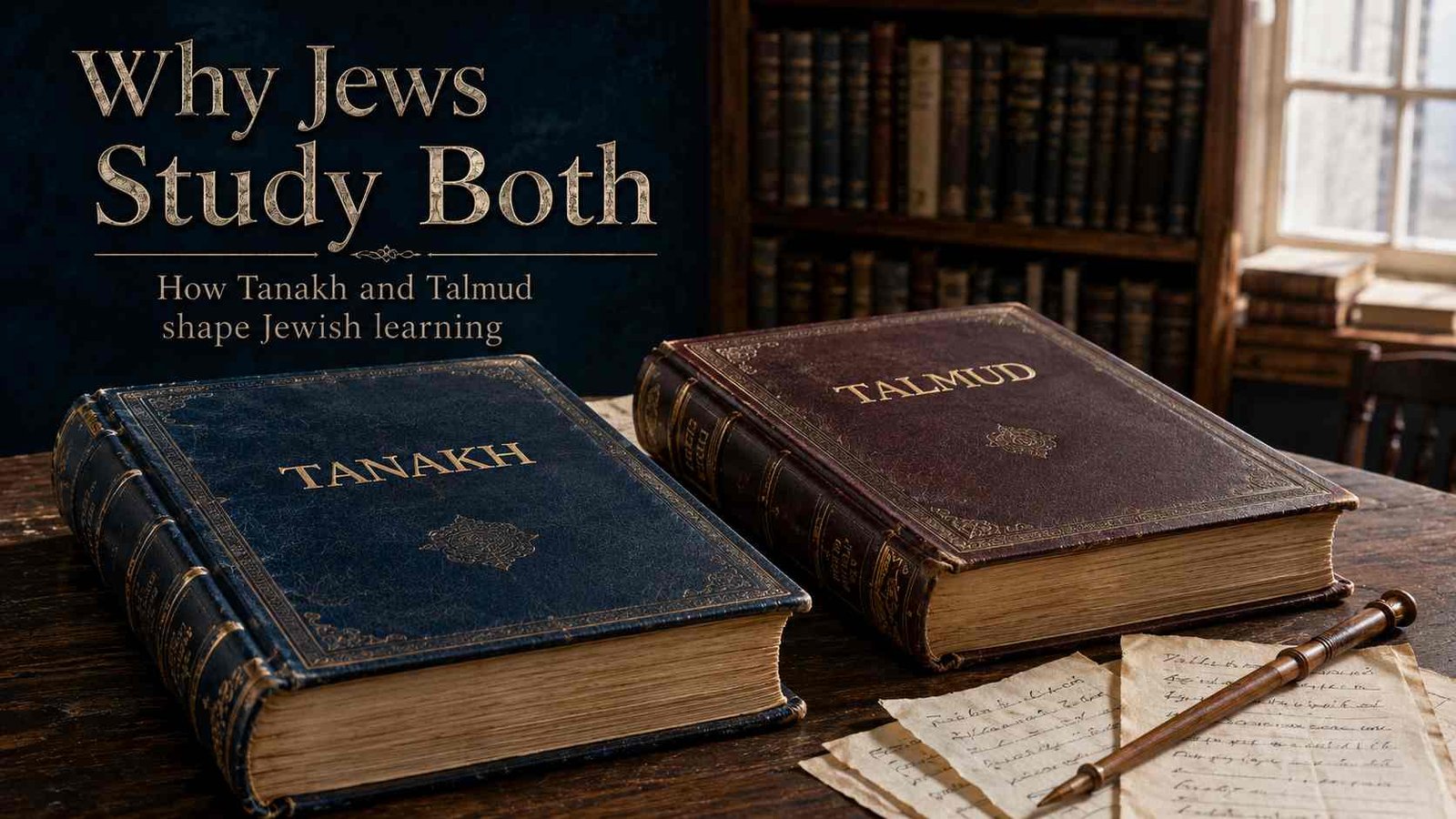
The Hebrew Bible, usually called the Tanakh, contains the foundational Scriptures of Judaism. The Talmud is a much later collection of rabbinic discussions about how biblical teachings, Jewish law, ethics, worship, and daily life should be understood and applied.
They are not two versions of the same book.
The Tanakh is Scripture. The Talmud records generations of interpretation, argument, legal reasoning, and teaching. Sefaria describes the Talmud as a textual record of centuries of rabbinic debate concerning law, theology, philosophy, biblical interpretation, and everyday practice.
There is another important point. Jewish communities are diverse. Orthodox, Conservative, Reform, Karaite, secular, and other Jewish communities do not necessarily view the authority of the Talmud in exactly the same way.
Understanding that difference helps us speak about Judaism accurately and respectfully.
Why Do Jewish People Study the Talmud and Hebrew Bible Today?
Many Jews study the Hebrew Bible because it contains the sacred writings at the foundation of Jewish faith, history, worship, and identity.
The Tanakh includes stories such as creation, Abraham and Sarah, the Exodus from Egypt, Moses, David, the prophets, the Psalms, and many other writings Christians will recognize from the Old Testament.
The Talmud serves a different purpose. It preserves discussions about what biblical commandments mean and how they should be practiced.
For Jews who follow traditional Rabbinic Judaism, reading a command in Scripture is often only the beginning of the question.
They may then ask:
What exactly does this command require?
When does it apply?
Are there exceptions?
How was it understood by earlier rabbis?
What happens when two biblical principles seem to conflict?
How should an ancient command be followed in a new situation?
Questions like these helped produce the enormous tradition of rabbinic learning preserved in the Mishnah, Gemara, and later Jewish writings.
So, when you see a Jewish student studying Talmud, that person is not necessarily choosing the Talmud instead of the Bible.
In traditional Rabbinic Judaism, Talmud study is one way of understanding how biblical teaching should be lived.
What Is the Hebrew Bible?
The Hebrew Bible is commonly called the Tanakh.
The name Tanakh comes from the first letters of its three major divisions:
- Torah — Teaching or Law
- Nevi’im — Prophets
- Ketuvim — Writings
Sefaria identifies these three sections as the basic structure of the Tanakh.
The Jewish Tanakh contains 24 books. Christians arrange and count some of these writings differently, which is one reason a Protestant Old Testament is normally counted as 39 books even though much of the underlying material corresponds to the Jewish Scriptures. My Jewish Learning likewise describes the Hebrew Bible as a 24-book collection consisting of Torah, Prophets, and Writings.
This also answers the related question, what is the Hebrew Bible called?
In Jewish usage, Tanakh is the usual term for the complete collection.
The Torah Is Part of the Hebrew Bible
Sometimes people use the words Torah and Hebrew Bible as though they mean exactly the same thing.
Usually, they do not.
The Torah is the first major section of the Tanakh and consists of five books:
- Genesis
- Exodus
- Leviticus
- Numbers
- Deuteronomy
Sefaria identifies these as the Five Books of Moses.
So when someone asks is the Torah and the Bible the same, the simplest answer is no. The Torah is the first five books of the Hebrew Bible, while the Tanakh contains the Torah plus the Prophets and Writings.
The word Torah can also be used more broadly within Jewish tradition to refer to religious teaching. That wider use is one reason the terminology can seem confusing to someone encountering Judaism for the first time.
What Is the Talmud?
The Talmud is not a biblical book.
It developed centuries after the writings that make up the Hebrew Bible.
Chabad describes the Talmud as a collection dealing with Jewish law and tradition that was compiled and edited over several centuries and written in a mixture of Hebrew and Aramaic. It preserves discussions associated especially with Jewish academies in the Land of Israel and Babylonia.
To understand the Talmud, two terms are especially helpful:
Mishnah: an early major written collection of rabbinic teachings and legal traditions.
Gemara: later rabbinic discussion and analysis of the Mishnah.
Together, the Mishnah and Gemara form what people commonly call the Talmud.
A simple comparison makes the difference clearer:
| Text | What It Is | Main Role |
|---|---|---|
| Torah | First five books of the Hebrew Bible | Foundation of biblical teaching and law |
| Tanakh | Complete Hebrew Bible | Jewish biblical Scriptures |
| Mishnah | Early collection of rabbinic teachings and law | Organizes traditions of the Oral Torah |
| Gemara | Rabbinic discussion of the Mishnah | Examines and debates the Mishnah |
| Talmud | Mishnah together with Gemara | Major source of rabbinic interpretation and law |
There are actually two major Talmudic collections: the Jerusalem Talmud, or Yerushalmi, and the Babylonian Talmud, or Bavli. In traditional Jewish legal development, the Babylonian Talmud eventually became especially influential.
Why Do Jews Believe in the Talmud?
The question Why do Jews believe in the Talmud? needs a small correction.
It is usually better to ask:
Why do many Jews consider the Talmud authoritative?
Jews do not normally “believe in” the Talmud in the same way a person might say they believe in God.
Instead, traditional Rabbinic Judaism treats the Talmud as an important source for understanding the Oral Torah, Jewish law, and the interpretation of Scripture.
According to traditional Jewish belief, Moses received not only the written commandments but also explanations about how those commandments should be understood and practiced. These teachings were passed down through generations and later preserved in rabbinic literature.
That traditional concept is known as the Oral Torah, or Torah she-ba’al peh.
The Written Torah and Oral Torah
Imagine reading a law that says something must be done, but the text gives very few instructions about exactly how to do it.
That creates questions.
One example discussed in Jewish explanations of the Oral Torah concerns tefillin, the small boxes traditionally worn during weekday prayer by observant Jewish men and, in some communities, others as well.
Biblical passages speak about binding God’s words as a sign on the hand and between the eyes. Yet the biblical text alone does not provide all the later details concerning the form, contents, construction, and use of tefillin.
Rabbinic tradition supplies those details.
Dietary law provides another example.
The Torah prohibits boiling a young goat in its mother’s milk. Rabbinic interpretation eventually developed a much broader system governing the separation of meat and dairy products.
For traditional Rabbinic Jews, these interpretations are not simply interesting historical opinions. They form part of the practical system of Jewish law known as halakha.
This helps explain why Jewish people study the Talmud and Hebrew Bible together. One provides the foundational biblical text. The other preserves a long tradition of interpreting and applying it.
How Talmud Study Became Central to Jewish Learning
The Mishnah was organized around the beginning of the third century CE under the leadership of Rabbi Judah HaNasi, also known as Judah the Prince. It collected earlier rabbinic teachings into an organized form.
But Jewish scholars did not simply read the Mishnah and stop.
They questioned it.
They compared one teaching with another.
They examined biblical passages.
They raised hypothetical cases.
They preserved disagreements.
They tried to understand why one rabbi interpreted a law differently from another.
These discussions eventually formed the Gemara.
This explains something unusual about the Talmud: it often does not read like a modern instruction manual.
A reader may encounter a question, several possible answers, an objection, a story, another objection, and then another legal distinction.
The debate itself matters.
Talmud study therefore trains students not only to memorize an answer but also to examine reasoning.
My Jewish Learning describes this conversational character as central to the development of rabbinic tradition. Rather than erasing every disagreement, the tradition preserved many competing arguments and attempted to understand the reasoning behind them.
That is one reason Talmud pages can seem difficult to beginners.
They are records of conversations stretching across generations.
Do All Jews Give the Talmud the Same Authority?
No.
This is one of the most important facts to understand about modern Judaism.
Different Jewish movements approach rabbinic authority differently.
Orthodox Judaism
In Orthodox Judaism, the Written Torah and Oral Torah are traditionally regarded as deeply connected. Rabbinic law based on the Talmud has binding religious importance.
My Jewish Learning summarizes the Orthodox approach by explaining that obligations contained in the Oral Law are regarded as binding alongside those rooted in the Written Torah.
For an Orthodox Jew who follows halakha closely, Talmudic and later rabbinic discussions can therefore affect matters such as prayer, Sabbath observance, dietary practice, marriage, business ethics, holidays, and family life.
Conservative Judaism
Conservative Judaism also takes rabbinic tradition and halakha seriously, but it allows greater room for historical development and modern rabbinic interpretation.
My Jewish Learning notes that Conservative Judaism officially accepts the authority of the oral tradition while allowing more flexibility than Orthodox Judaism in how earlier rulings are applied.
This has led Conservative rabbis to reach different conclusions from Orthodox authorities on some modern issues.
Reform Judaism
Reform Judaism generally does not view traditional halakha as binding in the same way Orthodox Judaism does.
Rabbinic tradition remains important for study, identity, ethics, and Jewish thought, but Reform communities may understand ancient laws through historical, moral, and contemporary perspectives.
That does not mean Reform Jews simply “reject the Talmud.”
Many study it.
The difference concerns the kind of authority it carries.
That distinction matters.
Someone may consider an ancient text deeply valuable without believing that every legal judgment preserved in that text must control modern practice.
Does the Talmud Support LGBTQ People?
This question is common online, but it cannot accurately be answered with one simple yes or no.
The first reason is historical.
The Talmud was created in the ancient world. The modern umbrella term LGBTQ developed in a completely different historical and social setting.
Ancient Jewish texts discuss particular sexual acts, gender categories, marriage laws, family relationships, and legal questions. They do not discuss the modern LGBTQ movement in the language people use today.
So asking whether “the Talmud supports LGBTQ” places a modern category onto an ancient collection.
A better question is:
How do Jewish communities today interpret biblical and rabbinic teachings when addressing LGBTQ people and relationships?
The answer depends greatly on the Jewish movement.
Reform Jewish Views Today
Reform Judaism officially takes an affirming approach toward LGBTQ people.
Current Reform Judaism resources state support for full inclusion and equality for people of different gender identities and expressions. LGBTQ Jews may become Reform rabbis and cantors, and Reform clergy commonly officiate at same-sex weddings.
This reflects the Reform movement’s broader approach to Jewish law, in which ancient texts are interpreted alongside ethical principles and modern knowledge.
Conservative and Masorti Jewish Views
The Conservative/Masorti movement has also developed approaches that permit and recognize same-sex relationships within its religious framework.
The Rabbinical Assembly provides official resources for rituals and documents relating to same-sex marriage and divorce, along with material addressing LGBTQ inclusion and Jewish law.
This is a good example of how a movement that takes halakha seriously can still reach conclusions different from Orthodox Judaism through its interpretation of Jewish law.
Orthodox Jewish Views
Orthodox Judaism generally maintains the traditional Jewish sexual ethic and defines religious marriage as a union between a man and a woman.
The Orthodox Union has publicly reaffirmed this definition while also stating that Judaism teaches respect for other people and condemns discrimination against individuals.
These differences are important.
It would therefore be misleading to write:
“Judaism supports LGBTQ relationships.”
It would also be misleading to write:
“Judaism rejects LGBTQ people.”
Both statements treat a diverse religious tradition as though every Jewish community held one identical position.
The more accurate answer names the particular Jewish movement and explains its teaching.
Do Any Jews Reject the Talmud?
Yes.
The clearest surviving example is Karaite Judaism.
Karaite Jews recognize the authority of the Hebrew Scriptures but do not accept the post-biblical rabbinic tradition preserved in the Talmud as divinely binding in the way Rabbinic Judaism does.
The Karaite Jews of America describe Karaism as a Jewish tradition that does not recognize the authority of the post-biblical tradition contained in the Talmud and later rabbinic works. Importantly, their explanation also says that rejecting the Talmud’s authority does not necessarily mean Karaites are forbidden from consulting it.
My Jewish Learning likewise notes that the ancient Sadducees rejected the authority of the Oral Torah and that the much later Karaite movement also rejected Talmudic authority.
So the answer to Do any Jews reject the Talmud? is clearly yes.
But Karaites represent a small community compared with Rabbinic Judaism.
Rejecting Binding Authority Is Not Always Rejecting the Book
There is also an important middle ground.
A Reform Jew who does not consider Talmudic law binding should not automatically be described as someone who “rejects the Talmud.”
The person may study it carefully, learn from its stories, respect its rabbis, appreciate its ethics, and use it as part of Jewish identity while still believing its ancient legal rulings can be reconsidered.
That is different from the Karaite position, which specifically denies the divine authority claimed for the Oral Torah in Rabbinic Judaism.
Again, careful wording helps us understand the difference.
Why Does the Talmud Preserve So Many Arguments?
If you open a modern textbook, you may expect the author to tell you the correct answer.
The Talmud often works differently.
It preserves debate.
One rabbi may give an interpretation. Another raises an objection. Another text is introduced. A biblical verse may be examined. A distinction may then be made between two situations.
This method reflects the importance placed on reasoning within rabbinic study.
Sefaria describes the Talmud as a record of centuries of debates involving Jewish law, philosophy, theology, and biblical interpretation.
That means disagreement is not simply clutter that should have been edited out.
Often, the disagreement is part of what students are meant to study.
They learn not only what a rabbi concluded but why.
For this reason, traditional Talmud study is sometimes carried out with a study partner. Students question one another, test arguments, and work through difficult passages together.
The goal is serious engagement with the text.
Why Jewish and Christian Readers May Read the Hebrew Bible Differently
Christians and Jews share many sacred writings, but they do not necessarily read those writings in the same theological framework.
A Christian may read Isaiah, Psalms, Genesis, or the books of Moses as part of a larger Bible that culminates in the New Testament and the life, death, and resurrection of Jesus Christ.
Judaism does not accept the New Testament as Scripture.
Jewish interpretation therefore develops within a different religious framework, shaped by the Tanakh and centuries of rabbinic teaching.
This difference helps answer another common question: do Jews follow the Bible?
Yes, Jewish religious life is deeply rooted in the Hebrew Bible. But in Rabbinic Judaism, the Bible is normally read alongside an interpretive tradition that includes the Mishnah, Talmud, medieval commentators, legal codes, and later rabbinic writings.
That is why comparing Judaism only with a Christian practice of personal Bible reading can create confusion.
The traditions approach their Scriptures differently.
What Language Were These Jewish Texts Written In?
The Hebrew Bible is primarily written in Hebrew, with some portions in Aramaic.
The Talmud uses both Hebrew and Aramaic, and its language reflects the different periods and communities represented in the text. Chabad describes the Talmud as written in a mixture of the two languages.
Knowing this helps when asking what language was the Bible originally written in.
For the Hebrew Bible, Hebrew is the main language, with some Aramaic passages.
For later rabbinic literature, Aramaic becomes especially important.
Language matters because translation sometimes cannot capture every wordplay, legal distinction, or grammatical detail that ancient interpreters discussed.
That is one reason advanced Jewish study often pays close attention to the original language.
Why Study Ancient Arguments in Modern Life?
At first, it may seem strange that people living with smartphones, airplanes, modern medicine, and global communication would spend hours discussing rabbis who lived many centuries ago.
But religious communities often ask an enduring question:
How should ancient truth shape life today?
For many Jewish students, Talmud study is one way of participating in that conversation.
A passage may begin with an ancient legal problem, but the discussion can raise wider questions about responsibility, honesty, property, marriage, prayer, compassion, disagreement, community, or justice.
Not every ancient case directly matches modern life.
The reasoning behind it may still matter.
This is also why later rabbis continued producing legal and interpretive writings after the Talmud was completed. Jewish law did not stop encountering new circumstances. My Jewish Learning notes that halakhic literature continued to develop after the classical Talmudic period as scholars interpreted and applied Jewish law to later situations.
The text became the beginning of many later conversations, not the end of every conversation.
Understanding Jewish Scripture With Respect
So, why do Jewish people study the Talmud and Hebrew Bible?
Because the two serve different but connected purposes within Rabbinic Jewish tradition.
The Hebrew Bible, or Tanakh, provides the sacred scriptural foundation.
The Torah forms its first five books and stands at the heart of Jewish religious teaching.
The Talmud preserves centuries of rabbinic interpretation, legal debate, ethical reflection, and discussion about how biblical teachings should be understood and practiced.
Yet we should not speak as though every Jewish person approaches these writings identically.
Orthodox Judaism generally regards traditional Oral Torah and halakha as binding. Conservative Judaism retains a strong commitment to Jewish law while allowing greater interpretive development. Reform Judaism values rabbinic tradition without generally treating traditional halakha as binding in the Orthodox sense. Karaite Judaism rejects the Talmud’s claimed divine authority altogether.
The same care is needed when discussing LGBTQ questions. The ancient Talmud cannot simply be labeled “pro-LGBTQ” or “anti-LGBTQ” using modern categories. Reform, Conservative, and Orthodox Jewish communities have developed significantly different contemporary positions.
For Christian readers, understanding these distinctions can make conversations about Jewish faith more accurate and respectful.
We do not need to erase real theological differences between Christianity and Judaism in order to describe another faith honestly.
Careful study begins by allowing people and texts to speak within their own historical setting.
And sometimes one of the most useful lessons from studying another tradition is very simple: before deciding what someone believes, first understand what their words mean.
Dr. Rachel is very smart and knows a lot about the Bible. He helps us understand the Bible better by talking about the old texts in a simple way.