
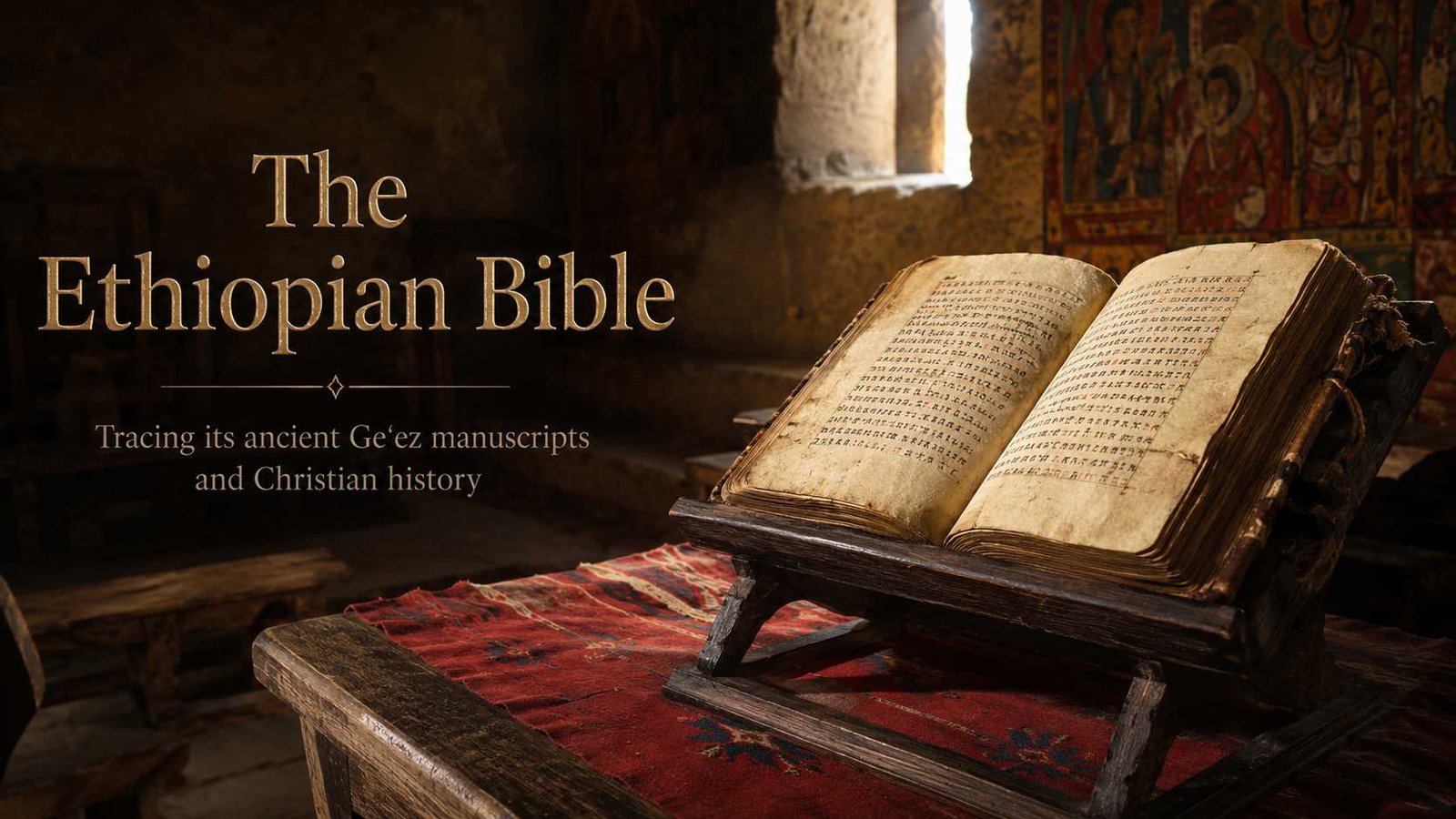
 The Ethiopian Bible is part of one of the oldest continuous Christian traditions in the world, but its age needs to be explained carefully.
You may have seen claims online saying that the Ethiopian Bible is 1,500 years old, that it is the oldest Bible on Earth, or even that it is the original Bible from which other Bibles came. Those statements mix several different facts together.
Here is the clearer answer.
The Geʿez biblical tradition of Ethiopia goes back roughly 1,400 to 1,700 years, with important biblical translation work taking place during the early Christian centuries. Some surviving Ethiopian Gospel manuscripts, especially the famous Garima Gospels, may date from between the fourth and seventh centuries. However, these ancient Gospel manuscripts are not a surviving 1,500-year-old copy of the entire 81-book Ethiopian Orthodox Bible.
The Ethiopian Orthodox Tewahedo Church today recognizes an 81-book biblical canon, making its collection of Scripture broader than the 66-book Protestant Bible and the 73-book Catholic canon.
Understanding that difference helps us appreciate Ethiopian Christianity without turning fascinating history into a claim the evidence cannot support.
How Old Is the Ethiopian Bible According to Historical Evidence?
When someone asks, “How old is the Ethiopian Bible?”, the first question we need to ask is what they mean by “the Ethiopian Bible.”
They may mean:
- the Ethiopian Christian biblical tradition
- the translation of Scripture into Geʿez
- the Ethiopian Orthodox canon of books
- a particular ancient Ethiopian manuscript
- the Garima Gospels
These are related, but they are not the same thing.
Christianity became deeply established in the ancient Kingdom of Aksum during late antiquity. Biblical texts were translated into Geʿez, the classical language that later became the great liturgical language of Ethiopian Christianity.
Scholars generally place major phases of this translation work in the early Christian centuries. Historical studies describe Scripture being translated into Geʿez during roughly the fifth through seventh centuries, while evidence from earlier Aksumite inscriptions shows that biblical language was already being used in Geʿez in late antiquity.
This means the roots of the Ethiopian Bible tradition reach back well over a thousand years.
That is remarkable.
But it is different from saying that one complete Ethiopian Bible containing all 81 books has survived unchanged as a single physical book for 1,500 years.
When Was the Bible Translated Into Geʿez?
There is no single date like “April 12, AD 450” when the entire Ethiopian Bible suddenly appeared.
Translation happened over time.
Different biblical books could have been translated, copied, revised, and transmitted at different stages. This was normal in the ancient world.
The earliest Ethiopian biblical tradition developed when Geʿez was still a living literary language of the Aksumite world. Ancient inscriptions provide evidence that biblical passages and Christian language were already circulating in Geʿez during this period.
This is why saying the Ethiopian Bible is about 1,500 years old can serve as a simple description of the ancient tradition, but it should not be taken as the exact age of every book or every manuscript used by Ethiopian Orthodox Christians today.
If you are interested in the languages behind Scripture more broadly, our guide to the original Bible language explains why Hebrew, Aramaic, Greek, and later translations all matter.
Was the Ethiopian Bible Translated From Hebrew or Greek?
Much of the early Geʿez biblical translation appears to have been made from Greek texts.
This is especially important for understanding the Old Testament. Greek-speaking Jews had translated Hebrew Scriptures into Greek centuries before Christianity. That ancient Greek collection became known as the Septuagint, often shortened to LXX.
The Septuagint was widely used among early Christians.
Scholars studying Ethiopian Christianity have found strong evidence of Greek influence on early Geʿez biblical texts. There has also been discussion about later Syriac, Arabic, Hebrew, and other influences in the long history of Ethiopian biblical transmission.
So the Ethiopian Bible did not appear independently from all earlier biblical traditions. It became part of the much larger history of Scripture being copied, translated, taught, and preserved across languages.
You can read more about this background in our guide to what LXX means in the Bible.
How Old Are the Earliest Ethiopian Bible Manuscripts?
This is where the story becomes especially interesting.
Ancient books normally do not survive easily.
Parchment wears out. Ink fades. Pages are damaged. Fires, war, moisture, insects, political upheaval, and ordinary daily use destroy manuscripts over time.
Because of this, the date when a text was first translated can be much earlier than the surviving copies we possess.
One of Ethiopia’s greatest treasures is the collection known as the Garima Gospels.
The Garima Gospels
The Garima Gospels are ancient manuscripts written in Geʿez containing the four canonical Gospels: Matthew, Mark, Luke, and John.
Modern research has dramatically changed how scholars understand their age.
A detailed study of the manuscripts reports radiocarbon ranges placing Garima 2 broadly between AD 390 and 570 and Garima 1 between about AD 530 and 660. These ranges do not mean one exact year has been proven, but they place the manuscripts firmly within late antiquity.
That makes the Garima manuscripts extraordinary witnesses to early African Christianity.
They are also beautifully illuminated.
Their artwork, writing, and physical construction show that sophisticated Christian manuscript culture existed in Ethiopia very early.
Yet one fact must remain clear:
The Garima Gospels are Gospel books, not a surviving complete 81-book Ethiopian Bible.
They contain Matthew, Mark, Luke, and John rather than the entire Ethiopian Orthodox biblical canon.
This distinction often disappears in social-media posts that call the Garima Gospels simply “the world’s oldest Ethiopian Bible.”
The real history is more interesting than the exaggerated version.
Why Manuscript Age Is Not the Same as Bible Age
Imagine buying a new Bible printed this year.
Your Bible is physically new.
But the Book of Genesis is ancient.
The Gospel of John is ancient.
Psalm 23 is ancient.
The age of your printed Bible and the age of the texts inside it are two different questions.
Ancient Ethiopian Christianity works the same way.
A manuscript copied in the sixth century may preserve a translation that began earlier. Another manuscript copied centuries later can preserve an ancient text. A modern printed Ethiopian Orthodox Bible can contain books that have been part of Ethiopian Christian tradition for many centuries.
So historians carefully separate:
the age of a text, the age of a translation, the age of a manuscript, and the history of a canon.
That simple distinction clears up much of the confusion surrounding the Ethiopian Bible.
Is the Ethiopian Bible Older Than the Bible?
No, not if by “the Bible” we mean the biblical writings themselves.
The Ethiopian Bible is not older than Genesis, Isaiah, the Psalms, Matthew, John, or the other biblical writings from which the Geʿez tradition developed.
Most of the Old Testament was originally written in Hebrew, with some Aramaic portions. The New Testament was written in Greek.
Those writings existed before they were translated into Geʿez.
The Geʿez Bible is therefore an ancient translation and textual tradition, not the source from which all earlier Hebrew and Greek Scripture came.
This is similar to asking whether the King James Bible is older than the New Testament.
The King James Version appeared in 1611, but the Greek New Testament is far older.
The same principle applies to Ethiopia.
The Geʿez biblical tradition is extremely old, but it belongs to the history of translating and preserving texts whose origins are earlier still.
Is the Ethiopian Bible Older Than the King James Bible?
Yes. By a very large margin.
The King James Version was first published in 1611.
Ethiopian Christians were reading Scripture in Geʿez roughly a thousand years before that.
The Garima Gospels alone may date back to between the fourth and seventh centuries.
So if the question is:
“Which tradition is older, the Geʿez Ethiopian Bible or the King James Version?”
The Ethiopian Geʿez tradition is clearly older.
But this does not mean the King James translators copied their Bible from Ethiopia. Both traditions ultimately belong to the wider history of biblical manuscripts and translations.
The KJV was translated mainly from Hebrew and Greek textual traditions available to scholars in early seventeenth-century Europe.
How Many Books Are in the Ethiopian Bible?
The Ethiopian Orthodox Tewahedo Church states that its biblical canon contains 81 books.
Its official presentation divides these into 46 books of the Old Testament and 35 books of the New Testament.
This is one reason people find the Ethiopian Bible so fascinating.
A common Protestant Bible contains 66 books.
The Catholic canon contains 73 books.
The Ethiopian Orthodox tradition recognizes a broader collection.
Among its distinctive writings are books such as 1 Enoch and Jubilees, which hold a particularly important place in Ethiopian Christian tradition. The preservation of complete Geʿez versions of ancient works such as Enoch has also been enormously important for scholars studying ancient Judaism and Christianity.
For a fuller breakdown, see our guide to how many books are in the Ethiopian Bible.
Why Does the Ethiopian Bible Have More Books?
Different Christian communities developed somewhat different biblical canons over long periods of history.
That is why Orthodox, Catholic, Protestant, and Ethiopian Orthodox Bibles do not all contain exactly the same number of books.
This should not be turned into a simple story in which one group secretly “removed” everything found in another tradition.
The history of biblical canon formation is more complex.
Christian communities inherited texts, used them in worship, copied them, discussed their authority, and preserved different collections over many centuries.
Ethiopian Christianity maintained several ancient writings that did not remain canonical in most Western Christian traditions.
This makes the Ethiopian tradition especially valuable to historians.
Does Having More Books Mean It Is the Original Bible?
No.
The number of books in a Bible does not tell us whether that Bible is older than every other biblical manuscript.
Canon size and manuscript age are separate questions.
An 81-book Ethiopian canon can preserve extremely ancient traditions without being the original physical Bible from which every other Christian Bible descended.
Likewise, a very old manuscript may contain only a few biblical books.
History is rarely as simple as “more books means older” or “older manuscript means original Bible.”
What Is the Oldest Bible on Earth?
This question sounds simple, but historians have to ask what “Bible” means.
Do we mean:
- the oldest fragment containing biblical words?
- the oldest Old Testament manuscript?
- the oldest Gospel manuscript?
- the oldest complete New Testament?
- the oldest manuscript containing most of the Christian Bible?
- the oldest complete Bible in a particular Christian canon?
These questions produce different answers.
One of the most important surviving Christian biblical manuscripts is Codex Sinaiticus.
It was handwritten in Greek in the middle of the fourth century, more than 1,600 years ago. The Codex Sinaiticus Project describes it as containing the earliest complete surviving copy of the Christian New Testament, along with a large portion of the Greek Old Testament.
The project therefore calls Codex Sinaiticus “arguably the earliest extant Christian Bible.”
That wording matters.
It does not mean there were no biblical writings before Codex Sinaiticus.
There certainly were.
Earlier biblical fragments and manuscripts survive, and the biblical books themselves were written centuries before Sinaiticus.
So when someone asks, “What is the oldest Bible on Earth?”, the safest answer is:
There is no single answer unless we define what counts as a complete Bible. Codex Sinaiticus is one of the earliest surviving Christian Bible codices and contains the oldest complete surviving New Testament.
The Garima Gospels belong to this same fascinating world of ancient Christian manuscript preservation, but they contain the four Gospels rather than the whole Christian Bible.
What Did Jesus Say in the Ethiopian Bible?
This question often comes from people who have heard that the Ethiopian Bible contains “lost” books and wonder whether Jesus teaches something completely different there.
The answer is much simpler.
The Ethiopian Orthodox canon contains the familiar four Gospels:
Matthew, Mark, Luke, and John.
That means Ethiopian Christians encounter the same central Gospel teachings of Jesus known throughout Christianity.
Jesus teaches people to love God and love their neighbor.
He teaches forgiveness.
He teaches prayer.
He calls people to repentance.
He speaks about mercy, humility, faith, justice, and the kingdom of God.
He teaches the Beatitudes in Matthew 5.
He gives the Lord’s Prayer in Matthew 6.
He teaches the great commandments in Matthew 22:37–40.
He speaks of loving one’s enemies in Matthew 5:44.
He tells His disciples to serve rather than chase power in Mark 10:42–45.
And in John’s Gospel, Jesus speaks repeatedly about faith, eternal life, love, and His relationship with the Father.
So there is not a completely different Ethiopian Jesus whose teachings overturn Matthew, Mark, Luke, and John.
The Ethiopian Church preserves a broader biblical canon, but its Gospel tradition remains centered on the same Jesus Christ proclaimed in the ancient Christian Gospels.
Does the Ethiopian Bible Contain Secret Sayings of Jesus?
This is another popular internet claim.
The existence of additional books in the Ethiopian canon does not mean Ethiopian Christians possess a hidden fifth Gospel containing a secret version of Jesus’ life that Western churches tried to erase.
That idea confuses several different subjects.
Ethiopian Christianity preserved important ancient writings that are not canonical in most Western churches. That is historically significant.
But the Ethiopian Orthodox Church’s canonical list still recognizes Matthew, Mark, Luke, and John as the four Gospels.
So if your question is, “What did Jesus say in the Ethiopian Bible?” the safest place to begin is still with those four Gospel books.
What Was Jesus Called in the Ethiopian Bible?
In Geʿez and related Ethiopian Christian usage, the name of Jesus appears as ኢየሱስ, commonly transliterated in English as Iyesus, Iyasus, or Iyäsus, depending on the transliteration system.
A University of Toronto Ethiopian manuscript collection, for example, catalogs an Ethiopian work called Te’amərä Iyesus, meaning The Miracles of Jesus.
You may also encounter the form Iyesus Kristos, meaning Jesus Christ.
This does not mean Ethiopian Christians believe in a different Jesus.
Names naturally take different forms when they move between languages.
For example:
Hebrew and Aramaic traditions give us forms connected with Yeshua.
Greek uses Iēsous.
Latin uses Iesus.
English eventually developed Jesus.
Geʿez has Iyesus/Iyäsus.
The spelling changes because languages use different sounds and writing systems. The person being named is the same Jesus of Nazareth.
Why Is the Ethiopian Bible So Important?
The Ethiopian Bible matters for several reasons.
First, it shows that Christianity has very deep roots in Africa.
Christian history is not simply a European story.
Ancient Christian communities existed across North Africa, Egypt, Nubia, Ethiopia, the Middle East, Asia Minor, and many other regions long before Christianity became associated with later European empires.
The Ethiopian tradition is one powerful reminder of this wider history.
Second, Ethiopian manuscripts preserve ancient textual traditions that scholars can compare with Greek, Syriac, Latin, Coptic, Armenian, and other biblical witnesses.
Third, Ethiopia preserved important works such as 1 Enoch in complete Geʿez form when complete versions had disappeared elsewhere. The Ethiopian Orthodox Church itself notes the scholarly importance of several such writings preserved in Geʿez.
Fourth, manuscripts such as the Garima Gospels reveal an ancient Christian artistic culture.
These books were not only containers for words.
They were carefully written, illustrated, bound, preserved, prayed over, and used within a living religious community.
There is something moving about that.
A Christian opening Scripture today belongs to a story of reading and preservation that reaches through countless generations.
Is the Ethiopian Bible the Original Bible?
It is better to say no, not in the way this claim is usually presented online.
There was never one ancient bound book called “the original Bible” from which every later Bible was photocopied.
The Bible is a collection of books written across different periods.
The Old Testament grew from ancient Hebrew and Aramaic writings.
The New Testament books arose in the first-century Christian world and were written in Greek.
Manuscripts were copied.
Texts traveled.
Translations were made.
Christian communities gradually recognized collections of authoritative books.
The Ethiopian Bible became one important branch of that history.
It is ancient.
It is distinctive.
It preserves valuable texts.
But it does not predate the Hebrew Scriptures or the Greek New Testament from which its biblical tradition ultimately developed.
That distinction protects the Ethiopian tradition from both dismissal and exaggeration.
We do not need to make Ethiopia the secret source of every Bible in order to recognize its extraordinary place in Christian history.
How Old Is the Ethiopian Bible? A Simple Timeline
Here is the history in a form that is easier to remember:
| Period | What Was Happening |
|---|---|
| Before Christianity | Hebrew and Aramaic Old Testament writings already existed |
| First century AD | New Testament books were written in Greek |
| Fourth century onward | Christianity became firmly established in the Aksumite world |
| Late antiquity | Major biblical translation and Christian literary work developed in Geʿez |
| c. AD 390–660 | Radiocarbon ranges associated with the earliest Garima Gospel manuscripts |
| Following centuries | Ethiopian biblical manuscripts continued to be copied and transmitted |
| Today | Ethiopian Orthodox Tewahedo tradition recognizes an 81-book canon |
The table shows why simply saying “the Ethiopian Bible is 1,500 years old” is both understandable and incomplete.
The tradition is ancient.
Some surviving manuscripts are extraordinarily old.
But the history developed across centuries rather than beginning with one complete Bible on one particular day.
What the Ethiopian Bible Teaches Us About Preserving Scripture
Ancient manuscripts can sometimes make faith feel distant.
We hear words like codex, Geʿez, Septuagint, and radiocarbon dating, and Scripture can begin to sound like an object in a museum.
But behind every manuscript were people.
Someone prepared the parchment.
Someone mixed the ink.
Someone carefully formed each letter.
Someone taught another person how to read those words.
Someone protected a manuscript through years of uncertainty.
Someone opened it in worship.
Someone heard the Gospel of Jesus from its pages.
The history of the Ethiopian Bible reminds us that Scripture has crossed languages and cultures without belonging to only one nation.
Hebrew speakers preserved sacred writings.
Greek-speaking Christians carried Scripture into a wider world.
Ethiopian Christians translated and preserved biblical texts in Geʿez.
Other Christians translated Scripture into Syriac, Coptic, Latin, Armenian, Georgian, and eventually thousands of other languages.
Different Christian traditions may not arrange or count every book in exactly the same way, yet all this history shows how seriously generations of believers treated Scripture.
They believed these words were worth preserving.
How Old Is the Ethiopian Bible? The Answer in Simple Terms
So, how old is the Ethiopian Bible?
The most accurate short answer is this:
The Ethiopian Geʿez biblical tradition reaches back roughly 1,400 to 1,700 years, with roots in the early centuries of Ethiopian Christianity. Some surviving Ethiopian Gospel manuscripts, especially the Garima Gospels, date to late antiquity. The Ethiopian Orthodox Church today recognizes an 81-book biblical canon.
But remember four important distinctions:
- The biblical writings themselves are older than their Geʿez translation.
- The Garima Gospels are ancient Gospel manuscripts, not a complete 81-book Bible.
- The Ethiopian Bible is much older as a tradition than the 1611 King James Version.
- Calling it “the original Bible” oversimplifies the long history of biblical writings, manuscripts, translations, and canons.
There is no need to exaggerate Ethiopia’s place in Christian history.
The real story is already extraordinary.
For well over a thousand years, Ethiopian Christians have prayed, worshiped, copied manuscripts, and preserved Scripture in a tradition that remains alive today.
Those ancient pages remind us that the Bible’s journey has never belonged to one language, one country, or one century.
It has traveled through generations.
And behind every surviving manuscript is the same quiet invitation Scripture still gives us today: not merely to admire an ancient book, but to listen carefully to the truth it carries.

Dr. Rachel is very smart and knows a lot about the Bible. He helps us understand the Bible better by talking about the old texts in a simple way.