

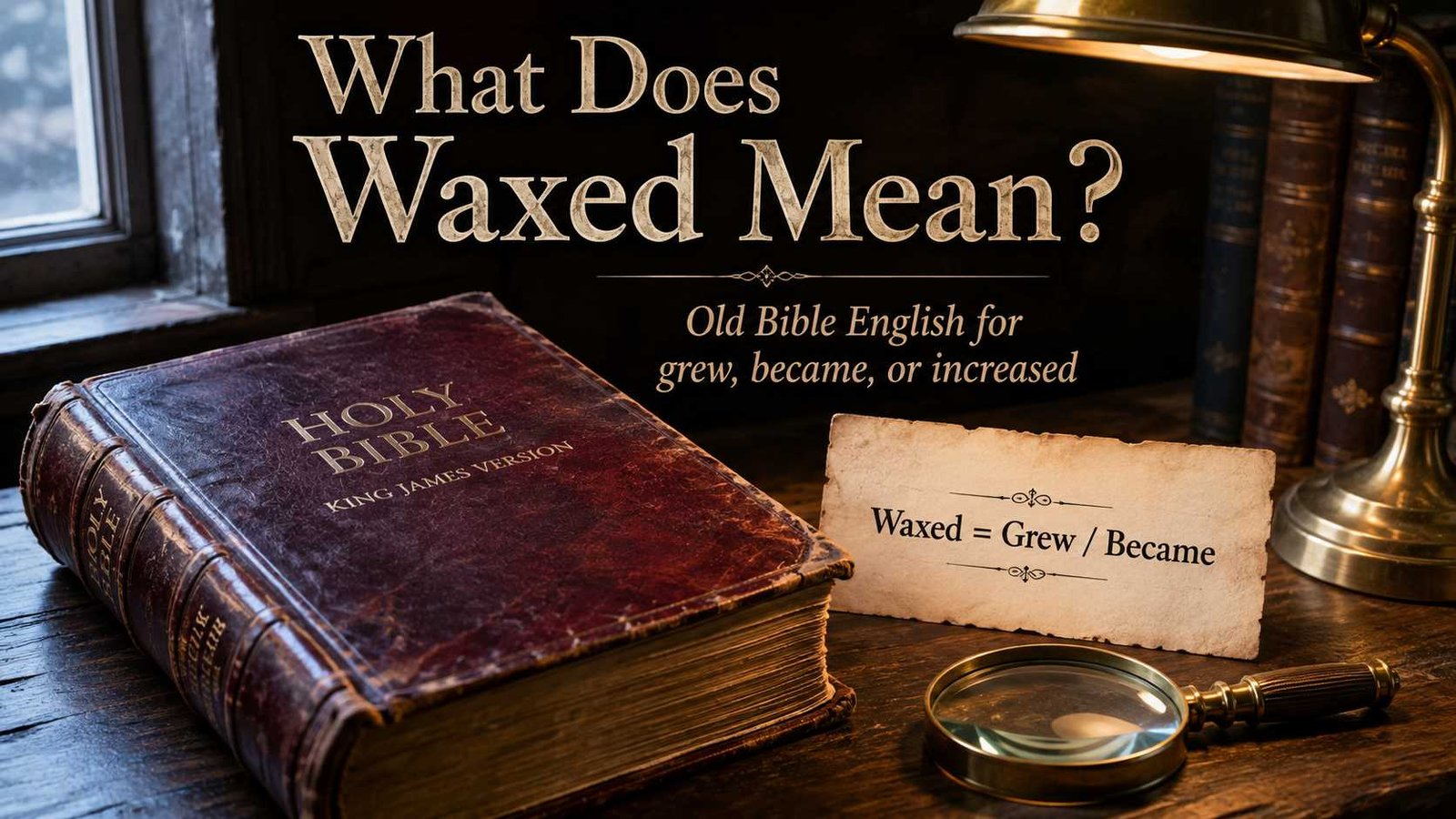
 If you read the King James Version of the Bible, you may come across a sentence that says someone “waxed strong,” “waxed great,” or “waxed old.” To modern ears, that wording can sound very strange.
So, what does “waxed” mean in the Bible?
In older English, waxed usually means grew, became, increased, or developed into a certain condition. It normally has nothing to do with the modern practice of using wax to remove body hair.
For example, Luke 1:80 says of John the Baptist:
“And the child grew, and waxed strong in spirit…”
Here, waxed strong simply means became strong or grew strong.
This older meaning of wax appears several times in the King James Bible. Once you understand it, many passages become much easier to read.
The word also gives us a useful lesson about Bible study. Sometimes a word that seems confusing is not mysterious at all. It is simply an older English word whose everyday meaning has changed.
What Does “Waxed” Mean in Biblical Terms?
In biblical terms, especially in older English translations such as the King James Version, to wax means to grow, become, increase, or develop.
The exact meaning depends on the words around it.
For example:
| Biblical Expression | Simple Modern Meaning |
|---|---|
| Waxed strong | Became strong |
| Waxed great | Became great or powerful |
| Waxed old | Grew old |
| Waxed worse | Became worse |
| Waxed fat | Grew fat or prosperous |
| Waxed cold | Became cold |
This is why we should not think of waxed as having only one modern definition.
In older English, a person could “wax strong” just as we might say today that a child “grew strong.”
Someone could “wax old,” meaning the person or thing became old.
A situation could “wax worse,” meaning it became worse.
The word describes change or growth from one condition into another.
Why Does “Wax” Sound Strange to Modern Readers?
Languages change.
Words that were normal hundreds of years ago may sound unusual today. Some words disappear almost completely from everyday speech. Others remain but take on different meanings.
The King James Bible was first published in 1611. Many English words that were familiar to readers at that time are no longer used in exactly the same way.
That does not mean the Bible itself is confusing. It means we are reading an older form of English.
You may notice the same thing with words such as holpen, succour, begat, or froward.
For example, if you have wondered [what does holpen mean in the Bible], the basic idea is “helped.” Likewise, [what does succour mean in the Bible] refers to giving help or support.
Understanding older vocabulary can open passages that once seemed difficult.
What Does “Waxed Strong” Mean in the Bible?
One of the clearest biblical examples comes from Luke 1:80.
The King James Version says:
“And the child grew, and waxed strong in spirit…”
The child in this passage is John the Baptist.
The phrase waxed strong does not refer to anything being placed on John. It means that he grew strong.
The verse describes his development as he grew toward adulthood and toward the work God had prepared for him.
Other English translations often use language such as “became strong” or “grew strong,” which expresses the same basic idea in words that are more familiar today.
The Meaning of Luke 1:80 in Context
Luke 1 tells the story surrounding the birth of John the Baptist.
John was born to Zechariah and Elizabeth after an angel announced that they would have a son. His birth was connected with an important purpose: he would prepare people for the coming of the Lord.
Near the end of the chapter, Luke summarizes John’s early development.
He grew physically, but the text also says he waxed strong in spirit.
The old English phrase communicates growth and development.
This helps us understand something important about biblical language. Sometimes a verse may contain a word that looks difficult, while the meaning of the entire sentence is actually very simple.
John grew.
John became strong.
He matured in preparation for what lay ahead.
When we replace the older word with a modern equivalent, the meaning becomes much clearer.
What Does “Waxed Old” Mean in the Bible?
Another helpful example appears in Hebrews 8:13.
The King James Version uses the phrase:
“…that which decayeth and waxeth old…”
Here, waxeth old means grows old or becomes old.
Again, the verb describes a change.
Something was not merely “old” in a fixed sense. It was becoming old.
That small difference helps us see how the word worked in older English.
The pattern is easy to recognize:
- Wax strong = become strong
- Wax old = become old
- Wax worse = become worse
- Wax great = become great
The word following wax often tells you what kind of change is happening.
Context Determines What “Waxed” Means
This is one of the most useful lessons we can learn from this word.
We should not study a Bible word completely by itself.
The surrounding sentence matters.
Suppose you read:
“waxed strong.”
The word strong tells you the direction of the change.
If you read:
“waxed old,”
the word old explains what is happening.
If something “waxed worse,” it was becoming worse.
This is a simple example of why biblical context matters so much.
A dictionary can help us understand a word, but the sentence helps us understand how the biblical writer is using it.
Why Does the KJV Use “Waxed” Instead of “Grew” or “Became”?
The King James Version uses wax because this meaning was much more familiar in earlier English.
To a reader several centuries ago, a sentence such as “he waxed strong” would not necessarily have sounded strange.
Modern English has changed.
Today, we usually say:
- became strong
- grew stronger
- became old
- grew worse
- increased
- developed
That is one reason modern Bible translations may use different English words even when they are communicating the same basic idea.
This does not require Christians to choose sides between Bible translations.
Many believers appreciate the King James Version for its history, rhythm, and familiar language. Others prefer translations that use more modern vocabulary.
Whichever translation you read, understanding older biblical English can help you compare passages more carefully.
Older Bible English Is Not a Secret Spiritual Language
Sometimes readers assume that an unfamiliar biblical word must have a hidden spiritual meaning.
That is not always the case.
Many difficult-looking words are simply old English.
For example, someone asking [what does frowardness mean in the Bible] may discover that the word refers to stubborn, contrary, or difficult behavior.
A reader studying [what does begot mean in the Bible] is also dealing with an older form of English connected with fathering or bringing forth a child.
The same principle applies to waxed.
There is no need to invent a mysterious meaning when the historical meaning of the word explains the passage naturally.
Examples of “Waxed” in the Bible
Looking at different kinds of expressions can make the meaning easier to remember.
“Waxed Strong”
This means grew strong or became strong.
Luke 1:80 is one familiar example concerning John the Baptist.
“Waxed Great”
This expression means became great, increased, or became powerful.
The idea is movement toward greatness or strength.
“Waxed Old”
This means grew old or became old.
Hebrews 8:13 provides a clear example of this older English usage.
“Waxed Worse”
This means became worse.
In everyday modern English, we would probably say that a person’s condition “got worse.”
“Waxed Cold”
This means became cold.
The word waxed again communicates movement from one condition toward another.
Once you recognize this pattern, you can often understand the verse without needing a long explanation.
Is “Waxed” Related to the Waxing Moon?
Interestingly, modern English still preserves an older sense of wax in one familiar expression: the waxing moon.
When people say the moon is waxing, they mean that the visible illuminated portion appears to be increasing.
The opposite is a waning moon, when the visible illuminated portion is decreasing.
This older use can help modern readers remember the biblical meaning.
Think of it this way:
Wax = grow or increase.
So:
- a moon can wax toward fullness
- a child can wax strong
- something can wax old
- a problem can wax worse
The exact expression changes, but the basic idea of development or increase remains.
What Does It Mean to Be Waxed Today?
This is where modern English can create confusion.
Today, if someone says a person “got waxed” or “was waxed,” the phrase may refer to hair removal using wax.
That meaning is completely different from the older biblical use.
Modern cosmetic waxing involves applying wax to unwanted body hair and removing the hair from the skin.
So we are dealing with two different uses of the same English word.
| Expression | Meaning |
|---|---|
| “Waxed strong” in older Bible English | Became strong |
| “Waxed old” in older Bible English | Grew old |
| Waxing moon | Increasing toward fullness |
| Having part of the body waxed | Removing hair with wax |
The context tells us which meaning is intended.
If you are reading the King James Bible and see that someone “waxed strong,” it has nothing to do with hair removal.
If you hear someone today say they went to a salon to be waxed, they are using the modern cosmetic meaning.
What Does It Mean to Wax a Girl?
In modern everyday language, to wax a girl or woman usually means to remove unwanted body hair using wax.
The exact area depends on the conversation.
This is a modern grooming expression. It is not a biblical phrase.
The Bible does not use the word wax in this modern cosmetic sense when it says a person “waxed strong,” “waxed great,” or “waxed old.”
That distinction is important because search engines may bring these two meanings together even though they come from very different contexts.
If you came to this page because you saw waxed while reading Scripture, the biblical meaning is usually grew, became, or increased.
Are Brazilian Waxes a Sin?
Another question sometimes connected with the word waxed is whether a Brazilian wax is sinful.
The Bible does not specifically mention Brazilian waxing or give a command about modern cosmetic hair-removal methods.
For that reason, it would be unwise to claim that Scripture directly calls this particular grooming practice a sin.
Christians may still think about broader biblical principles when making personal choices.
These may include:
- modesty
- privacy
- personal conscience
- motives
- wisdom
- respect for the body
- respect for one’s spouse
- avoiding unnecessary judgment of others
These principles can guide many decisions that the Bible does not discuss by modern name.
Be Careful About Calling Something Sin
Scripture takes sin seriously.
Christians should do the same.
But taking sin seriously also means we should be careful not to create a biblical command where the Bible has not given one.
There are many things in modern life that did not exist in their present form during biblical times.
The Bible does not name every hairstyle, beauty treatment, medical procedure, piece of clothing, or grooming method.
In such cases, Christians often look at biblical principles rather than searching for a verse that names the modern practice directly.
Romans 14 is often helpful when believers are considering matters of conscience where faithful Christians may reach different personal conclusions.
The goal should not be to judge another person quickly.
Instead, we can ask:
Does this decision honor God?
Is my motive healthy?
Am I acting with wisdom?
Does my conscience trouble me?
Am I treating my body and other people with respect?
Those questions are more useful than trying to force the old biblical word waxed into a modern grooming debate.
Does “Waxed” Have a Special Spiritual Meaning?
Usually, no hidden spiritual meaning is required.
The word itself simply describes growth, increase, or becoming.
Of course, the passage containing the word may have an important spiritual message.
For example, when John the Baptist “waxed strong in spirit,” the verse is talking about his growth and preparation.
But the word waxed itself is not a secret code.
This distinction matters.
Bible study becomes much clearer when we first ask:
What did this word normally mean in its language and context?
Only then should we ask what the larger passage teaches spiritually.
Otherwise, it is easy to give ordinary words meanings that the biblical writers never intended.
How to Understand Old Words in the King James Bible
If you regularly read the KJV, you will probably encounter other words that are unfamiliar today.
There is no reason to feel discouraged.
A few simple habits can help.
Read the Whole Sentence
Do not stop at the difficult word.
Read the full verse and the verses around it.
Often the surrounding words reveal the meaning.
If the sentence says someone “waxed strong,” the idea of becoming strong is fairly easy to recognize from context.
Compare Another Translation
You do not have to abandon your preferred Bible translation to benefit from another one.
Comparing translations can show how an older English expression is commonly stated today.
If one translation says “waxed strong” and another says “became strong,” you immediately gain useful information.
Use a Bible Dictionary or Lexicon
Bible dictionaries can explain old English vocabulary, historical background, places, names, customs, and important biblical terms.
For deeper study, a lexicon can help readers look at the Hebrew or Greek words behind an English translation.
You do not need to become a language scholar to benefit from these tools.
Notice Other Old Words
The more older biblical vocabulary you learn, the easier reading becomes.
For example, you might also study:
- [What Does Holpen Mean in the Bible]
- [What Does Succour Mean in the Bible]
- [What Does Frowardness Mean in the Bible]
- [What Does Begot Mean in the Bible]
- [What Does Unction Mean in the Bible]
- [What Does Strive Mean in the Bible]
Each word teaches us something about how English has changed while the biblical message remains rooted in its original historical setting.
Is “Waxed” the Same as “Waxeth”?
Yes, the basic verb is the same.
Waxed is a past-tense form.
Waxeth is an older English form that means something like waxes, grows, or becomes.
For example:
- “waxed strong” = became strong
- “waxeth old” = grows old or is becoming old
The ending -eth appears often in older English Bible translations.
You may also see forms such as:
- saith = says
- doeth = does
- cometh = comes
- liveth = lives
These endings can look unusual today, but they are mostly grammatical features of older English.
Understanding them removes much of the difficulty.
What Is the Difference Between Waxing and Waning?
The words wax and wane have traditionally been opposites.
Wax means to grow or increase.
Wane means to decrease or become less.
That is why we still speak of the moon as waxing and waning.
This contrast can make the biblical word easier to remember.
Imagine something moving upward or increasing:
Waxing = growing.
Imagine something becoming smaller or decreasing:
Waning = declining.
Although modern speakers rarely use wax this way in ordinary conversation, the older meaning survives in certain expressions.
Why Word Meanings Matter When Reading Scripture
A single misunderstood word can change how we read an entire sentence.
Suppose a person reads Luke 1:80 without knowing what waxed means.
They might imagine something physical being applied to John.
That would take the verse in a completely wrong direction.
But once we learn that waxed means grew or became, the sentence becomes clear.
This is why careful Bible reading matters.
Words have histories.
Translations have histories.
English itself has a history.
When we understand those things, we are less likely to force modern meanings into ancient or older texts.
Dr. Rachel Adams’s scholarly approach to Bible vocabulary is built on this simple principle: before asking what a word means for us today, we should first understand what it meant in its original sentence.
That protects us from confusion and helps us listen more carefully to Scripture.
Does Every Use of “Wax” Mean Exactly the Same Thing?
Not necessarily.
The basic idea may be growth, increase, or becoming, but the exact English word we use today depends on the sentence.
For example:
Waxed strong
We would probably translate this as “grew strong” or “became strong.”
Waxed old
We would say “grew old.”
Waxed worse
We might say “became worse” or simply “got worse.”
Waxed great
We might say “became great,” “grew powerful,” or “increased.”
So it is better to understand wax as a flexible old verb describing change rather than forcing one modern substitute into every verse.
That is normal in translation.
Very few words have only one possible English equivalent in every context.
What Does “Waxed” Teach Us About Reading the Bible Carefully?
The word waxed may seem like a small question, but it points to a larger truth about Bible reading.
We do not need to be frightened by unfamiliar words.
Sometimes the answer is much simpler than we expect.
When the Bible says a person waxed strong, it means that person grew strong or became strong.
When something waxed old, it grew old.
When a condition waxed worse, it became worse.
The word usually describes growth, increase, or movement into a new condition.
It does not normally refer to modern cosmetic waxing when it appears in older Bible translations.
And the Bible does not specifically condemn modern waxing practices such as Brazilian waxing. Questions like that are better considered through broader biblical principles of conscience, wisdom, modesty, and respect rather than by confusing the modern meaning of wax with the old biblical word.
Perhaps the most valuable lesson is this: when Scripture contains a word we do not understand, we should not rush to invent a meaning.
We can slow down.
Read the sentence.
Look at the surrounding verses.
Compare translations.
Study how the word was used.
Often, clarity comes quickly.
The Bible has many older words that may sound strange at first, but each one gives us another opportunity to read with care.
If you enjoy understanding older biblical English, you may also want to read What Does Holpen Mean in the Bible? and What Does Strive Mean in the Bible? Both explain words that can sound unfamiliar today but become simple once their context is understood.

Dr. Rachel is very smart and knows a lot about the Bible. He helps us understand the Bible better by talking about the old texts in a simple way.