

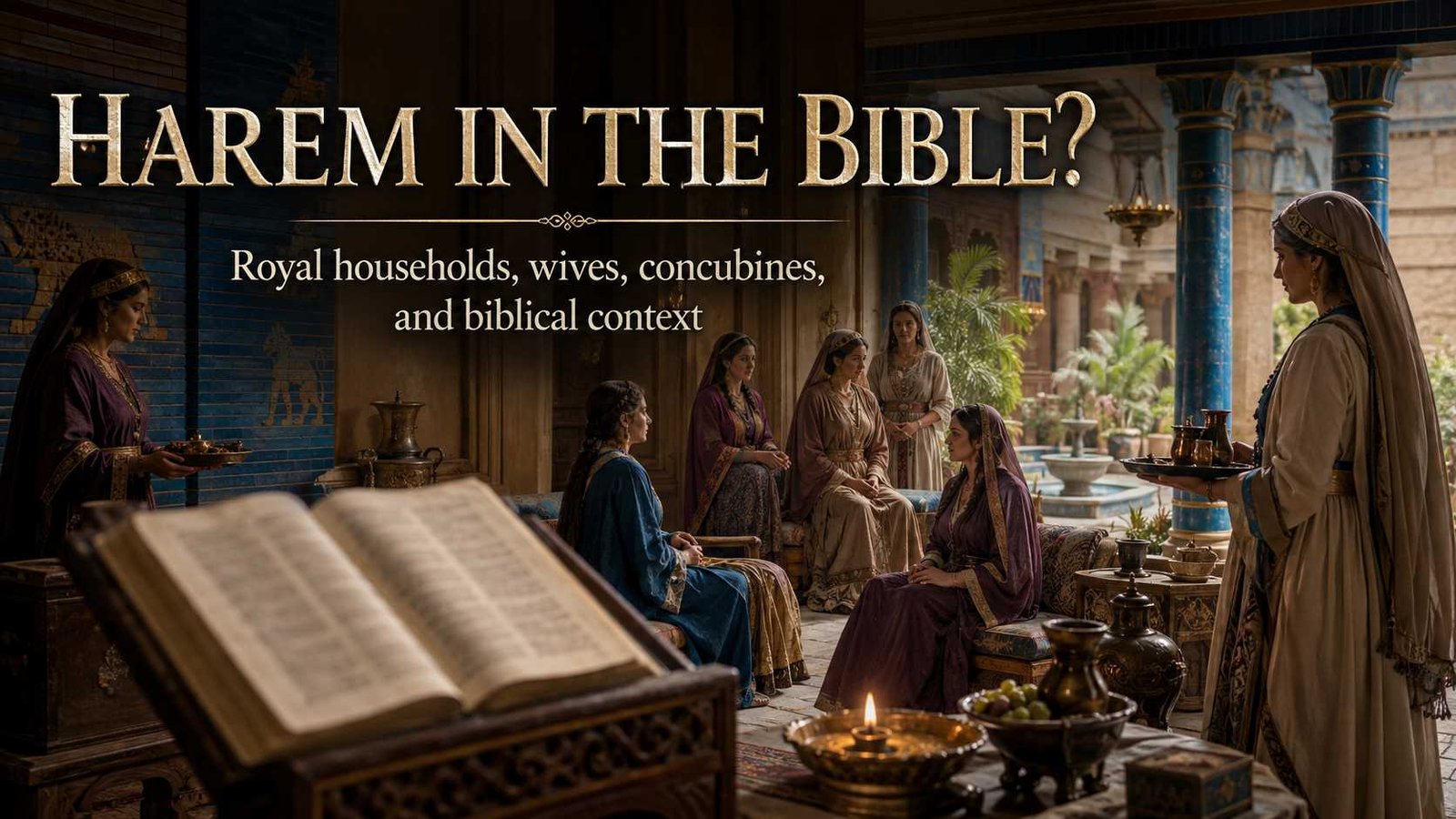
 When we hear the word harem today, our minds may go to movies, royal palaces, or stories about kings surrounded by many women. That picture can make the biblical meaning harder to understand.
So, what is a harem in the Bible?
In the biblical world, a harem was mainly a part of a royal household where women connected with a king lived. The word could also refer to the group of women living there. These women might include wives, concubines, servants, attendants, and women being considered for royal marriage.
The clearest example appears in the Book of Esther. Some modern Bible translations use the word harem when describing the women gathered at the Persian palace in Susa. Other translations use expressions such as the house of the women. The underlying Hebrew expression in Esther literally refers to the women’s house, which helps us understand what the term meant in that setting.
The Bible also records kings such as David and Solomon having many wives and concubines. We may describe such royal households as harem-like, but the Bible does not always use the word harem for them.
This distinction matters. The Bible records many customs of the ancient world without presenting every custom as God’s ideal.
What Is a Harem in the Bible? A Simple Meaning
A simple definition is:
A harem in the Bible is the women’s section of an ancient royal household, or the group of women who belonged to that household.
Esther 2 gives the clearest example. King Xerxes, also called Ahasuerus in some translations, needed a new queen after Queen Vashti was removed from her position.
His officials ordered young women from across the empire to be brought to Susa. The NIV says they were brought into the king’s harem and placed under the care of Hegai, a royal eunuch responsible for the women.
Other translations describe the same place as the house of the women. This is helpful because the English word harem can carry ideas that were not necessarily part of the original expression.
The basic idea was a separate royal living area for women.
A Harem Was More Than a Group of Wives
It is easy to think that a harem simply meant many wives. That is too narrow.
Historically, a royal women’s household could contain people with different roles and levels of status. There could be a queen, other wives, concubines, female servants, attendants, relatives, and other women connected with palace life.
In Esther’s case, the women were under royal supervision. Hegai was responsible for the group before a queen was selected. Esther 2 later mentions another official, Shaashgaz, who had responsibility for women in another part of the royal household.
Ancient Persian royal women should also not be pictured simply as helpless women hidden away from the world. Historical evidence from the Achaemenid Persian period shows that some royal and aristocratic women held significant social status, traveled, managed resources, and appeared in public settings. Ancient royal life was more complex than the popular image of a harem suggests.
Does the Word Harem Actually Appear in the Bible?
Yes, some English Bible translations use the word harem, especially in Esther 2.
For example, the NIV uses it when describing the women gathered at the citadel of Susa. The NLT and several other modern translations use similar language.
But this does not mean the original Hebrew Bible used the modern English word harem.
The Hebrew expression in Esther can be understood as house of the women. Translators sometimes use harem because it communicates the idea of a separate royal women’s household in a short and familiar way.
That is why one Bible may say harem while another says women’s quarters or house of the women.
They are describing the same basic setting.
Where Do We See a Harem in the Bible?
The strongest example is found in the story of Esther.
Other biblical kings had large households involving wives and concubines, but we should not automatically call every such household a harem. It is better to begin with the words Scripture itself uses.
Esther and the Royal Harem of King Xerxes
Esther lived during the period when the Jewish people were scattered throughout the Persian Empire.
She was a Jewish orphan who had been raised by her relative Mordecai. Her Hebrew name was Hadassah, while she was also known as Esther. Esther 2 explains that she was taken into the royal palace with other young women.
The women were placed under Hegai’s care.
This was not simply a social gathering. They were living within a highly controlled royal system. A new queen was to be chosen for the king.
Esther received special treatment and gained Hegai’s favor. Eventually, she was brought before the king and chosen as queen.
Her story later becomes much larger than palace life.
When a plan was made to destroy the Jewish people, Esther courageously approached the king and revealed both her identity and the danger facing her people. Her place in the royal household became part of God’s providential protection of the Jews.
That is one reason we should be careful with phrases such as harem girl when speaking about Esther. They can make her story sound like entertainment or romance when the biblical story is about danger, courage, identity, wisdom, and deliverance.
Solomon’s Wives and Concubines
King Solomon provides another important example of a very large royal household.
First Kings 11:3 says Solomon had 700 wives of royal birth and 300 concubines.
The passage does not celebrate this arrangement.
Instead, it explains that Solomon’s wives turned his heart toward other gods as he grew older. The man who had received extraordinary wisdom allowed his loyalties to become divided.
This becomes even more meaningful when we remember the instruction given to Israel’s kings in Deuteronomy 17:17. A king was warned not to multiply wives because doing so could lead his heart away from God.
Solomon’s story shows almost exactly the danger that command described.
If you want to understand this part of his life more deeply, the related question Who Had 700 Wives in the Bible? gives useful background.
What Was the Purpose of Harems?
Harems did not have only one purpose, and royal customs differed between civilizations.
In a royal court, women’s quarters could serve several functions.
They provided living space for women connected with the king. They helped organize a very large palace household. They could also be connected with royal marriage, family life, succession, political relationships, servants, and palace administration.
In powerful ancient kingdoms, marriage could have political importance as well as personal importance. Royal marriages sometimes connected ruling families or reflected a king’s status and influence.
The Book of Esther presents the women’s household as highly organized. The women were under the supervision of royal officials, lived in designated palace areas, and followed established procedures before appearing before the king.
Ancient Persian sources also show that eunuchs could hold important court responsibilities, including duties connected with royal women and the palace household.
So the purpose of a harem was broader than sexuality.
It could be part of the structure of royal family life and palace government.
This does not mean conditions were equal or freely chosen by everyone involved. Ancient royal systems operated under social and political structures very different from those most readers know today.
Esther herself is described as being taken into the king’s palace. That wording reminds us not to turn her experience into a modern romance story.
What Is the Difference Between a Concubine and a Harem?
This is one of the easiest places to become confused.
A concubine is a person.
A harem is a household, group, or living area.
In biblical societies, a concubine was generally a woman in a recognized relationship with a man but with a lower social or legal status than a primary wife. Details could differ between cultures and time periods. Biblical references clearly distinguish wives from concubines in a number of royal households.
Here is a simple comparison:
| Term | Simple Meaning |
|---|---|
| Wife | A woman joined to a man in marriage |
| Concubine | A woman in a recognized relationship with lower status than a primary wife |
| Harem | The women’s household, group, or living quarters |
| Queen | A royal wife holding a special position in the kingdom |
A king could therefore have several wives and concubines living within a larger royal women’s household.
The words should not be treated as synonyms.
For a fuller explanation of this distinction, What Is a Concubine in the Bible is the most closely related subject.
What Is a Harem in the Bible Compared With Biblical Marriage?
Here we need an important Bible-reading principle:
Description is not always approval.
The Bible honestly tells us what people did. That does not automatically mean God commanded or approved everything they did.
Scripture records jealousy, violence, deception, broken families, multiple marriages, political ambition, and many other human problems. Often, the consequences become part of the lesson.
The Bible’s first picture of marriage comes in Genesis 2, where a man and woman are united and become one flesh. Genesis 2:24 presents marriage as a deep covenant union. Jesus later referred back to this creation account when teaching about marriage.
Later, when Israel received instructions concerning future kings, Deuteronomy specifically warned the king not to accumulate many wives.
That warning is important when reading about Solomon.
Solomon’s enormous household demonstrated wealth and royal power, but spiritually it became a danger. First Kings does not say his many wives proved God’s blessing. It says they helped turn his heart away from wholehearted devotion to God.
This gives us a helpful rule when reading difficult Old Testament passages:
Do not ask only, What happened?
Also ask, What does the rest of Scripture say about what happened?
A practice can be historically real without being God’s highest purpose for His people.
Readers who want to explore that distinction further may also find How Does the Bible Define Marriage, What Is Adultery in the Bible, and Is Polyamory a Sin in the Bible useful companion topics.
Did Other Bible Characters Have Large Households?
Yes.
Several important Old Testament figures had more than one wife or had concubines.
But again, we should be careful about calling each family a harem.
Jacob’s Wives and Family
Jacob married both Leah and Rachel.
Genesis 29 explains that Jacob originally wanted to marry Rachel, but Laban deceived him and gave Leah to him first. Jacob later married Rachel as well.
Bilhah and Zilpah also became part of Jacob’s family arrangements and bore children to him. Genesis 30 describes these relationships within the customs of that ancient household.
The story is important because it shows that having several women within one family did not create a peaceful home.
There was jealousy.
There was competition.
There was pain.
There was favoritism.
The Bible does not hide those problems.
That is one reason the article How Many Wives Did Jacob Have in the Bible connects naturally with this subject.
David’s Wives and Concubines
David also had multiple wives and concubines.
Second Samuel 5:13 states that after David moved from Hebron to Jerusalem, he took additional wives and concubines and had more children.
Again, Scripture records the fact.
Later events in David’s family reveal deep conflict and suffering. His household became marked by rivalry, betrayal, violence, and struggles over the throne.
The size of a king’s family might communicate earthly power, but it did not guarantee peace.
Why Solomon Is the Strongest Israelite Example
Solomon stands apart because of the enormous numbers given in 1 Kings.
Seven hundred wives.
Three hundred concubines.
Those figures describe a royal household on a scale far beyond an ordinary family.
Yet the spiritual lesson of the passage is surprisingly simple.
A great king can still have a divided heart.
Solomon had wisdom, wealth, influence, and royal splendor. None of those things replaced the need for faithfulness to God.
Is a Harem Allowed in Islam?
This question often appears beside searches about biblical harems, but we should separate two different ideas.
A harem is not the same thing as plural marriage.
Historically, the word harem came to be strongly associated with women’s domestic quarters in Muslim societies, but forms of separate royal women’s households existed before Islam, including in ancient Persia.
Islamic teaching on marriage is a separate question.
Qur’an 4:3 discusses a man marrying up to four women and connects this permission with the responsibility to treat them justly. It also directs a man toward one wife if he fears he cannot maintain justice.
Therefore, saying simply that Islam allows harems would be misleading.
A more accurate statement is:
Traditional Islamic law discusses plural marriage, while the historical harem refers to a household structure or women’s quarters. The two ideas can overlap historically, but they are not the same thing.
For this Bible-focused discussion, the most important point is that harems existed in the ancient Near East before Islam. Esther’s story takes place in the Persian setting many centuries before the rise of Islam.
What Does Harem Girl Mean?
The phrase harem girl is not a specific biblical title.
Today it is usually a loose expression for a woman imagined as living in or belonging to a harem.
The problem is that movies, paintings, novels, and popular entertainment have often presented harems in a romantic or sexualized way. That can give readers a distorted picture of the ancient world.
The Bible does not introduce Esther as a harem girl.
It introduces her as Hadassah, also called Esther, a Jewish orphan raised by Mordecai. She was taken into the Persian royal household and eventually became queen.
Those details matter.
Calling her simply a harem girl can reduce a complicated biblical person to a modern stereotype.
Was Esther a Harem Girl?
Technically, Esther lived within what some modern Bible translations call the king’s harem.
So in a very broad historical sense, someone might say she became part of the royal harem system.
But harem girl is not the best biblical description of Esther.
The phrase carries modern associations that may distract from what the Book of Esther actually says.
Esther was taken into the royal household, placed under Hegai’s supervision, and later chosen by the king to become queen.
More importantly, the rest of her story is about courage.
Esther faced a terrible choice. Approaching the king without being summoned could place her life in danger. Yet when her people were threatened, she chose to act.
Her position in the palace gave her access to power, but courage was still required to use that position for others.
That is the Esther the Bible asks us to remember.
Why Did Kings Have So Many Wives and Concubines?
There was no single reason.
For ancient rulers, marriage could involve family, politics, status, wealth, alliances, succession, and personal desire.
Royal households could become enormous because a king had resources that ordinary people did not have.
But Scripture repeatedly reminds us that greater power does not automatically produce greater wisdom.
Solomon is the clearest warning.
He was one of Israel’s wealthiest and most famous kings. Yet the very abundance associated with his throne became connected with spiritual compromise.
Deuteronomy had warned Israel’s kings against multiplying wives, and 1 Kings later describes Solomon’s heart being led away.
That contrast is difficult to miss.
The biblical lesson is not, Powerful men should have enormous households.
The lesson is closer to the opposite:
Even the most powerful person must remain faithful to God.
Does the Bible Approve of Harems?
The Bible records royal harems and large households, but it does not give Christians a command to create them.
This distinction between recording and approving is essential.
Esther describes the Persian royal system because that is the world in which Esther lived.
First Kings describes Solomon’s wives and concubines because they were part of his history.
Second Samuel tells us about David’s household because it mattered to the events of his reign.
Genesis tells us about Jacob’s complicated family because his children became central to Israel’s story.
But none of these descriptions alone should be turned into a command.
When Scripture gives direct guidance concerning Israelite kings, it warns them against multiplying wives.
When Scripture presents the creation pattern for marriage, it describes the union of man and woman as becoming one flesh.
And when Solomon’s many marriages are evaluated, the focus is on how they contributed to his heart turning away from God.
That gives us a much clearer biblical picture than simply counting how many wives different kings had.
What Can We Learn From Biblical Harems Today?
Most Christians today will never live anywhere near a royal palace, so why should this subject matter?
Because these stories teach us how to read the Bible carefully.
First, historical setting matters.
The world of Esther was not our world. Ancient Persian court customs, royal authority, marriage arrangements, and social structures were very different from modern life. Historical knowledge can help us understand the text without changing its message.
Second, words matter.
When one translation says harem and another says house of the women, both may be trying to communicate the same ancient reality in different English words.
Third, description is not necessarily approval.
God’s Word can tell us truthfully about a broken practice without asking us to copy it.
Fourth, power does not protect the heart.
Solomon had almost everything a human ruler could desire. Yet his spiritual life suffered when his loyalties became divided.
Finally, God can work even in difficult human systems.
Esther did not choose the political world into which she was drawn. Yet her position eventually became part of the deliverance of her people.
That does not mean every detail of the Persian court was good.
It means human systems do not place God’s providence beyond reach.
Understanding a Harem Without the Modern Stereotypes
When reading the Bible, it helps to remove the pictures our culture has placed in our minds.
A biblical harem was not simply a room filled with women entertaining a king.
In Esther, it was an organized part of an ancient royal court. Women lived under officials responsible for the household. Different women could have different positions and futures. Esther eventually became queen.
Likewise, calling Solomon’s household a harem can be useful as a historical description, but the Bible itself emphasizes his wives and concubines and, more importantly, what those relationships did to his spiritual faithfulness.
The biblical writers are often less interested in satisfying our curiosity about palace life than in showing us what happens inside the human heart.
That is where the real lesson lies.
What the Bible’s Harems Teach Us About Faith
So, what is a harem in the Bible?
It was mainly a royal women’s household or the living quarters connected with that household. Esther gives us the clearest biblical example because modern translations such as the NIV directly use the word harem for the women’s section of the Persian palace at Susa. Other translations preserve the more literal idea of the house of the women.
A harem was not the same as a concubine.
A concubine was a woman with a recognized but generally lower-status relationship within an ancient household. A harem was the larger household, group, or place where royal women could live.
The Bible also tells us about kings with many wives and concubines, especially Solomon. Yet Scripture does not ask us to admire the size of Solomon’s household. It points instead to the danger of his divided heart.
Esther’s story gives us another lesson.
She lived inside a powerful royal system she did not control, yet her life became a story of courage and providence.
So when we encounter unfamiliar customs in Scripture, we do not have to either romanticize them or reject the Bible because they feel strange.
We can read patiently.
We can ask what the words meant in their original setting.
We can distinguish between what the Bible records and what it commands.
And above all, we can keep our attention on the spiritual truth Scripture is revealing.
Kings may build great palaces. They may gather wealth, wives, servants, and influence. But the Bible measures a life by something deeper.
It asks where the heart is turned.

Dr. Rachel is very smart and knows a lot about the Bible. He helps us understand the Bible better by talking about the old texts in a simple way.