
 Faith is one of the great themes of Scripture. Christians speak about having faith, growing in faith, walking by faith, and putting faith in God. So it is natural to wonder: How many times is faith mentioned in the Bible?
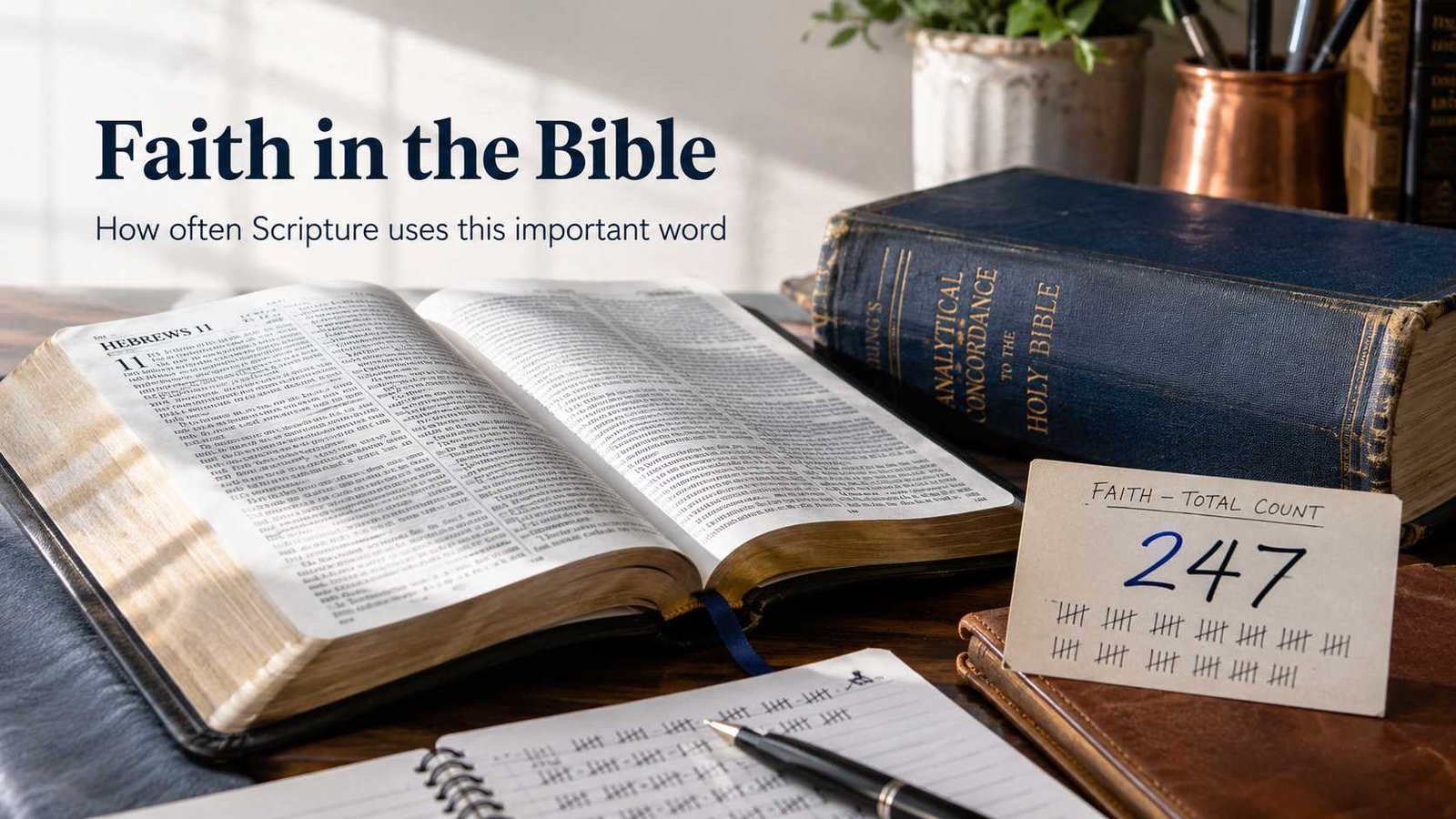
In the King James Version (KJV), the exact English word faith appears 247 times in 231 verses.
That is the simple answer, but there is an important detail. The number changes when you use a different Bible translation. The NIV, NASB, NRSV, ESV, and other translations do not always use the same English word for the same Hebrew or Greek term.
This means there is no single number that applies equally to every English Bible.
Even more important, counting the word faith does not measure everything the Bible teaches about trusting God. Scripture also uses words such as believe, trust, faithfulness, confidence, hope, and reliance to describe ideas closely connected with faith.
So the number is interesting, but the meaning is much richer.
How Many Times Is Faith Mentioned In The Bible? The Short Answer
If you are reading the King James Version, the word faith occurs 247 times.
Those occurrences are found in 231 different verses. The difference exists because some verses use the word faith more than once.
Here is a simple comparison:
| Bible Translation | Approximate Uses of “Faith” |
|---|---|
| King James Version | 247 |
| NASB 1995 | 250 |
| NRSV | 264 |
| NIV | 270 |
These numbers show why two people can search for the same word and get different answers.
One person may say faith appears 247 times. Another may find around 270 occurrences. Both may be accurately reporting what appears in the translation they searched.
This is one reason Bible word studies should always identify the translation being used.
Faith Appears 247 Times in the KJV
The KJV gives us one of the clearest figures because its wording has remained stable for centuries.
Its 247 uses of faith are heavily concentrated in the New Testament.
Only two KJV occurrences of the exact English word faith appear in the Old Testament:
Deuteronomy 32:20 speaks of children in whom there is no faith.
Habakkuk 2:4 gives the famous statement that the just shall live by his faith.
That does not mean Old Testament believers knew little about faith.
Quite the opposite.
Abraham trusted God. Moses trusted God. David trusted God. Hannah prayed with confidence. Daniel remained faithful when obedience became dangerous.
The concept is everywhere, even when the English KJV does not use the word faith.
This helps us understand an important rule of Bible study: a biblical idea can appear many times even when one particular English word does not.
The same principle applies when studying how many times trust is mentioned in the Bible.
Why Does the Number Change Between Bible Translations?
English Bible translations sometimes choose different words to express the same original-language idea.
The Old Testament was written mainly in Hebrew, while most of the New Testament was written in Greek.
Translators must decide how to express those ancient words clearly in English.
One translation may use faith.
Another may use faithfulness.
Another may use trust.
In some passages, several choices may be reasonable.
That is why a computer search of one English word cannot tell us everything Scripture teaches about a subject.
Consider Habakkuk 2:4. The Hebrew language allows translators to consider ideas connected with faith, faithfulness, steadfastness, and trustworthiness. When that verse is later quoted in the New Testament, it becomes deeply connected with the Christian teaching about living by faith.
Translation is not simply replacing one ancient word with one English word every time. Context matters.
This explains why the NIV can contain more appearances of the English word faith than the KJV without containing more Scripture.
The underlying biblical books are the same in a standard Protestant Bible. The English wording is simply different.
For this reason, when someone asks, “How many times is faith mentioned in the Bible?” the best response is:
Faith appears 247 times in the KJV, but the exact total depends on the translation you search.
That answer is both simple and accurate.
How Many Bible Verses Mention Faith?
In the King James Version, 231 Bible verses contain the exact word faith.
The word itself appears 247 times because a few verses contain it more than once.
But even the figure of 231 verses does not represent every passage about faith.
For example, Genesis 15:6 describes Abraham believing the Lord:
“And he believed in the LORD; and he counted it to him for righteousness.”
The KJV does not use the word faith in that verse.
Yet the New Testament clearly treats Abraham’s belief as one of Scripture’s most important examples of faith.
Paul discusses Abraham in Romans 4 and Galatians 3. James also refers to Abraham when explaining how genuine faith is shown through action.
So if you search only for the word faith, you will miss some of the Bible’s strongest teaching about faith.
This is why a good study of what the Bible says about faith must go beyond a concordance count.
Which Bible Books Talk About Faith Most?
Faith becomes especially prominent in several New Testament books.
Romans explains the relationship between faith, righteousness, grace, and salvation.
Galatians strongly emphasizes faith in Christ rather than dependence on works of the law.
Hebrews gives some of the Bible’s most memorable teaching about faith, especially in Hebrews 11.
James explains that real faith affects how we live.
The Gospels also show faith through people who came to Jesus for healing, forgiveness, mercy, and help.
Some had strong faith.
Others struggled.
Some asked Jesus to help their unbelief.
That makes the Bible’s teaching very human. Faith is not presented as pretending that life is easy. It is trusting God even when we do not see the whole path ahead.
If you are looking for what chapter in the Bible talks about faith, Hebrews 11 is one of the best places to begin.
What Does Faith Mean in the Bible?
The New Testament Greek word commonly translated as faith is pistis.
Depending on context, it can express ideas such as faith, trust, confidence, belief, or faithfulness.
Biblical faith is therefore more than agreeing that God exists.
It involves trusting Him.
Hebrews 11:1 gives one of Scripture’s best-known descriptions:
“Now faith is the substance of things hoped for, the evidence of things not seen.”
This does not mean Christians believe without reason.
The chapter that follows points to real people who trusted God enough to act.
Noah prepared the ark.
Abraham obeyed when God called him.
Moses chose to identify with God’s people.
Rahab acted on what she had come to believe.
Their faith produced decisions.
That is a major biblical pattern.
Faith begins in the heart, but genuine faith affects life.
Hebrews 11:6 also teaches that faith is central to a relationship with God. The believer comes to God trusting that He is real and that seeking Him matters.
A simple definition of faith in the Bible could therefore be expressed this way:
Biblical faith is trusting God, believing His truth, and relying on Him enough for that trust to shape how we live.
How Many Times Did Jesus Talk About Faith?
There is no universally agreed number for how many times Jesus talked about faith.
The reason is similar to the translation problem we have already seen.
Should we count only places where Jesus uses the noun faith?
Should we also count the word believe?
Should passages about trusting God be included even when neither English word appears?
If we focus on Gospel passages where the Greek noun pistis, usually translated faith, appears in sayings attributed to Jesus, we find roughly twenty such passages.
But Jesus taught about believing and trusting God far more broadly than that number suggests.
For example, He regularly responded to people whose trust in Him was connected with healing.
In Matthew 9:22, Jesus tells a woman that her faith has made her whole.
In Matthew 9:29, He speaks to two blind men about their faith.
In Mark 5:34, faith is again connected with a woman who came to Jesus seeking healing.
In Luke 7:50, Jesus tells a woman that her faith has saved her.
In Luke 17:19, He speaks of faith to the healed Samaritan who returned to give thanks.
Jesus also spoke of little faith when His disciples were anxious or afraid.
That is important.
Not every teaching about faith begins with someone who already feels spiritually strong.
Sometimes Jesus addressed frightened people.
Sometimes He corrected doubt.
Sometimes He praised extraordinary trust.
Sometimes He called people to keep believing.
Jesus Said, “Have Faith in God”
Mark 11:22 records one of Jesus’ clearest statements:
“Have faith in God.”
Those four words capture something essential.
Biblical faith is not faith in faith itself.
It is not positive thinking.
It is not the belief that we can force every situation to turn out exactly as we want.
Faith has an object.
Jesus directs faith toward God.
That distinction matters.
Christian faith does not teach us to trust our emotions, our circumstances, or our ability to control the future.
It teaches us to trust God.
What Are the Three Types of Faith According to the Bible?
People often ask, What are the three types of faith according to the Bible?
We should be careful with that wording.
The Bible does not give an official verse saying, “There are three types of faith.”
Different Christian teachers organize biblical teaching on faith in different ways.
Still, Scripture does describe faith in several different settings. For simple study, we can look at three helpful categories.
1. Saving Faith
The New Testament connects faith with receiving God’s grace.
Ephesians 2:8 says:
“For by grace are ye saved through faith.”
The emphasis is important.
Salvation begins with God’s grace.
Faith is not a payment made to God. It is not a human achievement that earns salvation.
Faith receives what God gives.
Paul develops this teaching in Romans and Galatians, especially when discussing Abraham.
Abraham believed God, and that trust became a central biblical example of righteousness by faith.
Saving faith therefore involves relying on God rather than trusting our own goodness to make us right with Him.
2. Living Faith
James warns about a kind of claimed faith that produces no fruit.
James 2:17 says:
“Even so faith, if it hath not works, is dead, being alone.”
James is not saying that people purchase salvation with good deeds.
He is asking whether claimed faith is genuine when it never affects a person’s life.
Think of it this way.
If someone says, “I trust this bridge,” but absolutely refuses to step onto it, you may question how much trust is really present.
Biblical faith is alive.
It changes choices.
It encourages obedience.
It produces love, mercy, courage, generosity, patience, and perseverance.
This is why the relationship between faith and works in the Bible deserves careful study rather than turning Paul and James into opponents.
Both writers treat genuine faith as something much deeper than empty words.
3. The Gift of Faith
First Corinthians 12:9 mentions faith among spiritual gifts given by the Holy Spirit.
This appears in a different setting from the basic faith through which a person trusts Christ.
Paul is describing gifts given within the body of believers for service.
Christians interpret the precise working of this gift in somewhat different ways, so we should avoid going beyond what the text clearly says.
What we can safely say is that Scripture recognizes a Spirit-given expression of faith in the context of spiritual gifts.
So the three categories above can help us study the subject:
- Saving faith
- Living or active faith
- The spiritual gift of faith
But remember, this is a teaching framework, not an official Bible list labeled “the three types of faith.”
Dead Faith Is a Warning, Not a Fourth Goal
James also gives us the phrase dead faith.
Dead faith is not presented as another healthy form of Christian faith.
It is a warning.
Someone can claim to believe while living as though the belief makes no difference.
James gives a practical example. If we see a brother or sister who lacks basic needs and only offer kind words without helping when we are able, our words have little value.
Faith should produce love.
This is one reason Jesus placed such importance on fruit.
A tree is known by what it produces. In the same way, faith becomes visible through the direction of a person’s life.
Believers are not perfect. They still fail, struggle, question, and repent.
Living faith does not mean flawless behavior.
It means faith is alive enough to keep drawing us toward God.
Who Had Great Faith in the Bible?
The Bible gives many examples of people who trusted God.
Hebrews 11 is sometimes called the “faith chapter” because it brings many of these stories together.
Abraham
Abraham is one of Scripture’s clearest examples.
God called him to leave his homeland and go toward a place he had not yet seen.
Abraham obeyed.
He did not know every detail of the journey.
That is often how faith works.
God does not always give us the complete map before asking us to trust Him.
Sarah
Hebrews also remembers Sarah in connection with faith.
Her story reminds us that faith can exist alongside long periods of waiting.
God’s promises do not always unfold according to our preferred schedule.
Moses
Moses faced Pharaoh, led Israel out of Egypt, and continued through years of difficulty.
His life included moments of courage as well as moments of weakness.
That makes his story valuable.
Faithful people are still human people.
Rahab
Rahab heard what the God of Israel had done and acted on what she believed.
The New Testament remembers her faith.
Her story shows that a person’s past does not prevent God from working through a life that turns toward Him.
You can find many more examples by studying who had faith in the Bible.
What Is Mentioned Over 700 Times in the Bible?
Another question connected with Bible word counts is, What is mentioned over 700 times in the Bible?
You may see online claims that the number seven is mentioned more than 700 times.
This needs qualification.
The total depends on what is being counted.
Are we counting only the exact word seven?
Are we including seventh?
Seventy?
Sevenfold?
Groups of seven?
Symbolic patterns built around seven?
Once related forms and patterns are added, a very large figure can be produced.
But that is different from counting one exact English word.
So it is better not to repeat “over 700 times” as though every Bible translation produces the same result.
Bible statistics can sound impressive, but they need context.
The same caution applies to popular claims such as “fear not appears 365 times.” Such statements often spread because they make memorable devotional points, but a careful Bible search may not support the exact number being claimed.
Scripture does not need an exaggerated statistic to make its message powerful.
Accuracy honors the text.
Faith, Believe, and Trust Are Closely Connected
One reason the biblical theme of faith is much larger than 247 occurrences is that the New Testament often uses the verb believe.
The Greek verb commonly translated believe is pisteuō.
It is closely related to pistis, the noun often translated faith.
English separates these words more sharply than Greek sometimes does.
We say:
“I believe God.”
“I have faith in God.”
Those sound like different constructions in English, but the underlying ideas are closely connected.
This is especially important in the Gospel of John.
John often speaks about believing in Jesus.
If someone searched John only for the English noun faith, that person could wrongly conclude that faith is not important in the Gospel.
Nothing could be further from the truth.
Believing is one of John’s central themes.
John 3:16 itself speaks of believing in God’s Son.
So word-count studies are useful, but they must not become too narrow.
The Bible teaches ideas, not merely English vocabulary.
Faith Is Not the Same as Blind Optimism
Modern culture often uses faith to mean believing that things will somehow work out.
Biblical faith is more specific.
Faith trusts God.
That means Christian faith can remain alive even when circumstances do not turn out as we hoped.
Hebrews 11 makes this very clear.
Some people experienced remarkable deliverance.
Others suffered.
Both groups are remembered in a chapter about faith.
That corrects an unhealthy idea that strong faith always guarantees immediate comfort, wealth, healing, or success.
Biblical faith says:
God is trustworthy even when life is painful.
God is present even when I do not understand.
God’s character does not change when my circumstances change.
I can obey Him even when the next step feels difficult.
This kind of faith is deeper than positive thinking because it rests on who God is rather than on our ability to predict what will happen.
Faith Comes Through Hearing God’s Word
Romans 10:17 gives another important truth:
“So then faith cometh by hearing, and hearing by the word of God.”
Faith grows as we hear and receive God’s truth.
This gives us a practical answer when we feel spiritually weak.
We do not have to manufacture stronger emotions.
We can return to Scripture.
Read the Gospels.
Remember what God has done.
Pray honestly.
Listen to God’s promises.
Spend time with believers who encourage trust rather than fear.
Faith can grow slowly.
A person may begin with many questions and still move toward deeper trust.
The father in Mark 9 gives one of the most honest prayers in Scripture when he asks Jesus for help with his unbelief.
That prayer reminds us that struggling with doubt does not mean you must run away from God.
You can bring the struggle to Him.
Faith and Faithfulness Belong Together
The Bible also connects faith with faithfulness.
This makes sense.
If we truly trust God, we learn to remain faithful to Him.
Faithfulness does not mean never failing.
Peter failed seriously when he denied knowing Jesus.
Yet his story did not end there.
Jesus restored him.
Peter later became a bold witness.
Christian faith includes repentance because believers still make mistakes.
When we fall, faith does not tell us to hide forever.
It calls us back to God.
This is another reason biblical faith should never be reduced to a statistic.
The number 247 cannot show us Peter weeping after failure.
It cannot show Abraham walking into an unknown future.
It cannot show a frightened woman reaching toward Jesus.
It cannot show Paul continuing to preach through suffering.
The stories reveal what the word means.
How Many Times Is Faith Mentioned In The Bible Really Matters Less Than Why
There is value in knowing that faith appears 247 times in the King James Version.
It tells us that faith is a major biblical subject.
But the more important question is not how many times the word appears.
It is what Scripture asks us to do with it.
The Bible does not present faith as a religious vocabulary word to memorize.
Faith is meant to be lived.
Second Corinthians 5:7 says:
“For we walk by faith, not by sight.”
Walking suggests movement.
Faith takes another step even when we cannot see everything ahead.
It does not mean ignoring facts.
It does not mean refusing wisdom.
It does not mean pretending danger is harmless.
It means that after we have done what wisdom requires, our deepest trust still rests in God.
A child may not understand every turn of a long journey, but the child can trust the parent who knows the road.
That picture is not perfect, but it helps us understand biblical faith.
We do not know everything God knows.
We do not see everything He sees.
Faith trusts His character even when our knowledge is incomplete.
What the Bible’s Many References to Faith Teach Us
So, how many times is faith mentioned in the Bible?
In the King James Version, the exact word faith appears 247 times in 231 verses.
Other Bible translations produce different totals because translators sometimes use words such as faith, faithfulness, trust, or belief in different places.
Jesus also spoke about faith and believing many times, so counting only the noun faith cannot capture the full weight of His teaching.
And although Christians sometimes speak about three types of faith, the Bible does not provide an official numbered list. It does, however, teach about saving faith, living faith, the gift of faith, and the danger of faith that is dead and fruitless.
Here is what matters most.
The Bible is not asking us merely to count faith.
It is inviting us to live by faith.
Faith trusts God when the answer is clear.
Faith trusts Him while waiting.
Faith keeps walking when the road feels uncertain.
Faith returns after failure.
Faith listens to God’s Word and allows that truth to shape daily life.
The 247 occurrences in the KJV are worth knowing.
But one sincere act of trusting God can help us understand the meaning of faith more deeply than memorizing the number alone.

Dr. Rachel is very smart and knows a lot about the Bible. He helps us understand the Bible better by talking about the old texts in a simple way.