

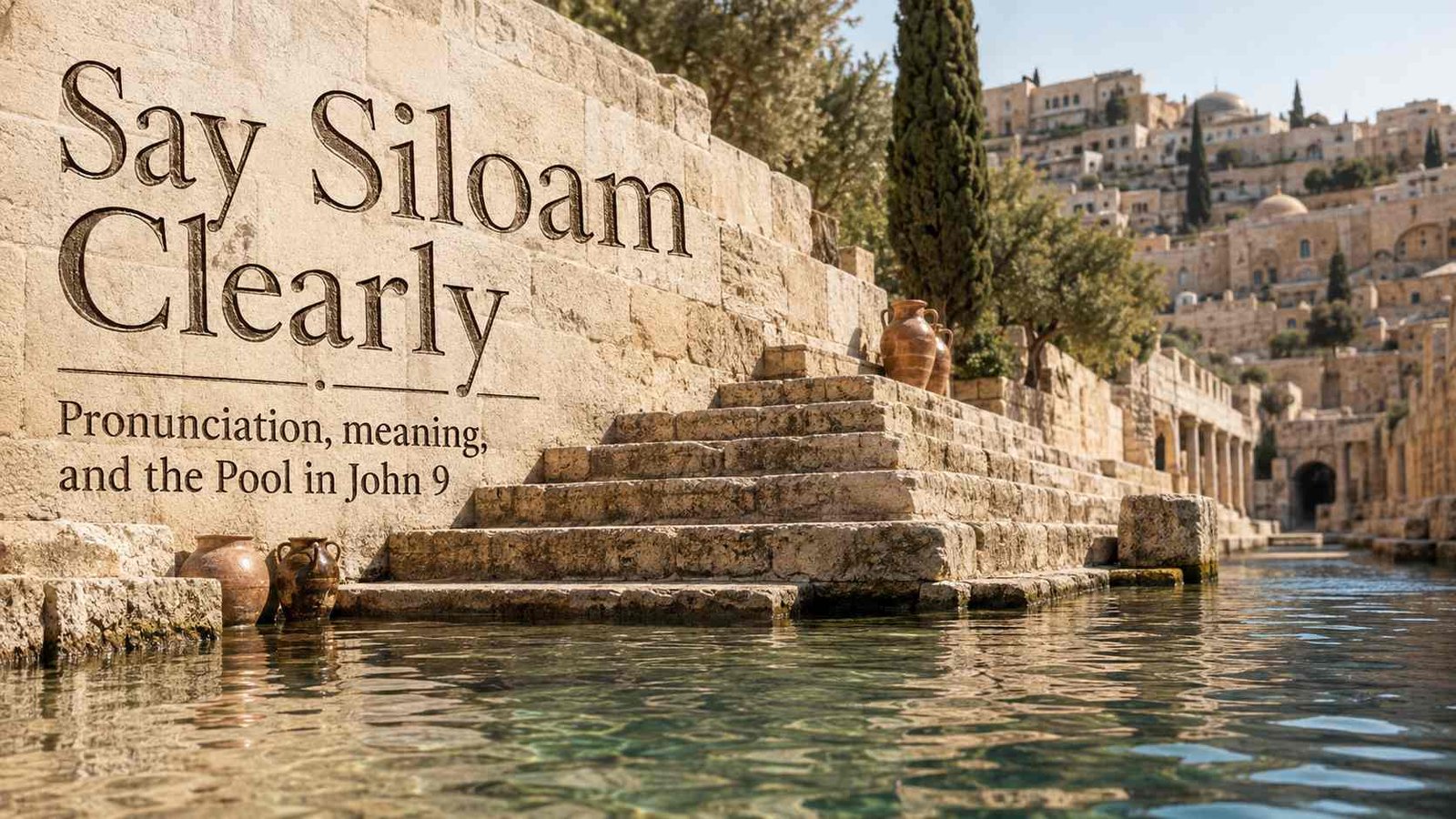
 If you have reached John chapter 9 and stopped at the word Siloam, you are not alone. Many Bible readers recognize the story but are unsure how to say the name aloud.
The simplest answer is:
Siloam is commonly pronounced: sih-LOH-uhm.
Say it slowly in three parts:
sih + LOH + uhm
Put the strongest stress on LOH.
In American English, dictionaries commonly give a pronunciation close to sih-LOH-uhm. British English may sound more like sy-LOH-uhm. Both forms can be heard among English speakers, so you should not be surprised if another reader says the first syllable differently.
But learning how to pronounce Siloam in the Bible opens the door to something more interesting than pronunciation. Siloam was a real place in ancient Jerusalem. It appears in the story of Jesus healing a man born blind, in Jesus’ reference to a fallen tower, and in related Old Testament passages about Jerusalem’s waters.
Most importantly, John explains the meaning of the name for us.
Siloam means Sent.
That small detail gives John 9 even greater depth.
How To Pronounce Siloam In The Bible
The easiest pronunciation for most American Bible readers is:
sih-LOH-uhm
You can practice it this way:
sih — like the beginning of “sincere”
LOH — rhymes roughly with “go”
uhm — a soft final sound
Put them together:
sih-LOH-uhm
Do not place the strongest stress on the first syllable. The middle part should stand out:
sih-LOH-uhm.
If you are reading John 9 aloud, you might say:
“Jesus told the man to go to the Pool of sih-LOH-uhm.”
Once you repeat it several times, the name becomes much easier.
This is true of many biblical names. At first, places such as Gihon, Golgotha, Sychar, Cyrene, and Siloam can look difficult on the page. Learning how to pronounce Bible names by dividing them into syllables usually makes them much less intimidating.
Is Siloam pronounced differently in British English?
Yes, sometimes.
British dictionaries may begin the word with a sound closer to sy, giving:
sy-LOH-uhm
American English commonly uses:
sih-LOH-uhm
This does not change the identity or meaning of the biblical place. It is simply a difference in English pronunciation.
For a broad international Christian audience, sih-LOH-uhm is a clear and easy pronunciation to learn.
How Do You Say Pool of Siloam?
The full phrase is pronounced:
Pool of sih-LOH-uhm
There is no special pronunciation change when “Pool of” comes before the name.
Try saying it naturally:
the Pool of sih-LOH-uhm
This is the place mentioned in one of the most memorable healing accounts in John’s Gospel.
John 9 begins with Jesus and His disciples encountering a man who had been blind from birth. After speaking about the situation, Jesus made mud, put it on the man’s eyes, and instructed him to wash in the Pool of Siloam.
John 9:7 says that Jesus told him to wash there and then explains that Siloam means Sent. The man obeyed, washed, and returned able to see.
So when you say Pool of Siloam, you are naming a place connected with both the geography of Jerusalem and one of Jesus’ signs recorded in the Gospel of John.
What Is Siloam in the Bible?
Siloam is a biblical place associated with the water system on the southern side of ancient Jerusalem.
The best-known biblical reference is the Pool of Siloam in John 9, but the name also appears in connection with a tower in Luke 13.
Related forms of the name occur in the Old Testament.
That gives us several important biblical connections:
| Biblical Reference | What It Mentions |
|---|---|
| John 9:7 | The Pool of Siloam and the healing of the blind man |
| Luke 13:4 | The tower in Siloam that fell |
| Isaiah 8:6 | The gently flowing waters of Shiloah |
| Nehemiah 3:15 | The Pool of Siloam/Shelah in Jerusalem |
The spellings can differ because Hebrew and Greek names do not always move into English in exactly the same form.
The Pool of Siloam in John 9
John 9 gives Siloam its strongest New Testament connection.
Jesus meets a man who had never been able to see. The disciples ask Jesus about the man’s condition, but Jesus redirects their attention away from simply assigning blame.
He then acts.
Jesus puts mud on the man’s eyes and tells him to wash in Siloam.
The man goes.
He washes.
He returns seeing.
John specifically pauses to tell his readers that Siloam means Sent.
That explanation matters because John could simply have named the pool and continued the story. Instead, he wants readers to notice the meaning of the place name.
The physical place is therefore important, but so is the word attached to it.
The Tower of Siloam in Luke 13
Siloam appears again in Luke 13:4.
In that passage, Jesus speaks about eighteen people who died when a tower in Siloam fell on them. He challenges the idea that those victims must have been greater sinners than everyone else living in Jerusalem.
This reference is different from the healing story in John 9.
John speaks about the Pool of Siloam.
Luke speaks about a tower in Siloam.
The Bible does not provide a detailed description of the tower or explain exactly why it collapsed. Jesus uses the tragedy to address repentance rather than to provide a history of the structure.
That distinction is worth keeping clear. We should not invent details Scripture does not give us.
What Does the Word Siloam Mean?
John gives us the answer directly.
Siloam means “Sent.”
In John 9:7, the Greek text uses the name Σιλωάμ, transliterated Silōam. John then explains it with a Greek word meaning Sent.
The name is connected with the Hebrew Shiloach or Shiloah. Biblical language resources connect the Hebrew form with the idea of being sent or conducted.
This is helpful because it shows that the meaning is not something modern Christians invented to make the story sound more spiritual.
John himself explains the name.
That should always be our starting point.
Why does “Sent” matter in John 9?
At the simplest level, the answer is easy: John tells us what the place name means.
There may also be a literary beauty in the way the story is told.
Jesus sends the man to a pool whose name means Sent.
The man responds to Jesus’ instruction. He goes to the pool, washes, and comes back seeing.
John’s Gospel also frequently speaks of Jesus in terms of being sent by the Father. Because of that larger theme, many Christian readers notice a meaningful connection between Jesus sending the man and the name Siloam.
Still, we should be careful.
John 9:7 explicitly tells us that Siloam means Sent. Any additional symbolism should be treated as interpretation rather than as a second dictionary definition.
That small distinction helps us read Scripture with both faith and care.
Siloam, Shiloah, and Siloah: Are They the Same Name?
One reason Bible readers can become confused is that similar forms appear in different passages and translations.
You may encounter:
Siloam
Siloah
Shiloah
Shiloach
These forms are related.
Isaiah 8:6 refers to the gently flowing waters of Shiloah. Nehemiah 3:15 refers to the pool in the same general Jerusalem water setting, although English translations may represent the name differently.
This happens because the Bible was not originally written in English.
The Old Testament is mainly Hebrew, while the New Testament is Greek. When ancient names move from Hebrew into Greek and then into English, spelling differences can appear.
Think about how a person’s name may sound slightly different when spoken in two modern languages. The person has not changed. The language has.
Siloam is a good example of why learning a little about the original biblical languages can make confusing Bible names easier to understand.
Where Was the Pool of Siloam?
The Pool of Siloam was located in ancient Jerusalem, toward the southern end of the area associated with the City of David.
The location fits Jerusalem’s ancient water landscape. The pool is associated with water from the Gihon Spring, an important natural water source for ancient Jerusalem. Archaeological work has uncovered a large stepped pool from the Second Temple period near the City of David, and researchers have identified it with the Siloam Pool known from ancient sources.
This background is especially useful when reading John 9.
The Gospel is not simply saying that Jesus sent the man toward some vague body of water. Siloam belonged to the real geography of Jerusalem.
For readers studying where Jerusalem is in the Bible, Siloam is one of those places where geography, history, and the biblical narrative meet.
The Gihon Spring and Siloam
The Gihon Spring was a vital source of water for ancient Jerusalem.
Water from the spring was carried through Jerusalem’s ancient waterworks toward the Siloam area. Biblical and archaeological discussions connect Siloam with this water system.
This makes how to pronounce Gihon in the Bible a useful related study for anyone interested in Siloam.
The two names belong to the same larger story of Jerusalem’s water supply.
The Bible’s geography can sometimes seem like a collection of unfamiliar names. Yet once you begin placing those names on the same landscape, Scripture becomes easier to picture.
Gihon was not an imaginary spring.
Siloam was not an imaginary pool.
Jerusalem was a living city whose people depended on water, roads, walls, gates, reservoirs, and springs.
That physical setting forms the background of many biblical events.
What Archaeology Tells Us About the Pool of Siloam
Archaeology adds useful historical context, but it is important to describe its role correctly.
In 2004, work near the southern end of the City of David led archaeologists Ronny Reich and Eli Shukron to identify ancient stone steps belonging to a large Second Temple-period pool. The Biblical Archaeology Society describes the remains as a monumental pool from the period in which Jesus lived.
Research published by the Israel Antiquities Authority discusses archaeological evidence supporting identification of the Silwan Pool with the Siloam Pool. It also argues that the pool was used for ceremonies and ritual immersion by pilgrims arriving in Jerusalem during the late Second Temple period.
That is valuable historical information.
But archaeology and Scripture answer different kinds of questions.
Archaeology can help establish that a pool existed, where it was located, how it was built, and how people may have used it.
Archaeology cannot excavate the healing itself.
John is the source that records Jesus’ miracle.
Keeping those categories separate produces a stronger and more responsible understanding of both history and faith.
How To Pronounce Siloam In The Bible Without Forgetting It
The easiest way to remember the pronunciation is to focus on the middle syllable:
sih-LOH-uhm
Try this simple pattern:
- Say sih
- Say LOH
- Say uhm
- Put them together: sih-LOH-uhm
- Repeat the full phrase: Pool of sih-LOH-uhm
You do not need to sound like a language professor when reading Scripture aloud.
Clear and confident is enough.
Many people avoid reading Bible passages publicly because they fear saying an unfamiliar name incorrectly. That is unfortunate. Biblical names become familiar through practice.
If you can learn Siloam, you can use the same method with other difficult places.
For example, you may also want to learn how to pronounce Sychar in the Bible, the Samaritan town connected with John 4, or how to pronounce Golgotha in the Bible, the name connected with Jesus’ crucifixion.
You may also come across names such as Cyrene, Gihon, Mahanaim, or Harosheth Haggoyim.
Break the name apart.
Find the stressed syllable.
Say it slowly.
Then say it naturally.
That method works surprisingly well.
Why the Pool of Siloam Matters in John 9
It would be easy to treat Siloam only as a pronunciation question.
But John 9 asks us to look deeper.
At the beginning of the story, the man cannot see.
By the time he returns from Siloam, he can.
Yet physical sight is only one part of the chapter.
As the story continues, the healed man’s understanding of Jesus develops. Other people question him. Religious leaders question him. His parents become involved. The man must speak about what happened to him.
The chapter moves from physical blindness toward questions of spiritual sight.
That makes Siloam part of a much larger story.
The man acted on what Jesus told him
One detail is especially easy to overlook.
Jesus told the man to go and wash.
The man went.
John does not record a long argument from him. He does not tell us that the man demanded an explanation for why mud had been placed on his eyes or why he needed to travel to a pool.
He went and washed.
Then he returned seeing.
Christians have often found a simple lesson in that response: faith can involve acting on what Christ says even before we understand every detail.
We should not turn the story into a mechanical formula. The Bible does not teach that water from Siloam had an automatic power to heal blindness.
The focus of John 9 is Jesus.
The pool is part of the event.
Christ is the One at the center of it.
Was the Pool of Siloam a Healing Pool?
It is better not to describe Siloam as a magical or naturally miraculous pool.
John does not say that anyone who washed in Siloam would be healed.
The miracle occurs because of Jesus.
That matters.
Sometimes biblical places become surrounded by traditions that go far beyond what Scripture actually tells us. A responsible reading keeps the emphasis where John places it.
Jesus encountered the man.
Jesus gave the instruction.
The man went to Siloam.
The man returned seeing.
The power of the story is not a mysterious property hidden in the water.
It is the authority and work of Christ.
How To Pronounce Siloam In The Bible When Reading John 9 Aloud
If you are preparing for church, a Bible study, Sunday school, or family reading, practice the name before you begin the passage.
Say:
Siloam — sih-LOH-uhm
Then say:
Pool of Siloam — Pool of sih-LOH-uhm
Finally, read a simple sentence aloud:
“Jesus sent the man to the Pool of Siloam.”
Once you have said it correctly a few times, you probably will not hesitate when you reach John 9:7.
Here is a quick reference:
| Question | Simple Answer |
|---|---|
| How do you pronounce Siloam? | sih-LOH-uhm |
| Where is the stress? | On LOH |
| How do you say Pool of Siloam? | Pool of sih-LOH-uhm |
| What does Siloam mean? | Sent |
| Where is it best known from? | John 9:7 |
| Where was Siloam? | Ancient Jerusalem |
| Is Siloam mentioned elsewhere? | Yes, including Luke 13:4 and related Old Testament forms |
Quick Answers About Siloam
How do you pronounce Siloam from the Bible?
The common American English pronunciation is sih-LOH-uhm, with the strongest stress on the middle syllable.
A British pronunciation may sound more like sy-LOH-uhm.
What is Siloam in the Bible?
Siloam is a place in ancient Jerusalem best known for the Pool of Siloam. In John 9, Jesus sends a man born blind to wash there, and the man returns seeing.
How do you say Pool of Siloam?
Say:
Pool of sih-LOH-uhm.
Keep the emphasis on LOH.
What does the word Siloam mean?
John 9:7 directly explains Siloam as meaning Sent. The Greek text also preserves this explanation.
Was Siloam a real place?
Yes. Ancient literary references and archaeological evidence identify a Siloam Pool in Jerusalem. Excavations have uncovered a large Second Temple-period pool near the southern end of the City of David.
Is the Tower of Siloam the same thing as the Pool of Siloam?
No. They are different features associated with the same general place name.
John 9 speaks about the Pool of Siloam.
Luke 13:4 speaks about a tower in Siloam that fell and killed eighteen people.
What Siloam Can Remind Us About Faith
Knowing how to pronounce Siloam in the Bible helps us read Scripture with confidence:
sih-LOH-uhm.
But the name carries more than a pronunciation lesson.
Siloam takes us into the streets and waters of ancient Jerusalem. It connects us with Isaiah’s gently flowing waters, Jerusalem’s ancient water system, Jesus’ reference to the fallen tower, and above all the man born blind in John 9.
John gives the meaning plainly:
Sent.
Jesus sent the man to Siloam. The man went, washed, and returned seeing.
There is something beautifully simple about that movement.
He heard.
He went.
He washed.
He came back changed.
We do not have to turn every detail into a hidden symbol to appreciate the power of the account. The text already gives us enough.
Siloam was a real place.
Its name had meaning.
And at that pool, John tells us that a man who had lived without sight came back able to see.
So the next time you reach John 9, you no longer need to hesitate over the name.
Say it clearly:
sih-LOH-uhm.
Then keep reading, because the most important part of the story is not simply how the name sounds. It is what the passage reveals about Jesus and the man who responded to His command.
For more help with difficult biblical names and places, continue with how to pronounce Bible names or explore how to pronounce Gihon in the Bible, the spring closely connected with Jerusalem’s ancient water system.
Dr. Rachel is very smart and knows a lot about the Bible. He helps us understand the Bible better by talking about the old texts in a simple way.