
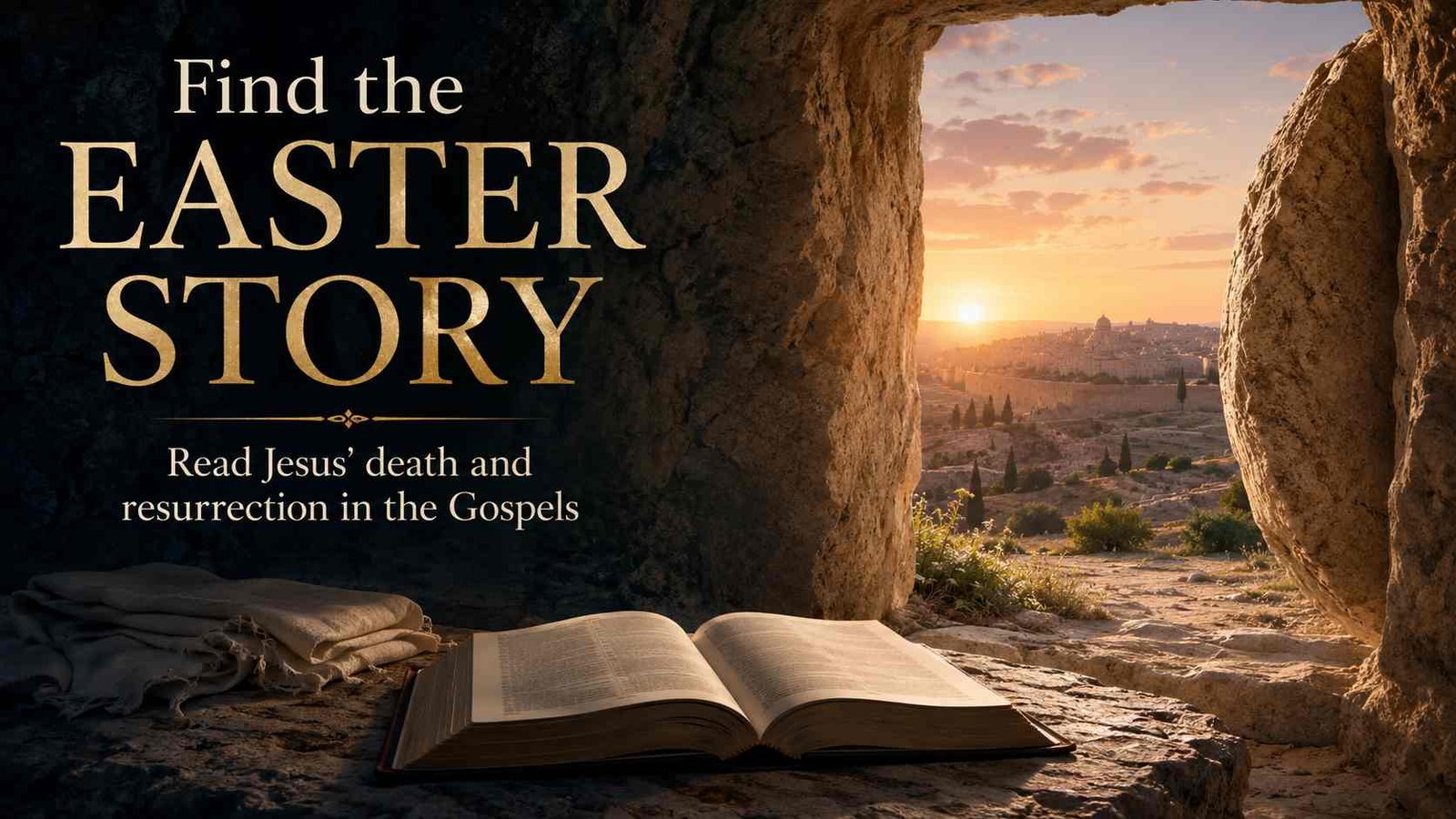
 If you have ever wondered where in the Bible is the Easter story, the simplest answer is this: you can find it in all four Gospels: Matthew, Mark, Luke, and John.
The Easter story is not contained in just one Bible verse. It is a series of events that begins before Jesus goes to the cross and continues through His resurrection from the dead.
For the fuller story, read:
- Matthew 26–28
- Mark 14–16
- Luke 22–24
- John 18–20
These passages tell about the Last Supper, Jesus praying in Gethsemane, His arrest, trial, crucifixion, burial, the empty tomb, and His appearances after He rose from the dead. Bible Gateway likewise identifies these four ranges as the main places to read the Easter story.
If you only want to read about Easter morning and the resurrection, go directly to Matthew 28, Mark 16, Luke 24, and John 20.
The heart of Easter is beautifully simple: Jesus was crucified and buried, but the grave did not hold Him. He rose again.
That is why Easter is a story of hope.
Where in the Bible Is the Full Easter Story?
There is no single chapter called “The Easter Story.”
Instead, God has given us four Gospel accounts of Jesus’ final days, death, and resurrection.
Here is an easy guide:
| Gospel | Full Easter Story | Resurrection Story | Important Details |
|---|---|---|---|
| Matthew | Matthew 26–28 | Matthew 28 | Gethsemane, crucifixion, tomb, resurrection, Great Commission |
| Mark | Mark 14–16 | Mark 16 | Last Supper, arrest, crucifixion, women at the empty tomb |
| Luke | Luke 22–24 | Luke 24 | Crucifixion, resurrection, road to Emmaus |
| John | John 18–20 | John 20 | Trial, cross, Mary Magdalene, Thomas, resurrection appearances |
Each Gospel tells the same central story while giving us different details and points of view. Reading all four helps us see a fuller picture of what happened.
If you are reading the Easter story for the first time, you do not have to read everything at once.
You could begin with Luke 22–24 because Luke gives a clear flow from the Last Supper to the resurrection. You could also begin with Mark 14–16 for a shorter account.
Then return later and read Matthew and John.
There is something beautiful about seeing the same hope from four different Gospel accounts.
Where in the Bible Is the Easter Story in Matthew?
The Easter story in Matthew begins in Matthew 26.
Jesus tells His disciples that His crucifixion is approaching. The chapter includes the plot against Jesus, the Last Supper, His prayer in Gethsemane, His betrayal by Judas, His arrest, and Peter’s denial.
Matthew 27 then brings us to Jesus before the authorities and eventually to His crucifixion.
Jesus is placed on the cross.
He dies.
His body is taken down and placed in a tomb.
For the disciples, everything appears to be over.
But Matthew does not end there.
Matthew 28 changes everything.
After the Sabbath, Mary Magdalene and another Mary go to the tomb. The Gospel describes an earthquake and an angel at the tomb. The women learn that Jesus is no longer there.
Matthew 28:6 contains one of the best-known messages of Easter:
“He is not here; he has risen, just as he said.”
The women leave with both fear and joy and carry the news to the disciples.
Later in Matthew 28, the risen Jesus meets His followers and sends them to make disciples among the nations.
So, if someone asks, Which Bible verse is the story of Easter?, Matthew 28:6 is a wonderful verse to remember.
But it is still only one part of the larger story.
To understand what led to the empty tomb, read Matthew 26 through 28.
Where in the Bible Is the Easter Story in Mark?
Mark tells the Easter story in Mark 14–16.
Mark 14 begins with plans to arrest Jesus. It also describes the Last Supper.
During the meal, Jesus speaks about the bread and the cup. The story then moves to Gethsemane, where Jesus prays as His suffering approaches.
Judas arrives with those who have come to arrest Jesus.
The disciples scatter.
Peter later denies knowing Jesus.
In Mark 15, Jesus is taken before Pilate. He is sentenced to crucifixion and taken to Golgotha.
After Jesus dies, Joseph of Arimathea asks Pilate for His body. Jesus is placed in a tomb, and a stone is rolled across the entrance.
Then comes Mark 16.
Mary Magdalene, Mary the mother of James, and Salome go to the tomb with spices. They wonder who will move the heavy stone.
But when they arrive, the stone has already been moved.
They are told that Jesus of Nazareth, who had been crucified, has risen.
Imagine their emotions.
They came expecting to care for a dead body.
Instead, they received news that changed the world.
Jesus was alive.
Where in the Bible Is the Easter Story in Luke?
The Easter story in Luke is found in Luke 22–24.
Luke 22 begins with the Passover approaching.
Jesus shares His final meal with His disciples. He later goes to the Mount of Olives and prays.
Then Jesus is arrested.
Peter denies Him.
Jesus is mocked and brought before the authorities.
In Luke 23, Jesus is brought before Pilate. After His trial, He is led away to be crucified.
Luke records Jesus’ death and burial.
Joseph of Arimathea takes Jesus’ body and places it in a tomb where no one had yet been laid.
Then comes Luke 24, one of the most important resurrection chapters in Scripture.
Very early on the first day of the week, women go to the tomb carrying spices they had prepared.
But something is different.
The stone has been rolled away.
They enter, but Jesus’ body is not there. They are told that He has risen.
The women tell the apostles what they have seen and heard.
Luke then gives us a wonderful story that the other Gospels do not tell in the same way: the road to Emmaus.
Two followers of Jesus are walking toward a village called Emmaus. They are talking about everything that has happened.
Jesus Himself comes near and walks with them, but they do not recognize Him at first.
He speaks with them about the Scriptures.
Later, they recognize Him.
Their sadness turns into hope.
Luke 24 then describes Jesus appearing to His followers. He assures them that He is truly alive and helps them understand how the Scriptures point toward what has happened.
If you want to sit down and read one flowing account of the Easter story, Luke 22–24 is an excellent place to begin.
Where in the Bible Is the Easter Story in John?
John tells the Easter story in John 18–20.
John 18 begins in a garden.
Jesus knows what is coming. Judas arrives with soldiers and officials, and Jesus is arrested.
Peter tries to defend Jesus, but Jesus does not escape His appointed path.
Jesus is questioned and eventually brought before Pilate.
In John 19, Pilate gives the order for Jesus to be crucified.
Jesus is taken away and placed on the cross.
After His death, Joseph of Arimathea and Nicodemus care for His body and place it in a tomb.
Then John 20 begins with one of the most moving scenes in the Bible.
It is still dark when Mary Magdalene goes to the tomb.
She sees that the stone has been removed.
She runs to Peter and the disciple whom Jesus loved and tells them what she has seen.
Peter and the other disciple run toward the tomb.
Later, Mary remains outside crying.
Then she encounters the risen Jesus.
At first, she does not recognize Him.
But when Jesus speaks her name, everything changes.
“Mary.”
It is a deeply personal moment.
The One she thought was dead is standing before her alive.
John 20 continues with Jesus appearing to His disciples.
Thomas, who was not present at one of the earlier appearances, struggles to believe what the others tell him.
Jesus later appears when Thomas is present.
Thomas sees that the news is true.
For readers who want an Easter account filled with personal encounters and emotion, John 18–20 is especially powerful.
Which Bible Verse Is the Story of Easter?
Many people search for one Easter Bible verse.
There are several important verses, but no single verse tells the entire Easter story.
Matthew 28:6 is perhaps one of the clearest resurrection announcements. It tells us that Jesus is not in the tomb because He has risen.
But another important passage appears outside the four Gospels.
In 1 Corinthians 15:3–5, Paul gives a short summary of the central Christian message.
He explains that Christ died for sins according to the Scriptures, was buried, was raised on the third day, and appeared to witnesses.
That makes 1 Corinthians 15:3–5 one of the best short answers to the question, What is the Bible story behind Easter?
The story can be summarized in four simple movements:
Jesus died.
Jesus was buried.
Jesus rose again.
Jesus appeared alive to His followers.
Yet the Gospels give us the people, places, conversations, emotions, and events surrounding those truths.
Four Resurrection Chapters to Read on Easter Sunday
If you do not have time to read all the Passion and resurrection chapters, read these four:
Matthew 28
You will read about the women visiting the tomb, the angelic announcement, Jesus meeting His followers, and the Great Commission.
Mark 16
You will read about the women bringing spices to the tomb and discovering that the stone has been rolled away and Jesus has risen.
Luke 24
You will read about the empty tomb, the road to Emmaus, and Jesus appearing to His disciples.
John 20
You will read about Mary Magdalene at the tomb, Peter and the other disciple running to investigate, Jesus appearing to Mary and the disciples, and Thomas coming to believe.
These chapters place the resurrection at the center of Easter morning.
If you have children, you might read one chapter together instead of trying to cover everything.
Pause occasionally.
Ask what they noticed.
Ask what surprised them.
The Easter story is powerful even when read slowly.
What Is the Bible Story Behind Easter?
The Bible story behind Easter begins before Sunday morning.
Jesus enters the final days of His earthly ministry knowing that suffering lies ahead.
Events move quickly.
He shares the Last Supper with His disciples.
He prays in Gethsemane.
Judas betrays Him.
Jesus is arrested.
Peter denies Him.
Jesus is questioned, mocked, and brought before Pilate.
He is sentenced to crucifixion.
He is taken to the cross.
He dies.
His body is placed inside a tomb.
A stone closes the entrance.
For those who loved Jesus, it must have seemed that everything had been lost.
The teacher they followed was dead.
Their hopes appeared buried with Him.
Then came the first day of the week.
Women went to the tomb.
The stone was moved.
The tomb was empty.
The message was announced:
Jesus had risen.
That is the turning point of the Easter story.
The cross was not the end.
Death was not the end.
The tomb was not the end.
The four Gospels all place the discovery of the empty tomb on the first day of the week and testify to Jesus’ resurrection.
How Passover Connects With the Easter Story
To understand Easter more clearly, it helps to understand what is Passover in the Bible.
Jesus’ final days took place during the Passover season.
Matthew 26 begins by connecting the approaching Passover with Jesus’ coming crucifixion. The Gospel accounts also place Jesus’ final meal and arrest within this Passover setting.
Passover reaches back to the book of Exodus, when God delivered the Israelites from slavery in Egypt.
By the time of Jesus, Passover was an established Jewish festival remembering God’s deliverance.
This historical setting matters because the Easter story did not happen in isolation. Jesus’ death and resurrection took place within the Jewish world and biblical story in which He lived.
This also helps us understand why readers sometimes encounter both the words Passover and Easter when studying these passages.
What Happened Before Easter Sunday?
The resurrection makes more sense when we understand the days leading to it.
Many Christians call this period Holy Week or Passion Week.
It includes events such as Jesus entering Jerusalem, teaching there, eating His final meal with His disciples, praying in Gethsemane, being arrested, and being crucified. BibleProject’s Holy Week guide likewise treats Jesus’ death and resurrection as part of one connected biblical story.
Readers often ask, what does Palm Sunday mean in the Bible?
Palm Sunday remembers Jesus’ entry into Jerusalem, when people welcomed Him as He entered the city. The event comes before His arrest and crucifixion.
Another common question is what does Good Friday mean in the Bible?
Good Friday is the traditional Christian remembrance of Jesus’ crucifixion and death.
If you are wondering where is the crucifixion in the Bible, you can read it in:
- Matthew 27
- Mark 15
- Luke 23
- John 19
These chapters lead directly into the burial and resurrection accounts.
So Easter Sunday should not be separated completely from the cross.
The empty tomb comes after the crucifixion.
The joy of resurrection morning follows the grief of Jesus’ death.
Does the Word Easter Actually Appear in the Bible?
This question can sometimes cause confusion.
In most modern English Bible translations, you will not find the word Easter used as the name of Jesus’ resurrection celebration in the Gospel accounts.
Instead, the Bible directly describes Jesus’ death, burial, and resurrection.
However, the King James Version uses the word “Easter” once in Acts 12:4.
Acts 12 is not describing Jesus’ resurrection.
It tells the story of Herod arresting Peter.
The KJV says Herod intended to bring Peter before the people “after Easter.”
Most modern translations use Passover in that verse instead. Bible Gateway’s comparison of translations shows “Passover” in versions such as the NIV and NKJV.
The Greek text contains the word pascha.
Here is what matters for someone simply trying to find the Easter story:
Acts 12:4 is not the story of Easter morning.
To read about Jesus rising from the dead, go to Matthew 28, Mark 16, Luke 24, or John 20.
That keeps the answer simple and prevents one English translation choice from confusing the main biblical story.
Who Wrote the Easter Story in the Bible?
Another common question is, Who wrote the Easter story in the Bible?
The resurrection is recorded in the four canonical Gospels known as:
- The Gospel according to Matthew
- The Gospel according to Mark
- The Gospel according to Luke
- The Gospel according to John
Christian tradition has long associated these Gospel accounts with Matthew, Mark, Luke, and John.
Matthew and John are traditionally identified with two of Jesus’ apostles. Mark has traditionally been connected with Peter’s testimony, while Luke is traditionally associated with Luke, a companion of Paul. Sources explaining traditional Gospel authorship likewise identify these four names with the canonical Gospel accounts.
There is also academic discussion about exactly how the Gospels were composed and how their traditional titles developed. For a simple Bible-reading question, however, Christians around the world know these four books as Matthew, Mark, Luke, and John.
The important point for Easter is that all four canonical Gospels testify to Jesus’ death and resurrection.
Why Do All Four Gospels Tell the Easter Story?
Why would we need four accounts instead of one?
Think about an important family event.
Several people may attend the same event. Later, each person may remember different details.
One person remembers what was said.
Another remembers who arrived first.
Someone else remembers the emotion in the room.
Their accounts can focus on different details while still describing the same central event.
Something similar happens when we read the four Gospels.
Matthew gives details such as the guards and ends with Jesus commissioning His disciples.
Luke gives us the road to Emmaus.
John gives special attention to Mary Magdalene and Thomas.
Each Gospel has its own way of telling the story.
Bible Gateway notes that reading more than one Gospel account brings additional detail and nuance to the Easter narrative.
This is why it can be rewarding to read all four.
You begin to notice details you may have missed before.
Where in the Bible Is the Story of Jesus’ Crucifixion?
If your main interest is not Easter morning but the cross itself, the answer is easy to remember.
Read:
Matthew 27
Mark 15
Luke 23
John 19
These are the main crucifixion chapters.
If you have searched where in the Bible is the story of Jesus crucifixion, these four chapters are the best starting point.
They describe Jesus before Pilate, His journey toward crucifixion, His death, and His burial.
Then move into the next chapter of each Gospel to read what happened afterward.
Matthew 27 leads to Matthew 28.
Mark 15 leads to Mark 16.
Luke 23 leads to Luke 24.
John 19 leads to John 20.
You move from the cross to the empty tomb.
From death to life.
From grief to hope.
What Does the Bible Say About Easter Sunday?
The Bible does not describe an annual holiday using the modern phrase Easter Sunday.
Instead, the Gospels tell us what happened on the morning Christians remember at Easter.
Matthew says that after the Sabbath, as the first day of the week was beginning, women went to the tomb.
Mark places the visit early on the first day of the week.
Luke says the women came very early on the first day of the week.
John says Mary Magdalene went to the tomb early on the first day of the week while it was still dark.
All four direct our attention toward the same central truth:
The tomb was empty, and Jesus had risen.
So when someone asks what does the Bible say about Easter Sunday, the strongest answer is not found in customs, food, decorations, or traditions.
It is found at the empty tomb.
Where Should a Beginner Read the Easter Story?
If you are new to the Bible, do not feel that you must understand every detail immediately.
Start simply.
For the shortest route to Easter morning, read:
Matthew 28
It is only one chapter and gives you the resurrection and Jesus’ commission to His followers.
If you want more of the story leading up to Easter, read:
Luke 22–24
You will see the Last Supper, Jesus’ prayer, His arrest, crucifixion, burial, resurrection, and the road to Emmaus.
If you want a more personal account with several close encounters after the resurrection, read:
John 18–20.
If you want the fullest study, read all four:
Matthew 26–28
Mark 14–16
Luke 22–24
John 18–20
Do not rush.
You might read one Gospel account each day.
Keep a notebook nearby.
Write down what Jesus says.
Notice what the disciples do.
Pay attention to the women who come to the tomb.
Notice how fear becomes joy, confusion becomes understanding, and sorrow gives way to hope.
The Easter Story Is Bigger Than One Morning
Sometimes Easter can become only a date on the calendar.
We think about Easter Sunday, church services, family meals, or familiar traditions.
But the biblical Easter story asks us to look deeper.
It brings us to Jesus.
It brings us to the cross.
It brings us to a sealed tomb.
And then it brings us to a stone that no longer closes the way.
The resurrection stands at the heart of the Christian message.
Paul makes this especially clear in 1 Corinthians 15. He presents Jesus’ death, burial, resurrection, and appearances as matters of first importance and later explains how central the resurrection is to Christian faith.
Easter therefore speaks to something many of us understand deeply: the longing for hope when everything looks finished.
The disciples knew grief.
Mary knew tears.
Thomas knew doubt.
The followers walking toward Emmaus knew disappointment.
Yet the risen Jesus met people in each of those places.
That is one reason the Easter story continues to speak so powerfully to readers.
It does not pretend sorrow is unreal.
It shows hope entering the middle of sorrow.
Where in the Bible Is Easter Story? Remember These Four Places
If you forget everything else, remember four passages:
Matthew 26–28
Mark 14–16
Luke 22–24
John 18–20
Those chapters answer the question where in the Bible is Easter story.
And if you want only the resurrection morning, remember four chapters:
Matthew 28
Mark 16
Luke 24
John 20
The Easter story is not mainly about finding the word “Easter” printed on a Bible page.
It is about discovering what happened to Jesus.
He was betrayed.
He was arrested.
He was crucified.
He died.
He was buried.
And then came the morning that changed everything.
The tomb was empty.
Jesus had risen.
For Christians, that is why Easter carries such deep hope. Death does not receive the final word in the Gospel story.
If you want to follow the story from its earlier events, read about what Palm Sunday means in the Bible and what Good Friday means in the Bible. Together with the resurrection accounts, they help us see the journey from Jesus entering Jerusalem to the cross and finally to the empty tomb.
The story begins in sorrow, but it does not stay there.
It leads us toward hope.

Professor Sarah knows the Bible deeply. She shares stories about Jesus’ life and the early church in a warm, simple way that makes learning feel real and meaningful.