 If you have ever looked at the word Bible and wondered whether you are saying it correctly, the answer is simple.
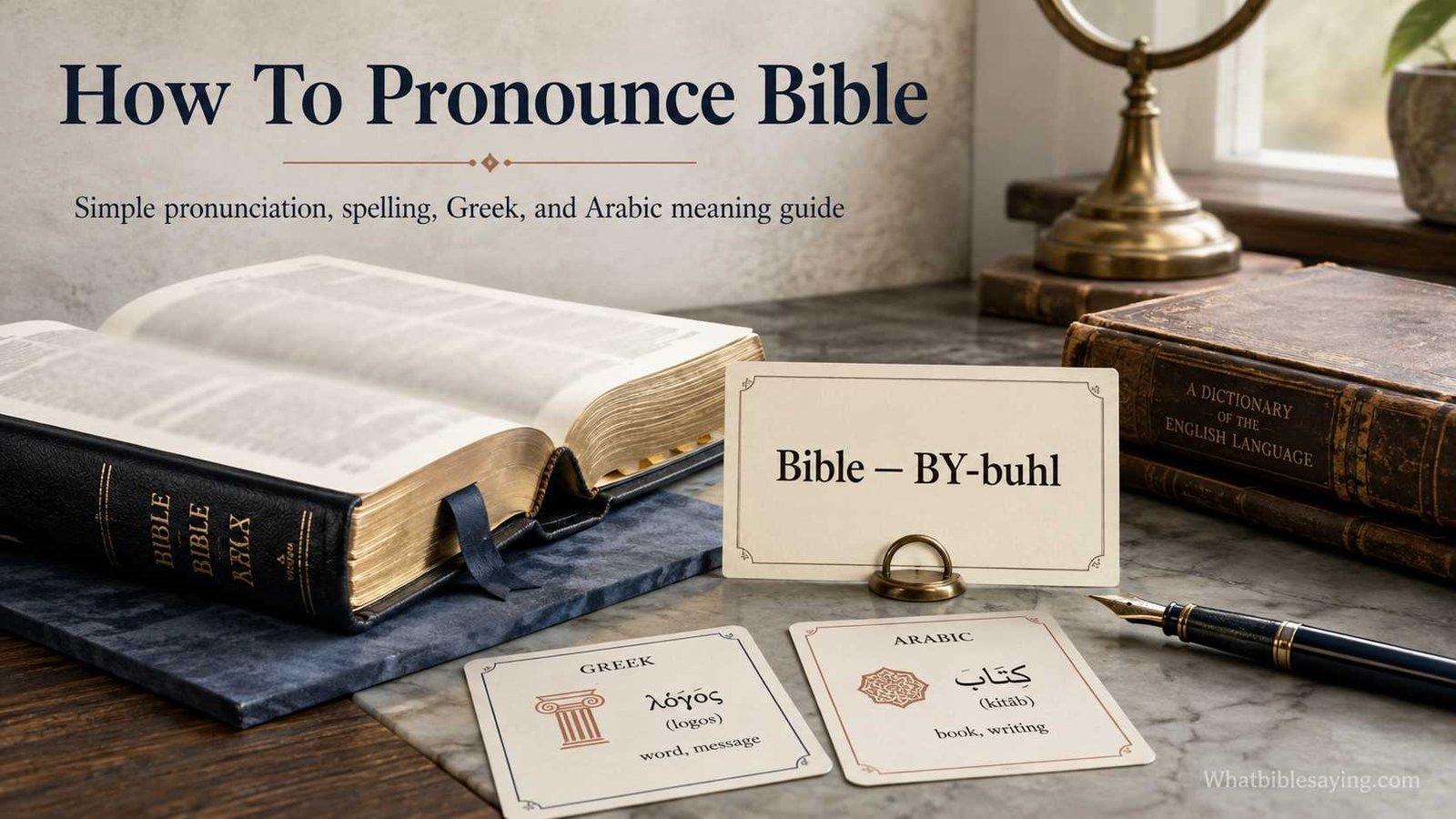
Bible is pronounced “BY-buhl.”
It has two syllables:
BY + buhl
The first syllable sounds like the word buy. The second syllable is softer and sounds like buhl.
So when you put them together, you get:
BY-buhl
The standard English pronunciation can be written phonetically as:
/ˈbaɪ.bəl/
The stress falls on the first syllable.
This may seem like a very simple word to English speakers, but Bible readers around the world often speak English as a second language. Others may be learning to read Scripture aloud for the first time. That makes pronunciation worth explaining clearly.
The word also has a fascinating history. It connects with Greek words for books, while Christians in Arabic-speaking communities use a very different expression for the Holy Bible.
Understanding these details can make Bible reading feel less intimidating and more meaningful.
How To Pronounce Bible Correctly in English
The easiest way to pronounce Bible is to break it into two parts:
| Part | Sound |
|---|---|
| Bi | BY |
| ble | buhl |
| Bible | BY-buhl |
Say the first part clearly:
BY
Then add the softer second syllable:
buhl
Now say them together:
BY-buhl
The word should not normally sound like “bib-lee,” “bee-bull,” or “bye-bell.”
The final part is weak and relaxed. You do not need to pronounce every written letter separately.
A simple practice sentence is:
I read the Bible every day.
Say it slowly:
“I read the BY-buhl every day.”
Then repeat it at normal speaking speed.
The word becomes much easier after you hear yourself say it several times.
Where Is the Stress in Bible?
English words often have one syllable that receives more emphasis.
In Bible, the stress is on the first syllable:
BY-buhl
Not:
by-BUHL
The first part should sound stronger.
This stress pattern is important because changing the stress can make an English word sound unusual even when all the individual sounds are close.
How To Pronounce Bible and Spell It Correctly
Bible is spelled:
B-I-B-L-E
That gives us five letters:
- B
- I
- B
- L
- E
The spelling is simple, but the pronunciation is not based on sounding out each letter individually.
The letters B-I form the “BY” sound in this word.
The ending B-L-E becomes the softer “buhl” sound.
That is why English learners should remember the word as a complete sound:
Bible = BY-buhl
Should Bible Be Capitalized?
When the word refers to the Christian Scriptures, it is normally written with a capital letter:
Bible
For example:
She opened her Bible before church.
We read the Bible together.
The word may sometimes appear in lowercase when it is being used more generally to describe a book considered an authority on a subject.
Someone might say:
“This handbook is the gardener’s bible.”
In that sentence, the person is not talking about Holy Scripture. The word is being used figuratively.
When speaking about Christian Scripture, Bible is the normal form.
Readers who want to understand this writing rule more deeply may also find the topic is the word Bible capitalized helpful.
What Is a Pronouncing Bible?
A pronouncing Bible, sometimes called a self-pronouncing Bible, is a Bible designed to help readers say difficult biblical names and places correctly.
Anyone who has tried reading Scripture aloud knows why this can be useful.
Words such as:
- Nebuchadnezzar
- Melchizedek
- Mahanaim
- Capernaum
- Onesiphorus
- Zerubbabel
can look challenging at first.
A pronouncing Bible may use special marks, divided syllables, accent marks, or pronunciation guides to show readers how a word should be spoken.
The purpose is practical.
It helps someone read Scripture publicly without having to stop every few sentences to search for a pronunciation.
Why Were Pronouncing Bibles Created?
For generations, Christians have read Scripture aloud in churches, homes, schools, prayer meetings, and Bible studies.
Reading aloud creates a special problem.
You may understand the meaning of a verse but still feel uncertain when you reach an unfamiliar Hebrew or Greek name.
Imagine reading before a group and suddenly seeing:
Mephibosheth
You may know who the person is, but you may not be sure how to say the name.
Pronouncing Bibles were created to make moments like this easier.
Some editions place pronunciation information directly beside difficult words. Others provide a pronunciation key or glossary.
Modern readers can also use Bible apps, audio Bibles, dictionaries, and online pronunciation tools.
If difficult names are your main concern, a guide on how to pronounce Bible names can make public and private Bible reading much easier.
Do All Christians Pronounce Bible Names the Same Way?
No.
There can be differences.
Biblical names originally came through languages such as Hebrew, Aramaic, and Greek. They later entered Latin, English, Arabic, and many other languages.
Because of this, a name may sound somewhat different depending on language and tradition.
For example, a biblical name used in English may not sound exactly like the same name spoken in Hebrew or modern Greek.
This does not mean one person is necessarily disrespecting Scripture.
Languages naturally adapt names to their own sound systems.
What matters most when reading aloud is to use a clear and widely understood pronunciation.
How To Pronounce Bible in Greek
The Greek connection is especially interesting because the English word Bible ultimately comes to us through Greek.
The Greek word βίβλος, often transliterated as biblos, can mean a book or written work.
In modern Greek pronunciation, βίβλος sounds roughly like:
VEE-vlos
The Greek letter beta developed a “v” sound in modern Greek, which is one reason modern pronunciation can surprise English speakers.
However, when people talk specifically about the Holy Scriptures in Greek, another expression is also very common:
Η Αγία Γραφή
This means:
The Holy Scripture
It can be pronounced approximately:
ee ah-YEE-ah gra-FEE
The exact sound depends on the speaker and regional accent.
Why Does Bible Sound Different From the Greek Word?
Languages change over time.
The English word Bible did not simply appear by copying the modern Greek pronunciation.
It traveled through centuries of language development.
The English term is connected with Greek biblia, a word associated with books.
Greek influenced Latin, and Latin influenced many European languages. Eventually forms related to “Bible” became established in English.
That means the English pronunciation BY-buhl reflects the history of English, not the way a modern Greek speaker would pronounce every related Greek word today.
This difference is normal.
The same thing happens with many ancient names and words.
What Does the Greek Word Biblia Mean?
The Greek expression connected with our word Bible is biblia.
It is related to the idea of books.
That is a beautiful detail because the Bible is not one single book written at one moment by one human author.
It is a collection of biblical books.
Depending on Christian tradition, the number of books recognized in the biblical canon differs. Protestant, Catholic, and Orthodox Bibles are not identical in their Old Testament contents.
Yet Christians across these traditions recognize Scripture as a collection of sacred writings rather than one ordinary book.
The word’s history reflects that reality.
The Bible contains history, poetry, wisdom, prophecy, letters, Gospel accounts, laws, songs, and other forms of writing.
So when we use the word Bible, we are referring to an entire collection of sacred texts.
This also connects naturally with the question what is the meaning of Bible.
How To Pronounce Bible in Arabic
Arabic-speaking Christians commonly refer to the Bible as:
الكتاب المقدس
This is transliterated as:
al-Kitāb al-Muqaddas
A simple English-friendly pronunciation is approximately:
al-kee-TAAB al-moo-KAD-das
The phrase means:
The Holy Book
or, in Christian use:
The Holy Bible
Let us break it down.
al-Kitāb means the book.
al-Muqaddas means the holy or the sacred.
Together:
al-Kitāb al-Muqaddas
means:
the Holy Book
Do Arabic Christians Use the English Word Bible?
Arabic-speaking Christians may use English words when speaking English, of course.
But in Arabic worship, Bible publishing, Christian education, and everyday speech, al-Kitāb al-Muqaddas is a standard way of referring to the Holy Bible.
This reminds us that Christianity has never belonged to only one language.
Christians have read Scripture in many languages for centuries.
Today, people may hear the same biblical passage read in English, Arabic, Greek, Spanish, French, Urdu, Korean, or hundreds of other languages.
The pronunciation changes.
The message being read remains the focus.
Where Does the Word Bible Come From?
The English word Bible has a long language history.
It is connected with Greek biblia, associated with books.
The word eventually passed through Latin forms before entering English.
This language journey helps explain why the English pronunciation does not look completely obvious from the spelling.
English has borrowed thousands of words from other languages.
When borrowed words enter English, their pronunciation often changes over time.
Bible is one example.
Does Bible Mean Basic Instructions Before Leaving Earth?
You may have heard someone say that BIBLE stands for:
Basic Instructions Before Leaving Earth
It is memorable, but it is not the historical origin of the word.
The word Bible existed long before that English phrase was created.
It comes through ancient Greek and Latin language history.
“Basic Instructions Before Leaving Earth” is better understood as a modern acronym made from the existing English letters.
It may be used as a teaching phrase, but it should not be presented as the true origin of the word Bible.
That difference matters when we are studying Scripture carefully.
Faith and accuracy belong together.
What Languages Was the Bible Originally Written In?
When discussing the origin of the word Bible, another question often appears:
What language was the Bible written in?
The answer is not just one language.
The biblical books were written mainly in:
- Hebrew
- Aramaic
- Greek
Most of the Old Testament was written in Hebrew.
Parts contain Aramaic.
The New Testament was written in Koine Greek, the widely used Greek of the eastern Mediterranean world during the early Christian period.
This distinction is important.
The word Bible has its own language history, but the biblical books themselves were originally written in several ancient languages.
These are related questions, but they are not the same question.
Someone researching this further may want to read about what are the original languages of the Bible.
Why Does This Matter for Pronunciation?
It helps explain why biblical names can be difficult.
An English Bible contains names that came from ancient languages with sounds and spelling systems different from English.
When translators brought those names into English, they had to represent them using English letters.
Later generations developed familiar English pronunciations.
That means the way you pronounce a biblical name in English may not exactly reproduce its ancient Hebrew or Greek pronunciation.
This should not discourage you.
Translation has always required people to move meaning between languages.
The goal is understanding.
How To Pronounce Bible Names With More Confidence
Knowing how to pronounce Bible is easy.
Pronouncing all the names inside the Bible can be harder.
Fortunately, you do not need to be a Greek or Hebrew scholar to improve.
A few habits can help.
Break Long Names Into Smaller Parts
A long word becomes easier when divided into syllables.
Take:
Nebuchadnezzar
Do not try to say the whole name immediately.
Break it into smaller sound groups.
The same method works with many biblical names.
Your eyes may see one very long word, but your mouth only needs to say one syllable at a time.
Listen to an Audio Bible
Audio Bibles are especially helpful because you can hear biblical names used naturally inside sentences.
Listening also teaches rhythm and stress.
Read the passage with your eyes while listening.
Then pause the recording and repeat the difficult word.
This is one of the simplest ways to develop confidence.
Use a Bible Dictionary
Bible dictionaries often provide pronunciation help along with information about people, places, customs, and historical settings.
This gives you two benefits at once.
You learn how to say the name and what the name refers to.
Do Not Be Embarrassed by Mistakes
Even experienced pastors, teachers, and Bible readers sometimes hesitate over unfamiliar names.
The Bible includes words from ancient cultures far removed from modern English.
Needing help does not mean you are a poor reader.
It means you are learning.
A person who carefully checks a pronunciation is showing respect for the text rather than weakness.
For more help with difficult names, how to pronounce Bible names with ease is a useful related study.
Does Perfect Pronunciation Matter When Reading Scripture?
Correct pronunciation is useful.
It makes public reading clearer. It can help listeners recognize names and places. It may also give you more confidence when teaching or discussing Scripture.
But pronunciation should never become a barrier that keeps you from reading the Bible.
Sometimes people become afraid to read aloud because they think everyone else knows the difficult words.
Usually, that fear is much larger than the problem itself.
Imagine a child reading a Bible story and mispronouncing “Nebuchadnezzar.”
Would the most important question be whether every syllable was perfect?
Of course not.
The important thing is that the child is reading, learning, and growing.
Adults deserve some of that same patience.
Learning Scripture is a lifelong process.
Understanding Matters More Than Showing Off
There is a difference between learning carefully and trying to impress people.
Pronunciation is a tool.
It is not the purpose of Bible reading.
The purpose is to understand what the text says.
You can pronounce every difficult name perfectly and still miss the meaning of a passage.
You can also stumble over a name yet deeply understand the truth being taught.
Good Bible study aims for both clarity and humility.
We learn the words because we want to understand the message.
A Simple Pronunciation Guide to Remember
Here is the main answer again:
| Question | Answer |
|---|---|
| How do you pronounce Bible? | BY-buhl |
| How many syllables? | Two |
| Where is the stress? | First syllable |
| How do you spell Bible? | B-I-B-L-E |
| Greek-related word | Biblia / Biblos |
| Common Greek Scripture phrase | Η Αγία Γραφή |
| Arabic for Holy Bible | الكتاب المقدس |
| Arabic transliteration | al-Kitāb al-Muqaddas |
If all you needed was the pronunciation, remember this:
Bible = BY-buhl
That is the normal English pronunciation.
Why Bible Pronunciation Can Feel Confusing
English spelling is not always predictable.
Consider words such as:
- table
- able
- noble
- Bible
They share some similar letters, but their vowel sounds are not identical.
English developed through contact with many languages, including Old English, French, Latin, Greek, and others.
As a result, spelling and pronunciation do not always match perfectly.
That is why simply looking at a word may not tell a new English learner exactly how to pronounce it.
There is no shame in checking.
In fact, checking a dictionary pronunciation is often the quickest way to learn.
Is There More Than One Acceptable Accent?
Yes.
A person from the United States, England, Scotland, Australia, Canada, Nigeria, India, or another English-speaking community may not pronounce every sound exactly alike.
Accent differences are normal.
The central pronunciation of Bible, however, remains recognizable.
You will usually hear something close to:
BY-buhl
Small differences in vowel quality or rhythm do not change the word.
Christianity is spoken in thousands of accents around the world.
No one accent makes Scripture more sacred.
How Children Can Learn to Say Bible
If you are teaching a child, keep it very simple.
Say:
Buy
Then say:
buhl
Then combine them:
Buy-buhl
Ask the child to repeat it three times.
You can also use a short sentence:
This is my Bible.
Avoid giving young learners too much phonetic information at once.
They usually learn pronunciation better by hearing and repeating than by studying symbols.
Older students and adults may find phonetic spelling more useful.
How To Pronounce Bible When Reading Publicly
If you are preparing to read Scripture at church, school, or Bible study, read the passage aloud beforehand.
Mark every word that feels difficult.
Then check those words one by one.
Do not wait until you are standing in front of people.
Preparation removes most of the anxiety.
A good routine is:
- Read the passage silently.
- Read it aloud slowly.
- Circle unfamiliar names.
- Check their pronunciation.
- Listen to the passage if an audio Bible is available.
- Read it aloud again at normal speed.
This simple practice can greatly improve confidence.
You do not need to sound like a professional narrator.
You only need to read clearly enough for people to follow the text.
What the Word Bible Ultimately Points Us Toward
Learning how to pronounce Bible gives us a small glimpse into a much larger story.
The English word is pronounced BY-buhl.
Its language history connects us with Greek words associated with books. Greek-speaking Christians have their own ways of referring to Holy Scripture. Arabic-speaking Christians commonly call it al-Kitāb al-Muqaddas, the Holy Book.
Behind all these words stands something much greater than pronunciation.
For Christians, the Bible is Scripture to be read, heard, studied, remembered, and lived.
You may sometimes stumble over a difficult biblical name.
You may need to check a dictionary.
You may hear another Christian pronounce a name differently.
That is all part of learning.
Do not allow the fear of saying a word incorrectly to keep you from opening Scripture.
Start with what you know.
Learn what you do not know.
Read slowly when necessary.
Ask questions.
Listen carefully.
The goal is not to become the person in the room who can pronounce every ancient name perfectly.
The goal is to become a person who listens carefully to what Scripture is saying.
And that begins with something wonderfully simple:
Open the Bible.
Pronounce it BY-buhl.
Then begin reading.

Dr. Rachel is very smart and knows a lot about the Bible. He helps us understand the Bible better by talking about the old texts in a simple way.