

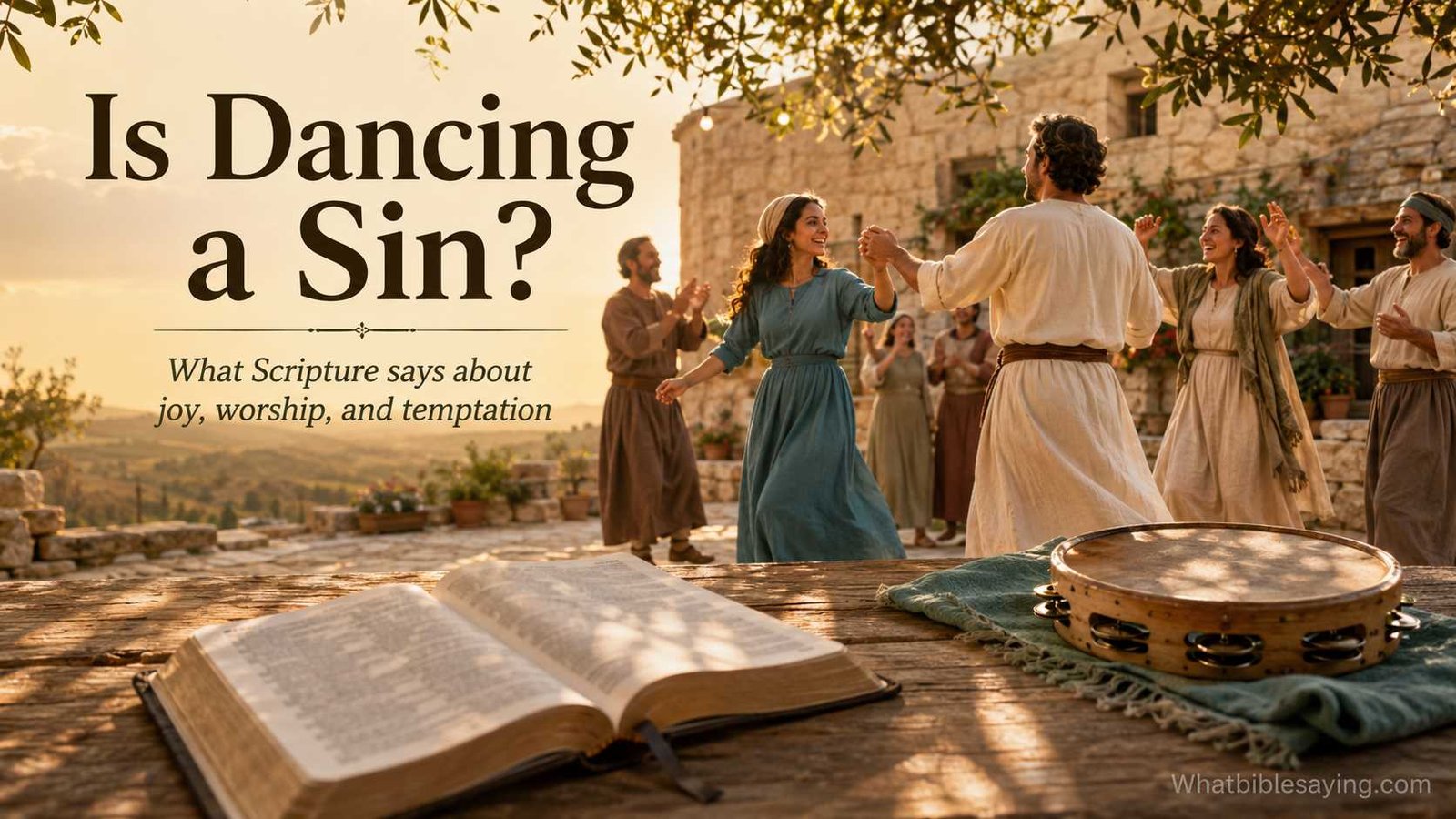
 If you enjoy dancing, you may have wondered whether it is something a Christian should do. Maybe you grew up in a church where dancing was discouraged. Perhaps someone told you that all dancing is sinful. Or maybe you have seen Christians dance at weddings, family celebrations, and even during worship and wondered why believers have such different views.
So, is dancing a sin in the Bible?
The simple answer is no, dancing itself is not automatically a sin in the Bible.
Scripture actually describes people dancing during moments of joy, victory, celebration, and praise. Miriam danced after God delivered Israel from Egypt. David danced before the Lord when the ark was brought into Jerusalem. The Psalms even speak of praising God with dancing. Ecclesiastes says there is “a time to dance.”
But that does not mean every kind of dancing, in every place, for every reason, is good.
The Bible also warns Christians against sexual immorality, sensuality, drunkenness, wild behavior, and losing self-control.
That gives us a more helpful question.
Instead of simply asking, “Is dancing sinful?” we should ask:
What kind of dancing is this? Why am I doing it? What effect does it have on me and other people? Can I do it with a clean conscience before God?
Those questions help us understand the Bible’s message without adding rules that Scripture itself does not give.
Is Dancing a Sin in the Bible? The Short Answer
There is no verse in the Bible that gives a general command saying Christians must never dance.
In fact, several passages speak positively about dancing.
At the same time, the Bible does not give unlimited approval to everything people call dancing. A dance can happen in a joyful family celebration, during worship, at a wedding, or in a setting built around lust, drunkenness, or sexual behavior.
Those situations are not morally identical.
The movement of the body is not the only thing that matters.
The motive, setting, attitude, clothing, behavior, and effect on others can all matter.
Think of singing as an example. Singing itself is not sinful. People sing praises to God. They also sing songs containing hateful, vulgar, or immoral ideas. The act of singing is not the problem. What is being expressed matters.
Dancing can work in a similar way.
Dancing Is an Action, but Motive Matters
A little child dancing because she is happy is very different from someone deliberately using sexual movements to create lust.
A husband and wife dancing together at their wedding is different from a drunken party where people lose control.
A church community expressing joy through movement is different from a performance created mainly to stir sexual desire.
The Bible encourages us to look deeper than the outward action.
First Corinthians 10:31 gives Christians a broad principle: whatever we do should be done for the glory of God.
That principle reaches far beyond dancing.
It applies to our entertainment, relationships, music, clothes, celebrations, work, and private choices.
The better question is often not simply, “Am I allowed to do this?”
It is:
“Can I honor God while doing this?”
Why Dancing Is Not Automatically a Sin in the Bible
Some of the clearest evidence comes from the Bible itself.
Dancing appears several times in Scripture without being condemned.
Miriam and the Women Danced After Deliverance
One of the earliest examples appears in Exodus 15.
Israel had just escaped Pharaoh’s army. God had brought the people safely through the sea. It was an unforgettable moment of rescue.
Miriam, the sister of Aaron, took a tambourine. Other women joined her with tambourines and dancing.
Their dancing was connected with thanksgiving.
They were celebrating what God had done.
This was not a picture of rebellion against God. It was a response to His deliverance.
Imagine living for years under slavery and fear, then suddenly realizing that you were free.
There would have been tears.
There would have been singing.
There would have been joy.
And according to Exodus, there was dancing.
That alone should make us careful about saying, “The Bible teaches that dancing is always sinful.”
It clearly does not.
David Danced Before the Lord
Another famous example appears in 2 Samuel 6.
The ark of the covenant was being brought to Jerusalem. This was a deeply important event for Israel.
David responded with great joy.
Second Samuel 6:14 says David danced before the Lord with all his might.
The passage does not present David’s dancing as sinful simply because he moved energetically.
His joy was connected with worship and celebration before God.
This does not mean every modern dance can be defended by saying, “David danced.”
Context still matters.
David was not at a modern nightclub. He was celebrating a major moment in Israel’s worship life.
Still, the passage teaches something important: physical expressions of joy are not automatically unspiritual.
Sometimes people imagine reverence as always being quiet, still, and serious.
The Bible presents a wider picture.
People prayed quietly.
People knelt.
People lifted their hands.
People sang.
People shouted for joy.
And sometimes people danced.
If you want to understand this wider picture, the related topic what does Bible say about worship can help show how Scripture describes worship in many different forms.
Psalms Connect Dancing With Praise
Psalm 149 gives another clear example.
The psalm calls God’s people to praise His name with dancing and make music with instruments.
Again, dancing appears beside praise and music.
Psalm 150 also connects praise with instruments and joyful expression.
The point is not that every Christian church must include dancing.
Church traditions differ.
Some worship services are quiet and formal. Others are expressive and energetic. Christians can worship sincerely in both settings.
The important point is simpler:
The Bible does not treat dancing itself as morally evil.
Ecclesiastes Says There Is a Time to Dance
Ecclesiastes 3 describes different seasons of human life.
There is a time to weep and a time to laugh.
There is a time to mourn and a time to dance.
That statement places dancing alongside normal expressions of human joy.
Life contains funerals and weddings.
It contains loss and celebration.
There are days when our hearts feel heavy, and there are days when happiness almost seems too large to hold inside.
The Bible understands both.
Dancing can be one natural expression of that joy.
Does the Bible Say We Can’t Dance?
No. The Bible does not contain a general command telling God’s people that they cannot dance.
That distinction matters.
Sometimes Christian culture and biblical commands become mixed together.
A church may have a tradition against dancing.
A family may believe avoiding dancing is the wisest choice.
A Christian may personally feel uncomfortable dancing because of past experiences.
Those convictions deserve respect.
But a personal conviction should not automatically be presented as a direct Bible command.
When Scripture gives a clear command, Christians should take it seriously.
When Scripture leaves room for wisdom and conscience, we should also be careful not to create a rule and then say God gave it.
Romans 14 gives a helpful principle here.
Paul was dealing with disagreements about matters such as food and special days, not dancing specifically. Still, he taught believers not to judge one another carelessly and not to become a stumbling block for another Christian.
That balance is useful.
You may decide that a certain type of dancing is not wise for you.
Another sincere Christian may reach a different conclusion about a wedding dance or joyful family celebration.
Both should ask how they can honor Christ rather than trying to win an argument.
What Did Jesus Say About Dancing?
Jesus never gave a recorded command saying, “Do not dance.”
That is important because people sometimes claim that Christianity directly forbids all dancing.
The Gospels do not support that claim.
Jesus actually mentioned dancing in His teaching.
Jesus Used Dancing in an Everyday Illustration
In Matthew 11:17, Jesus described children calling to one another:
They played the flute, but the others did not dance.
Jesus was using a familiar picture from everyday life to make a larger spiritual point.
The verse is not a command to dance.
But neither is dancing treated as something shocking or automatically immoral.
It is simply part of the picture Jesus uses.
Jesus Included Dancing in the Story of the Lost Son
Another example appears in Luke 15.
Jesus told the well-known parable of a son who left home, wasted what he had, and eventually returned to his father.
The father welcomed him back with great joy.
When the older brother came near the house, he heard music and dancing.
The celebration represented joy over the son’s return.
Again, we should be precise.
Jesus was telling a parable. The passage does not establish rules for Christian dancing.
But it does show that Jesus could use music and dancing as normal parts of a joyful celebration without stopping to condemn dancing itself.
What We Should Not Claim About Jesus and Dancing
Two extremes should be avoided.
The first says:
“Jesus mentioned dancing, so every kind of dancing must be acceptable.”
That goes too far.
Jesus mentioning dancing does not bless every dance, every motive, or every environment.
The other extreme says:
“Jesus taught that Christians must never dance.”
The Gospels do not say that either.
A careful Christian approach stays close to what Scripture actually says.
Jesus did not issue a blanket ban on dancing.
He did teach His followers to live with purity, love, faithfulness, humility, and obedience to God.
Those values should guide every part of life, including dancing.
Is It Forbidden to Dance in Christianity?
Christianity as a whole does not have one universal human rule about every form of dancing.
Different Christians have reached different conclusions.
Some believers avoid dancing because they associate it with temptation, sexual behavior, or unhealthy environments.
Others believe wholesome dancing at weddings, family gatherings, cultural celebrations, or worship can be perfectly appropriate.
The Bible gives principles that help Christians make these decisions.
That is often wiser than trying to produce a list of permitted and forbidden dance styles.
For example, Scripture asks us to care about purity.
It asks us to practice self-control.
It asks us to love other people.
It asks us not to encourage someone else toward sin.
It asks us to honor God with our bodies.
It asks us to avoid drunkenness and sexual immorality.
When those principles guide us, many questions become clearer.
Music can raise similar questions, which is why the related topic is listening to worldly music a sin Bible verse connects closely with this discussion. Music and dancing are not automatically sinful, but their message, purpose, and effect deserve thoughtful attention.
What Kind of Dancing Is a Sin?
The Bible does not name modern dances one by one.
You will not find a verse listing salsa, ballet, ballroom dancing, hip-hop, folk dance, or any other modern style and marking each one “approved” or “forbidden.”
Instead, Scripture gives moral principles.
That means dancing can become sinful when it becomes a vehicle for something the Bible clearly condemns.
When Dancing Is Meant to Stir Sexual Lust
Galatians 5:19–21 warns against sexual immorality, impurity, sensuality, drunkenness, and other works of the flesh.
Notice that Paul does not list “dancing” among these sins.
That is important.
We should not rewrite the passage.
But a dance deliberately designed to encourage lustful behavior can become part of a larger problem involving sensuality and sexual temptation.
The heart matters here.
Ask yourself:
Am I trying to attract sexual attention?
Are my movements meant to create lust?
Does this environment encourage people to treat bodies as sexual objects?
Is this leading me toward thoughts or behavior I know are wrong?
Those questions deal with the deeper issue.
Someone studying what is sensuality in the Bible will notice that biblical warnings go beyond a single physical movement. They deal with desires and behavior that pull people away from purity and self-control.
When Dancing Is Connected With Drunkenness and Wild Behavior
The Bible repeatedly warns about drunkenness.
Galatians 5 includes drunkenness and uncontrolled revelry among behaviors Christians should avoid.
First Peter 4:3 likewise describes a former way of life involving lust, drunkenness, carousing, and idolatrous behavior.
Once again, the problem is not simply that music is playing and bodies are moving.
The larger environment matters.
Suppose someone attends a celebration where people are dancing, talking, eating, laughing, and enjoying time together.
That is very different from an environment built around getting drunk, losing control, sexual pressure, fighting, or other destructive behavior.
Christians are called to wisdom.
You do not need a verse naming every possible situation.
Sometimes you can look around and recognize that an environment is pulling you away from the kind of person God calls you to be.
When Dancing Causes You to Lose Self-Control
Self-control is an important Christian virtue.
First Corinthians 6:12 teaches that not everything a person may be free to do is helpful, and Paul refuses to be mastered by anything.
That principle can apply to entertainment.
Ask:
Can I control my behavior?
Can I stop when I should stop?
Am I making wise decisions?
Would I be embarrassed if trusted Christian friends saw what I was doing?
Do I become a different person in this environment?
Am I using dancing, alcohol, attention, or excitement to escape problems in an unhealthy way?
Christian freedom is not the freedom to become controlled by our desires.
It is freedom to live wisely.
The broader subject what does the Bible say about self-control is especially helpful here because self-control affects far more than dancing. It shapes anger, speech, sexuality, food, alcohol, money, relationships, and entertainment.
When Your Conscience Is Warning You
Sometimes there is no simple rule for a particular situation, yet your conscience keeps troubling you.
Do not ignore that without thinking carefully.
Romans 14 teaches believers to take conscience seriously while also showing grace toward other Christians. The chapter specifically discusses disputed matters such as food, but its emphasis on faith, conscience, love, and avoiding stumbling blocks is useful when considering other choices too.
Suppose your past involved unhealthy parties, sexual temptation, or addiction.
Returning to certain dance environments may not be wise for you even if another Christian could attend without the same struggle.
That does not make you weak.
It means you know where temptation has harmed you before.
Wisdom sometimes means staying away from something that might not be sinful for everyone.
What About the Dance Before King Herod?
Some Christians point to the story of Herodias’s daughter in Mark 6 as an example of sinful dancing.
The story is certainly dark.
Herod was holding a banquet. Herodias’s daughter came in and danced, pleasing Herod and his guests. Herod then promised to give her what she requested. After asking her mother what she should request, she asked for the head of John the Baptist.
John was then executed.
This is clearly a terrible story involving corrupt power and murder.
But we should be careful with one detail.
Mark does not explicitly say that the dance itself was sexually immoral.
People sometimes describe it as a seductive dance, but the biblical text does not give those details.
The safest conclusion is that the dance took place inside a deeply sinful situation, but this passage does not prove that all dancing is sinful.
We honor Scripture best when we do not add details that Scripture does not give.
Is Dancing at a Wedding a Sin?
For most Christians, the biblical question about wedding dancing is not whether people move to music.
The better questions involve the way it is done.
A wedding is naturally a joyful event.
Families gather.
Friends laugh.
People eat together.
Music plays.
Couples celebrate.
Jesus’ parable in Luke 15 even presents music and dancing as part of a joyful household celebration.
There is therefore no biblical reason to declare that every wedding dance is automatically sinful.
But the same moral principles still apply.
A Christian may want to ask:
Is the dancing respectful?
Is it becoming sexually explicit?
Is drunkenness taking control of the event?
Am I behaving in a way that honors my spouse or future spouse?
Am I encouraging someone else toward temptation?
Can I participate with a clear conscience?
A gentle slow dance between a husband and wife is not morally identical to intentionally sexual behavior with strangers.
Context matters.
Can Christians Dance for Fun?
Yes, Christians can experience ordinary human joy.
The Bible does not present holiness as a life without laughter, music, celebration, beauty, friendship, food, or happiness.
Ecclesiastes recognizes both mourning and dancing.
There is a time to grieve.
There is also a time to celebrate.
Sometimes Christians become so afraid of doing something wrong that they begin treating everything enjoyable as suspicious.
That is not a healthy way to read Scripture.
At the same time, saying something is “fun” does not automatically make it wise.
Christians should be able to enjoy life while still practicing discernment.
Healthy fun does not require you to violate your conscience.
It does not require you to become drunk.
It does not require sexual behavior.
It does not require humiliating yourself or another person.
Joy and holiness do not have to be enemies.
Can Dancing Be Worship?
Biblically, dancing can be connected with worship.
Miriam’s dancing was connected with praise after God’s deliverance. David danced before the Lord. Psalm 149 connects dancing with praising God’s name.
That does not mean every Christian must dance during worship.
Some people worship best through quiet prayer.
Others sing loudly.
Some kneel.
Some stand.
Some raise their hands.
Some Christian traditions use carefully planned movement or dance as part of worship, while others do not.
Scripture leaves room for different expressions while keeping the focus on God.
The movement itself should never become more important than the One being worshiped.
True worship is not a performance designed to make people admire us.
It turns attention toward God.
That connects directly with the wider biblical question what does Bible say about worship. Worship involves far more than music or movement. It includes obedience, gratitude, prayer, love, service, and a life offered to God.
A Simple Biblical Test Before You Dance
Sometimes you will not have a verse telling you exactly what to do.
In those moments, biblical questions can help.
Before dancing, ask yourself:
- Why do I want to do this?
Is it simple joy, celebration, exercise, culture, friendship, or worship? Or am I seeking sexual attention? - Does this encourage lust?
Am I deliberately trying to stir desires that should not be stirred? - What kind of environment am I entering?
Is it safe and wholesome, or is it built around drunkenness, drugs, sexual pressure, or violence? - Can I remain self-controlled?
Freedom should not become slavery to excitement, alcohol, attention, or desire. - Is my conscience clear?
If I already feel strongly that participating would be wrong, I should not casually ignore that conviction. - How am I treating other people?
Christian love never reduces another person to a body for our pleasure. - Could my actions pull someone else toward serious temptation?
Romans 14 reminds Christians to care about how their choices affect others. - Can I honestly honor God in this?
First Corinthians 10:31 gives this simple standard for ordinary life: whatever we do should be done for God’s glory.
These questions are often more useful than asking for a list of forbidden dances.
What If My Church Says Dancing Is Wrong?
Treat your church leaders with respect.
They may have reasons for encouraging caution.
Perhaps they have seen people harmed through certain nightlife environments. Maybe their church tradition has long connected dancing with worldly behavior. Perhaps they are trying to protect young people from sexual pressure.
Listen carefully.
Ask questions kindly.
Study Scripture.
At the same time, learn to distinguish between a biblical command and a church rule or pastoral recommendation.
A church can decide that certain activities are not appropriate at its own events.
That is different from saying, “The Bible teaches that every Christian who dances anywhere is committing a sin.”
Scripture gives several positive examples of dancing, so such a sweeping statement would be difficult to support.
Christians should be able to discuss these differences without mocking one another.
A believer who chooses not to dance should not be pressured into it.
A believer who participates in wholesome dancing should not automatically be accused of sin when Scripture has not given such a blanket rule.
Grace matters.
What If Dancing Has Become a Source of Temptation?
This is where the question becomes very personal.
Something does not have to be sinful in every possible situation for it to be dangerous to you.
You may know your own weaknesses.
Perhaps certain parties lead you toward drinking too much.
Perhaps a particular kind of dancing stirs sexual temptation.
Perhaps you crave attention in a way that damages your relationships.
Perhaps an old lifestyle begins calling you back whenever you enter certain places.
If that is happening, wisdom may mean stepping away.
You do not have to prove your freedom by staying close to temptation.
Christian maturity sometimes says:
“I could argue that this is allowed, but it is not helping me follow Christ.”
First Corinthians 6:12 reminds us that not everything that may be permissible is beneficial.
That is a powerful principle.
God is not trying to remove joy from your life.
His commands protect what is good.
Sometimes saying no to one environment creates room for a healthier kind of joy somewhere else.
Does the Bible Say We Can’t Dance? Remember the Whole Picture
When we gather the biblical evidence, the answer becomes clearer.
The Bible shows:
| Biblical Example | Passage | What It Shows |
|---|---|---|
| Miriam and the women dance after deliverance | Exodus 15:20 | Dancing can express joyful thanksgiving |
| David dances before the Lord | 2 Samuel 6:14 | Dancing can accompany worship and celebration |
| The Psalms mention praising with dance | Psalm 149:3 | Dance can be connected with praise |
| Ecclesiastes mentions a time to dance | Ecclesiastes 3:4 | Dancing can be part of ordinary human joy |
| Jesus mentions children dancing | Matthew 11:17 | Dancing appears as a familiar everyday image |
| Jesus’ parable includes music and dancing | Luke 15:25 | Dancing can accompany celebration |
| Paul warns against sensuality and drunkenness | Galatians 5:19–21 | Sinful behavior surrounding entertainment matters |
These passages do not tell us that every dance is good.
But they certainly do not support the idea that all dancing is automatically sinful.
What This Teaches Us About Christian Freedom and Joy
So, is dancing a sin in the Bible?
Not by itself.
The Bible contains clear examples of dancing connected with joy, praise, victory, and celebration.
Miriam danced.
David danced.
The Psalms speak of dancing.
Ecclesiastes says there is a time to dance.
Jesus referred to dancing in familiar scenes of daily life and celebration.
But Christian freedom always walks beside Christian wisdom.
A dance can become part of sinful behavior when it is driven by lust, sexual immorality, drunkenness, loss of self-control, idolatry, or deliberate temptation. Galatians 5 makes those boundaries clear even though it does not condemn dancing as an act in itself.
So do not judge the whole subject by one word: dance.
Look at the heart.
Look at the setting.
Look at the purpose.
Look at what the activity is producing in you.
If you can dance with joy, purity, self-control, respect for others, and a clear conscience before God, Scripture gives no blanket command saying you must never do so.
If a particular kind of dancing pulls you toward temptation or behavior you know dishonors God, walking away may be the wiser and more faithful choice.
God is interested in more than whether your feet are moving.
He cares about where your heart is going.
And that is a principle worth carrying into every part of life.

Reverend James has spent years studying and teaching the Bible. With warmth and wisdom, he shares deep truths in a way that’s clear, simple, and easy to understand.