
 When modern readers see the word fat in the Bible, it can sound strange. We usually think about body weight or food. But biblical writers often used the word in a much wider way.
So, what does fat symbolize in the Bible?
In Scripture, fat can symbolize the best or richest portion, abundance, prosperity, satisfaction, and something especially offered to God. In other passages, becoming “fat” can picture a person or nation becoming so comfortable and prosperous that the heart grows proud, stubborn, or spiritually dull.
This means fat does not have one fixed meaning everywhere in the Bible.
The context matters.
The Hebrew word often translated as “fat,” chelev, can refer to literal animal fat. It can also describe something rich, choice, or especially valuable. That helps explain why the same word can appear in a sacrifice in Leviticus and in the expression “fat of the land” in Genesis.
Once we understand that background, several unusual Bible verses become much easier to understand.
What Does Fat Symbolize in the Bible Most Often?
Fat in the Bible is commonly connected with four ideas:
- The best or choicest portion
- Abundance and prosperity
- Satisfaction and fullness
- Spiritual dullness when abundance leads to pride
These meanings may look very different, but they are connected.
In the ancient world, food was not as easy to obtain as it is for many people today. A rich harvest, healthy livestock, oil, grain, and plenty of food were signs of prosperity.
Something described as “fat” could therefore mean something rich, full, fertile, or valuable.
But Scripture also warns that abundance can become dangerous when people enjoy God’s gifts while forgetting the God who gave them.
That is why fat imagery can be positive in one passage and negative in another.
Fat as the Best or Choicest Portion
One of the clearest examples appears in Genesis.
When Joseph’s brothers came to Egypt during the famine, Pharaoh invited Joseph’s family to move there. He promised them good land and abundant food.
Genesis 45:18 describes this as enjoying the “fat of the land.”
The expression does not mean they were being offered literal fat. It means they would receive the best and richest things the land could provide.
Modern Bible translations sometimes make this meaning clearer by using words such as “best,” “richness,” or “finest produce.”
So when fat is used this way, it represents:
- richness
- abundance
- quality
- prosperity
- the choicest part
This meaning is important because it helps us avoid reading modern ideas into ancient expressions.
The Bible often uses physical things to describe greater ideas. We see this with what does wheat represent in the Bible, where grain can be literal food but can also appear in teachings about harvest, judgment, provision, and spiritual fruitfulness.
The surrounding passage tells us what an image means.
Fat as Abundance and Satisfaction
Fatness can also describe being completely satisfied.
Psalm 63 presents a beautiful example. David speaks about longing for God and then describes his soul as deeply satisfied, using the image of rich and plentiful food.
The point is not physical weight.
David is describing fullness of soul.
Imagine someone who has been hungry for a long time finally sitting down to a generous meal. The hunger is gone. The person is satisfied.
That is the picture.
David is saying that knowing God satisfies him at a level that ordinary things cannot.
This teaches us something important about biblical imagery. Physical abundance is sometimes used to explain spiritual abundance.
Food fills the stomach.
God fills the heart.
What Does Fat Symbolize in the Bible’s Sacrifices?
One of the most important uses of fat appears in the Old Testament sacrificial laws.
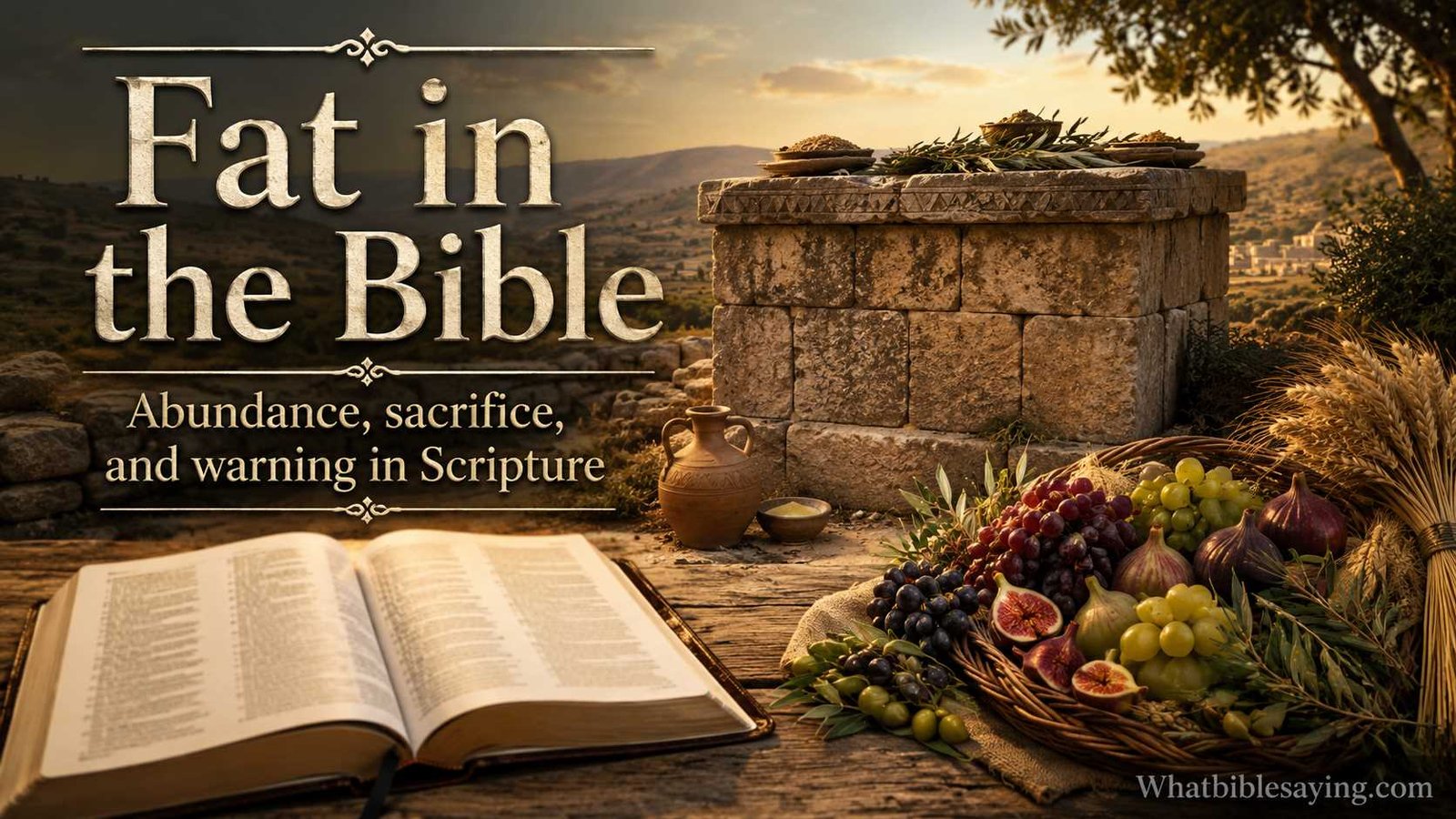
Leviticus 3 describes the peace offering. Certain fatty portions of the animal were removed and burned on the altar.
Leviticus 3:16 states that all the fat belonged to the Lord.
Here, fat is literal. The passage is describing actual parts of the sacrificial animal.
But its place in worship also carries an important message.
Why Was the Fat Offered to God?
The fatty portions were treated as special parts of the sacrifice. They were not simply discarded.
They were presented to God.
This fits a larger biblical pattern in which God is honored with what is valuable rather than treated as an afterthought.
Israel was repeatedly taught that worship should involve honor, reverence, and obedience.
The sacrifice was not meant to say that God physically needed food. Scripture presents God as the Creator and giver of all things.
Instead, the offering expressed worship and covenant devotion.
The worshiper was acknowledging that everything ultimately belonged to God.
The same Old Testament sacrificial system also gives special importance to blood, although blood and fat have different meanings and functions. This makes what does blood represent in the Bible another useful study for understanding biblical sacrifice.
Blood is especially connected with life and atonement.
Fat is associated with the portion presented to God.
We should not mix the two symbols together.
Does Fat Always Symbolize Giving God Your Best?
It is tempting to turn every biblical detail into a spiritual rule.
We should be careful.
Because the sacrificial fat belonged to God, Christians sometimes summarize the principle by saying, “Give God your best.”
That can be a useful application, but it should not replace what the passage actually says.
Leviticus is first describing Israel’s sacrificial worship under the Old Covenant.
From that historical setting, we can recognize a broader truth: God deserves honor.
But we should not claim that every occurrence of the word fat means “give God your best.”
Biblical symbols must be interpreted from their own passages.
What Does Fat Symbolize in the Bible When It Has a Negative Meaning?
Fat imagery is not always positive.
Sometimes Scripture uses abundance to warn about what can happen when people become comfortable and forget God.
Deuteronomy 32 gives one of the strongest examples.
When Prosperity Leads to Pride
Deuteronomy 32:15 describes Jeshurun, a poetic name for Israel, becoming fat and then turning away from God.
The image is powerful.
Israel had received God’s provision, protection, and blessing. But prosperity did not automatically make the people more faithful.
Instead, abundance became connected with rebellion.
The problem was not food.
The problem was not body size.
The problem was forgetfulness and pride.
People received good things and then forgot the One who had provided them.
That spiritual danger still makes sense today.
A person may pray constantly during hardship:
“God, please help me.”
Then life improves.
The bills are paid.
Work is going well.
The family is healthy.
The crisis passes.
Slowly, prayer becomes less important.
Dependence on God becomes self-confidence.
Gratitude becomes entitlement.
That is the danger pictured in Deuteronomy 32.
Prosperity itself is not condemned. But prosperity can test the heart just as hardship can.
Sometimes we remember God most clearly when we need something.
Scripture teaches us to remember Him when our lives are full as well.
What Does a “Fat Heart” Mean in the Bible?
Some older Bible translations contain an even stranger expression: a fat heart.
This can be confusing if we read it with modern English in mind.
Psalm 119:70 says in the King James Version:
“Their heart is as fat as grease; but I delight in thy law.”
The writer is not describing heart disease.
He is using figurative language.
Many modern translations communicate the idea with words such as:
- callous
- insensitive
- dull
- unfeeling
- stubborn
The picture is of a heart that has become difficult to reach.
Fatness as Spiritual Insensitivity
Isaiah 6:10 uses similar language.
Older translations speak of making the people’s heart “fat,” while many modern translations express the idea as making their hearts or minds dull or insensitive.
The surrounding verse also speaks about ears that do not truly hear and eyes that do not truly see.
This is spiritual language.
A person may hear God’s truth but refuse to respond.
The words reach the ears, but not the heart.
That is the kind of spiritual condition these passages describe.
Think about soil that has become hard.
Rain falls on it, but the water does not easily soak in.
In a similar way, a spiritually insensitive person may hear truth many times without allowing it to change the heart.
That is very different from the positive image of richness in “the fat of the land.”
Same general word picture.
Very different context.
Does Being Physically Fat Mean Something Spiritual in the Bible?
This deserves a clear answer.
No. The Bible does not teach that a person’s body size automatically reveals his or her spiritual condition.
Someone should not read verses about Israel becoming “fat” or about a “fat heart” and use them to judge people according to physical appearance.
Those passages use imagery within specific contexts.
Deuteronomy 32 is warning about prosperity and rebellion.
Psalm 119 is describing spiritual insensitivity.
Isaiah 6 is describing people who are unwilling or unable to respond properly to God’s message.
None of these passages gives Christians permission to shame someone because of body size.
Scripture repeatedly looks deeper than outward appearance.
People tend to judge what can be seen.
God knows the heart.
That should make Christians especially careful about using biblical language to insult or embarrass another person.
Why Biblical Symbols Must Always Be Read in Context
One of the biggest mistakes in Bible study is assuming that every symbol always has exactly the same meaning.
The Bible is not a simple symbol dictionary.
A lion can represent one thing in one passage and something different in another.
Fire can represent God’s presence, purification, judgment, or destruction depending on the context.
Water can picture life, cleansing, danger, chaos, or blessing.
The same is true of animals.
This is especially important when readers ask questions such as what does a dog symbolize in the Bible, what does a bear symbolize in the Bible, or what does a bird symbolize in the Bible.
There is usually no single answer that fits every verse.
What Does a Dog Symbolize in the Bible?
Dogs appear in several biblical settings.
In some passages, dogs are connected with scavenging, humiliation, danger, or contempt.
Calling someone a dog could be a serious insult in the ancient world.
But that does not mean the Bible teaches that every actual dog is evil.
Nor should we conclude that seeing a dog today carries a hidden spiritual message.
The meaning belongs to the passage.
The Bible also recognizes dogs as ordinary animals that lived around human communities.
So if you are studying what dogs symbolize, first ask:
Who is speaking?
What is happening?
Is this a literal animal?
Is it a comparison?
Is it an insult?
Is it part of a prophetic picture?
Those questions are more reliable than assigning one spiritual definition to every dog in Scripture.
What Does a Bear Symbolize in the Bible?
Bears can represent strength, danger, fierceness, or destructive power.
The Bible describes the danger of meeting a bear robbed of her cubs. That picture communicates fierce protective anger.
A bear also appears in Daniel’s prophetic vision.
But Daniel’s bear belongs to a specific symbolic vision. We should not use it to say that every bear in every biblical passage carries exactly the same prophetic meaning.
If you are studying what does a bear represent in the Bible, the safe method is the same: begin with context.
A bear in a historical account and a bear in an apocalyptic vision may serve very different purposes.
What Does a Bird Symbolize in the Bible?
The question what does a bird symbolize in the Bible is even broader because Scripture mentions many kinds of birds.
Different birds can carry different images.
A dove may be associated with peace, innocence, sacrifice, or the Holy Spirit in particular passages.
An eagle can represent strength, speed, protection, or judgment.
Ravens appear in several very different settings.
Sparrows are used by Jesus when teaching about God’s care.
Birds can also appear in parables and prophetic visions.
So “bird” does not equal one fixed spiritual meaning.
That is why what does a dove symbolize in the Bible requires a more focused answer than simply asking what all birds mean.
Good Bible study moves from the specific passage outward, not from a modern symbol list inward.
What Does Fat Symbolize in the Bible Compared With Other Symbols?
Looking at several biblical symbols together makes the pattern easier to see.
| Biblical image | Possible meanings depending on context |
|---|---|
| Fat | Richness, best portion, abundance, satisfaction, spiritual dullness |
| Blood | Life, sacrifice, atonement |
| Wheat | Food, harvest, provision, people, spiritual fruit |
| Gold | Wealth, value, glory, refinement |
| Dove | Sacrifice, gentleness, peace, Holy Spirit imagery |
| Bear | Strength, danger, fierceness, prophetic imagery |
| Dog | Scavenging, contempt, danger, ordinary animal life |
The word possible matters.
A symbol should never be separated from its verse and treated as a universal code.
Even when studying what does gold symbolize in the Bible or what does the ox represent in the Bible, we have to examine the story, law, poem, prophecy, or teaching where that image appears.
That protects us from making Scripture say something it never says.
What Does Fat Symbolize in the Bible for Christians Today?
The Old Testament setting may be ancient, but several lessons still speak clearly to Christian life.
Be Thankful When Life Is Full
There is nothing wrong with thanking God for good food, a safe home, work, family, health, or other blessings.
Abundance can become an opportunity for worship.
The danger comes when the gift becomes more important than the Giver.
Deuteronomy warns us not to enjoy God’s provision while forgetting God Himself.
Gratitude keeps blessing in its proper place.
Do Not Let Comfort Make Your Heart Dull
Hard times can test faith.
So can easy times.
When everything feels secure, we may begin thinking we do not need God very much.
Prayer becomes shorter.
Scripture stays closed.
Worship becomes less important.
We become comfortable.
The biblical warning about spiritual fatness asks a useful question:
Has comfort made my heart less sensitive to God?
That question is not about guilt.
It is about awareness.
A healthy heart remains teachable whether life feels empty or full.
Give God Honor, Not Leftovers
The sacrificial laws belong to ancient Israel, and Christians do not repeat those animal sacrifices.
Yet the worship behind them reminds us that God is worthy of honor.
Faith should not consist only of whatever time and attention remain after everything else has been done.
God is not meant to be an emergency contact we remember only when life falls apart.
Prayer, gratitude, obedience, generosity, and worship can become natural parts of daily life.
Seek the Kind of Fullness That Reaches the Soul
Psalm 63 points us beyond material abundance.
A person can have plenty of possessions and still feel empty.
Another person may have very little and yet know deep peace.
The Bible does not deny physical needs. Hunger matters. Poverty matters. Providing for a family matters.
But Scripture also teaches that human beings have a deeper hunger.
We were made for God.
That is why David could describe his soul as richly satisfied in God’s presence.
The greatest fullness in Scripture is not simply having more things.
It is knowing the One who gives life.
How Can You Tell What “Fat” Means in a Bible Verse?
When you encounter the word, use a simple four-step method.
1. Read the Whole Paragraph
Do not stop at one sentence.
Look at what happens before and after it.
2. Ask Whether the Word Is Literal or Figurative
Leviticus may be talking about actual sacrificial fat.
Genesis may use fat figuratively for rich produce.
Psalm 119 may use it figuratively for spiritual insensitivity.
Those are different uses.
3. Compare Several Bible Translations
Older translations sometimes preserve expressions that sound unusual today.
Modern translations may make the sense clearer.
For example, where an older Bible speaks about a heart being “fat,” another translation may say “callous,” “dull,” or “insensitive.”
Comparing translations can help you understand the idea without changing the message.
4. Let Scripture Explain Scripture
Look for other passages using similar expressions.
This often reveals patterns that a single verse cannot show.
Genesis helps us understand fatness as richness.
Leviticus shows literal fat in worship.
Deuteronomy shows abundance becoming spiritually dangerous.
Psalms and Isaiah show fatness as a picture of insensitivity.
Together, these passages give us a much fuller answer.
What the Biblical Meaning of Fat Teaches Us About the Heart
So, what does fat symbolize in the Bible?
There is no single meaning for every verse.
Sometimes fat represents the best and richest portion.
Sometimes it represents abundance, prosperity, or deep satisfaction.
In Israel’s sacrificial system, particular fatty portions were presented to God.
In other passages, becoming fat becomes a warning picture of comfort turning into pride, forgetfulness, or spiritual dullness.
That range of meaning teaches us an important lesson about reading Scripture.
Context matters.
We should resist quick spiritual formulas.
We should also resist turning ancient imagery into judgments about people’s bodies today.
The deeper question is about the heart.
When God gives us abundance, do we become grateful or forgetful?
When His Word speaks, are we teachable or insensitive?
When life is comfortable, do we still seek Him?
The Bible’s strange-sounding language about fat eventually points us toward something very simple: God wants hearts that remain thankful, humble, responsive, and satisfied in Him.
That is a lesson worth carrying long after we have closed the page.

Dr. Rachel is very smart and knows a lot about the Bible. He helps us understand the Bible better by talking about the old texts in a simple way.