
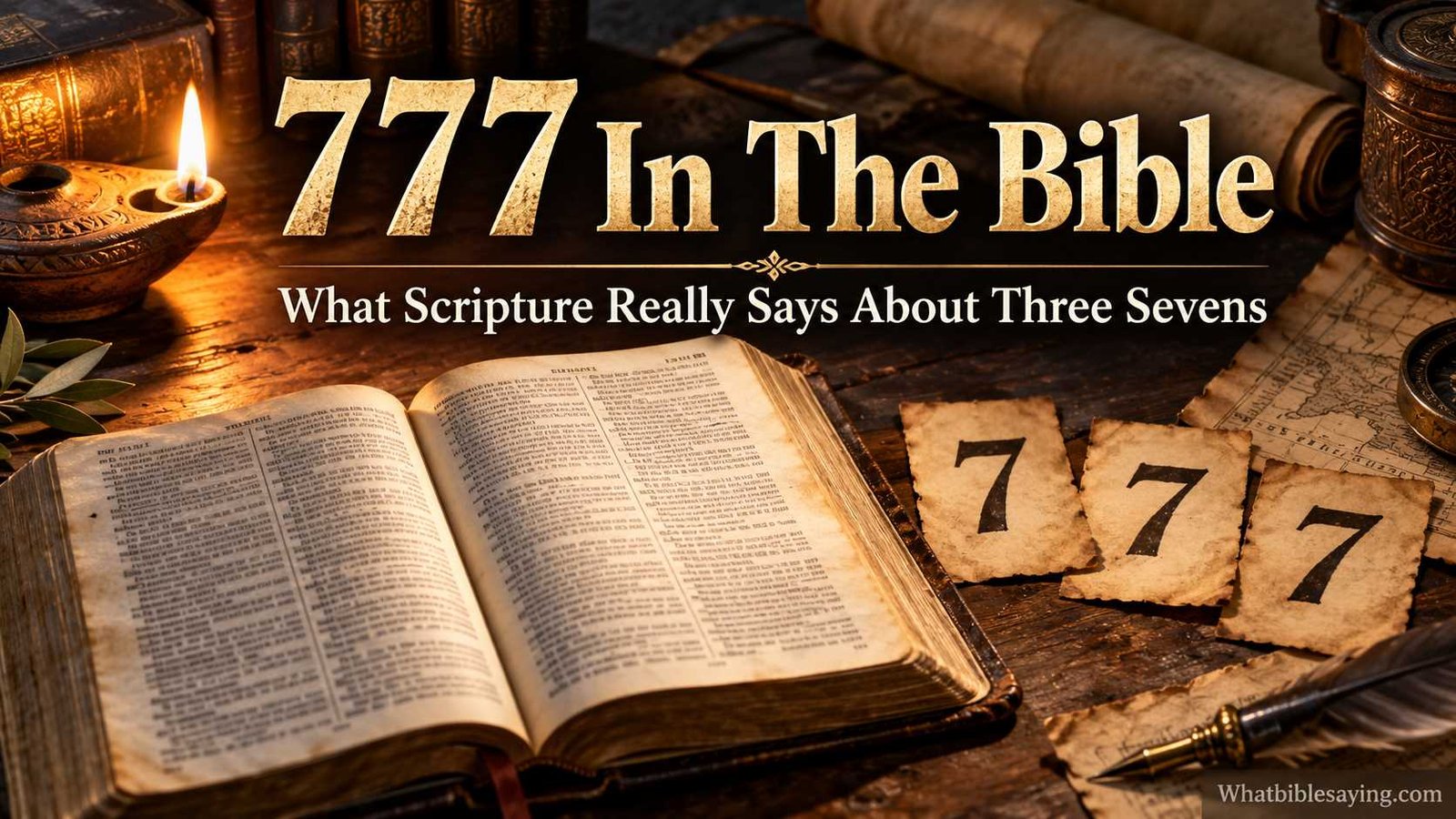
 If you have wondered, What is 777 mean in the Bible?, the most important thing is to begin with what Scripture actually says.
The number 777 does appear in the Bible. Genesis 5:31 tells us that Lamech, the father of Noah, lived 777 years.
But the Bible never directly says that 777 means “divine perfection,” that it is “God’s number,” or that seeing 777 means God is sending you a private message.
Those ideas come from interpretations built around the biblical importance of the number seven.
Seven appears many times in Scripture and is often connected with completion, sacred order, rest, and fullness. God completed His work of creation and rested on the seventh day. Revelation also uses groups of seven again and again, including seven churches, seven seals, seven trumpets, and seven bowls.
For this reason, some Christians view 777 as an intensified picture of completeness or perfection. That can be a meaningful symbolic interpretation, but we should not present it as something the Bible directly defines.
Here is what matters: biblical numbers can carry meaning, but their meaning should come from Scripture and context rather than speculation.
What Does 777 Mean In The Bible According to Scripture?
There is a difference between something the Bible states and something Christians later interpret symbolically.
Genesis 5 gives the clearest biblical appearance of 777:
“Altogether, Lamech lived a total of 777 years, and then he died.”
Genesis 5:31, NIV
That verse gives us one fact with complete certainty: Lamech lived 777 years.
Genesis does not stop afterward to explain that 777 represents God, perfection, heaven, angels, or the Trinity.
So a careful Bible reader should distinguish between several common claims.
| Claim about 777 | What Scripture supports |
|---|---|
| Lamech lived 777 years | Explicitly stated in Genesis 5:31 |
| Seven often carries symbolic importance | Strong biblical pattern |
| 777 represents complete perfection | Common Christian interpretation |
| 777 represents the Trinity | Possible symbolic interpretation, not explicitly taught |
| 777 is officially “God’s number” | Not stated in Scripture |
| Seeing 777 predicts a blessing | Not taught in Scripture |
This distinction protects us from turning biblical symbolism into something the biblical writers never said.
Where Is 777 Found In The Bible?
The clearest occurrence is found in Genesis 5:31.
Genesis 5 records a genealogy from Adam through the generations leading toward Noah. Each person is introduced with details about his descendants and lifespan.
Lamech appears near the end of that genealogy.
Genesis tells us that Lamech became the father of Noah and later died at the age of 777. The following verse moves directly to Noah and his sons Shem, Ham, and Japheth.
Lamech Lived 777 Years
It is worth identifying this Lamech carefully because Genesis contains another man with the same name.
The Lamech of Genesis 5 belongs to the family line leading from Adam through Seth to Noah.
He should not be confused with the Lamech mentioned earlier in Genesis 4 in Cain’s family line.
The Genesis 5 Lamech became Noah’s father. He expressed hope that Noah would bring relief from the painful labor associated with the cursed ground.
Then Genesis records his lifespan: 777 years.
The unusual pattern naturally attracts attention, especially because seven has such an important place elsewhere in Scripture.
Still, Genesis 5 itself does not tell us to decode Lamech’s age as a hidden numerical prophecy.
That is a useful principle whenever we study numbers and their meanings in the Bible: start with what the passage says before asking what a number might symbolize.
Why Is the Number 7 Important in the Bible?
To understand why 777 attracts so much attention, we need to understand the biblical importance of seven.
Seven appears throughout Scripture in important settings.
It would be too simple to say that every appearance of seven means exactly the same thing. Sometimes seven is simply a number. But in many important passages, seven appears in patterns associated with completion, sacred order, covenant life, worship, and God’s purposes.
Seven and the Completion of Creation
The foundation appears at the beginning of the Bible.
Genesis describes God’s creative work across six days. By the seventh day, His work was finished. God rested from His work and blessed the seventh day.
That does not mean God became tired. The passage presents His creative work as complete.
This is one reason seven became strongly associated with completion and rest in biblical thought.
The seventh day also became important in Israel’s Sabbath rhythm.
So when Christians speak about seven as a number associated with completeness, they are not inventing the connection from nothing. It grows from patterns that begin in Genesis.
But we still need to be careful. A biblical pattern does not give us permission to assign a secret meaning to every seven we encounter.
Seven in Israel’s Worship and Sacred Life
Seven appears repeatedly in Israel’s religious life.
The Sabbath established a seven-day rhythm. Biblical festivals sometimes followed seven-day patterns. Israel also counted years in groups of seven, including the Sabbath year system.
These patterns helped organize worship, work, rest, remembrance, and covenant life.
The importance is not that seven works like a magical number.
It does not.
The importance comes from what God commanded or revealed in each biblical setting.
That is an essential rule when studying biblical numbers and their meanings. Numbers receive their significance from their context.
We should never reverse the process and force a predetermined meaning onto every passage.
Seven Appears Throughout Revelation
The book of Revelation makes particularly extensive use of seven.
Readers encounter:
- seven churches
- seven spirits
- seven lampstands
- seven stars
- seven seals
- seven trumpets
- seven angels
- seven bowls
The repeated structure is difficult to miss. Biblical scholar Felix Just notes the many sets of seven throughout Revelation, including its churches, lampstands, seals, trumpets, plagues, and bowls.
Many interpreters understand this repeated use of seven as communicating ideas such as fullness or completeness.
Yet even here, context remains essential.
Seven is associated with churches, worship, judgment, visions, and other themes. We cannot simply replace every seven with the word “perfection.”
The Bible uses numbers as part of its literary structure as well as its message.
Does 777 Mean Divine Perfection?
You will often read that 777 means divine perfection.
There is a reasonable idea behind that interpretation, but it needs qualification.
Seven is frequently connected with completion and fullness in Scripture. If seven carries such associations, three sevens can naturally be understood by some Christians as an intensified image of completeness.
That is an interpretation, however.
There is no verse that says:
777 means divine perfection.
Genesis 5:31 simply tells us how long Lamech lived.
A recent discussion of the biblical use of seven similarly cautions that not every appearance of seven carries a symbolic meaning, even while recognizing that seven sometimes communicates completeness, perfection, or wholeness.
That balance is important.
Symbolism can enrich Bible study. Speculation can weaken it.
Does 777 Represent the Father, Son, and Holy Spirit?
Another popular explanation says that the three sevens represent the Father, Son, and Holy Spirit.
Christians confess one God and recognize the Father, Son, and Holy Spirit throughout Scripture. But the Bible never links each person of the Trinity with one of the three digits in 777.
There is no verse saying:
7 = Father
7 = Son
7 = Holy Spirit
For that reason, the Trinity interpretation should not be taught as the biblical definition of 777.
Someone may use three sevens as a devotional symbol of God’s perfection or fullness. That is different from saying Scripture itself establishes the symbol.
Good Bible study keeps those categories separate.
Is 777 God’s Number?
People sometimes call 777 God’s number.
The phrase sounds familiar, but it does not come directly from Scripture.
The Bible gives God many names, titles, and descriptions. It calls Him Creator, Lord, Father, King, Shepherd, and many other things.
It does not identify 777 as an official numerical name for God.
This matters because God is not a mathematical code we must unlock.
Numbers in Scripture may support patterns, structure events, organize time, or communicate symbolism. But biblical faith is centered on knowing God through His revealed Word, not discovering hidden numerical formulas.
So is 777 God’s number?
Not in the sense that the Bible explicitly calls it that.
Is 777 the Opposite of 666?
This is another common comparison.
The Bible explicitly mentions 666 in Revelation 13:18. The passage calls it the number associated with the beast and says that understanding it requires wisdom.
Because 666 has such a negative association, people sometimes place 777 on the opposite side:
666 = evil
777 = God
The contrast looks neat, but Scripture never creates that equation.
Revelation gives 666 a specific place in its vision. It does not then introduce 777 as God’s answering number.
Therefore, saying that 777 is the official biblical opposite of 666 goes beyond the text.
If you are studying what does the number 666 represent in the Bible, read Revelation 13 in its full context rather than building the answer only from comparisons with 777.
What Is the Difference Between 7, 77, and 777 in the Bible?
The numbers 7, 77, and 777 should not automatically be treated as increasingly powerful versions of the same spiritual idea.
Their meanings depend on their passages.
| Number | Biblical example | Best way to understand it |
|---|---|---|
| 7 | Seventh day of creation | Often connected with completion, sacred order, or fullness |
| 77 | Appears in several biblical contexts | Meaning depends on the specific passage |
| 777 | Lamech’s lifespan in Genesis 5:31 | Explicitly 777 years; Scripture gives no direct symbolic definition |
This is why studying what does the number 7 mean in the Bible is not exactly the same as studying 777.
Likewise, what does the number 77 mean in the Bible deserves attention to its own passages rather than assuming it simply means double perfection.
Biblical numbers work inside stories, laws, poetry, prophecy, and visions. Context comes first.
Does Seeing 777 Mean God Is Sending You a Message?
Suppose you notice 7:77-like patterns, 777 on a receipt, a phone number, an address, or another everyday place.
Does that automatically mean God is speaking to you?
The Bible never teaches Christians to interpret repeating numbers encountered in daily life as personalized messages from God.
That is different from recognizing numbers that the biblical writers intentionally use within Scripture.
The safest response is not fear or obsession.
If seeing 777 reminds you of God, you can certainly allow that moment to turn your mind toward prayer, gratitude, or Scripture. But that is different from claiming:
“God showed me 777, so something specific is about to happen.”
Scripture does not give us that rule.
Christian guidance comes from God’s Word, prayer, wisdom, and faithful discernment rather than from decoding random numerical patterns.
777 and Angel Numbers Are Not the Same Thing
Modern spiritual culture often calls 777 an angel number.
Angel-number systems usually claim that repeating numbers carry personal spiritual messages about relationships, money, destiny, opportunities, or future events.
That system should not be confused with biblical number symbolism.
The Bible certainly speaks about angels. Angels are God’s servants and messengers.
But Scripture does not teach an angel-number system in which believers discover messages by repeatedly noticing 111, 222, 444, 777, or similar sequences.
This difference is important.
Biblical symbolism begins with Scripture.
Modern numerology often begins with a number and then assigns a spiritual message to it.
Those are not the same method.
How Should Christians Understand Biblical Numbers?
When people study number meanings in the Bible, it is easy to move from careful observation into speculation.
A simple method can help.
- Read the surrounding passage. Ask what the author is actually discussing.
- Notice repeated biblical patterns. Some numbers do appear repeatedly in meaningful ways.
- Look at the literary setting. A number in historical narrative may function differently from one in apocalyptic literature such as Revelation.
- Separate explicit teaching from interpretation. If Scripture says something directly, we can state it confidently. If we infer symbolism, we should identify it as interpretation.
- Do not build doctrine on a number alone. Major Christian teachings are grounded in clear biblical revelation, not numerical codes.
This approach keeps biblical study both thoughtful and humble.
Other Important Number Meanings in the Bible
Several numbers receive special attention because they appear repeatedly in important biblical settings.
Three often appears in significant patterns and events, though its meaning still depends on context.
Seven is strongly associated with completion, sacred rhythms, and fullness.
Twelve appears prominently with the twelve tribes of Israel and the twelve apostles.
Forty appears in important periods of testing, preparation, or transition, such as Israel’s wilderness years and Jesus’ forty days in the wilderness.
666 has an explicit association with the beast in Revelation 13:18.
These examples show why biblical numbers and their meanings can be a fascinating field of study.
But Scripture is not a numerical dictionary in which every number always means one thing.
A number’s biblical meaning grows from how the inspired text uses it.
What 777 Can Remind Us About God
After all these cautions, does 777 have any value for Christian reflection?
Yes, as long as we keep the order right.
Scripture comes first. Symbolic reflection comes second.
Seven repeatedly appears in biblical settings of creation, Sabbath, worship, and Revelation. Those passages can remind us that God’s purposes are ordered and that His work moves toward fulfillment.
Three sevens may therefore serve as a devotional reminder of fullness or completeness for some Christians.
But the power is not in the digits.
The power belongs to God.
You do not need to find 777 on a clock, receipt, license plate, or phone screen to know that God is present.
You already have His Word.
That is far more certain than any numerical coincidence.
Common Questions Christians Ask About 777
Is 777 actually in the Bible?
Yes. Genesis 5:31 says that Lamech lived 777 years.
What is the biblical meaning of 777?
The Bible does not provide a direct symbolic definition of 777. Christians sometimes associate it with intensified completeness because seven frequently carries themes of fullness or completion.
Does the Bible call 777 God’s number?
No. Scripture never uses the phrase “God’s number” for 777.
Does 777 represent the Trinity?
Some Christians use three sevens as a symbol of the Father, Son, and Holy Spirit, but Scripture never explicitly makes that connection.
Does 777 mean divine perfection?
Divine perfection is a common interpretation of 777 based on biblical associations surrounding seven. It is not a definition directly stated in Scripture.
Is 777 the opposite of 666?
The Bible identifies 666 with the beast in Revelation 13:18, but it never establishes 777 as its official opposite.
What does seeing 777 mean spiritually?
Scripture does not teach that repeatedly seeing 777 in everyday life carries a specific personal message from God.
Is 777 an angel number in the Bible?
No biblical passage teaches an angel-number system. Modern angel-number beliefs should not be confused with biblical number symbolism.
A Careful Biblical Answer About 777
So, what is 777 mean in the Bible?
The clearest answer is simpler than many internet explanations make it.
777 appears explicitly in Genesis 5:31 as the lifespan of Lamech, Noah’s father. The Bible does not directly define 777 as God’s number, the Trinity, an angel number, or a promise of coming blessing.
At the same time, seven is undeniably important throughout Scripture. It appears in the completion of creation, Sabbath patterns, Israel’s sacred life, and the repeated structures of Revelation. Because of these biblical patterns, Christians have often viewed three sevens as a fitting symbol of complete or intensified perfection.
That interpretation can be meaningful when presented honestly.
But our faith should never rest on finding secret codes.
If numbers lead us deeper into Scripture, they can be useful. If they pull us away from the plain message of Scripture into fear, prediction, or superstition, we have gone too far.
God has given us something better than a hidden numerical message: His revealed Word.
For further study, you may also explore what does the number 7 mean in the Bible and what do numbers mean in the Bible to see how biblical symbolism should be understood in its proper context.

Reverend James has spent years studying and teaching the Bible. With warmth and wisdom, he shares deep truths in a way that’s clear, simple, and easy to understand.