

 If you come across the word span while reading the Bible, it may sound like a period of time. In biblical measurements, however, a span usually means something very different.
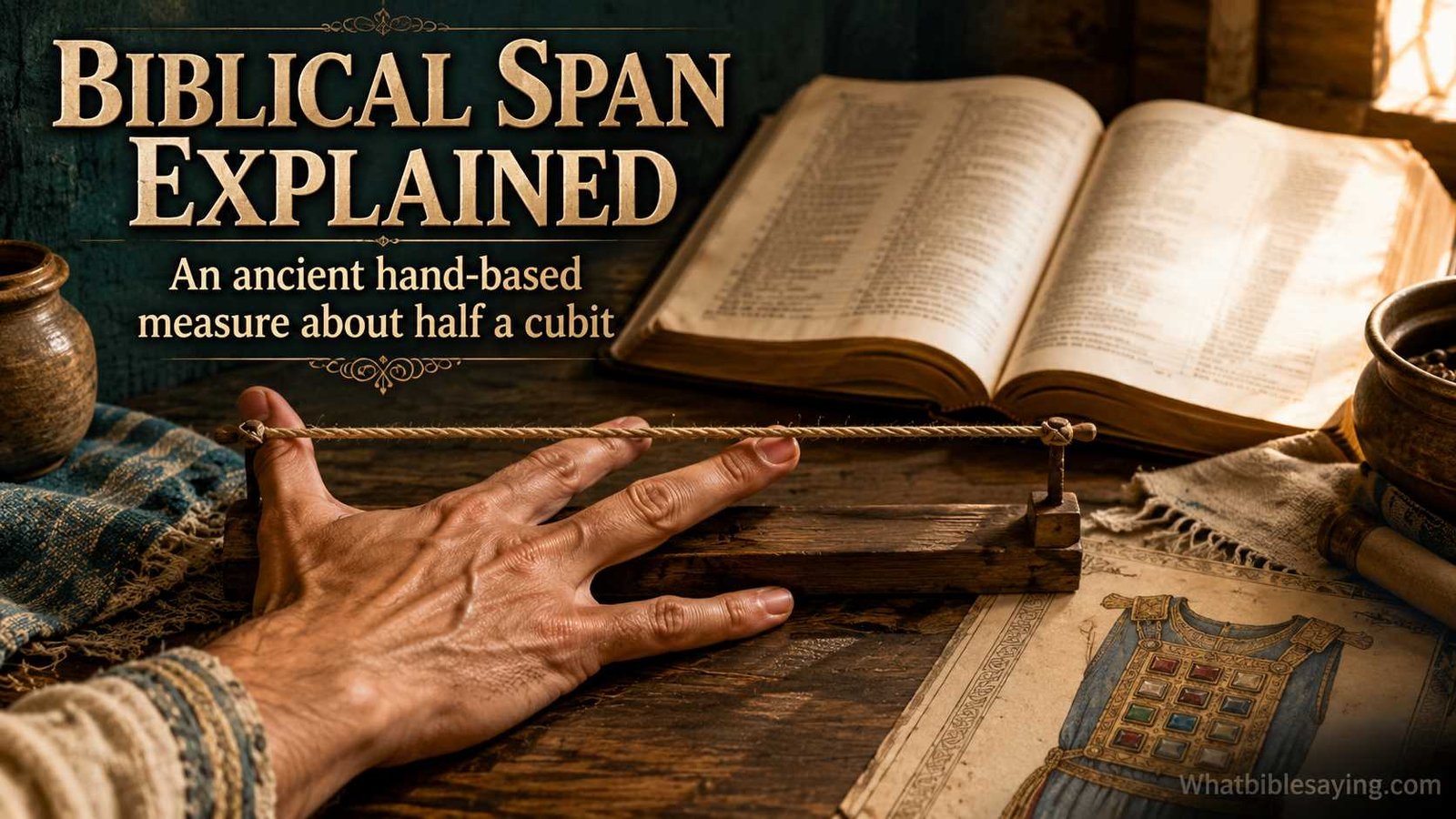
A span in the Bible was an ancient unit of length equal to about half a cubit. It was approximately 9 inches, or about 22 centimeters. It was based on the distance from the tip of the thumb to the tip of the little finger when the hand was stretched open.
That makes a biblical span easy to picture. Spread your hand as wide as you comfortably can. The distance between the outer tips of your thumb and little finger gives you a rough idea of what ancient people meant by a span.
The Bible uses this measurement when describing the high priest’s breastpiece, Goliath’s height, and even the greatness of God.
Understanding this small ancient measurement can make several familiar Bible passages much easier to imagine.
How Long Is a Span in the Bible?
A biblical span was about 9 inches long, which is approximately 22 centimeters.
The English Standard Version gives this approximate measurement directly in its footnote to Exodus 28:16. That verse describes the breastpiece worn by Israel’s high priest as one span long and one span wide.
Here is a simple comparison:
| Biblical Measurement | Approximate Modern Length |
|---|---|
| 1 span | About 9 inches |
| 1 span | About 22 centimeters |
| 1 span | About half a cubit |
| 2 spans | About 1 cubit |
These numbers should be treated as approximate, not as modern engineering measurements.
Ancient people did not normally carry rulers marked in inches or centimeters. Many early measurements were connected to parts of the human body. A cubit was associated with the forearm, while a span was connected with the stretched hand.
A traditional biblical measurement system therefore placed two spans in one cubit. Historical reference works also describe the span as three palms and roughly 9 inches.
So if someone asks, What is the length of a span in the Bible?, the simplest answer is:
A biblical span was roughly 9 inches or 22 centimeters, about half the length of a cubit.
What Was a Biblical Measurement of a Span?
The Hebrew word commonly translated span is zereth.
Biblical Hebrew lexicons describe zereth as a unit of measurement connected with the distance between the thumb and little finger of an outstretched hand. It was approximately half a cubit.
This tells us something important about the ancient world.
People used what was always available to them: their own bodies.
They could estimate shorter distances using fingers, palms, or handbreadths. They could measure something larger with a cubit based on the forearm.
The span fit naturally between these smaller and larger measurements.
Measuring From Thumb to Little Finger
Try this simple exercise.
Hold one hand in front of you.
Stretch your thumb to one side and your little finger to the other.
Now imagine measuring the distance between the two fingertips.
That is the basic idea behind a span.
Of course, one person’s hand is not exactly the same size as another person’s. Ancient societies therefore developed more standardized versions of these measurements over time.
That is one reason modern Bible references normally say a span was about 9 inches instead of claiming that every ancient span was exactly the same length.
How a Span Compared With a Cubit
The span becomes even easier to understand when we compare it with a cubit.
A common biblical cubit is often estimated at roughly 18 inches or 45 centimeters. Bible Gateway’s ESV notes, for example, describe a cubit in 1 Samuel 17:4 as about 18 inches or 45 centimeters.
Since a span was about half a cubit:
1 cubit ≈ 2 spans
That means:
1 span ≈ 9 inches
If biblical measurements interest you, understanding How Big Is a Cubit in the Bible also helps make many descriptions of the tabernacle, temple, Noah’s ark, and other biblical structures easier to picture.
Where Does the Bible Mention a Span?
The word span does not appear everywhere in Scripture, but the places where it does appear are memorable.
Three especially useful examples are found in Exodus, 1 Samuel, and Isaiah.
A Span in Exodus 28:16
One of the clearest examples appears in the instructions for the high priest’s breastpiece.
Exodus 28 describes sacred garments made for Aaron and the priests. The breastpiece was to be carefully made and decorated with precious stones representing the tribes of Israel.
Exodus 28:16 says that it was to be square, with its length and width each measuring one span. The ESV footnote identifies that span as about 9 inches or 22 centimeters.
This gives us a useful picture.
The breastpiece was not a huge object covering the priest’s entire chest. It was a relatively compact square piece, approximately the width of a large outstretched hand in each direction.
Knowing the measurement makes the description much more concrete.
Instead of reading the word span and moving on, we can begin to picture what the garment may have looked like.
The same measurement appears again when the priestly garments are described as completed in Exodus 39.
How Long Is a Span in the Bible When Describing Goliath?
Perhaps the best-known use of a span appears in the story of David and Goliath.
In the Hebrew textual tradition behind translations such as the KJV and ESV, 1 Samuel 17:4 describes Goliath’s height as six cubits and a span.
The important point for our subject is that the span is the smaller measurement added after the cubits.
Think of someone today saying:
“He was six feet and three inches tall.”
Feet give the larger measurement, and inches give the remaining smaller amount.
The biblical description works in a similar way. Cubits provide the larger unit, while the span adds another half cubit.
There is an ancient textual difference concerning the number of cubits in this verse. The ESV footnote notes that the Septuagint, Dead Sea Scrolls, and Josephus preserve four cubits rather than six, and some modern translations reflect that reading.
That textual question does not change the meaning of a span. In either reading, the span remains the smaller ancient unit of length.
Readers who want to understand the larger unit can also study How Long Was a Cubit in the Bible.
Isaiah 40:12 and God’s Span
A very different use appears in Isaiah 40:12.
Isaiah speaks poetically about God measuring the waters in His hand and marking off the heavens with a span.
This is powerful imagery.
A span was something ordinary people understood. They could look at their own hands and know what the word meant.
Isaiah takes that familiar measurement and uses it to show the unimaginable greatness of God.
For a human being, a span can measure only a small object.
In Isaiah’s picture, the heavens themselves are presented as something God can measure.
The verse is not trying to give us the physical dimensions of God’s hand. The language is poetic and meant to show His greatness, authority, wisdom, and power.
The creation that seems overwhelming to us is not overwhelming to its Creator.
That is one reason understanding biblical measurements matters. A technical word can sometimes carry a powerful spiritual picture.
How Big Is 1 Span in Everyday Terms?
Modern readers may find centimeters and inches useful, but sometimes ordinary comparisons make the measurement easier to imagine.
One biblical span was roughly:
- 9 inches
- 22 centimeters
- Half a common cubit
- About the spread of a large adult hand
- Two spans to one cubit
Do not worry if your own stretched hand measures somewhat less or more than 9 inches.
The modern conversion is an estimate of an ancient standardized measure. Your hand is simply a useful visual example.
Imagine the high priest’s breastpiece in Exodus.
Picture a square roughly one span by one span.
Now imagine Goliath’s height being expressed in cubits with another span added.
Then read Isaiah’s description of God marking off the heavens with a span.
Suddenly, the ancient word feels far less mysterious.
Why Biblical Measurements Are Not Always Exact in Modern Units
You may notice that different Bible dictionaries give slightly different modern equivalents for ancient measurements.
That does not necessarily mean one source is careless.
Ancient systems did not always match modern standardized units perfectly. Measurements could also vary by period, location, and the particular standard being used.
The traditional relationship is easier to remember than the exact conversion:
1 cubit = about 2 spans
1 span = about half a cubit
One historical Bible reference lists the span as three palms, about 9 inches, and the cubit as two spans, about 17.6 inches.
The ESV uses about 18 inches for a cubit and about 9 inches for a span.
For ordinary Bible study, that level of precision is enough.
You usually do not need to know whether an object was 8.8 inches or 9 inches wide. The purpose is to understand its approximate size and the picture the biblical author is giving us.
This same principle is useful when studying other ancient measurements, including questions such as How Far Is 15 Furlongs in the Bible or How Much Is a Hin in the Bible. Modern conversions help us visualize the text, but they should not make us forget the ancient setting.
Was a Span the Same as a Handbreadth?
No. A span and a handbreadth were related, but they were not the same measurement.
A handbreadth or palm was smaller.
Traditional biblical measurement tables commonly describe:
- A handbreadth or palm as about 3 inches
- A span as about 3 palms
- A cubit as about 2 spans
That gives us this simple pattern:
3 palms ≈ 1 span
2 spans ≈ 1 cubit
Historical Bible measurement references preserve this basic relationship.
This is useful because the Bible sometimes uses several different body-based units.
Ancient people could move from a small unit such as a finger or palm to a span and then to a cubit.
They did not need a modern measuring tape to understand the basic relationship.
Why Did Ancient People Use the Human Body for Measurements?
Imagine living in a world without mass-produced rulers.
You are building something, buying cloth, describing someone’s height, or giving instructions to a craftsman.
What measuring tool is always with you?
Your body.
Hands, fingers, arms, and steps provided convenient reference points.
This helps explain why several ancient measurements sound anatomical to modern readers.
The span is connected with the hand.
The cubit is associated with the forearm.
The handbreadth is connected with the width of the hand.
These units were practical because people could understand them without carrying special equipment everywhere.
Over time, societies needed standards so that one person’s cubit or span would not constantly conflict with another person’s. Yet the names continued to reflect their body-based origins.
That background makes many Old Testament descriptions feel more natural.
The Bible was written in real historical settings. Its writers used words their first readers understood.
When we learn those words, we enter their world a little more clearly.
How Many Years Is the Span of the Bible?
This question uses the word span in a completely different sense.
When someone asks, “How many years is the span of the Bible?” they are usually asking about a period of time, not the ancient hand measurement called a span.
There are actually several possible questions hidden inside that phrase.
Someone may be asking:
- How many years did it take for the biblical books to be written?
- How much historical time do the events of the Bible cover?
- Does the Bible define a span as a certain number of years?
For the third question, the answer is no.
The measurement called a span is a unit of length, not a unit of years.
When people speak about the Bible being written over a certain “span of years,” they are using the ordinary English meaning of span: a period of time.
The dating and composition of biblical books is a separate subject. Scholars understand the biblical collection as developing over many centuries, and the formation of the Hebrew Bible involved texts composed and collected across a long period.
Because the dating of some early biblical material is debated, it is better not to treat a popular figure such as “1,500 years” as though the Bible itself gives that number.
The Bible does not say, “These books were written over exactly 1,500 years.”
That is a modern estimate based on particular assumptions about the dates of biblical books.
So remember:
Biblical span as a measurement = about 9 inches.
Span of time = simply a period of years, with the exact number depending on what period you mean.
This distinction is similar to understanding phrases such as How Many Years Is a Score in the Bible, where older English vocabulary may create a different kind of measurement question.
Does the Bible Give an Exact Modern Length for a Span?
No Bible verse gives the measurement in inches or centimeters.
Those units belong to much later measurement systems.
When a modern Bible footnote says that a span was about 9 inches or 22 centimeters, translators and scholars are converting an ancient measure into units modern readers recognize.
That distinction matters.
Exodus did not originally say “22 centimeters.”
The Hebrew text used the ancient term zereth.
Modern measurements help us understand what that word represented.
This is similar to translating ancient money, weight, or distance into modern terms. The conversion is useful, but it remains an approximation.
For normal Bible reading, saying about 9 inches or 22 centimeters communicates the meaning clearly without pretending to have more precision than the ancient evidence allows.
What Does a Biblical Span Teach Us About Reading Scripture?
At first, a question about a span may seem like a small detail.
Yet small details often open the door to a clearer understanding of Scripture.
When Exodus says the priestly breastpiece measured a span, we can picture its approximate size.
When 1 Samuel adds a span to Goliath’s height, we understand how the measurement works.
When Isaiah describes God marking off the heavens with a span, the poetic picture becomes stronger because we know how small a human span really is.
That is good Bible study.
We do not study historical details simply to collect facts. We study them because context helps us hear the text more clearly.
A word that seemed strange becomes understandable.
An object becomes easier to picture.
A poetic image gains greater force.
The ancient world becomes less distant.
How Long Is a Span in the Bible? The Simple Answer
If you need one sentence to remember, use this:
A span in the Bible was an ancient length measurement of about 9 inches or 22 centimeters, roughly half a cubit, based on the distance from the thumb to the little finger of an outstretched hand.
You can also remember it with this simple formula:
2 spans ≈ 1 cubit
The Bible uses spans when describing physical dimensions such as the high priest’s breastpiece and Goliath’s height. Isaiah also uses the span poetically to describe God’s greatness.
Seeing Ancient Measurements With New Eyes
The word span reminds us that Scripture came to us through real people living in real places and historical settings.
They measured things differently from us.
They spoke different languages.
Their everyday objects were different.
Yet the message remains understandable.
Sometimes all we need is one small piece of background information.
Now, when you read that the priestly breastpiece was a span wide, you can picture it.
When you read about Goliath being measured in cubits and a span, the wording makes sense.
And when Isaiah says that God can mark off the heavens with a span, you can feel the contrast Isaiah intended: what is impossibly vast to us is completely under God’s authority.
A span may be only about nine inches.
But understanding it can make the world of the Bible feel much closer.

Dr. Rachel is very smart and knows a lot about the Bible. He helps us understand the Bible better by talking about the old texts in a simple way.