

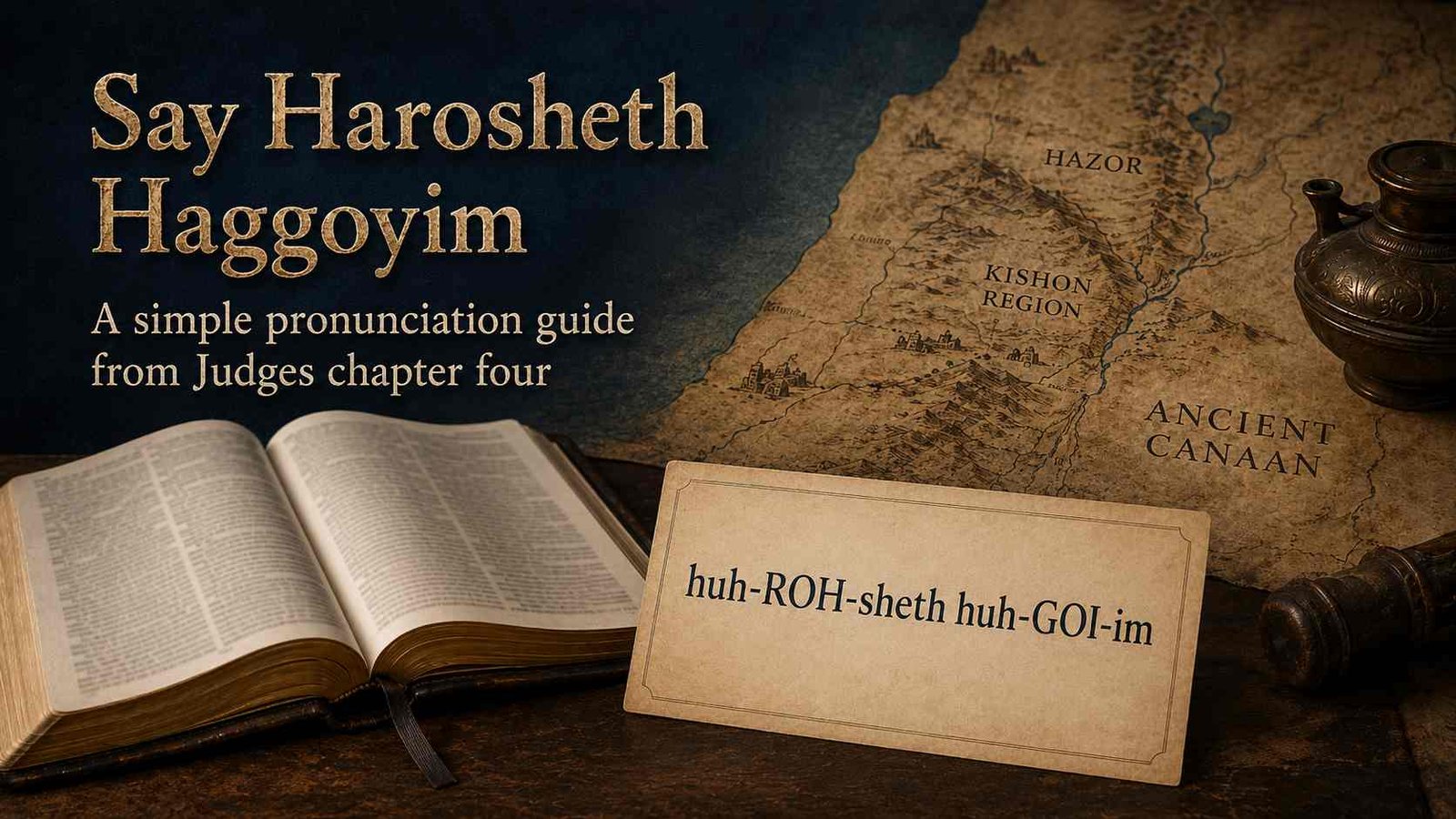
 If you reached Judges 4 and stopped at Harosheth Haggoyim, you are not alone. It is one of those Bible place names that looks much harder to say than it really is.
A simple English-friendly way to pronounce Harosheth Haggoyim is:
huh-ROH-sheth huh-GOI-im
Say it in two parts:
Harosheth: huh-ROH-sheth
Haggoyim: huh-GOI-im
Then put them together slowly:
huh-ROH-sheth | huh-GOI-im
A Hebrew-influenced pronunciation may sound closer to khar-OH-sheth ha-go-YEEM, especially because the first Hebrew sound can have a rough, throat-based sound that ordinary English does not use. Blue Letter Bible gives the pronunciation of the Hebrew name Harosheth as approximately khar-o’-sheth.
So if you hear two slightly different pronunciations, that does not necessarily mean one person is reading the Bible incorrectly. English Bible readers often soften Hebrew sounds.
How To Pronounce Harosheth Haggoyim In The Bible
The easiest way to learn the name is to stop looking at it as one long word.
Break it apart.
| Part | Easy pronunciation | Helpful sound |
|---|---|---|
| Ha | huh / kha | Short opening sound |
| ro | ROH | Like “row” |
| sheth | sheth | Similar to “Seth” with “sh” |
| Ha | huh / ha | Short opening sound |
| goy | GOI | Roughly rhymes with “boy” |
| im | im / eem | Short ending in English; “eem” in Hebrew-style speech |
For an English Bible reading, try:
huh-ROH-sheth huh-GOI-im
For a more Hebrew-shaped pronunciation, you may hear:
khar-OH-sheth ha-go-YEEM
The important point is not to rush through it. Say Harosheth first. Then say Haggoyim. After each part feels natural, join them.
Try this three times:
huh-ROH-sheth
huh-ROH-sheth
huh-ROH-sheth
Then:
huh-GOI-im
huh-GOI-im
huh-GOI-im
Now say:
huh-ROH-sheth huh-GOI-im
That is much easier than trying to pronounce the whole name at first sight.
The same method works for many difficult Bible names. Instead of being embarrassed by a name you do not know, divide it into sounds and practice it slowly.
If biblical names often slow down your reading, our guide to How To Pronounce Hophni In The Bible uses the same simple approach. That article is already part of the pronunciation series on WhatBibleSaying.
How To Pronounce Harosheth Haggoyim In The Bible Slowly
When reading aloud, rhythm matters almost as much as individual sounds.
Try putting a small pause between the two words:
huh-ROH-sheth | huh-GOI-im
The strongest sound in Harosheth falls around ROH in the common English-style pronunciation.
In Haggoyim, give the middle portion enough space so it does not become “hag-im” or “hag-goy.”
Think of it like this:
Ha + ro + sheth
then
Ha + goy + im
You do not have to imitate a perfect modern Hebrew accent to read the passage well. Biblical Hebrew contains sounds that do not match English neatly, so transliterated Bible names naturally develop different pronunciations in different churches, countries, and Bible-reading traditions.
This explains why one audio Bible may sound a little different from another.
The goal is confidence without pretending that every ancient Hebrew sound can be represented perfectly with English letters.
Where Is Harosheth Haggoyim In The Bible?
Harosheth Haggoyim appears in the story of Deborah, Barak, Sisera, and King Jabin in Judges 4.
Judges 4:2 introduces Sisera as the commander of the army of Jabin, king of Canaan, who ruled from Hazor. Sisera was based at Harosheth Haggoyim. Different English translations spell or translate the place name in different ways, including Harosheth-hagoyim, Harosheth Haggoyim, Harosheth of the Nations, and Harosheth of the Gentiles.
This was not simply a random village mentioned once and forgotten.
Harosheth Haggoyim was closely connected with Sisera’s military power.
Judges 4 tells us that Sisera had 900 iron chariots. When the battle approached, he gathered his chariots and troops from Harosheth Haggoyim and moved toward the Kishon River.
That detail helps us picture the story.
Harosheth Haggoyim was the place from which a powerful Canaanite commander brought out his forces. Israel, by contrast, had lived under Jabin’s oppression. Deborah called Barak to act, and the story became one of the most memorable deliverance accounts in the Book of Judges.
After Sisera’s army was defeated, Judges 4:16 says Barak pursued the fleeing forces back toward Harosheth Haggoyim.
So the name appears at important moments in the chapter:
Judges 4:2 — Sisera is associated with Harosheth Haggoyim.
Judges 4:13 — his chariots and soldiers move from Harosheth Haggoyim toward the Kishon.
Judges 4:16 — Barak pursues Sisera’s defeated army toward Harosheth Haggoyim.
Knowing this background makes the name easier to remember. Harosheth Haggoyim is not just a pronunciation exercise. It belongs to the larger biblical account of Deborah and Barak.
What Does Harosheth Haggoyim Mean?
The second part of the name gives us the clearest clue.
The Hebrew word connected with goyim refers to nations or Gentiles. That is why several Bible translations do not simply transliterate the entire name.
The King James Version says:
Harosheth of the Gentiles
Other translations use:
Harosheth of the Nations
Still others preserve the Hebrew-shaped place name:
Harosheth Haggoyim
The Judges 4:2 Hebrew lexicon identifies goy as a word used for a nation or people, and the plural form goyim means nations.
That gives us the general sense behind Haggoyim.
The meaning of Harosheth itself is less certain and should be treated with more care. Some study resources associate the word with woodland or a wooded place, while older discussions have suggested other possible connections. Because the exact origin is debated, it is better not to build a major spiritual lesson on one uncertain English meaning.
This is a useful Bible-study habit.
Sometimes the Bible gives us a clear meaning. Sometimes Hebrew scholarship gives us a likely meaning. And sometimes we simply do not know enough to speak with certainty.
Good Bible study does not need to pretend otherwise.
Why Some Bibles Say Harosheth of the Gentiles
You may open one Bible and see Harosheth Haggoyim, then open another and find Harosheth of the Gentiles.
Nothing has disappeared from the story.
The translators simply made different choices.
One translation may transliterate a Hebrew name. Transliteration tries to carry the sound of the Hebrew word into English letters.
Another translation may translate part of the name so English readers can understand its meaning.
That is why Judges 4:2 may appear as:
Harosheth-hagoyim
Harosheth Haggoyim
Harosheth of the Nations
Harosheth of the Gentiles
BibleHub’s comparison of Judges 4:2 shows several of these forms side by side.
They point to the same biblical place.
This also explains why learning Bible names can feel confusing. We are often reading ancient Hebrew names through English spelling systems that developed much later.
If you enjoy learning difficult biblical place names, How To Pronounce Mahanaim In The Bible is another useful example of a Hebrew place name that becomes much easier once it is divided into syllables.
Is Harosheth Haggoyim the Same as Haggai?
No.
Haggoyim and Haggai may look similar in English, but they are not the same word.
Haggai is the name of a biblical prophet and the name of a short Old Testament book.
A common English pronunciation is:
HAG-eye
A more Hebrew-shaped pronunciation sounds closer to:
khag-GAH-ee
The Hebrew lexicon lists Haggai as Chaggay and gives a pronunciation close to khag-gah’-ee.
Harosheth Haggoyim, however, contains the word connected with goyim, meaning nations.
So remember:
Haggai = a prophet.
Haggoyim = part of the place name Harosheth Haggoyim.
They are not interchangeable.
This is one reason a reader should be careful about guessing Hebrew pronunciation only from English spelling. Two words can look similar in English while having different Hebrew forms and meanings.
How Do You Pronounce Haggai In The Bible?
Since the names are often confused, it helps to practice Haggai separately.
For normal English Bible reading:
HAG-eye
For a pronunciation closer to the Hebrew form:
khag-GAH-ee
The first Hebrew sound is stronger and more guttural than the English letter H. English speakers often soften such sounds because English does not use them in the same way.
Haggai was a prophet, while Harosheth Haggoyim was a place connected with Sisera in Judges.
That simple difference will keep the two names clear in your mind.
How Do You Pronounce Haroset?
Another word that can cause confusion is haroset, more commonly written charoset.
It looks surprisingly close to Harosheth, but it is not the same thing.
Charoset is a traditional food served at the Jewish Passover Seder. The Jewish English Lexicon records pronunciations including:
chah-ROH-sit
and
chah-ROW-set.
Charoset is commonly made as a sweet mixture using ingredients such as fruit and nuts, with recipes varying among Jewish communities. It has a symbolic place in the Passover meal.
Harosheth Haggoyim, by contrast, is an ancient place in the Book of Judges.
So:
Harosheth Haggoyim = biblical place connected with Sisera.
Charoset = Passover food.
They sound somewhat alike because both come to English through Hebrew-related language traditions, but they should not be treated as the same term.
How To Pronounce Hebrew Names In The Bible
Hebrew Bible names often become easier when you follow a few simple habits.
Break the name into pieces
Do not attack the whole word at once.
Harosheth Haggoyim becomes:
Ha-ro-sheth
Ha-goy-im
This immediately reduces the difficulty.
Look for familiar sounds
The goy sound in Haggoyim is easier when you think of a sound close to boy.
The ROH portion of Harosheth is also easy for most English speakers.
Now most of the word is already familiar.
Expect Hebrew sounds to change in English
Hebrew contains guttural sounds made farther back in the throat.
That is why Harosheth may begin with something closer to khar in a Hebrew-oriented pronunciation, while many English readers simply say har or huh. Blue Letter Bible’s lexicon reflects the more guttural form in its pronunciation of Harosheth.
Do not become anxious about accents
An American Christian, British Christian, Hebrew speaker, and reader from another country may not pronounce every Bible name exactly alike.
That is normal.
Language changes when words travel from one language into another.
Your goal should be respectful, informed pronunciation rather than fear of making a small accent difference.
For another New Testament example, see How To Pronounce Clopas In The Bible. WhatBibleSaying also has a guide to How To Pronounce Cephas In The Bible, another name shaped by the languages of the biblical world.
How To Pronounce Harosheth Haggoyim While Reading Judges 4
Sometimes you can pronounce a name alone but stumble when it appears inside a sentence.
The solution is to practice the rhythm of the sentence.
Take the setting of Judges 4:2.
Do not rush toward the difficult name.
Read naturally until you reach it. Then give the place name a little extra space:
Sisera … lived in … huh-ROH-sheth huh-GOI-im.
Now try the setting of Judges 4:13:
from huh-ROH-sheth huh-GOI-im … toward the Kishon River.
By the third or fourth reading, the name will begin to feel normal.
This works because your mind is no longer seeing Harosheth Haggoyim as an unfamiliar wall of letters. It starts hearing the name as a pattern of sounds.
That is one of the best ways to become comfortable reading Scripture aloud.
What Was Happening at Harosheth Haggoyim?
Understanding the story also makes the name easier to remember.
Israel had again fallen into a period of trouble during the era of the judges. Jabin, a Canaanite king associated with Hazor, oppressed Israel, while Sisera commanded his military forces. Judges describes Sisera’s strength in part through his 900 iron chariots.
Deborah served as a judge and prophetess. She called Barak and gave him instructions concerning the coming battle.
Sisera then brought his forces from Harosheth Haggoyim toward the Kishon.
The military situation looked frightening. Iron chariots represented serious power in ancient warfare, and Sisera had hundreds of them.
Yet Judges 4 turns that picture of strength upside down.
Sisera’s army was defeated, Barak pursued the enemy, and the Canaanite military force associated with Harosheth Haggoyim was broken.
That context gives the place name emotional weight.
When an Israelite listener heard Harosheth Haggoyim in this story, the name was connected with power, oppression, battle, and finally defeat.
It reminds us that biblical place names are often more than strange words on a page. They belong to real stories.
Where Was Harosheth Haggoyim Located?
The Bible clearly connects Harosheth Haggoyim with Sisera and the Kishon River region, but its exact archaeological location is not known with certainty.
Bible reference works have proposed locations in northern ancient Israel near the Kishon region, but scholars have not reached a universally certain identification.
That uncertainty should not trouble us.
The biblical narrative itself gives us the information needed to understand Harosheth Haggoyim’s role. It was Sisera’s base and the point from which his forces moved toward the Kishon.
We can understand the story even when modern archaeology cannot place an exact pin on every ancient settlement.
That is another useful distinction in Bible study:
What Scripture clearly says should be stated clearly.
What historians strongly suspect can be described as likely.
What remains uncertain should remain uncertain.
There is no need to turn a possibility into a fact.
How Do You Pronounce God’s Real Name In Hebrew?
People searching for Hebrew pronunciation often move from biblical names to a much larger question: How do you pronounce God’s name in Hebrew?
The personal divine name in the Hebrew Bible is represented by four Hebrew consonants commonly written in English as:
YHWH
These four letters are called the Tetragrammaton.
The pronunciation Yahweh, often represented approximately as YAH-way, is widely used by modern scholars as a reconstruction of the ancient pronunciation. Bible Odyssey identifies Yahweh with the four-letter divine name YHWH.
There is, however, an important difference between scholarly reconstruction and Jewish reading tradition.
For centuries, Jewish readers have traditionally avoided pronouncing the four-letter divine name directly. When Scripture is read aloud, Adonai, meaning Lord, is commonly used. In other settings, HaShem, meaning the Name, is widely used.
For that reason, it is better to avoid saying that we possess absolute certainty about exactly how every ancient Israelite pronounced YHWH thousands of years ago.
A careful summary is:
YHWH = the four-letter Hebrew divine name.
Yahweh = the common scholarly reconstruction.
Adonai = traditional substitute used when reading.
HaShem = the Name, commonly used in Jewish speech.
The subject deserves respect because it touches not only language but also a long religious tradition.
Common Mistakes When Saying Harosheth Haggoyim
Most pronunciation problems come from trying to read the letters too quickly.
Here are several mistakes worth avoiding.
Saying Haggoyim like Haggai
These are different words.
Haggai: HAG-eye.
Haggoyim: huh-GOI-im or Hebrew-influenced ha-go-YEEM.
Dropping the middle of Harosheth
Do not reduce the name to something like Har-sheth.
Keep the middle sound:
Ha-RO-sheth
Confusing Harosheth with charoset
Harosheth Haggoyim is a biblical place.
Charoset is associated with the Passover Seder.
Thinking one English accent is inspired
The biblical text was not originally written with modern American, British, Australian, or Canadian pronunciation.
English pronunciations are approximations of ancient names.
Learning the Hebrew background can improve our reading, but we should not turn small accent differences into a spiritual issue.
An Easy Way to Remember Harosheth Haggoyim
Use this five-second memory method:
ROH + GOI
Those are the two sounds to emphasize in the English-friendly version.
Now build around them:
huh-ROH-sheth
then
huh-GOI-im
Finally:
huh-ROH-sheth huh-GOI-im
You can also connect the name with one person:
Sisera
When you hear Harosheth Haggoyim, think:
Sisera’s base in Judges 4.
Then connect it with one event:
900 iron chariots moving toward the Kishon River.
Pronunciation, person, event.
That gives your mind three ways to remember the name instead of only one.
Reading Difficult Bible Names With Confidence
Bible names can feel intimidating because we rarely use names like Harosheth Haggoyim in everyday conversation.
But there is no reason to skip them.
Names and places help us see that Scripture’s stories happen in settings filled with people, rulers, towns, rivers, journeys, and conflicts.
Harosheth Haggoyim matters because it places us inside the world of Judges 4. It was connected with Sisera, Jabin’s army, the iron chariots, the Kishon region, and the victory associated with Deborah and Barak.
So when someone asks how to pronounce Harosheth Haggoyim in the Bible, the simplest answer is:
huh-ROH-sheth huh-GOI-im
If you want a pronunciation closer to the Hebrew sounds, you may hear something like:
khar-OH-sheth ha-go-YEEM
Neither form should make you afraid to read the passage aloud.
Slow down. Break the name into parts. Practice it two or three times. Then return to the story.
Before long, a name that once looked impossible becomes familiar.
And that is often how Bible study works. What first seems strange becomes clearer when we give it patient attention.

Dr. Rachel is very smart and knows a lot about the Bible. He helps us understand the Bible better by talking about the old texts in a simple way.