

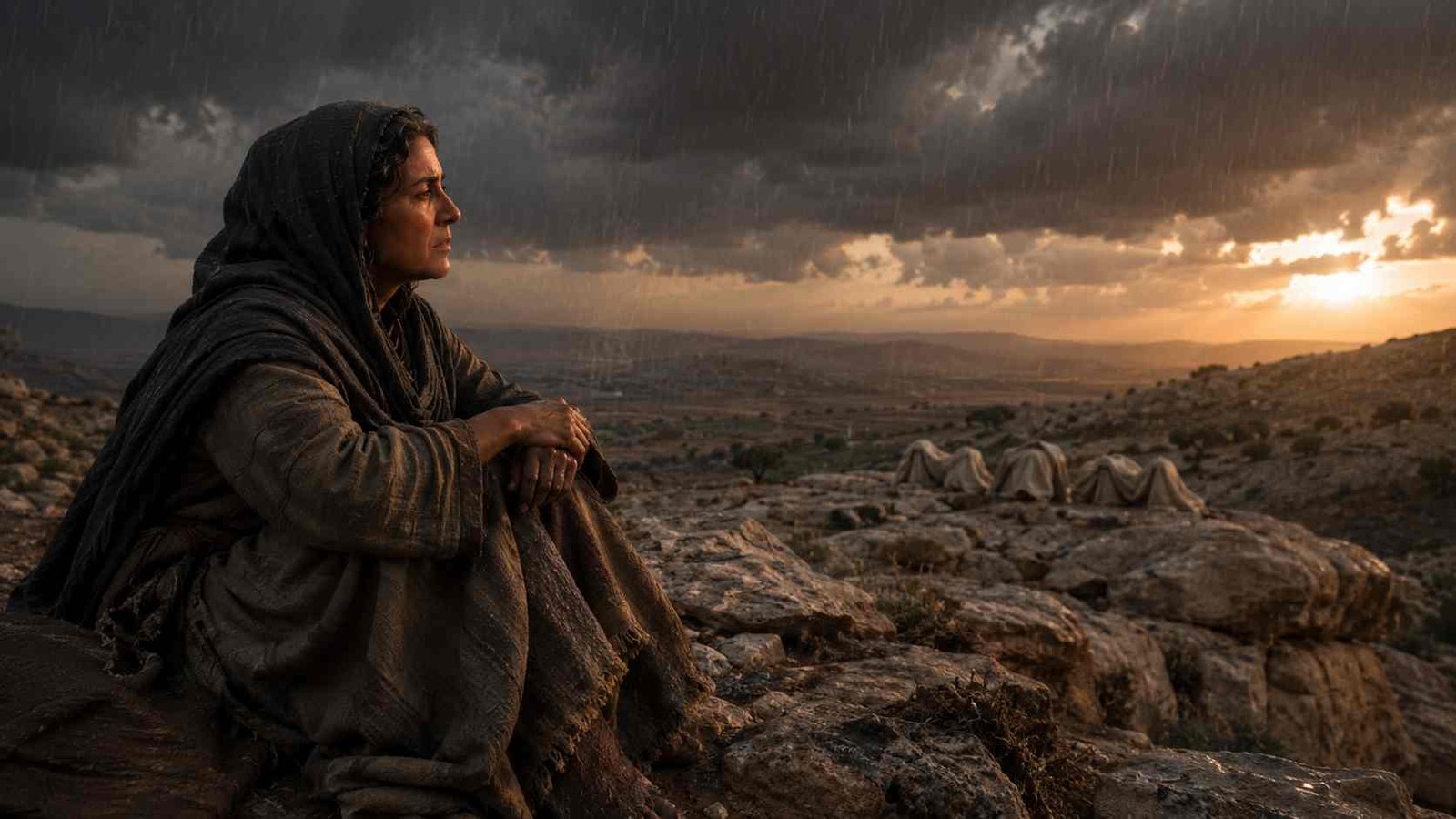
 Rizpah is easy to miss when reading the Old Testament. She was not a queen, prophet, judge, or military leader. She did not give a famous speech. The Bible records no prayer spoken by her. Yet her actions became powerful enough to reach King David and change what happened next.History
So, what can we learn from Rizpah in the Bible?
Rizpah teaches us about faithful love, grief, courage, human dignity, and persistence. When her two sons were killed, she stayed near their bodies and protected them from birds and wild animals. She could not undo their deaths, but she refused to let them be treated without dignity. When David heard what she had done, he acted to give Saul, Jonathan, Rizpah’s sons, and the other dead men an honorable burial.
Her story is mainly found in 2 Samuel 21, although she is first introduced in 2 Samuel 3:7. Her name occurs only four times in Scripture, but those few verses have left a lasting impression.
Rizpah’s story is also difficult. It contains famine, political conflict, death, grief, and questions about justice. We should therefore read it carefully. We should not turn every detail into a spiritual symbol or claim that the Bible says more than it actually does.
When we stay close to the biblical text, the quiet courage of Rizpah becomes even more meaningful.
Who Was Rizpah in the Bible?
Rizpah was the daughter of a man named Aiah and a concubine of King Saul.
The Bible first identifies her in 2 Samuel 3:7:
“And Saul had a concubine, whose name was Rizpah, the daughter of Aiah.”
— 2 Samuel 3:7, KJV
A concubine in the ancient biblical world had a recognized relationship with a man but usually held a lower social position than a primary wife. Rizpah therefore belonged to Saul’s royal household, but she did not possess the power we might associate with a queen.
If you want more background on this ancient practice, the topic what is a concubine in the Bible helps explain why women such as Rizpah could be close to royal power while having very little control over their own circumstances.
Rizpah had two sons by Saul:
- Armoni
- Mephibosheth
This Mephibosheth should not be confused with another man of the same name, Jonathan’s son, whom David had previously treated with kindness.
Rizpah lived through a dangerous period in Israel’s history. Saul and Jonathan had died. David was ruling Judah, while Saul’s son Ish-Bosheth ruled over much of the rest of Israel with the support of Abner, Saul’s military commander.
That political struggle brought Rizpah’s name into the biblical record.
Rizpah and the Dispute Between Abner and Ish-Bosheth
In 2 Samuel 3, Ish-Bosheth accused Abner of sleeping with Rizpah.
This was much more serious than a private family dispute.
In the ancient royal world, taking a dead king’s concubine could be understood as a challenge involving royal authority. Similar political meaning can be seen elsewhere in the Old Testament when possession of a king’s wives or concubines becomes connected with claims to the throne.
Abner became furious over the accusation and soon promised to transfer his political support to David.
But there is an important detail we should not miss: the Bible records Ish-Bosheth’s accusation, but it does not clearly tell us whether the accusation was true.
We should therefore avoid saying with certainty that Abner slept with Rizpah. Some later writers and dictionaries go further than the biblical text does. The safer reading is simply that Ish-Bosheth accused him and that Abner reacted strongly.
Rizpah does not speak during this entire dispute.
Men argue about power, loyalty, and kingship, while she becomes part of their conflict.
That makes what happens later even more striking.
What Happened to Rizpah’s Sons?
Rizpah disappears from the story until 2 Samuel 21.
By then, David is king over Israel, and the country is suffering from a famine that has lasted three years.
David seeks the Lord concerning the famine. According to 2 Samuel 21:1, the crisis is connected with Saul’s bloodshed against the Gibeonites.
The background reaches back to Joshua 9.
Long before Saul became king, Israel had made a sworn agreement with the people of Gibeon. Although the agreement began under unusual circumstances, Israel’s leaders had given their oath that the Gibeonites would not be destroyed.
Saul later violated that obligation by attacking them.
When David asked the surviving Gibeonites how the wrong could be addressed, they refused silver or gold. Instead, they asked for seven male descendants of Saul to be handed over.
David agreed.
Among those seven were Rizpah’s sons, Armoni and Mephibosheth. The other five came from another branch of Saul’s family.
The Gibeonites killed the seven men at the beginning of the barley harvest and exposed their bodies on a hill. 2 Samuel 21:8–10 identifies Rizpah’s sons and describes what happened afterward.
It is a painful passage.
The Bible often tells the truth about human suffering without making the story comfortable for us.
Two Men Named Mephibosheth
Readers sometimes become confused because 2 Samuel 21:7 says David spared Mephibosheth, while the next verse says a man named Mephibosheth was handed over to the Gibeonites.
There is no contradiction. They were two different men.
Mephibosheth son of Jonathan was Saul’s grandson. David spared him because of the covenant between David and Jonathan.
Mephibosheth son of Saul and Rizpah was Saul’s son. He was one of the seven handed over to the Gibeonites.
Remembering the different fathers makes the passage much easier to understand.
What Can We Learn From Rizpah In The Bible About a Mother’s Love?
After the deaths, Rizpah did something extraordinary.
Second Samuel 21:10 says she took sackcloth and spread it on a rock. She remained there from the beginning of harvest until rain came. During the day, she kept birds away from the bodies. During the night, she kept wild animals away.
Scripture does not record her shouting at David.
It does not record her gathering an army.
It does not record her delivering a public speech.
She simply stayed.
That quiet action gives us one of the strongest pictures of a mother’s devotion in the Old Testament.
Love Remains When It Cannot Change the Past
Rizpah could not bring her sons back.
She could not reverse David’s decision.
She could not change what Saul had done years earlier.
She could not control the Gibeonites.
But there was still something she could do.
She could remain near her sons and protect their bodies from further dishonor.
This is one reason her story connects so naturally with the broader question of what the Bible says about mothers.
Love does not always have the power to fix everything.
A parent may not be able to remove a child’s illness. A friend may not be able to erase another person’s grief. A husband or wife may not be able to repair every painful event.
But love can still remain.
Sometimes the most faithful thing we can do is stay present.
Faithful Love Is Seen in Action
Rizpah’s love was not only a feeling.
It required effort.
Imagine the heat of the day, the darkness of the night, the loneliness of the hillside, and the repeated work of driving away animals.
The Bible gives no record of someone sharing this burden with her.
She remained because the people lying there were not simply political names to her. Two of them were her sons.
Faithfulness often looks like this.
It is not always dramatic. It may mean caring for an aging parent, sitting beside someone in a hospital, comforting a grieving friend, keeping a promise when it becomes difficult, or continuing to do what is right when few people notice.
This is closely connected with the biblical meaning of faithfulness. True faithfulness continues when love becomes costly.
What Can We Learn From Rizpah In The Bible About Grief?
Rizpah’s story does not hide grief.
She took sackcloth, a material strongly associated with mourning in the biblical world, and spread it on the rock.
Then she stayed with her sorrow.
The Bible does not rebuke her for grieving deeply.
That matters.
Sometimes people feel they must recover from grief quickly to prove that they have faith. Rizpah’s story does not support that idea.
Grief can be long.
Grief can be visible.
Grief can change our routines.
Grief can make us sit with questions that have no easy answers.
Biblical Grief Does Not Have to Be Hidden
Throughout Scripture, faithful people mourn openly.
Abraham mourned Sarah.
Jacob mourned Joseph when he believed his son had died.
David mourned Jonathan.
Job expressed deep anguish.
Jesus Himself wept at the tomb of Lazarus.
Grief is not automatically a sign of weak faith.
The Bible does not tell us everything Rizpah thought or felt, so we should not place words in her mouth. But her actions make one thing clear: she refused to act as though the deaths of her sons meant nothing.
Her grief honored their value.
For readers walking through loss, what the Bible says about death and mourning offers the same important reminder. Faith does not demand that we pretend pain is painless.
Pain and Faith Can Exist Together
Rizpah’s story does not give us a simple explanation for every kind of suffering.
It should not.
The Bible never teaches us to look at every tragedy and decide that we know exactly why God allowed it.
Second Samuel 21 gives a particular reason for the famine in that particular historical situation. We should not turn it into a universal rule.
If a family experiences illness, unemployment, an accident, drought, or bereavement today, we should not assume God is punishing them for some hidden sin.
Scripture contains many examples, especially the book of Job, showing why such quick judgments can be wrong.
When considering what the Bible says about suffering, Rizpah reminds us that faithfulness can exist even when life contains questions we cannot easily answer.
What Is the Significance of Rizpah in the Bible?
The significance of Rizpah becomes especially clear in 2 Samuel 21:11:
David heard what she had done.
That is the turning point.
Rizpah had no throne, army, or official position. Yet her actions reached the king.
When David learned about her vigil, he took steps concerning the dead members of Saul’s family.
Years earlier, after Saul and Jonathan died in battle, the Philistines had displayed their bodies at Beth-shan. Brave men from Jabesh-gilead recovered them and buried their remains.
Now David retrieved the bones of Saul and Jonathan from Jabesh-gilead.
He also gathered the remains of the seven men who had been killed by the Gibeonites. Saul, Jonathan, and the seven were then buried in the tomb of Saul’s father Kish.
The chapter closes by saying:
“And after that God was intreated for the land.”
— 2 Samuel 21:14, KJV
The biblical sequence is important. Rizpah kept watch. David heard. David arranged the burial. Then the chapter records that God answered prayer concerning the land.
We should be careful not to claim more than the passage says. The text does not directly quote God saying, “I acted because of Rizpah.” But the writer clearly places Rizpah’s vigil between the deaths and David’s decision to honor the dead.
Her actions mattered.
Rizpah Defended Human Dignity
In the ancient biblical world, proper burial carried great importance. Being left exposed to birds and wild animals was associated with disgrace.
Rizpah could not prevent her sons from dying, but she could prevent animals from tearing at their remains.
That was an act of dignity.
It reminds us of a simple biblical truth: human lives should not become mere numbers.
News reports may tell us that hundreds or thousands have died in a war, earthquake, famine, or disaster. Numbers are necessary, but each number represents someone who had a name, family, memories, hopes, and people who loved them.
Rizpah saw sons where political leaders could easily see only members of Saul’s house.
That is part of her lasting significance.
Quiet Actions Can Influence Powerful People
Rizpah apparently did not have direct access to David’s throne.
Yet David eventually heard about her.
Her conduct became a message.
Many people assume influence belongs only to those with money, status, education, or public authority. Rizpah challenges that belief.
You may never speak before a government.
You may never lead thousands.
You may never become famous.
But faithfulness still has influence.
A parent influences children.
A teacher influences students.
A caregiver influences a family.
A faithful friend can change someone’s darkest day.
The Bible repeatedly shows God working through people whom society might overlook.
Rizpah belongs among them.
What Can We Learn From Rizpah In The Bible About Persistence?
Rizpah stayed from the beginning of the harvest until rain fell from heaven.
Some commentators have tried to turn this into an exact period of three months, five months, or another estimate based on ancient agricultural seasons.
The Bible itself does not give an exact number.
That distinction matters.
What Scripture emphasizes is not a calendar calculation but the length and determination of her vigil. She continued through days and nights until conditions changed.
Her persistence teaches several practical lessons:
- Do what remains possible.
Rizpah could not change the past, but she could decide what she would do in the present. - Do not confuse quietness with weakness.
She did not need political authority for her actions to matter. - Protect human dignity.
She treated the dead as people worthy of honor. - Faithfulness may require endurance.
Some good work lasts longer than we expect. - Do not assume nobody notices.
Eventually, news of Rizpah reached David.
Persistence does not mean that Christians will always receive the exact outcome they want.
Rizpah’s sons did not return to life.
The Bible offers something more serious than a promise of easy results. It shows that doing what is loving and honorable still matters, even when we cannot control the ending.
Rizpah’s Story and the Difficult Question of Justice
Second Samuel 21 should not be treated as an easy passage.
Saul attacked the Gibeonites.
Years later, seven of Saul’s descendants were handed over and killed.
That naturally raises questions about responsibility and justice.
Elsewhere, Scripture teaches that children should not simply be executed for the crimes of their parents. Deuteronomy 24:16, for example, says fathers should not be put to death for their children, nor children for their fathers.
How, then, should we understand 2 Samuel 21?
The chapter does not give us every piece of information we might want.
It speaks about Saul and his “bloody house,” but it does not provide biographies of the seven men or tell us clearly whether they participated in Saul’s actions. The text also comes from an ancient setting where family, kingship, covenant responsibility, and national life were understood more corporately than they usually are today.
Scholars and Christian interpreters have proposed different explanations.
Because Scripture does not settle every question for us, humility is wiser than pretending there is no difficulty.
The safest lesson is not that descendants should be punished for an ancestor’s wrongdoing. Rather, the story shows how destructive injustice can spread across generations and how serious broken covenant obligations were in Israel’s history.
This is one reason a wider study of what justice means in the Bible is helpful. Biblical justice should be understood from the whole witness of Scripture, not from one difficult historical event alone.
What We Should Not Assume From Rizpah’s Story
Rizpah’s story does not give Christians permission to make harmful conclusions about suffering.
We should not teach that:
- children today should be punished for their parents’ sins;
- every famine, illness, or disaster is direct punishment from God;
- people who suffer must have committed some hidden sin;
- grief always produces the outcome we desire;
- revenge is the proper Christian response to injustice;
- every detail in Rizpah’s story should become a spiritual symbol.
The passage describes a unique event in Israel’s history.
Good Bible reading asks first, “What does the text actually say?” before asking, “How can I apply it to my life?”
That protects us from turning a serious biblical story into something Scripture never intended.
What Is the Spirit of Rizpah?
The phrase “spirit of Rizpah” sometimes appears in modern Christian sermons and devotional teaching.
It is important to understand what that phrase means and what it does not mean.
The Bible never names a supernatural being called “the spirit of Rizpah.”
It also never gives a doctrine called “the Rizpah spirit.”
When modern preachers use the phrase, they usually mean a Rizpah-like attitude of persistence, parental devotion, prayer, courage, or refusing to give up on loved ones. For example, contemporary sermons have used “The Spirit of Rizpah” as a devotional picture of parents persistently praying for their children.
That can be a useful illustration if it is clearly described as an application rather than a biblical term.
The actual biblical text focuses on what Rizpah did.
She mourned.
She stayed.
She protected.
She endured.
Her example can encourage persistent love, but we should not create a spiritual doctrine that Scripture itself never gives.
How Many Times Is Rizpah Mentioned in the Bible?
Rizpah’s name appears four times in the Bible, all in 2 Samuel.
Bible concordances list these four occurrences.
| Bible Reference | What We Learn About Rizpah |
|---|---|
| 2 Samuel 3:7 | Rizpah is identified as Aiah’s daughter and Saul’s concubine. |
| 2 Samuel 21:8 | Her sons are named Armoni and Mephibosheth. |
| 2 Samuel 21:10 | She guards the bodies from birds and wild animals. |
| 2 Samuel 21:11 | David hears what Rizpah has done. |
Only four direct mentions.
Yet those four verses are enough to make her one of the Bible’s memorable examples of a grieving mother’s determination.
That alone is worth thinking about.
A person’s importance in Scripture is not measured simply by how many verses mention them.
What Can We Learn From Rizpah In The Bible Today?
Rizpah lived thousands of years ago, but the human experiences in her story are still familiar.
Parents still worry about children.
Families still grieve.
People still feel powerless when decisions are made above them.
Political conflicts still leave ordinary families suffering.
And many people still wonder whether small acts of love make any difference.
Rizpah’s answer comes through action rather than words.
Be Present With People Who Grieve
When someone is hurting, we often search for the perfect sentence.
Sometimes there is no perfect sentence.
Rizpah reminds us of the power of presence.
When a friend has lost someone, sitting nearby may matter more than explaining why the loss happened.
Listen.
Remember the person’s name.
Bring a meal.
Help with ordinary tasks.
Pray when prayer is welcomed.
Do not pressure people to stop grieving before they are ready.
Compassion often begins by staying near.
Protect the Dignity of Vulnerable People
Rizpah protected people who could no longer protect themselves.
That principle reaches far beyond burial.
Christians can care about the dignity of children, widows, older adults, people living in poverty, refugees, people with disabilities, grieving families, and others whose voices may be ignored.
We do not need to be powerful before we can treat someone with honor.
Human dignity begins with seeing a person as a person.
Do Not Underestimate Faithful Persistence
There must have been moments when Rizpah’s vigil appeared useless.
The men were already dead.
The political decision had already been made.
Yet she continued.
Then David heard.
That does not mean persistence always changes a king or government. Scripture never promises that.
It means faithful action is still worthwhile even when the result is outside our control.
Do the next right thing.
Then do it again when necessary.
Let Grief Make Us More Compassionate
Pain can close our hearts, but it can also deepen them.
Someone who has experienced loss may become more sensitive to another grieving family.
Someone who has struggled financially may become more generous toward people in need.
Someone who has felt overlooked may become the person who notices others.
Rizpah did not allow the political meaning of her sons’ deaths to erase their human meaning.
We can learn to do the same.
What Rizpah Teaches Us About Faithful Love
When asking what can we learn from Rizpah in the Bible, the answer is not that she possessed some mysterious power.
Her strength was far more human and, in some ways, more moving.
She loved.
She grieved.
She stayed.
She guarded what remained.
And eventually, the king heard.
Rizpah could not control Saul’s past actions. She could not control the Gibeonites. She could not control David’s first decision. She could not command the rain to fall.
She simply refused to treat her sons as though their lives no longer mattered.
That is why her few verses still speak so strongly.
Her story teaches us that grief deserves compassion, human dignity matters, faithful love can endure terrible circumstances, and people without public power can still influence what happens around them.
It also teaches us to read difficult Bible stories carefully. We do not have to invent easy answers where Scripture leaves questions open. Faithful Bible study can acknowledge pain while still listening for truth.
Perhaps that is one of Rizpah’s deepest lessons.
When you cannot change yesterday, ask what love requires of you today.
When you cannot control the outcome, remain faithful in what you can control.
When someone is suffering, do not reduce that person to a problem, statistic, or inconvenience.
And when grief comes, remember that mourning does not make faith meaningless.
Rizpah’s story is short, but her vigil is difficult to forget.
A woman with little social power stood on a lonely hillside and defended the dignity of those she loved.
The king eventually heard.
And Scripture remembered her name.

Dr. Rachel is very smart and knows a lot about the Bible. He helps us understand the Bible better by talking about the old texts in a simple way.