

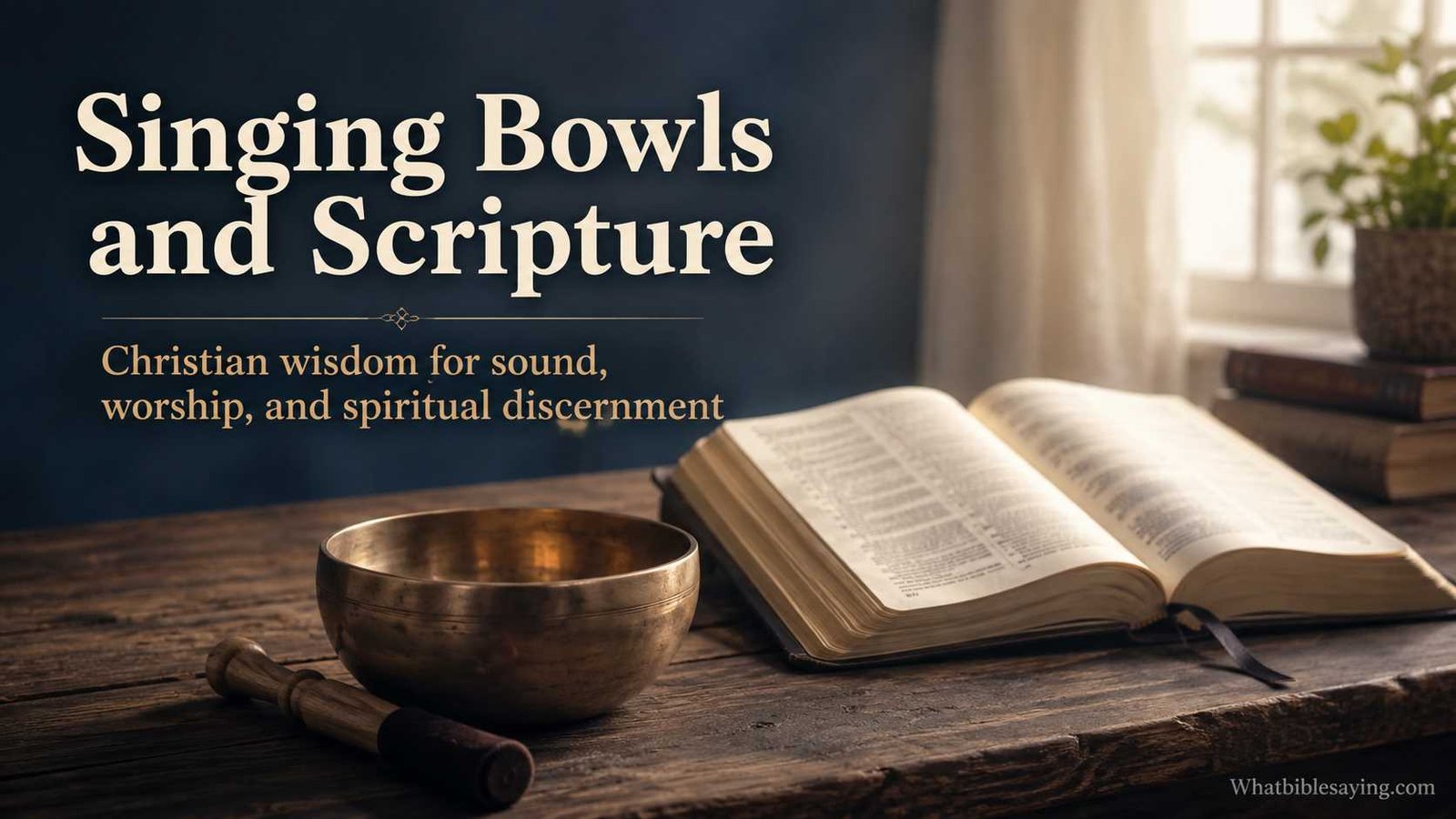
 A singing bowl can make a gentle, ringing sound that many people find peaceful. Today, these bowls may appear in meditation sessions, wellness centers, yoga spaces, sound baths, or private homes. Because they are sometimes connected with spiritual practices, Christians naturally ask an important question: What does the Bible say about singing bowls?
Here is the clearest answer first.
The Bible does not mention modern singing bowls, Tibetan singing bowls, sound baths, or spiritual sound healing by name. Scripture does mention many kinds of bowls, and it also speaks often about music, worship, prayer, idolatry, spiritual practices, and Christian discernment. Those passages give us useful principles for deciding how a Christian should think about singing bowls.
A metal bowl is not automatically holy, sinful, or spiritually powerful. What matters greatly is how it is being used, what a person believes about it, and whether the practice directs the heart toward God or toward another source of spiritual power.
That distinction helps us approach the subject without fear and without making claims the Bible itself never makes.
Bible Insights on Singing Bowls and Spiritual Use: What Scripture Actually Says
When Christians discuss a modern spiritual practice, it is important to separate three things:
- What the Bible directly says.
- What biblical principles may apply.
- What people have added through tradition or personal belief.
Singing bowls belong mostly to the second category.
You will not find a verse saying, “Do not use a singing bowl.” You will also not find a verse telling Christians to use bowls for meditation, healing, prayer, spiritual cleansing, or connecting with God.
That means we should be careful with absolute statements.
Saying that every singing bowl is demonic goes further than Scripture goes. But saying that every spiritual use of a singing bowl is harmless can also ignore biblical warnings about worship, idolatry, divination, and spiritual practices outside devotion to God.
Christian wisdom asks a better question:
What am I actually doing with this object, and what spiritual meaning am I giving it?
Are Singing Bowls Mentioned in the Bible?
Modern singing bowls are not specifically described in Scripture.
The Bible contains many references to bowls, cups, basins, dishes, cymbals, trumpets, harps, and other objects. Yet none of those passages describes the modern practice of striking or rubbing a metal bowl to produce a sustained tone for meditation or a sound bath.
For example, Exodus 25 describes bowls used with the sacred furnishings of the tabernacle. These were practical worship vessels associated with offerings, not musical meditation bowls.
This distinction matters.
Simply finding the word bowl in a Bible passage does not mean the passage is talking about a singing bowl.
What Does the Bible Say About Sound Bowls?
The phrase sound bowl does not appear as a biblical category either.
Scripture certainly recognizes the power of sound. People sing, shout, pray, play instruments, blow trumpets, use cymbals, and praise God with music.
Psalm 150 is one of the clearest examples. It calls for praise with trumpet, harp, lyre, strings, pipe, and cymbals. The emphasis of the psalm is not that one musical frequency is more spiritual than another. The repeated focus is praise directed toward God.
That gives us an important principle:
Sound itself can be beautiful and meaningful, but the Bible places the spiritual focus on the One being worshiped, not on the supposed spiritual power of an instrument.
This connects closely with the broader question of what the Bible says about singing. Biblical singing is repeatedly connected with praise, thanksgiving, remembrance, joy, sorrow, and prayer.
What Is the Spiritual Significance of Singing Bowls?
This question needs two different answers because there is a difference between modern spiritual beliefs about singing bowls and biblical teaching.
Today, singing bowls are often used during meditation and relaxation practices. Researchers have also studied singing-bowl sessions for possible effects on stress, mood, heart rate, blood pressure, and emotional well-being. A 2024 review discussed possible psychological and physiological responses, while more recent research has continued examining stress-related effects.
That research should be understood carefully.
If a person feels calmer after hearing a slow, resonant sound, that does not prove the bowl contains spiritual energy. A physical or emotional response to sound is different from a supernatural claim.
Music can affect emotion. Quiet environments can help people settle down. Repeated sounds may help someone focus. None of those observations automatically shows that a particular vibration cleanses spiritual energy, opens a spiritual center, removes sin, communicates with spirits, or gives access to God.
Those are much larger religious claims.
Sound and Relaxation Are Not the Same as Spiritual Power
Suppose you sit beside the ocean and find the sound of waves calming.
You probably would not conclude that the ocean has forgiven your sins.
In the same way, a pleasant tone from a bowl may help someone relax without proving that the bowl possesses spiritual authority.
This distinction protects Christians from two mistakes.
The first is fear. We do not need to imagine that every unfamiliar object contains hidden supernatural power.
The second is spiritual confusion. We should not assign divine powers to an object simply because an experience feels peaceful.
Christian faith teaches us to seek God rather than treating created things as sources of spiritual salvation or authority.
Why the Purpose Behind the Practice Matters
The setting changes the question.
A person may hear a singing bowl in a piece of music and think nothing more about it. Another person may deliberately use the same bowl in a ritual designed to contact spirits, manipulate spiritual forces, practice divination, or participate in the worship of another deity.
Those situations are not spiritually identical.
Scripture gives direct warnings concerning divination, sorcery, mediums, spiritists, and attempts to consult the dead. Deuteronomy 18:9–12 lists such practices among things Israel was commanded to avoid.
Paul also tells Christians in 1 Corinthians 10 to flee idolatry. His concern is not fear of ordinary material objects. His concern is participation in worship that competes with devotion to God.
So the biblical issue is deeper than the shape of a bowl.
It is about worship, trust, allegiance, and spiritual participation.
What Do Bowls Represent in the Bible?
There is no single biblical meaning for every bowl.
This is important because internet discussions sometimes treat biblical symbols as if each object always has one secret spiritual definition. Scripture does not work that way.
A bowl can serve one purpose in one passage and represent something very different in another.
Bowls Used in Worship and Sacred Service
In Exodus 25:29, bowls were included among the vessels connected with the table in the tabernacle. They were made of gold and used in sacred service, including the pouring out of offerings.
Numbers 7 also describes silver sprinkling bowls among the offerings brought by Israel’s leaders for the dedication of the altar.
These bowls were not presented as objects that created spiritual energy through sound.
Their importance came from their place within the worship God had commanded Israel to practice.
This is useful when thinking about what bowls represent in the Bible. Sometimes a bowl is simply a vessel used for a specific sacred purpose. We should not automatically turn every physical item in Scripture into a mystical symbol.
Golden Bowls and Prayer in Revelation 5:8
One of the most beautiful bowl images appears in Revelation 5.
John sees the living creatures and twenty-four elders before the Lamb. They hold harps and golden bowls filled with incense. Revelation 5:8 directly identifies the incense with the prayers of God’s people.
This is rich symbolic imagery.
But notice what the passage does not say.
The bowls are not making sounds that produce spiritual healing. They are not being struck as instruments. Their importance comes from what they contain in John’s vision: incense connected with prayer.
The passage therefore should not be used as proof that modern singing bowls are biblical.
It teaches something much more beautiful: the prayers of God’s people matter before God.
This also connects with biblical teaching about incense. Readers interested in that subject may also find what the Bible says about burning incense helpful because Scripture’s use of incense should not automatically be equated with every modern spiritual use of incense.
The Seven Bowls of Revelation
Revelation later uses bowls in a completely different way.
Revelation 16 begins with seven angels being commanded to pour out seven bowls associated with God’s wrath and judgment.
Now compare the images:
In Revelation 5, golden bowls contain incense connected with the prayers of God’s people.
In Revelation 16, bowls are connected with judgment.
This alone shows why Christians should be cautious about statements such as, “A bowl always symbolizes prayer,” or, “A bowl always represents blessing.”
Biblical symbols gain meaning from their context.
There is no universal spiritual formula saying that every bowl represents the same thing.
Bible Insights on Singing Bowls and Spiritual Use in Christian Worship
A Christian may still wonder, “Could I use a singing bowl simply as a musical instrument?”
The Bible gives us no direct command about that exact object.
What Scripture does show clearly is that musical sound itself can be used in worship.
Psalm 150 mentions a wide variety of instruments, including loud and resounding cymbals. Its closing command is that everything that has breath should praise the Lord.
So Christianity is not a faith that rejects musical sound.
The central question is where the worship is directed.
The Bible Welcomes Music and Sound in Worship
Throughout Scripture, God’s people use voices and instruments in praise.
Sound can express joy. It can help a community sing together. It can accompany thanksgiving. It can mark celebration and solemn moments.
This is why the related question what is worship in the Bible matters so much.
Biblical worship is not mainly about producing the correct tone or reaching a special frequency. Worship involves honoring God, trusting Him, loving Him, obeying Him, and recognizing who He is.
An instrument may assist worship.
It does not become the object of worship.
An Instrument Is Not Automatically a Spiritual Authority
Think about a guitar.
A guitar can be played during Christian worship. It can also be played during a completely secular event. The wood and strings do not determine the spiritual meaning of everything happening around them.
The purpose matters.
The beliefs involved matter.
The same careful reasoning can help with a singing bowl.
A Christian does not need to believe that a metal object possesses independent spiritual power merely because someone else uses it religiously.
At the same time, Christians should not ignore the meaning of a ritual when an object is being deliberately used as part of that ritual.
Context matters.
Is It Okay for Christians to Use Singing Bowls?
There is no verse that directly says Christians may or may not own or strike a singing bowl.
So a careful answer is:
Using a bowl simply to create a sound is not specifically forbidden in Scripture. Using it as part of idolatry, divination, spirit contact, or a religious practice that transfers trust away from God raises a very different biblical concern.
That distinction comes from broader biblical principles, not from a verse specifically written about singing bowls.
Paul’s teaching in 1 Corinthians is useful here. He recognizes that a physical object associated with pagan worship is not itself another god, while at the same time strongly warning believers against actual participation in idolatrous worship.
Christian discernment therefore asks more than, “Is this object allowed?”
It asks, “What am I participating in?”
Ask What You Believe the Bowl Is Doing
Before using a singing bowl, a Christian can ask a few simple questions:
- Do I believe this bowl contains spiritual power?
- Am I using it only because I enjoy its sound?
- Am I expecting a frequency to cleanse my spirit?
- Is another deity, spirit, or spiritual force being invoked?
- Is this part of worship that conflicts with my faith in God?
- Am I treating an object as necessary for reaching God?
- Does using it trouble my conscience?
- Can I participate while keeping my trust centered on Christ?
These questions move the discussion away from superstition and toward spiritual clarity.
Christian Freedom Does Not Remove Christian Discernment
Romans 14 discusses disagreements among believers over disputable matters, especially food and the observance of days. Paul tells Christians not to despise or condemn one another carelessly over such matters.
Romans 14 was not written about singing bowls, so we should not pretend that it directly settles this modern question.
Still, the chapter offers helpful principles concerning conscience.
A Christian should not violate a troubled conscience simply to prove freedom. Neither should a Christian create new biblical commandments where Scripture has not given them.
This requires humility.
One believer may decide, “I do not want anything connected with this practice in my home.”
Another may hear the sound of the same type of bowl in music without attaching any spiritual significance to it.
Instead of quickly judging motives, Christians can return to Scripture and ask what kind of worship and belief is actually involved.
Bible Insights on Singing Bowls and Spiritual Use: A Simple Discernment Test
When Scripture does not name a modern object directly, five questions can help.
1. Scripture
Does the practice clearly contradict something God has already revealed?
For example, Scripture directly warns against idolatry, divination, sorcery, and attempts to consult spirits or the dead.
If a singing-bowl ritual includes those things, the problem is no longer merely the bowl.
The practice itself conflicts with biblical teaching.
2. Purpose
Why are you using it?
There is a difference between appreciating a sound and believing the sound has the power to save, cleanse sin, reveal the future, manipulate spiritual forces, or connect you with spiritual beings.
Purpose often reveals what is happening in the heart.
3. Belief
What do you believe about the object?
If you begin trusting a bowl, crystal, frequency, incense, charm, or another created object for spiritual protection or power that belongs to God, the deeper issue is misplaced trust.
This principle can also help readers studying what the Bible says about burning sage or similar modern spiritual practices.
4. Worship
Who or what receives your spiritual attention?
First Corinthians 10 makes worship allegiance a serious matter. Paul tells believers to flee idolatry and refuses to treat participation in competing worship as spiritually neutral.
Christian worship is centered on God.
5. Conscience
Can you do this with a peaceful and faithful conscience before God?
Do not ignore sincere conviction simply because another person feels differently.
At the same time, examine whether your fear comes from Scripture or merely from rumors about an object.
Christian discernment should be shaped by truth rather than superstition.
Test What You Hear and Practice
First Thessalonians 5:21 gives believers a useful principle: test everything and hold on to what is good.
That is a balanced approach.
Christians do not need to accept every spiritual claim because it sounds peaceful or ancient. Neither do they need to panic whenever they encounter something unfamiliar.
Test the claim.
Ask what it means.
Compare it with Scripture.
Look at where it directs your trust.
A statement such as “This sound helps me feel calm” is very different from “This frequency removes spiritual darkness from my soul.”
Those claims belong to different categories and should not be treated as though they are the same.
Keep Christ at the Center
Colossians 2:8 warns believers not to be taken captive by hollow or deceptive philosophies that draw them away from Christ. The passage then emphasizes spiritual fullness in Christ.
This gives Christians a strong center.
The goal is not to spend life frightened by objects.
The goal is to remain rooted in Christ.
Whenever a spiritual teaching suggests that you need a special vibration, secret technique, object, hidden knowledge, or spiritual force in order to become complete, it is reasonable for a Christian to ask whether that claim is drawing trust away from Christ.
This principle also relates to questions such as what the Bible says about praying to the universe and what the Bible says about spirits.
Christian prayer is directed to God. Christian hope rests in God. Christian spiritual life is not built around controlling invisible energies.
What About Singing Bowls Used Only for Relaxation?
This may be the hardest practical question.
Imagine someone says:
“I do not worship the bowl. I do not believe it contains spiritual energy. I simply like the sound because it helps me relax.”
The Bible does not directly address that situation.
Scientific research has explored singing-bowl meditation and has reported possible benefits involving relaxation, stress, mood, and other psychological or physiological measures. At the same time, research in this area has limitations, and a 2025 systematic review noted differences among studies and a limited evidence base.
So it is reasonable to distinguish a relaxation response from a supernatural claim.
Feeling calmer does not prove a spiritual doctrine.
For Christians, that distinction can remove unnecessary fear while preserving biblical discernment.
If the bowl is simply producing a sound, that fact is different from participating in a ritual in which the sound is believed to summon spiritual power.
Can Christians Use Singing Bowls During Prayer?
This question deserves extra care because prayer is an act of faith.
The Bible presents prayer as communication with God. Revelation 5 even uses the beautiful image of golden bowls of incense representing the prayers of God’s people.
But that vision does not teach that Christians need bowls in order to pray.
You do not need a certain sound frequency for God to hear you.
You do not need a vibration to make prayer spiritually effective.
You do not need a bowl to enter God’s presence.
If someone happens to hear quiet music or a soft sound while praying, that is different from believing that the sound itself creates access to God.
The danger begins when a helpful object becomes spiritually necessary in our minds.
Christian prayer should remain dependent on God rather than on a technique.
When a Christian May Decide to Avoid Singing Bowls
There are situations in which avoiding a singing bowl practice may be a wise and simple choice.
You may decide not to participate when:
- The bowl is being used explicitly in worship directed toward another deity.
- The ceremony calls upon spirits or spiritual guides.
- The practice includes divination or attempts to contact the dead.
- You are being taught that the bowl has supernatural authority.
- You are encouraged to trust frequencies instead of God for spiritual cleansing.
- The practice seriously troubles your conscience.
- Participating would communicate support for worship you do not actually believe.
Deuteronomy 18 gives clear biblical boundaries concerning divination, sorcery, mediums, and communication with the dead.
The point is not that Christians should be afraid of metal.
The point is that Christians should take worship seriously.
Does a Singing Bowl Open the Door to Spirits?
The Bible does not say that striking a metal bowl automatically opens a spiritual doorway.
That claim should not be presented as biblical fact.
Scripture does warn strongly against deliberately seeking spirit contact, mediums, divination, and occult practices.
Those are actions and spiritual choices.
So if a person is using a singing bowl as part of a deliberate attempt to contact spirits, the biblical concern comes from the attempted spirit contact, not from a teaching that the shape or metal of the bowl automatically creates a portal.
That distinction matters because Christians should resist both occult practices and superstition.
Faith does not require us to invent spiritual dangers Scripture never identifies.
What This Teaches Us About Sound, Worship, and Faith
So, is it okay for Christians to use singing bowls?
There is no biblical verse that gives a simple yes or no about the modern object itself.
The Bible does not identify singing bowls as Christian worship instruments, spiritual healing tools, demonic objects, or sources of divine power.
Instead, Scripture gives us principles.
Sound can be beautiful. Psalm 150 even celebrates loud and varied musical instruments used in praise to God.
Bowls can also carry different meanings depending on biblical context. Some served practical sacred purposes. Revelation 5 connects golden bowls of incense with prayer, while Revelation 16 uses bowls in a vision of judgment.
That means we should not build a theology of singing bowls simply from the word bowl.
Here is what matters most:
The Bible does not tell Christians to fear a metal bowl. Neither does it teach Christians to seek spiritual power from one.
If you enjoy a peaceful sound, do not automatically confuse relaxation with spiritual revelation.
If someone tells you that a frequency can cleanse your soul, connect you with spiritual beings, replace prayer, or give you hidden spiritual power, examine that claim carefully.
Test what you hear.
Keep what is good.
Reject what turns your worship away from God.
And keep Christ, not an object, at the center of your spiritual life.
That is a safer and more biblical path than either fear or unquestioning acceptance.

Dr. Rachel is very smart and knows a lot about the Bible. He helps us understand the Bible better by talking about the old texts in a simple way.