
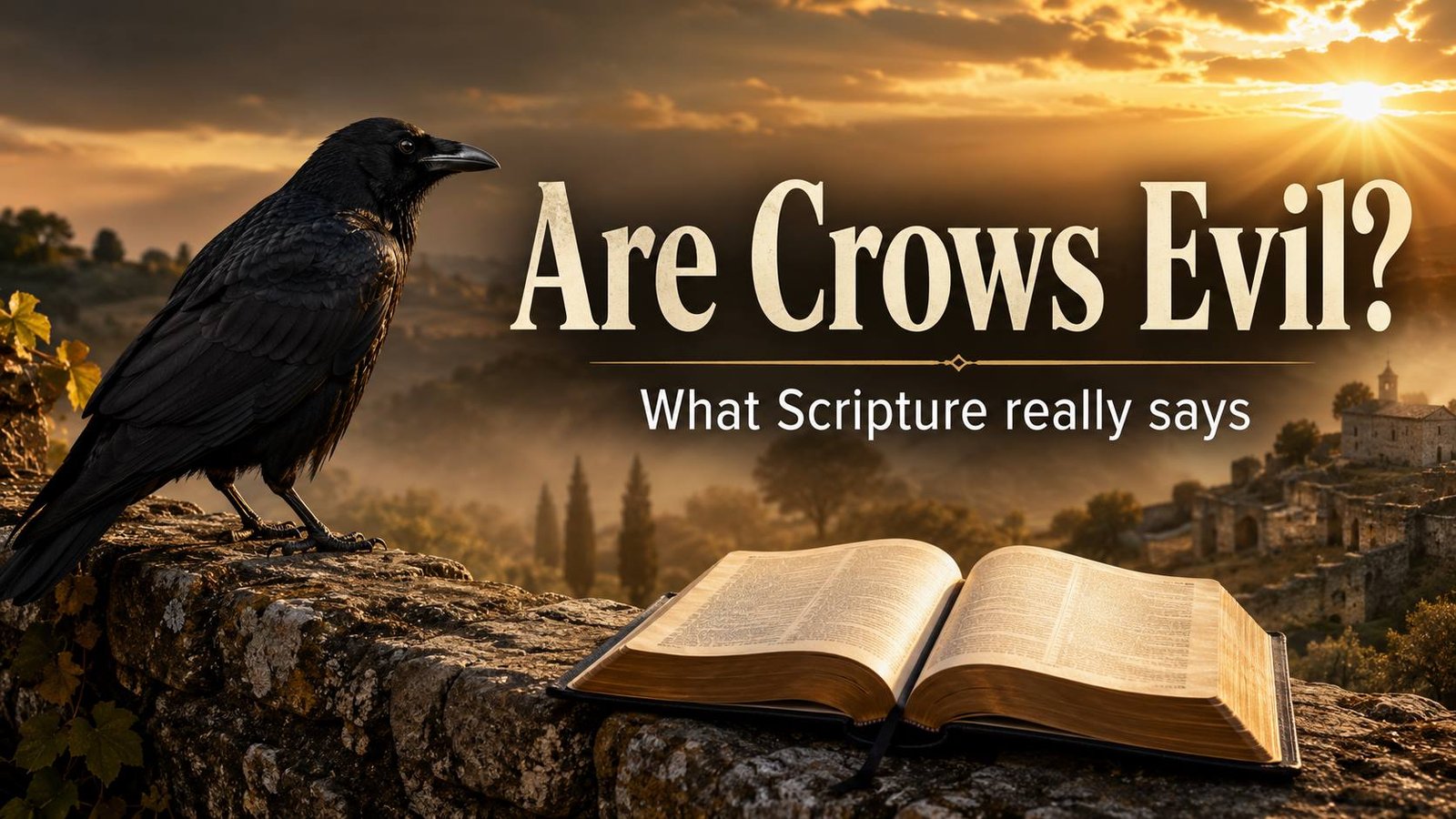
 No, crows are not evil in the Bible.
That is the simple answer. The Bible does not teach that crows are demons, evil spirits, bad omens, or cursed creatures. In fact, most Bible passages do not use the word “crow” directly. They usually speak about the raven, a close bird in the same family as crows. Some Bible translations even use “crows” in Luke 12:24, where Jesus says God feeds them.
That matters.
Because if Jesus uses ravens or crows to teach us about God’s care, then we should be careful before calling them evil.
Crows can look mysterious. Their dark feathers, sharp calls, and habit of eating dead things can make people feel afraid. In many cultures, people connect black birds with death, bad luck, or spiritual danger. But the Bible does not ask us to build our faith on fear. It asks us to listen to God’s Word.
In Scripture, ravens are called unclean birds under Old Testament food laws. Leviticus 11:15 and Deuteronomy 14:14 say Israelites were not to eat ravens. But “unclean” does not mean “evil.” It means they were not permitted as food for Israel under the law of Moses.
That is a big difference.
A bird can be unclean for eating and still be part of God’s creation. A bird can appear in scenes of judgment and still not be a demon. A bird can remind us of death and still teach us about God’s provision.
So when someone asks, “Are crows evil in the Bible?” the best biblical answer is this: No. Crows and ravens are not evil in Scripture. They are unclean birds in Old Testament law, but God also uses them to show His care, command, and provision.
Are Crows Evil in the Bible or Just Unclean Birds?
To understand this topic, we need to separate two words: unclean and evil.
In the Bible, “evil” is about sin, rebellion, wickedness, and opposition to God. Evil is moral. It belongs to choices, hearts, spirits, and actions that go against God.
“Unclean” is different. In many Old Testament passages, unclean refers to ritual or dietary status. Some animals were clean for Israel to eat. Others were not. Some conditions made a person ritually unclean for a time. That did not always mean the person had sinned.
Ravens were included among birds Israel was not allowed to eat. Leviticus 11 lists several birds that were forbidden as food, including “any kind of raven.”
That does not mean the raven was spiritually evil.
Think of it this way. Pork was also forbidden under Old Testament food laws, but pigs were not demons. Certain sea creatures were forbidden, but they were not evil spirits. The food laws helped Israel live as a holy and distinct people. They taught separation, obedience, and worship.
The raven’s unclean status likely connects with its diet. Ravens and crows are scavenger birds. They may eat dead animals. In the world of Israel’s purity laws, contact with death often carried uncleanness. That made ravens a fitting example of an unclean bird.
But God is still Creator over ravens.
The same Bible that calls ravens unclean also says God feeds them. Job 38:41 and Psalm 147:9 both connect ravens with God’s care.
So the Bible does not say, “Fear the raven.”
It says, in effect, “Look and learn. Even this small, wild, unclean bird is not forgotten by God.”
That is a powerful lesson.
If you are writing or reading more about this, a helpful related topic is what does it mean to be unclean in the Bible, because many people misunderstand that word. In Scripture, uncleanness is often about worship boundaries, not about a creature being morally wicked.
What Does God Say About the Crow and Raven?
The Bible gives several important pictures of ravens. These pictures are not all the same, but together they show a balanced view.
God sees ravens.
God feeds ravens.
God commands ravens.
God uses ravens.
In Job 38:41, God asks Job who provides food for the raven when its young cry out. The point is not that ravens are scary. The point is that God cares for creatures that humans often ignore.
Psalm 147:9 says God gives food to the animals and to the young ravens that cry. Again, the focus is God’s mercy over creation.
Then Jesus speaks about ravens in Luke 12:24. He tells His listeners to consider the ravens. They do not sow. They do not reap. They do not have barns. Yet God feeds them. Then Jesus says people are worth much more than birds.
This is one of the clearest answers to the question, “What does God say about the crow?”
God says, in simple terms:
“Look at them. I feed them. You are worth more.”
That is not a message of fear.
That is a message of comfort.
Jesus could have chosen a beautiful dove, a singing bird, or a clean animal. But He chose the raven. That is meaningful. He chose a bird many people might overlook or dislike. He used that bird to teach anxious hearts about trust.
So when you see a crow or raven, you do not need to think, “Something bad is coming.” A Christian response can be much healthier:
God cares for even this bird.
God sees even small things.
God will not forget me.
That is the heart of Luke 12:24.
Are Crows Biblically Evil?
No, crows are not biblically evil.
The Bible never says that crows are Satanic. It never says they are demons. It never says they carry curses. It never tells believers to fear them.
What the Bible does show is more layered.
Ravens appear near judgment. Noah sends out a raven after the flood in Genesis 8:7. The raven flies back and forth until the waters dry from the earth.
That scene comes after a great judgment, so some people connect the raven with death or desolation. But the text does not call the raven evil. It is simply the first bird Noah sends out.
Ravens also appear in harsh poetic images. Proverbs 30:17 uses ravens in a warning picture about dishonoring parents. Isaiah 34:11 includes ravens in a scene of desolation after judgment. These images are serious, but they still do not mean the bird itself is evil.
The Bible often uses animals symbolically.
A lion can picture danger, but Jesus is also called the Lion of Judah.
A snake can picture evil, but Moses lifted up a bronze serpent in the wilderness.
A dove can picture peace, but doves were also ordinary birds used in sacrifices.
So we should not flatten biblical symbols into one meaning.
A raven can appear in a scene of judgment.
A raven can be listed as unclean.
A raven can feed Elijah by God’s command.
A raven can teach us not to worry.
All of those can be true at once.
That is why the question “Are crows biblically evil?” needs a careful answer. They may carry dark or serious symbolism in some contexts, but Scripture does not define them as evil creatures.
What Is a Crow in the Bible?
When modern readers ask about crows in the Bible, they are usually asking about ravens.
Crows and ravens are related birds. They belong to the corvid family. They are intelligent, dark-feathered, vocal birds. In normal speech, people often group them together. Some Bible translations use “ravens,” while a few render Luke 12:24 in a way that says “crows.” BibleHub shows translations where Luke 12:24 is rendered with “ravens” in many versions and “crows” in some simpler translations.
The common biblical word behind “raven” in the Old Testament is connected with the Hebrew word often written as orev. In the New Testament, Luke 12:24 uses the Greek word korax, meaning raven.
For a normal reader, the important point is simple:
When the Bible talks about ravens, it is very close to the question people ask about crows.
So if someone asks, “What is a crow in the Bible?” the answer is: it usually points to the raven, a dark scavenger bird mentioned in important Bible passages such as Genesis 8, Leviticus 11, 1 Kings 17, Job 38, Psalm 147, and Luke 12.
The Bible does not focus on the bird’s mystery. It focuses on what God does with it.
And God’s action is the key.
Noah, Elijah, and the Raven in Scripture
Two major Old Testament stories help us understand ravens clearly: Noah and Elijah.
The first is Noah.
After the flood, Noah sent out a raven. Genesis 8:7 says the raven went out and flew back and forth until the waters dried up. Then Noah sent out a dove. Many sermons focus on the dove because it returns with an olive leaf later. But the raven comes first.
The raven’s role is connected with the world after judgment. It flies over waters, death, and a changing earth. Still, the Bible does not condemn the raven. It simply tells us what happened.
The second story is Elijah.
In 1 Kings 17, the prophet Elijah speaks of drought. God then sends him to the brook Cherith. There, God commands ravens to bring him bread and meat in the morning and evening. BibleHub notes the unusual point clearly: even an unclean bird becomes God’s obedient servant when the Creator commands it.
This story is beautiful because it surprises us.
God could have sent an angel.
God could have sent a wealthy supporter.
God could have sent another prophet.
Instead, God sent ravens.
That tells us something about God. He is not limited by human expectations. He can use what people would not choose. He can provide through an unlikely source.
If Elijah had judged the ravens by fear, he might have missed God’s provision. But Elijah received what God sent.
That is a strong lesson for faith.
Sometimes God’s help does not arrive in the shape we expected. It may come through a person, place, delay, or situation we would never have chosen. But if God commands it, He can use it.
Why God Used Ravens to Feed Elijah
The Elijah story answers the fear around crows and ravens better than almost any other passage.
Ravens were unclean birds under the law. They were scavengers. They were not animals a prophet would naturally look to for holy help.
Yet God used them.
This does not make uncleanness meaningless. It shows that God is Lord over all creation. He can command the clean and the unclean. He can rule over kings, storms, widows, animals, and wilderness places.
Elijah was alone.
The land was dry.
The brook was temporary.
The future looked uncertain.
But every morning and evening, food came.
Through ravens.
That is not a picture of evil. It is a picture of God’s power.
The ravens did not become Elijah’s savior. God was Elijah’s provider. The ravens were only the means God used.
That distinction matters for us too.
We should not worship animals.
We should not fear animals as omens.
We should not treat birds as spiritual rulers.
God alone is Lord.
The raven in 1 Kings 17 points away from superstition and toward trust.
Are Crows Evil Spirits?
No. Crows are not evil spirits according to the Bible.
There is no Bible verse that says a crow is a demon. There is no passage that teaches a crow carries a dead person’s soul. There is no command telling Christians to fear crows as spiritual attackers.
Some people may feel afraid when a crow lands near their house or calls loudly. That fear often comes from culture, family stories, movies, or local superstition. But Christian faith must be shaped by Scripture, not fear.
The Bible does speak about evil spirits. It speaks about demons. It speaks about spiritual warfare. But it does not identify crows or ravens as evil spirits.
This is important because fear can grow quickly.
A person sees a crow.
Then they remember a scary story.
Then they wonder if God is warning them.
Then anxiety takes over.
But the Bible gives a steadier path.
Jesus says God feeds the ravens. He does not say they are evil spirits.
So if you are asking, “Are crows evil spirits?” the answer is no. A crow is a bird. A raven is a bird. They are part of God’s creation. Like all creation, they live under God’s authority.
A related topic worth linking here is what does the Bible say about superstitious beliefs, because this question often comes from fear of omens. The Christian life is not built on signs from birds. It is built on God’s Word, prayer, wisdom, and trust in Christ.
Why Dark Birds Can Feel Scary to People
It is still understandable why crows make some people uneasy.
Crows are dark.
They are loud.
They are smart.
They gather in groups.
They often appear near roads, fields, or dead animals.
Because of that, many cultures have treated them as signs of death or bad luck. Stories, poems, and films have made that feeling stronger.
But culture is not the same as Scripture.
The Bible does not deny that ravens can appear in hard scenes. They are connected with wilderness, hunger, death, and judgment in some passages. But the Bible also places them under God’s care.
This gives us a better way to think.
A crow may remind us that the world is fallen. Death exists. Creation groans. Not every image in nature feels soft and peaceful.
But the same crow can also remind us that God feeds what we forget.
That is how faith changes our view.
Fear says, “This bird is a bad sign.”
Faith says, “My Father sees every creature.”
Fear says, “Something evil is near.”
Faith says, “God is greater than what I feel.”
This does not mean we become careless or strange about animals. It simply means we do not let superstition rule our minds.
What Crows Can Teach Us About God’s Care
Crows and ravens can teach us several simple lessons.
First, God cares for overlooked creatures.
Most people do not admire ravens the way they admire doves or eagles. Yet God speaks about feeding them. This shows that God’s care is wider than human preference.
Second, God provides daily.
Ravens do not build barns. Jesus says they do not sow or reap, yet God feeds them. This does not mean people should be lazy. The Bible honors work. But it does mean worry should not rule us.
Third, God can use unlikely means.
The ravens that fed Elijah were not the expected helpers. Yet they came by God’s command. That reminds us not to limit God to our preferred methods.
Fourth, God values people even more.
Jesus did not say, “You are equal to the ravens.” He said people are worth much more than birds. If God feeds ravens, He surely sees His children.
That is deeply comforting.
When you feel forgotten, remember the ravens.
When you feel anxious, remember Luke 12:24.
When help comes in an unexpected way, remember Elijah.
When life feels like a flood has passed over you, remember Noah watching for dry ground.
God is not absent.
A helpful internal topic here is what does the Bible say about animals, because the Bible gives animals a meaningful place in creation. They are not equal to humans, but they are not worthless. They belong to the world God made.
A Gentle Answer for Anyone Afraid of Crows
Some readers come to this question because they are truly afraid.
Maybe a crow keeps appearing near your home.
Maybe you heard that crows mean death.
Maybe someone told you they are evil spirits.
Maybe you saw one after a painful event, and now your heart connects the bird with fear.
Here is the gentle answer: you do not need to be afraid of crows.
The Bible does not tell you to fear them. It does not say they control your future. It does not say they bring curses. It does not say they are demons.
Your life is in God’s hands, not in the wings of a bird.
That does not mean every bird image in Scripture is cheerful. Some are serious. Some are connected to warning or judgment. But no crow has power over the child of God.
If you belong to Christ, your hope is not fragile. It is not broken by a bird call. It is not threatened by a shadow in the sky. It is held by the Lord who made heaven and earth.
So when fear rises, pray simply:
“Lord, help me trust Your Word more than my fear.”
That is enough for the moment.
Quick Biblical Answers
| Question | Simple Biblical Answer |
|---|---|
| Are crows evil in the Bible? | No. The Bible does not call crows or ravens evil. |
| Are crows biblically evil? | No. Ravens are unclean under Old Testament food laws, but not morally evil. |
| Are crows evil spirits? | No. Scripture never identifies crows as demons or evil spirits. |
| What does God say about the crow? | The Bible says God feeds ravens and uses them to teach trust. |
| What is a crow in the Bible? | It usually connects with the raven, a related bird mentioned several times in Scripture. |
| Why were ravens unclean? | They were forbidden as food for Israel, likely connected with purity laws and scavenging habits. |
What This Teaches Us About Faith
The Bible gives us a calmer view of crows and ravens than superstition does.
They are not evil spirits.
They are not masters of fate.
They are not signs that Christians must fear.
They are birds under God’s rule.
Yes, ravens were unclean under Old Testament law. Yes, they sometimes appear in dark or serious scenes. But God also fed them, noticed their young, used them to feed Elijah, and placed them in the mouth of Jesus as a lesson about trust.
That should shape our answer.
Are crows evil in the Bible? No. They are part of God’s creation, and Scripture uses ravens to remind us that God provides even in lonely, dry, and frightening places.
So the next time you see a crow, you do not have to think of evil.
You can remember Elijah by the brook.
You can remember Jesus teaching anxious people.
You can remember that God feeds the ravens.
And you can rest in this truth: you are worth much more than birds.

Dr. Rachel is very smart and knows a lot about the Bible. He helps us understand the Bible better by talking about the old texts in a simple way.