

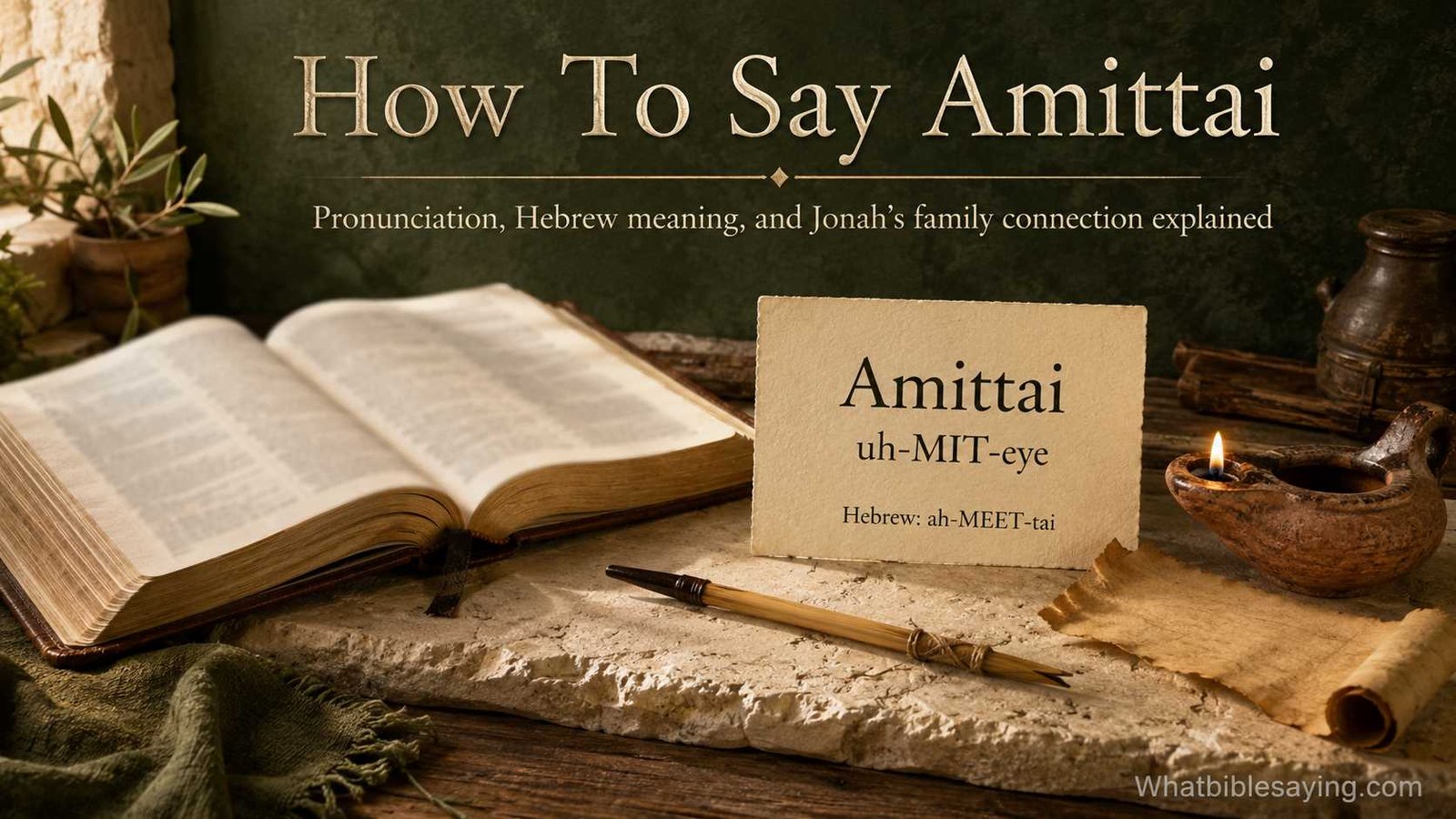
 If you have reached the opening verse of Jonah and stopped at the name Amittai, you are not alone. Some Bible names look much harder to pronounce than they really are.
A common English pronunciation of Amittai is:
uh-MIT-eye
Say it slowly at first:
uh + MIT + eye
Then bring the sounds together:
uh-MIT-eye
Dictionary.com gives the American pronunciation as uh-MIT-eye, with the main stress on the middle syllable.
You may also hear pronunciations that sound somewhat different, especially when teachers try to follow the Hebrew form more closely. Strong’s Hebrew pronunciation guide represents the name approximately as am-it-tah’ee.
So if two careful Bible readers pronounce Amittai a little differently, that does not necessarily mean one of them has completely misunderstood the name.
More important, Amittai is not simply a difficult Bible name. He was the father of the prophet Jonah, and his name is connected with the Hebrew idea of truth. Scripture mentions him briefly in 2 Kings 14:25 and Jonah 1:1.
Understanding the name helps us read those passages with more confidence.
How To Pronounce Amittai In The Bible
For most English Bible readers, the easiest way to pronounce Amittai is:
uh-MIT-eye
The strongest part is MIT.
Think of the name in three simple pieces:
| Part | Sound |
|---|---|
| A | uh |
| mit | MIT |
| tai | eye |
| Full name | uh-MIT-eye |
Do not try to say every letter with the same strength. The middle part should stand out.
Say it several times:
uh-MIT-eye
uh-MIT-eye
Amittai
After a few repetitions, the name usually feels much more natural.
This is useful when reading Jonah aloud in church, during family Bible study, or in your own quiet reading time. You do not need to rush over a name simply because it looks unfamiliar.
Biblical names become easier when you break them into small sounds.
If you often struggle with names like this, learning how to pronounce Bible names by syllables can make Scripture reading much less intimidating. Many names that look complicated become simple once you know where the stress belongs.
How Do I Pronounce Amittai Naturally?
The best way is not to stare at all the letters at once.
Start with:
uh
Then:
MIT
Then:
eye
Now put them together:
uh-MIT-eye
The name should flow as one word rather than three separate words.
Try this simple practice:
- Say MIT-eye.
- Add the soft opening sound: uh-MIT-eye.
- Repeat the full name three or four times.
- Read it inside the phrase Jonah son of Amittai.
That last step is especially helpful because names often become easier when we hear them in a sentence.
You could say:
Jonah, son of uh-MIT-eye.
Once you can say the phrase smoothly, you will probably remember the pronunciation the next time you see the name.
There is no need to feel embarrassed if you have pronounced it differently before. Biblical names have passed from Hebrew into Greek, Latin, English, and many other languages. Pronunciation naturally changes across languages and regions.
The goal is to read carefully and understand the person and passage.
How To Pronounce Amittai In The Bible From the Hebrew
Here is where the pronunciation becomes a little more interesting.
The Hebrew spelling of Amittai is:
אֲמִתַּי
It is commonly transliterated as Amittay or Amittai. Strong’s Hebrew entry gives the phonetic spelling approximately as am-it-tah’ee.
That is not exactly the same as the common American English uh-MIT-eye.
Why?
Because transliteration is not the same thing as pronunciation.
When a Hebrew name is written with English letters, translators are trying to represent sounds from one language using the alphabet of another language. That process is never perfectly exact.
English speakers also develop traditional ways of saying Bible names.
Think about familiar names such as:
- Isaiah
- Jeremiah
- Elijah
- Zechariah
- Jerusalem
An English-speaking Christian may pronounce these names differently from a Hebrew speaker, yet everyone can still understand which biblical person or place is meant.
Amittai works in a similar way.
If you are reading an English Bible aloud, uh-MIT-eye is a clear and recognized pronunciation.
If you are studying biblical Hebrew, you may hear a pronunciation closer to the Hebrew transliteration.
Both situations should be understood in their proper context.
Why Do Biblical Names Have Different Pronunciations?
The Bible was not originally written in English.
Most of the Old Testament was written in Hebrew, with some portions in Aramaic. The New Testament was written in Greek.
When those texts moved into other languages, names had to move with them.
That means a biblical name may have:
- an ancient Hebrew pronunciation
- a Greek form
- a Latin form
- a traditional English pronunciation
- slightly different pronunciations in Britain, America, Australia, and other English-speaking regions
This is why you sometimes hear two pastors pronounce the same Old Testament name differently.
It does not always mean that one person is careless.
Pronunciation traditions can differ.
The safest approach is simple: use a recognized pronunciation, understand the biblical identity of the person, and do not let fear of a difficult name keep you from reading Scripture aloud.
The same method is useful when learning names and places such as Arabah, Abinadab, Cephas, or Mahanaim.
What Does the Name Amittai Mean in the Bible?
The name Amittai is connected with the Hebrew idea of truth.
Strong’s Hebrew lexicon gives the short meaning true and connects the name with the Hebrew word associated with truth.
Dictionary.com gives the etymological meaning my truth.
You may therefore see Amittai explained in several similar ways:
- true
- truthful
- faithful
- my truth
These meanings are closely related, although different dictionaries may choose different English words.
Behind the name is an idea of something that is reliable, true, or faithful.
That makes Amittai an interesting biblical name, especially because he is the father of Jonah, a prophet whose story deals so strongly with God’s word, obedience, judgment, mercy, and truth.
Still, we should be careful.
The Bible does not tell us that Amittai was given this name because of a special prophecy about Jonah.
It also does not tell us that Amittai personally represented some hidden spiritual symbol.
Those ideas may sound attractive, but Scripture does not say them.
A careful Bible reader should distinguish between the meaning of a Hebrew name and a spiritual lesson that someone later attaches to the name.
The meaning is supported by Hebrew language study. A deeper symbolic interpretation may only be an opinion.
Is “My Truth” the Only Meaning of Amittai?
No.
This is one reason Bible name studies can sometimes look confusing.
One source may say true.
Another may say faithful.
Another may say my truth.
These do not necessarily contradict one another.
Biblical Hebrew words can have related shades of meaning, and English translators may choose different words to communicate them.
The Brown-Driver-Briggs material included in Strong’s entry connects Amittai with the Hebrew concept of true.
Another traditional Bible dictionary renders the name in the sense of faithful.
So a simple way to remember it is:
Amittai is a Hebrew name connected with truth and faithfulness.
That gives the reader the main idea without pretending that every dictionary must use exactly the same English phrase.
Who Was Amittai in the Bible?
Amittai was the father of Jonah.
Jonah is far better known because an entire biblical book tells the story of God’s call for him to preach to Nineveh.
Amittai himself remains in the background.
Jonah 1:1 begins by identifying the prophet through his family:
“The word of the Lord came to Jonah son of Amittai.”
That short statement gives Amittai his best-known place in Scripture.
The Bible does not give us a story about Amittai’s childhood, work, marriage, character, or death.
We are not told about conversations between Amittai and Jonah.
We are not told how he raised his son.
We are not even given a separate speech or action performed by Amittai.
His biblical importance comes from the simple description:
Jonah son of Amittai.
That may seem like very little information, but family identification mattered greatly in the ancient world. A father’s name could help distinguish one person from another and connect an individual with a known family line.
When Scripture identifies Jonah as the son of Amittai, it is identifying Jonah as a real person within a family and historical setting.
Was Amittai Himself a Prophet?
The Bible does not clearly call Amittai a prophet.
This point needs careful wording because 2 Kings 14:25 calls Jonah the prophet.
The passage speaks about God’s message through Jonah son of Amittai, the prophet from Gath Hepher. Grammatically and contextually, the title prophet identifies Jonah.
So we should not say:
Amittai was a prophet
as though the Bible directly tells us that.
What can we safely say?
We can say:
Amittai was the father of the prophet Jonah.
That statement is directly supported by Scripture.
This is a good example of why Bible study requires patience.
Sometimes one small comma or phrase can change how we understand a sentence.
It is easy to repeat something we have heard for years without checking the actual biblical wording.
A careful reader asks, “Does Scripture really say that?”
That question protects us from turning tradition, guesses, or assumptions into biblical facts.
Where Is Amittai Mentioned in the Bible?
Amittai is specifically named in two important passages:
2 Kings 14:25
and
Jonah 1:1
Those passages connect the historical prophet Jonah with Amittai.
Amittai in 2 Kings 14:25
Second Kings gives us information about Jonah outside the Book of Jonah.
During the reign described in 2 Kings 14, the writer refers to a word God had spoken through Jonah son of Amittai, identifying Jonah as a prophet from Gath Hepher.
This passage is important because some readers know Jonah only from the story of Nineveh and the great fish.
Second Kings shows Jonah in another historical setting.
It tells us that Jonah had a prophetic ministry connected with Israel.
It also confirms the same family identification found in Jonah:
Jonah son of Amittai.
The agreement between these passages gives us a clear biblical connection between the Jonah of 2 Kings and Jonah son of Amittai at the beginning of the prophetic book.
If you are studying where Jonah appears in the Bible, 2 Kings 14:25 is therefore an important verse to remember.
Amittai in Jonah 1:1
The Book of Jonah opens very quickly.
It does not begin with a long description of Jonah’s family.
It simply identifies him:
Jonah son of Amittai.
Then God tells Jonah to go to Nineveh.
That means Amittai’s name appears right at the beginning of one of the Bible’s most memorable prophetic stories.
Nineveh was the destination.
Jonah was the prophet.
Amittai was Jonah’s father.
The story then focuses almost completely on Jonah’s response to God’s command.
Jonah initially runs away, boards a ship, faces a violent storm, is thrown into the sea, and is swallowed by a great fish. Later, he goes to Nineveh and delivers God’s warning.
Amittai is not mentioned again as an active character in that story.
For this reason, we should resist trying to create a biography the Bible does not provide.
Scripture gives us enough to know who he was in relation to Jonah, but not enough to reconstruct his whole life.
Was Amittai From Gath Hepher?
This requires another small distinction.
Second Kings 14:25 identifies Jonah as the prophet from Gath Hepher.
Some Bible dictionaries also describe Amittai as being associated with Gath Hepher because that was Jonah’s home and family setting.
But the verse directly says this about Jonah.
So the safest biblical wording is:
Jonah, the son of Amittai, was from Gath Hepher.
We can reasonably connect Amittai with Jonah’s family background there, but we should recognize where the Bible is explicit and where we are making an inference.
That small habit makes Bible study stronger.
Facts should remain facts.
Reasonable conclusions should be called reasonable conclusions.
And things Scripture does not tell us should remain unknown.
What Do We Actually Know About Amittai?
Because Amittai receives so little space in Scripture, a simple table helps separate fact from speculation.
| Question | Biblical Answer |
|---|---|
| Who was Amittai? | Jonah’s father |
| Where is he named? | 2 Kings 14:25 and Jonah 1:1 |
| Was Jonah a prophet? | Yes |
| Does the Bible call Amittai a prophet? | No |
| What does Amittai mean? | Connected with truth, true, or faithfulness |
| Do we know Amittai’s occupation? | No |
| Do we know his wife’s name? | No |
| Do we know how he died? | No |
| Do we have words spoken by Amittai? | No |
That may seem like a short list.
Yet it is better to have a short list of reliable facts than a long list filled with guesses.
This is especially important with lesser-known biblical characters.
The internet often mixes Scripture, later tradition, legend, imagination, and personal interpretation.
Those things should not all be treated as equal.
When Scripture is silent, a good Bible teacher should be willing to say, we do not know.
How To Pronounce Amittai In The Bible Without Forgetting It
Here is the easiest memory trick:
MIT + eye
Add the soft opening sound:
uh + MIT + eye
Now say:
uh-MIT-eye
You can connect it with Jonah:
Jonah son of uh-MIT-eye.
That phrase is often easier to remember than the name by itself.
If you prefer to study the Hebrew form more closely, remember that some Hebrew-focused resources give a pronunciation closer to am-it-tah’ee.
There is no reason for this difference to become a source of anxiety.
Pronouncing a Hebrew name with a traditional English accent does not stop you from understanding Scripture.
And learning the Hebrew background does not make ordinary English pronunciation useless.
Both approaches can help, depending on why you are studying.
How Do You Pronounce Biblical Words More Easily?
Amittai teaches us a useful method that works with many Bible names.
Break the Word Into Syllables
Do not attack the whole word at once.
For Amittai:
uh | MIT | eye
For another name, find two, three, or four smaller sound units.
Find the Stressed Syllable
One part of most names receives more emphasis.
In the common American pronunciation of Amittai, that is:
MIT
So say:
uh-MIT-eye.
Read the Name in Its Verse
A name often becomes easier when surrounded by familiar words.
Instead of practicing only Amittai, practice:
Jonah son of Amittai.
Your brain begins to remember the rhythm.
Do Not Be Afraid to Check a Pronunciation Guide
Pastors, teachers, scholars, and longtime Bible readers still check unfamiliar names.
That is not a weakness.
It is careful reading.
You can use the same approach when learning how to pronounce Arabah in the Bible or other less familiar biblical words.
Remember That Accents Differ
A Christian in Texas may not sound exactly like a Christian in London.
A Hebrew scholar may pronounce an Old Testament name differently from both.
The important question is whether the pronunciation is understandable and based on a reasonable linguistic tradition.
Does Correct Biblical Pronunciation Matter to God?
There is no biblical teaching that says God refuses to hear a person because he or she mispronounces an ancient Hebrew name.
That should bring some peace to anyone who feels nervous reading Scripture publicly.
Pronunciation matters because clear reading helps communication.
Learning the correct or commonly accepted form shows care.
But pronunciation is not a test of spiritual worth.
A child reading Jonah slowly and stumbling over Amittai can still understand God’s message.
A new Christian with an accent can still read Scripture faithfully.
A lifelong believer may discover that a Bible name has been pronounced differently than expected for many years.
That is simply part of learning.
Scripture invites us to grow in knowledge, not to become embarrassed by what we have not learned yet.
Study should make us more humble, not more proud.
Common Questions About Amittai
How do I pronounce Amittai?
A common American English pronunciation is:
uh-MIT-eye
Dictionary.com gives the pronunciation as uh-mit-ahy, with stress on the middle syllable.
A Hebrew-oriented guide may sound somewhat different, with Strong’s giving a phonetic form similar to am-it-tah’ee.
What does the name Amittai mean in the Bible?
Amittai is a Hebrew name connected with truth. Lexical sources give meanings including true, faithful, and my truth.
Who was Amittai in the Bible?
Amittai was the father of Jonah, the Old Testament prophet. Scripture identifies Jonah as the son of Amittai in 2 Kings 14:25 and Jonah 1:1.
Was Amittai a prophet?
The Bible does not directly identify Amittai as a prophet.
It identifies Jonah, Amittai’s son, as the prophet.
How many times is Amittai mentioned in the Bible?
The name Amittai appears in 2 Kings 14:25 and Jonah 1:1 in the biblical text. These are the two passages normally cited for him.
Was Amittai Jonah’s father?
Yes.
Both passages identify Jonah as the son of Amittai.
What language does the name Amittai come from?
Amittai is a Hebrew name. Its Hebrew form is אֲמִתַּי, and its meaning is related to truth or faithfulness.
What Amittai Teaches Us About Reading Bible Names Carefully
Amittai has no long speech in Scripture.
There is no chapter devoted to his life.
We do not know most of the details we might like to know about him.
Yet his name has been read for centuries because of one simple relationship:
He was Jonah’s father.
That little detail reminds us that the Bible is filled not only with famous kings, prophets, apostles, and judges but also with quieter names standing beside them.
Sometimes those names help place a person in a family.
Sometimes they preserve a historical connection.
Sometimes their Hebrew meaning opens a small window into the language of Scripture.
And sometimes they simply remind us to slow down.
So the next time you reach Jonah 1:1, you do not have to hesitate.
Say:
Amittai: uh-MIT-eye.
Remember that the name is connected with truth.
Remember that Amittai was Jonah’s father.
And then keep reading, because the greater purpose of learning a biblical name is not simply to pronounce it correctly. It is to understand the Word around it more clearly.
Every difficult name can become an invitation to study more carefully.
That is one of the quiet joys of reading the Bible.

Dr. Rachel is very smart and knows a lot about the Bible. He helps us understand the Bible better by talking about the old texts in a simple way.