
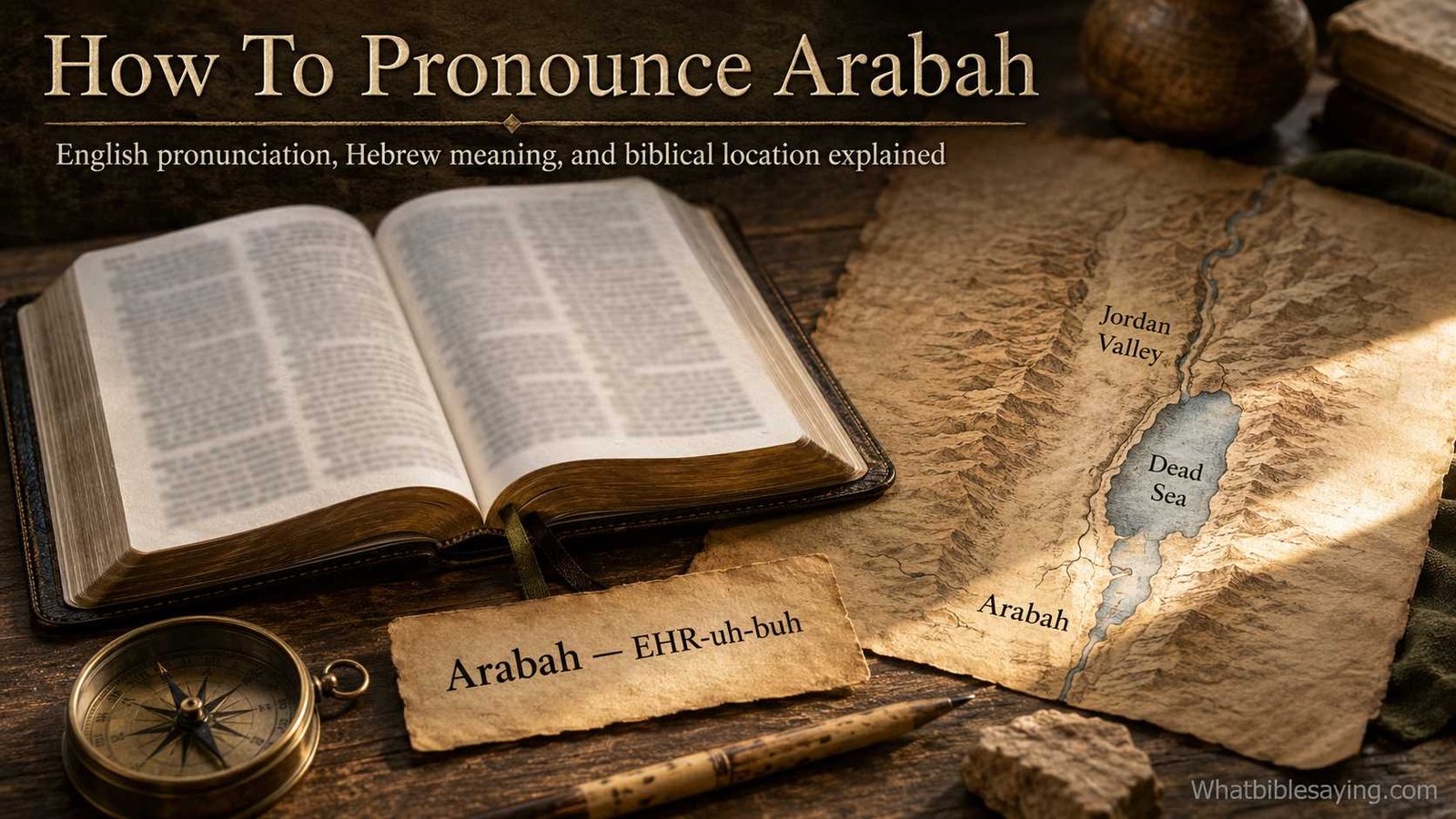
 If you are wondering how to pronounce Arabah in the Bible, the easiest common English pronunciation is:
EHR-uh-buh
Say it slowly as:
EHR + uh + buh
The first part, EHR, receives the strongest stress.
You may also hear a pronunciation closer to ah-rah-VAH. That is because Arabah comes from the Hebrew word עֲרָבָה, often transliterated ʿărābâ or aravah. A pronunciation closer to ah-rah-VAH reflects the Hebrew form more directly. English Bible pronunciation guides, however, commonly use EHR-uh-buh.
So, if you are reading the Bible aloud in English, EHR-uh-buh is a clear and widely understandable way to say it.
But Arabah is more than a difficult Bible word. It is also an important geographical term. It describes a dry plain or wilderness region connected with the Jordan Valley, the Dead Sea, and the land farther south.
Learning what Arabah means and where it was located makes the word much easier to remember.
| Word | Simple Pronunciation | Meaning or Use |
|---|---|---|
| Arabah | EHR-uh-buh | Common English Bible pronunciation |
| Hebrew Arabah | ah-rah-VAH | Pronunciation closer to the Hebrew form |
| Arab | AIR-ub / AR-ub | A different English word |
How To Pronounce Arabah In The Bible Correctly
For most English-speaking Bible readers, you can pronounce Arabah like this:
EHR-uh-buh
Break it into three simple parts:
EHR
uh
buh
Now put them together naturally:
EHR-uh-buh
Do not worry about making every syllable equally strong. The first syllable normally carries the emphasis in this common English Bible pronunciation. A Bible pronunciation reference gives the word as EHR-uh-buh.
You can practice it in a sentence:
Moses spoke about the land of the Arabah.
Read it aloud:
Moses spoke about the land of the EHR-uh-buh.
After saying it a few times, the word begins to feel much more natural.
Bible place names can look intimidating because many entered English through Hebrew, Greek, Latin, and later Bible translations. The spelling we see in English does not always tell us immediately how the original word sounded.
That is why learning how to pronounce Bible names can make reading Scripture aloud much easier.
Why Do People Pronounce Arabah Differently?
You may hear more than one pronunciation of Arabah.
That does not always mean someone is making a mistake.
There is a difference between asking:
How do English-speaking Christians normally pronounce Arabah?
and asking:
How would the Hebrew word sound?
In common English Bible reading, EHR-uh-buh is a useful pronunciation. A Hebrew-based pronunciation is closer to ah-rah-VAH. The Hebrew lexical form is עֲרָבָה, and pronunciation resources for the Hebrew word place the main stress near the end.
This happens with many biblical names.
English speakers say Jerusalem differently from a modern Hebrew speaker. Moses does not sound exactly like the Hebrew name Moshe. Jesus is an English form that came through Greek and Latin traditions from a Hebrew or Aramaic name.
Languages naturally adapt names.
So you do not need to feel embarrassed if your church, Bible teacher, or audio Bible pronounces Arabah a little differently.
The main goal is to understand the word and read Scripture clearly.
How To Pronounce Arabah In The Bible in English and Hebrew
The English form Arabah represents the Hebrew word:
עֲרָבָה
It is commonly transliterated as ʿărābâ, arabah, or aravah.
A Hebrew-oriented pronunciation sounds approximately like:
ah-rah-VAH
The final part receives more emphasis than it usually does in the common English pronunciation. Lexical resources describe the Hebrew term as referring to a desert, plain, wilderness, or steppe.
This helps explain something important.
Arabah is not simply a person’s name or a mysterious biblical term. It is primarily a geographical word.
When ancient Israelites heard the term, they could understand it as describing a particular kind of dry land or, depending on the passage, a specific region.
Is EHR-uh-buh or ah-rah-VAH Correct?
Both can be appropriate depending on what you are trying to do.
If you are reading an English Bible aloud, you can comfortably say:
EHR-uh-buh
If you are studying biblical Hebrew or discussing the original Hebrew word, you may hear:
ah-rah-VAH
The difference comes from language, not from two different places.
Think about familiar biblical names. An English Bible reader usually uses an English pronunciation rather than trying to reproduce every sound exactly as an ancient Hebrew speaker may have pronounced it.
Arabah works in much the same way.
For a normal English Bible study, you do not need a perfect Hebrew accent. Understanding the word is more important than worrying over every sound.
What Does Arabah Mean In The Bible?
The Hebrew word translated or transliterated as Arabah refers to a dry plain, desert region, wilderness, or steppe.
This meaning fits the geography very well.
Much of the region connected with the Arabah is dry and rugged. In Scripture, the term may describe a geographical zone rather than just one small town or landmark.
That is important because English readers sometimes expect every capitalized Bible word to be the name of a city.
Arabah is different.
Depending on the verse and translation, it may refer broadly to a plain or wilderness area, or more specifically to the great north-south depression associated with the Jordan Valley, the Dead Sea, and the territory continuing southward. Biblical geography references describe the Arabah broadly in connection with the Jordan Valley, Dead Sea region, and the area south toward the Gulf of Aqaba.
Arabah Can Mean a Plain or Wilderness
Imagine standing in an open, dry valley.
There is little rainfall. Mountains may rise in the distance. The land feels wide, exposed, and harsh.
That picture helps us understand why the Hebrew word could be associated with a desert plain or wilderness.
The Bible often uses geographical words in very practical ways. Rivers formed boundaries. Mountains became landmarks. Valleys provided roads or battle routes. Wilderness regions could separate peoples and kingdoms.
Arabah belongs to that world of real biblical geography.
It is not a secret spiritual code.
It is a word connected with actual land.
Arabah Can Also Name a Particular Region
In other passages, the Arabah refers to a recognizable geographical region.
Deuteronomy 3:17 connects the Arabah with the Jordan, Chinnereth, and the Salt Sea. The Salt Sea is what we commonly call the Dead Sea today.
This shows why Bible readers should pay attention to context.
Sometimes Arabah describes the character of the land.
Sometimes it functions almost like a regional name.
Both ideas are connected.
Where Is Arabah In The Bible?
The biblical Arabah belongs to the great north-south geographical depression running through the land associated with the Jordan River and Dead Sea.
Its precise meaning can change somewhat depending on the biblical passage and the historical period being discussed.
A biblical geography reference divides the broader Arabah into the Jordan Valley, Dead Sea region, and the territory south of the Dead Sea toward the Gulf of Aqaba.
Today, the name Arava or Arabah is often used more narrowly for the dry valley south of the Dead Sea toward the Gulf of Aqaba. Historically and biblically, however, the term could have a wider geographical sense.
This distinction helps prevent confusion when comparing a modern map with an ancient Bible map.
The Arabah and the Jordan River
Deuteronomy 3:17 gives us one of the clearest geographical descriptions.
The passage describes territory using the Jordan and the Arabah as boundaries and refers to the area extending from Chinnereth to the Sea of the Arabah, identified as the Salt Sea.
Chinnereth is associated with the body of water later known as the Sea of Galilee.
The Salt Sea is the Dead Sea.
So Arabah is part of a large geographical picture that includes some of the Bible’s most familiar locations.
When you read the word, do not picture an isolated village.
Picture a long valley system.
The Arabah and the Dead Sea
The Dead Sea is especially important when locating the Arabah.
Deuteronomy 3:17 calls the Salt Sea the Sea of the Arabah in its geographical description.
That expression tells us how closely the region and the sea were connected in biblical geography.
The Dead Sea sits within the great Jordan Rift system. The depression continues north through the Jordan Valley and south through the Arabah toward the Gulf of Aqaba.
This is why the same biblical geographical term may appear to cover more territory than the modern use of Arabah or Arava.
Arabah, Edom, and Moab
Knowing nearby biblical lands can make the map clearer.
Moab lay mainly east of the Dead Sea.
Edom was connected with territory south and southeast of the Dead Sea.
The Arabah therefore appears within a geographical world that included Israel, Judah, Moab, Edom, the Jordan Valley, and routes leading farther south.
If you are building a clearer mental map of Scripture, reading about where Edom was in the Bible and where Moab was located in the Bible can help connect these places.
Bible geography becomes easier when we stop treating each name as an isolated fact.
The locations connect to one another.
Where Does Arabah Appear in Scripture?
Arabah appears in several parts of the Old Testament, especially in passages concerned with land, travel, borders, battles, and geographical descriptions.
Here are several useful examples.
Deuteronomy 1:7
Near the beginning of Deuteronomy, Moses speaks about Israel moving toward the land and mentions the Arabah among several geographical regions.
The context reminds us that the Arabah belonged to the real landscape through which Israel’s story unfolded.
The Bible does not present Israel’s journey in an imaginary world. It names mountains, rivers, deserts, cities, valleys, and neighboring territories.
Arabah is one of those geographical terms.
Deuteronomy 2:8
Deuteronomy 2 describes Israel’s movement near the territory of Edom.
The Arabah is mentioned in connection with a route near Elath and Ezion-geber.
This passage is especially helpful because Elath and Ezion-geber belonged to the far southern geographical setting near the Gulf of Aqaba.
It shows that the term Arabah could be associated with the southern route as well as the broader valley system.
Deuteronomy 3:17
This verse is perhaps one of the easiest places to understand the term geographically.
It connects the Arabah with the Jordan and identifies the Sea of the Arabah as the Salt Sea.
If you remember only one passage when learning the geography of Arabah, Deuteronomy 3:17 is a useful one.
It gives you three landmarks:
Jordan River
Arabah
Salt Sea or Dead Sea
Put those together on a map, and the word becomes much easier to understand.
Joshua 3:16
Joshua 3 describes Israel crossing the Jordan.
The passage again connects the geographical setting with the Sea of the Arabah, the Salt Sea.
This is another example of how Arabah is linked with the larger Jordan and Dead Sea landscape.
Joshua 11
The book of Joshua also uses Arabah in geographical descriptions connected with military campaigns and territories.
These passages show that biblical writers expected their first readers to recognize the region.
For modern readers thousands of years later, a Bible map can do what local geographical knowledge did for ancient readers.
It gives names a physical setting.
Ezekiel 47
Arabah appears again in Ezekiel’s vision of water flowing from the temple.
The water travels toward the eastern region and down into the Arabah before reaching the sea.
The passage has a prophetic and visionary setting, yet it still uses recognizable geographical language.
This is another reason understanding Bible geography can deepen our reading.
A word that first seems strange may actually help us visualize the passage.
How To Pronounce Arabah In The Bible Without Confusing It With Arab
One common mistake is to assume Arabah and Arab are simply two forms of the same English word.
They are not.
Arabah is the biblical geographical term we have been discussing.
Arab is an English noun and adjective referring to Arab people or things associated with them.
Standard English dictionaries give pronunciations of Arab such as AIR-ub in American English and a form closer to AR-ub in British English.
So compare them:
Arabah: EHR-uh-buh
Arab: AIR-ub or AR-ub
They may look similar on the page, but they are not pronounced exactly the same way and should not be treated as interchangeable words.
What Is the Correct Pronunciation of Arab?
If you are asking about the English word Arab, Cambridge gives the British pronunciation approximately as AR-ub and the American pronunciation approximately as AIR-ub. Merriam-Webster also records more than one accepted English pronunciation.
That is different from:
Arabah: EHR-uh-buh
A simple memory trick is to notice that Arabah has an extra syllable:
Arab: two syllables
Arabah: three syllables
That final uh sound helps separate the biblical place word from Arab.
How To Pronounce Arabah In The Bible When Reading Aloud
Reading Bible names aloud can make some people nervous.
Perhaps you are reading in church.
Maybe you lead a small Bible study.
Maybe your child asks you to read a passage, and suddenly you reach a name you have never said before.
It happens to almost everyone.
When you reach Arabah, you can use this simple method.
Step 1: Divide the Word
Look at it as three parts:
EHR | uh | buh
Step 2: Stress the First Part
Say:
EHR
Then add:
uh-buh
Now say the whole word:
EHR-uh-buh
Step 3: Say the Sentence, Not Just the Word
A word may feel awkward when we repeat it alone.
Put it into a Bible-related sentence:
They traveled through the Arabah.
Then:
The Arabah was a dry region.
Then:
The Salt Sea was called the Sea of the Arabah.
Once your mouth becomes familiar with the sound, you will probably stop thinking about the pronunciation.
Step 4: Remember the Meaning
Connect the sound with an image.
When you hear:
Arabah
think:
dry plain, valley, wilderness, Dead Sea region
Meaning helps memory.
This same method works with many difficult biblical places. For example, readers who want to build confidence with other geographical names may also find how to pronounce Negeb in the Bible useful.
Is Arabah the Same as the Negev?
Arabah and Negev are connected with the dry southern geography of the biblical land, but they should not simply be treated as two names for exactly the same place.
The Arabah is especially associated with the long valley or depression connected with the Dead Sea and territory extending southward.
The Negev is a broader dry region lying mainly to the west of the southern Arabah in modern geographical usage.
For a Bible reader, the safest approach is to pay attention to the verse rather than assuming every desert term describes the same location.
Ancient geographical language does not always fit perfectly into modern political boundaries or modern map labels.
This is normal.
The Bible was written in the geographical language of its own times.
Why Was the Arabah Important?
The Arabah mattered because geography mattered in the biblical world.
People usually traveled on foot or with animals.
Mountains, valleys, rivers, deserts, and water sources affected where people could move.
A dry valley could become a travel corridor.
A river could form a border.
A mountain range could separate one territory from another.
A wilderness could be difficult to cross.
So when Scripture mentions the Arabah, the word helps locate the story in a real landscape.
This is especially useful in books such as Deuteronomy and Joshua, where boundaries and journeys often matter.
The Arabah also stood near territories connected with Edom and routes leading toward the Red Sea region. Understanding where Midian is in the Bible can add another piece to that southern biblical geography.
You do not need to memorize every ancient border.
Even a basic map can help.
When you know that Arabah is associated with the Jordan-Dead Sea valley system and the dry land extending south, many passages become easier to picture.
Does Arabah Have a Spiritual Meaning?
Because the Bible uses deserts and wildernesses in many meaningful stories, readers sometimes ask whether Arabah itself has a special spiritual meaning.
We should be careful here.
The word Arabah primarily has a geographical meaning.
It describes a plain, dry region, wilderness, or specific geographical area.
The Bible does contain important events in wilderness settings. God’s people experienced testing, provision, guidance, judgment, and deliverance in dry places.
But that does not mean every occurrence of the word Arabah secretly represents one spiritual idea.
A good Bible-reading habit is to begin with what the text actually says.
First ask:
What does this word mean here?
Then ask:
What is happening in this passage?
Only after that should we consider a wider spiritual lesson.
This protects us from giving biblical words meanings that Scripture itself does not give them.
Why Bible Geography Makes Arabah Easier to Understand
Many people read names like Arabah and move past them quickly.
That is understandable.
A geographical name can feel unimportant compared with a command, promise, miracle, or story.
But biblical geography often helps us understand those very things.
Suppose you read that someone traveled from one region to another.
If you know where those places are, you may suddenly understand why the journey was difficult.
If two kingdoms fought over a valley, geography may explain why the land was valuable.
If a river forms a boundary, the map may make a political story much clearer.
This is why learning about the Promised Land in the Bible can give useful background for hundreds of passages.
Arabah is one small part of that larger picture.
You do not have to become an archaeologist or professional geographer.
Even knowing four simple facts can help:
- Arabah is pronounced EHR-uh-buh in common English Bible reading.
- The Hebrew form sounds closer to ah-rah-VAH.
- The word can mean a dry plain, desert, wilderness, or steppe.
- The biblical Arabah is closely connected with the Jordan Valley and Dead Sea geographical system.
That is enough to make many verses clearer.
A Simple Way to Remember Arabah
Here is an easy memory sentence:
Arabah is a dry Bible valley near the Dead Sea: EHR-uh-buh.
You can also remember it in three parts:
Sound: EHR-uh-buh
Meaning: dry plain or wilderness
Place: Jordan-Dead Sea region
Sound, meaning, place.
Those three pieces work together.
The next time Arabah appears in your Bible, you will not simply see an unfamiliar word.
You will know what kind of place the writer is describing.
Common Questions About Arabah
How do you pronounce Arabah in English?
A common English Bible pronunciation is:
EHR-uh-buh
Say it in three syllables: EHR + uh + buh.
What does Arabah mean in the Bible?
Arabah comes from a Hebrew term associated with a desert, plain, wilderness, or steppe. In many Bible passages, it also refers to a specific geographical region.
Where is Arabah in the Bible?
The biblical Arabah is associated with the great valley system of the Jordan River, Dead Sea, and land extending southward toward the Gulf of Aqaba. Its exact geographical scope can depend on the passage.
Is Arabah another name for the Dead Sea?
No.
Arabah is the name of a region or geographical feature, not simply another name for the Dead Sea.
However, Deuteronomy 3:17 refers to the Dead Sea, or Salt Sea, as the Sea of the Arabah because of its location within that geographical setting.
Is Arabah the same as Arabia?
No.
Arabah and Arabia are different geographical terms.
Arabah refers to the biblical plain or valley region discussed above. Arabia refers much more broadly to the Arabian Peninsula and surrounding historical regions.
The similarity in English spelling can cause confusion, but Bible readers should not treat the two words as synonyms.
What is the Hebrew pronunciation of Arabah?
A Hebrew-based pronunciation is approximately:
ah-rah-VAH
This differs from the common English Bible pronunciation EHR-uh-buh.
What Bible verses mention Arabah?
Helpful passages include Deuteronomy 1:7, Deuteronomy 2:8, Deuteronomy 3:17, Joshua 3:16, Joshua 11:2, and Ezekiel 47:8.
Reading several of these passages together makes it easier to see that Arabah is mainly a geographical term.
Remembering Arabah When You Read Scripture
Learning how to pronounce Arabah in the Bible is simple once you break the word into pieces:
EHR-uh-buh
If you hear someone say ah-rah-VAH, remember that this reflects the Hebrew form more closely. You do not need to argue over the difference. The two pronunciations come from different language settings.
More important is knowing what the word means.
Arabah points us toward a dry plain or wilderness region closely tied to the Jordan Valley, Dead Sea, and lands farther south.
That little bit of geography can change the way you read.
A strange word becomes a place.
A place becomes part of a journey.
And a journey becomes easier to picture as you follow the people and events of Scripture.
Bible study often grows this way. We learn one word, one place, or one name at a time. What once seemed confusing slowly becomes familiar.
So the next time you see Arabah, you can read it with confidence:
EHR-uh-buh.
And you can remember the landscape behind the name.

Dr. Rachel is very smart and knows a lot about the Bible. He helps us understand the Bible better by talking about the old texts in a simple way.