
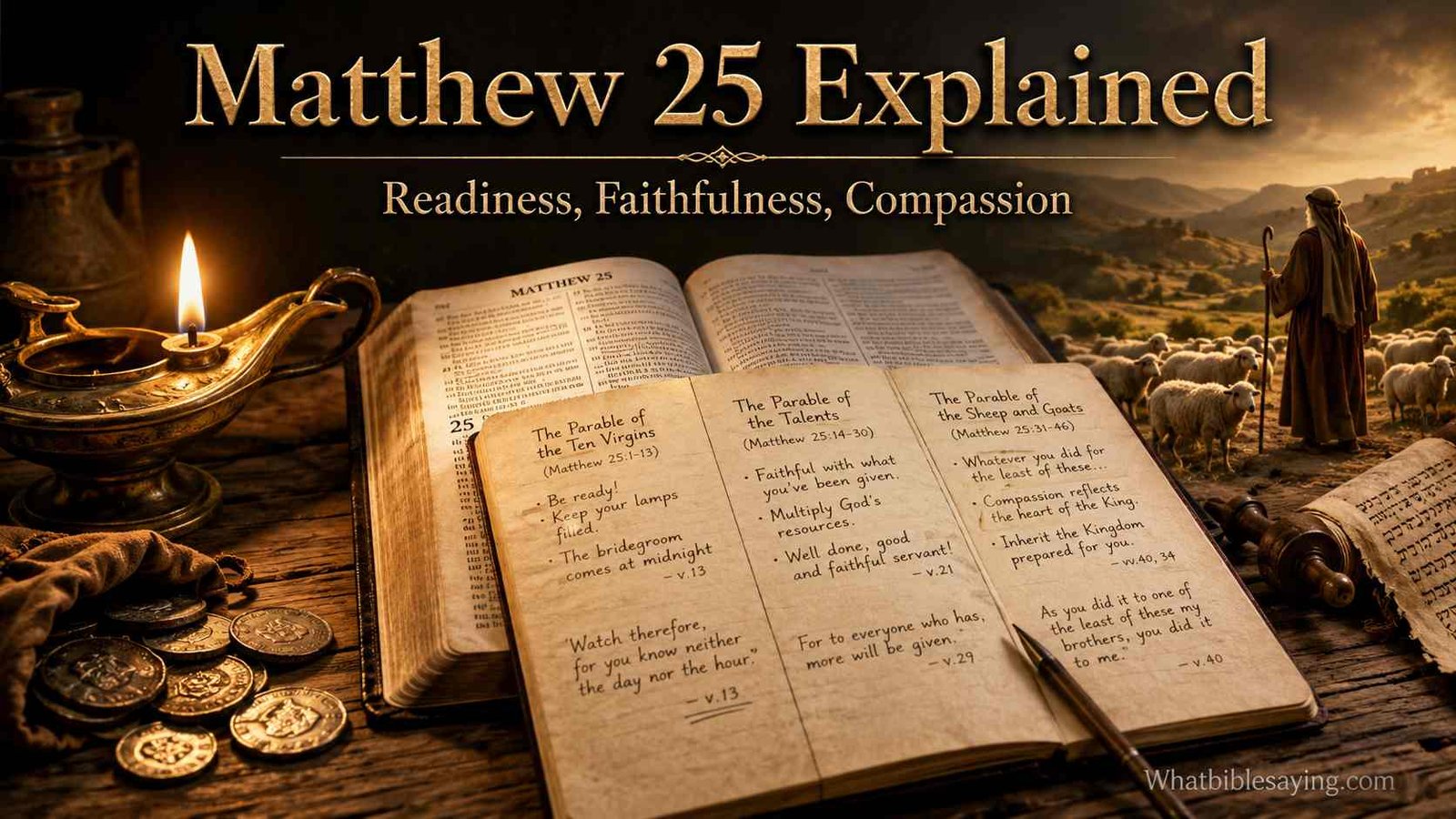
 The words of Jesus in Matthew Chapter 25 are among the most meaningful teachings in the New Testament because they address a question every believer faces: How should we live while waiting for God’s promises to be fulfilled?
Matthew 25 explained in its full context is not only about future events. It is also about daily faithfulness. Jesus teaches His followers to remain spiritually prepared, use their God-given responsibilities wisely, and show genuine love through their actions.
This chapter appears near the end of Jesus’ teaching on the Mount of Olives, shortly before His crucifixion. In Matthew 24 and 25, Jesus speaks about His return, the importance of watchfulness, and the coming judgment. Rather than giving only information about the future, Jesus gives His disciples guidance for how they should live in the present.
Matthew Chapter 25 contains three powerful teachings:
- The Parable of the Ten Virgins (Matthew 25:1–13)
- The Parable of the Talents (Matthew 25:14–30)
- The Teaching of the Sheep and Goats (Matthew 25:31–46)
Together, these passages reveal three important truths:
- Faith requires preparation.
- God expects faithful stewardship.
- True devotion is shown through love and service.
Understanding these teachings helps us see that following Christ is not only about what we believe but also about how we live.
Understanding Matthew Chapter 25 Explained Through Jesus’ Three Teachings
Matthew 25 begins with the phrase, “Then the kingdom of heaven will be like…” This connects the chapter with Jesus’ previous discussion about the end of the age and His return.
Throughout Matthew’s Gospel, Jesus frequently used parables to explain spiritual realities. A parable is a story that uses familiar situations to communicate deeper truths about God’s Kingdom.
In Matthew 25, Jesus uses everyday examples that His listeners would understand:
- A wedding celebration
- Servants managing their master’s resources
- A shepherd separating sheep from goats
These examples reveal spiritual principles.
The first teaching focuses on readiness. The second focuses on responsibility. The third focuses on compassion.
Although each parable has its own meaning, they all point toward the same message: God calls His people to live faithfully while waiting for His Kingdom.
Jesus was not encouraging fear or anxiety. Instead, He was calling His followers to have active faith. A prepared believer is not someone who simply waits for the future but someone who faithfully serves God today.
Matthew 25:1–13 Explanation of the Ten Virgins and Spiritual Readiness
The first section of Matthew 25 contains the Parable of the Ten Virgins.
Jesus says:
“Then the kingdom of heaven will be like ten virgins who took their lamps and went to meet the bridegroom.” (Matthew 25:1)
In the story, five virgins are described as wise, while five are called foolish. The wise virgins brought extra oil for their lamps, but the foolish ones did not prepare enough.
When the bridegroom was delayed, all ten became tired and fell asleep. At midnight, a cry announced that the bridegroom was coming.
The wise virgins were ready because they had prepared beforehand. The foolish virgins tried to find oil at the last moment, but they were not ready when the bridegroom arrived.
Jesus ends the parable with an important warning:
“Therefore keep watch, because you do not know the day or the hour.” (Matthew 25:13)
What Does the Oil Represent?
Christians have interpreted the oil in different ways throughout history. Many understand it as representing spiritual readiness, genuine faith, or the inner work of God in a person’s life.
The central message is clear: preparation cannot be borrowed at the last moment.
A person cannot depend only on someone else’s faith. Each individual must personally seek God, grow spiritually, and remain faithful.
This connects with the broader biblical teaching about learning and understanding Scripture. Many believers begin their journey by asking questions such as how to understand the Bible and how to develop a deeper relationship with God through His Word.
Lessons From the Ten Virgins
The Parable of the Ten Virgins teaches several important lessons:
1. Spiritual preparation matters
Jesus reminds His followers that faith requires attention and commitment. A relationship with God grows through prayer, obedience, and trust.
2. Waiting seasons test faith
The bridegroom’s delay represents seasons when believers may feel uncertain. Faith is revealed not only during exciting moments but also during times of waiting.
3. Readiness is personal
The wise virgins could not give their oil to the foolish virgins. This reminds us that each person must personally respond to God.
The lesson is not simply “wait for the future.” The lesson is “live faithfully today.”
The Parable of the Talents in Matthew 25 Explained: Using God’s Gifts Wisely
The second teaching in Matthew 25 is the Parable of the Talents.
Jesus describes a man who goes on a journey and entrusts his servants with different amounts of money.
One servant receives five talents, another receives two, and another receives one.
In biblical times, a talent was a large unit of money, not a natural ability as the modern English word often means. However, many Christians apply this teaching as a principle about using the abilities, opportunities, and resources God gives them.
The servants with five and two talents invest what they received and increase their master’s resources. The servant with one talent hides it because he is afraid.
When the master returns, he praises the faithful servants:
“Well done, good and faithful servant.” (Matthew 25:21)
What Does the Parable of the Talents Mean?
This parable teaches that God cares about faithfulness.
The servants were not compared by how much they received. They were judged by how faithfully they used what was entrusted to them.
This is an important truth because people often compare themselves with others.
One person may have many opportunities, while another may have fewer. But Jesus teaches that God looks at faithfulness, not comparison.
A small act done with love and obedience can have great value in God’s eyes.
Using God’s Gifts for His Purpose
The Bible teaches that every person has responsibilities and gifts that can be used for God’s glory.
These gifts may include:
- Teaching others
- Encouraging people
- Serving family and community
- Helping those in need
- Sharing faith
- Using professional skills honestly
This connects with questions many believers ask, such as what does the Bible say about gifts and talents?
Matthew 25 reminds us that gifts are not only blessings; they are also responsibilities.
God gives according to His wisdom, and He expects His people to use those blessings faithfully.
The Danger of Fear
The third servant’s problem was not that he had less than the others. His problem was that fear prevented him from acting.
Fear can stop people from using their abilities.
Someone may think:
“I am not important enough.”
“My contribution is too small.”
“Someone else can do it better.”
But Jesus’ teaching challenges this mindset.
God does not ask every person to do the same thing. He asks every person to be faithful with what they have received.
The Parable of the Talents also teaches us that faith is not passive. God does not call His people to simply receive blessings and keep them hidden. He calls them to use what He has given for His purposes.
A person’s resources, time, abilities, knowledge, and opportunities can all become ways to serve God and others.
The faithful servants in the parable understood that their master had trusted them with something valuable. They did not see their responsibility as a burden. They saw it as an opportunity.
This principle appears throughout Scripture. God often works through ordinary people who are willing to faithfully use what they have.
Moses had a staff.
David had a sling.
The widow had a small offering.
The disciples had a few loaves and fish.
What they offered seemed small, but God used their faithfulness for greater purposes.
“Well Done, Good and Faithful Servant”
One of the most memorable phrases in Matthew 25 is the master’s response:
“Well done, good and faithful servant.” (Matthew 25:21)
These words reveal something important about God’s view of success.
The world often measures success by wealth, influence, popularity, or recognition. But Jesus highlights faithfulness.
A person who quietly serves their family, helps their neighbors, encourages others, or faithfully follows God in difficult circumstances may be accomplishing something precious in God’s eyes.
Matthew 25 reminds believers that God sees the heart behind the work.
The question is not only:
“How much did I accomplish?”
The deeper question is:
“Was I faithful with what God placed in my hands?”
Matthew 25:31–46 Meaning of the Sheep and Goats Judgment
The final teaching in Matthew Chapter 25 is known as the Parable of the Sheep and Goats.
Jesus describes a scene where the Son of Man comes in glory and separates people as a shepherd separates sheep from goats.
He says:
“He will put the sheep on his right and the goats on his left.” (Matthew 25:33)
The sheep represent those who responded to God with compassion and love. The goats represent those who ignored the needs of others.
Jesus explains that when people cared for the hungry, thirsty, stranger, naked, sick, and imprisoned, they were serving Him.
“For whatever you did for one of the least of these brothers and sisters of mine, you did for me.” (Matthew 25:40)
Who Are the Sheep and Goats?
The imagery would have been familiar to Jesus’ listeners. Shepherding was common in the ancient world, and people understood the difference between sheep and goats.
However, Jesus was using this picture to teach a spiritual truth.
The separation is not based on appearance, social position, or human achievements. It reveals the condition of the heart.
A person’s relationship with God should produce a life marked by love, mercy, and compassion.
Serving Others as Serving Christ
One of the strongest messages in this passage is that acts of kindness toward others matter deeply to God.
Jesus identifies Himself with those who are overlooked and suffering.
This means Christian compassion is not simply charity. It is an expression of love toward Christ.
Helping someone in need can include:
- Providing food for someone who is hungry
- Supporting someone experiencing hardship
- Visiting those who are lonely
- Encouraging people who are discouraged
- Showing kindness without expecting something in return
This teaching connects with the broader biblical message about what the Bible says about helping others.
Throughout Scripture, God shows concern for the poor, the vulnerable, and those who need support.
Faith That Produces Action
The sheep and goats passage teaches that genuine faith produces visible results.
Jesus does not separate belief from action. A transformed heart naturally begins to show love.
This does not mean people earn God’s love through good deeds. Rather, good deeds reveal the work God has already begun inside a person.
A tree is recognized by its fruit. In the same way, a believer’s life reveals what is happening within.
How Matthew Chapter 25 Applies to Everyday Christian Life
Although Matthew 25 speaks about the future Kingdom of God, Jesus’ message is meant to shape everyday decisions.
The chapter asks each believer important questions:
Am I spiritually prepared?
Am I using what God has given me?
Am I showing Christ’s love to others?
These questions are not meant to create fear. They are invitations to grow.
Living Ready Like the Wise Virgins
Being spiritually ready means developing a consistent relationship with God.
Preparation can include:
- Reading and studying Scripture
- Spending time in prayer
- Growing in obedience
- Seeking wisdom from God
- Keeping faith during difficult seasons
Many believers searching for deeper faith ask questions like how to study the Bible for yourself because they desire a stronger foundation.
Matthew 25 reminds us that spiritual growth requires attention and commitment.
A person cannot build a strong faith only during emergencies. Just as the wise virgins prepared before the bridegroom arrived, believers are called to prepare their hearts daily.
Using Your Gifts Like the Faithful Servants
Every person has something they can offer.
You may not have the same abilities as someone else, but God does not ask you to live someone else’s calling.
A teacher may serve through education.
A parent may serve through raising children with love.
A worker may honor God through honesty and excellence.
A neighbor may serve through kindness.
The question is not:
“Do I have as much as someone else?”
The question is:
“Am I faithful with what God has given me?”
Showing Compassion Like the Sheep
The final section of Matthew 25 reminds us that love must move beyond words.
Faith becomes visible when it reaches people.
Small acts of kindness can have eternal significance.
A message of encouragement.
A meal shared with someone struggling.
A prayer offered for someone in pain.
A helping hand during a difficult moment.
These actions reflect the heart of Jesus.
Important Lessons We Learn From Matthew Chapter 25 Explained
Matthew Chapter 25 brings together three powerful lessons from Jesus.
| Teaching | Main Message |
|---|---|
| The Ten Virgins | Stay spiritually prepared and watchful |
| The Talents | Use God’s gifts faithfully and responsibly |
| The Sheep and Goats | Show God’s love through compassion and service |
Together, these teachings describe what a faithful follower of Christ looks like.
A faithful believer is:
- Prepared but not fearful
- Active but not proud
- Compassionate but not seeking recognition
Jesus shows that true faith affects both our relationship with God and our relationship with people.
Popular Verses in Matthew That Connect With Chapter 25
The Gospel of Matthew contains many well-known teachings of Jesus. Several verses connect closely with the themes found in Matthew 25.
Matthew 5:16
“Let your light shine before others…”
This connects with the wise virgins who carried lamps and reminds believers that their lives should reflect God’s light.
Matthew 6:33
“Seek first the kingdom of God and his righteousness…”
This connects with Matthew 25 because Jesus teaches His followers to prioritize God’s Kingdom.
Matthew 11:28
“Come to me, all you who are weary and burdened, and I will give you rest.”
This reminds believers that preparation for God is not based on anxiety but trust in Christ.
Matthew 22:37–39
Jesus teaches that the greatest commandments are loving God and loving our neighbor.
This connects directly with the sheep and goats teaching because love for others reflects love for God.
Matthew 28:19–20
The Great Commission reminds believers to continue Christ’s mission by making disciples and teaching His ways.
These are among the famous Matthew Bible verses that continue to guide Christians around the world.
The Easter Story in the Bible and Matthew’s Message
The Gospel of Matthew also contains the account of Jesus’ death and resurrection, which forms the foundation of Christian hope.
The events surrounding Easter appear in Matthew chapters 26–28:
- Jesus shares the Last Supper with His disciples.
- Jesus is arrested and crucified.
- Jesus rises from the dead.
- Jesus commissions His followers.
Matthew Chapter 25 comes immediately before these events, making its message especially meaningful.
Before Jesus went to the cross, He taught His disciples to remain faithful, prepared, and compassionate.
The resurrection shows that Jesus’ promises are trustworthy. The teachings of Matthew 25 point believers toward faithful living while waiting for the fulfillment of God’s Kingdom.
What Matthew Chapter 25 Teaches Us About Faith and Hope
Matthew Chapter 25 explained in its entirety gives believers a balanced picture of Christian life.
Jesus teaches that faith is not simply waiting for the future. It is living faithfully today.
The wise virgins teach us to remain spiritually awake.
The faithful servants teach us to use our blessings responsibly.
The sheep teach us that love must be expressed through action.
Together, these lessons reveal the heart of Jesus:
A prepared heart.
A faithful life.
A compassionate spirit.
Every generation of believers faces the same invitation Jesus gave His disciples: remain faithful until He comes.
Matthew 25 encourages us to examine our lives with humility and hope.
Are we growing closer to God?
Are we using our gifts for His purpose?
Are we showing His love to those around us?
The answer to these questions shapes the way we live each day.
Jesus’ message in Matthew 25 is ultimately a call to faithful love. He invites us not only to believe His words but to live them.
When we remain prepared, serve faithfully, and love others, we reflect the character of Christ and become ready for the Kingdom He promised.

Reverend James has spent years studying and teaching the Bible. With warmth and wisdom, he shares deep truths in a way that’s clear, simple, and easy to understand.