

 If you have searched for what are the 12 sins in the Bible, you may have found several very different answers. One website lists pride, greed, lust, envy, and other familiar sins. Another gives a completely different group. Some people connect the question with the Seven Deadly Sins, while others point to the Ten Commandments.
There is a reason for the confusion.
The Bible does not contain an official list called “the 12 sins.”
There is no verse that says, “These are the twelve sins.” Scripture speaks about many sins in many places. However, one passage comes surprisingly close to the question people are asking.
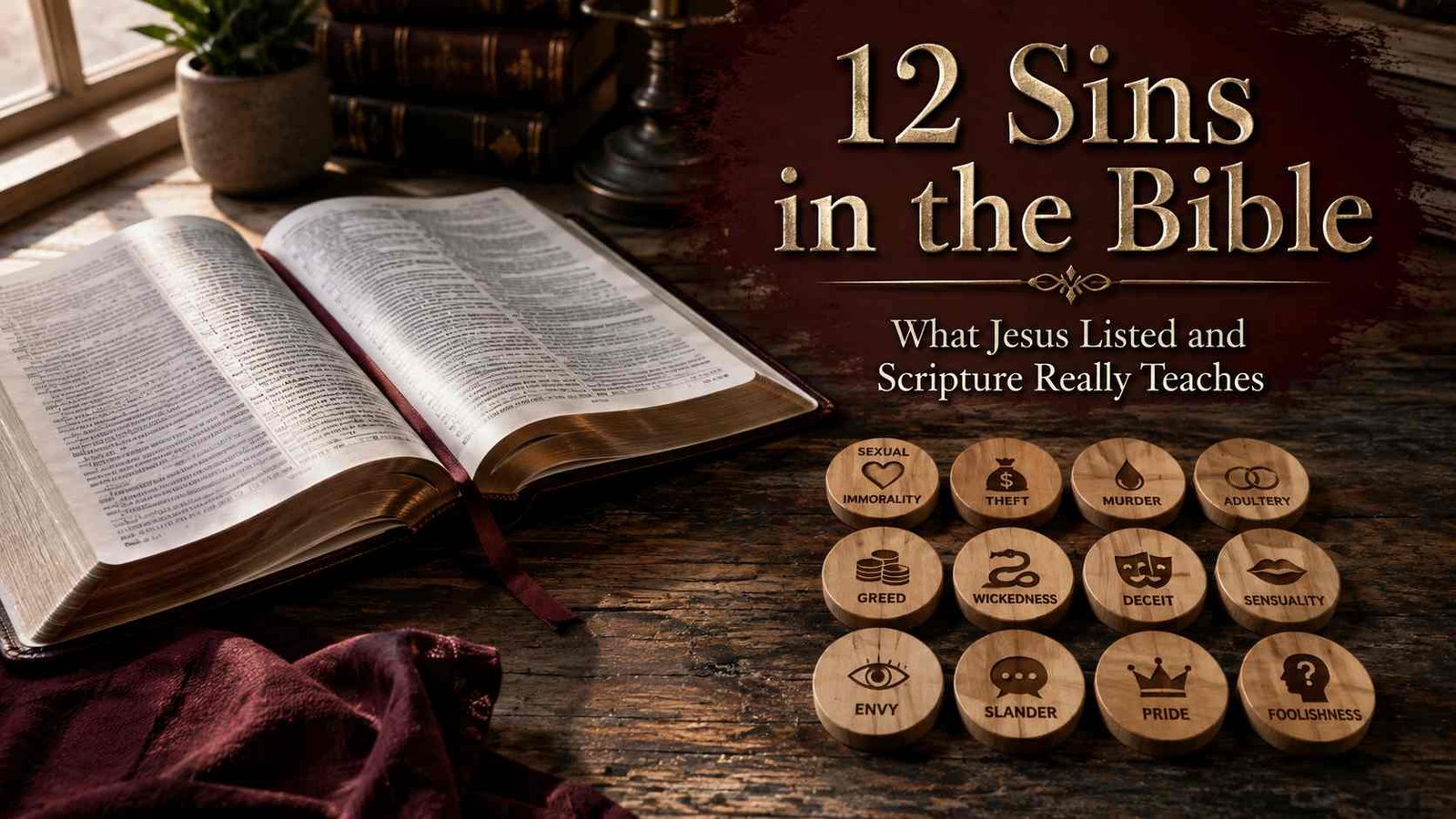
In Mark 7:21–23, Jesus describes the evil things that come from the human heart. Depending on how the opening phrase “evil thoughts” is counted, the passage contains either thirteen expressions of evil or twelve more specific evils following that broader description. The passage includes sexual immorality, theft, murder, adultery, greed, wickedness, deceit, sensuality, envy, slander, pride, and foolishness.
That makes Mark 7 one of the best places to begin when someone asks about twelve sins.
But Jesus was doing more than making a list. His deeper message was that sin begins inside the human heart.
Are There Really 12 Sins in the Bible?
Not as an official biblical category.
The Bible never teaches that there are only twelve sins. In fact, several passages contain different lists of sinful attitudes and actions.
For example, Galatians 5:19–21 names sexual immorality, impurity, idolatry, jealousy, anger, envy, drunkenness, and several other “works of the flesh.” Paul even ends the list with words meaning “and things like these,” showing that it was not intended to be an exhaustive catalog.
Proverbs 6:16–19 gives another famous list. It describes seven things that are detestable to the Lord, including pride, lying, shedding innocent blood, planning evil, false testimony, and stirring up conflict.
So when we ask what are sins according to the Bible, we should not expect one numbered master list.
The Bible deals with sin throughout Scripture.
Still, Mark 7 is especially helpful because Jesus gathers many important sins together and explains where they come from.
What Are the 12 Sins in the Bible According to Mark 7?
In Mark 7:21–23, Jesus says evil comes from within a person. The English wording varies slightly between Bible translations, but the basic ideas remain clear.
If we treat “evil thoughts” as the broad opening category, twelve specific evils follow:
| # | Sin | Simple Meaning |
|---|---|---|
| 1 | Sexual immorality | Sexual behavior outside God’s moral boundaries |
| 2 | Theft | Taking what belongs to someone else |
| 3 | Murder | Wrongfully taking human life |
| 4 | Adultery | Sexual unfaithfulness in marriage |
| 5 | Greed | An excessive desire to have more |
| 6 | Wickedness | Deliberately choosing what is evil |
| 7 | Deceit | Misleading someone through dishonesty |
| 8 | Sensuality or lewdness | Unrestrained immoral behavior |
| 9 | Envy | Resenting another person’s good or possessions |
| 10 | Slander | Using harmful speech against another person |
| 11 | Pride | Lifting ourselves above others or God |
| 12 | Foolishness | Rejecting moral wisdom and acting without godly judgment |
Jesus’ main purpose was not to encourage people to count sins. He was showing that moral corruption does not begin with dirty hands, certain foods, or outward appearances. It begins within the person.
Let us look at these twelve more carefully.
1. Sexual Immorality
Sexual immorality is a broad biblical term for sexual behavior outside the moral boundaries Scripture gives.
Different translations of Mark 7 may use words such as “fornication,” “sexual sins,” or “sexual immorality.” The Greek term behind this wording is broad and should not be reduced to only one kind of sexual wrongdoing.
Jesus’ teaching also makes an important point: sexual sin is not merely an outward problem. In Matthew 5, Jesus connects immoral actions with desires of the heart.
That is why biblical purity is deeper than simply avoiding visible wrongdoing. It includes the way we think about and treat other people.
2. Theft
Theft means taking something that rightfully belongs to another person.
The command against stealing appears clearly in the Ten Commandments, and Jesus includes theft among the evils that come from within.
Most people think immediately of stealing money or possessions. But the principle behind theft is larger. It involves taking what is not ours to take.
Honesty, respect for others, and contentment are therefore important parts of biblical character.
3. Murder
Murder is one of the most serious actions named in Scripture.
The command “You shall not murder” stands among the Ten Commandments. Jesus also speaks about murder in Mark 7 because violence has an inner source.
In the Sermon on the Mount, Jesus goes deeper than the outward act. He warns about destructive anger and contempt as matters of the heart.
This does not mean anger and murder have identical earthly consequences. It means we should not ignore the inner attitudes from which destructive actions can grow.
4. Adultery
Adultery refers to sexual unfaithfulness within marriage.
It appears separately from the broader term sexual immorality in Mark 7. That distinction shows how seriously Scripture treats faithfulness between husband and wife.
The prohibition against adultery also appears in the Ten Commandments.
For readers wanting a deeper study, what is adultery in the Bible is closely connected with Jesus’ teachings about marriage, faithfulness, desire, and the heart.
Biblical faithfulness is more than avoiding betrayal. It involves keeping promises, honoring another person, and treating marriage as a serious covenant.
5. Greed
Greed is the uncontrolled desire for more.
It can involve money, possessions, power, influence, status, or anything else we begin to crave.
Greed becomes spiritually dangerous because it is rarely satisfied. A person may already possess much and still believe, “I need more.”
That is why the problem is not simply having possessions. The problem is allowing possessions or desires to control the heart.
Mark 7 places greed beside sins that may appear more dramatic because Jesus is concerned with the condition of the inner person, not merely public reputation.
6. Wickedness or Malice
Bible translations use different English words here, including “wickedness,” “malice,” and “evil actions.”
The idea involves an active willingness to do what is wrong.
Sometimes sin happens in a moment of weakness. Wickedness can describe something darker: knowingly planning, choosing, or enjoying what harms others.
Proverbs 6 similarly warns about a heart that plans wicked schemes and feet that hurry toward evil.
Jesus reminds us that God is concerned not only with what people finally do, but with what they allow to grow inside them.
7. Deceit
Deceit is dishonesty with the purpose of misleading someone.
A person may deceive through a direct lie, a half-truth, hidden information, manipulation, or deliberately creating a false impression.
Scripture repeatedly treats truthful speech as a moral issue.
Proverbs 6 includes both a lying tongue and a false witness in its list of things God hates.
This is why deceit can damage relationships so deeply. Trust takes time to build but can disappear quickly when people discover they have been deliberately misled.
8. Sensuality or Lewdness
Some Bible translations use “sensuality,” while others use words such as “lewdness,” “licentiousness,” or “unrestrained immorality.”
The basic idea is a lack of moral restraint.
It describes behavior in which a person allows desire to rule without proper boundaries or concern for what is right.
Galatians 5 also includes sensuality among the works of the flesh.
The biblical answer is not shame for having human desires. It is learning self-control and directing our desires in ways that honor God and other people.
9. Envy
Envy is more than noticing that someone else has something good.
It begins when their good becomes painful to us.
We may envy another person’s money, appearance, marriage, home, career, gifts, success, friendships, or opportunities.
Envy quietly says, “Why should they have that when I do not?”
That attitude can destroy gratitude.
Galatians 5 also names envy among the works of the flesh, showing that the problem was important in early Christian moral teaching.
The opposite of envy is learning to thank God for what we have while also being able to rejoice when someone else receives something good.
10. Slander
Slander uses words to damage another person.
Depending on the translation, the Greek term in Mark 7 can be rendered with language such as slander or blasphemy. The context concerns corrupt speech coming from the heart.
Words can wound even when no physical harm takes place.
A rumor can damage a reputation. A false accusation can destroy trust. Cruel speech can remain in someone’s memory for years.
That is why the Bible treats speech as a serious moral matter.
Truthfulness should always be joined with love and wisdom.
11. Pride or Arrogance
Pride in this setting does not mean being pleased that you worked hard or being thankful for something you accomplished.
Biblical pride becomes sinful when we exalt ourselves wrongly.
It may cause us to look down on other people, refuse correction, seek constant praise, or live as though we do not need God.
Proverbs 6 begins its seven detestable things with “haughty eyes,” a vivid picture of arrogant self-importance.
Pride can be difficult to recognize because it often hides behind respectable behavior.
Humility, by contrast, allows us to recognize both our value and our limits.
12. Foolishness
Foolishness in Scripture is often a moral problem, not an intelligence problem.
A person can be highly educated and still act foolishly.
Biblical foolishness appears when someone knows what is right but repeatedly rejects wisdom, correction, or truth.
Jesus ends the Mark 7 list with foolishness, showing again that sin includes attitudes and choices as well as dramatic actions.
Wisdom listens. Foolishness refuses.
Wisdom accepts correction. Foolishness assumes it has nothing to learn.
That difference can shape an entire life.
Why Do Some People Say There Are 13 Sins in Mark 7?
This is where many online explanations become confusing.
If every expression in Mark 7:21–22 is counted separately, there are thirteen:
- Evil thoughts
- Sexual immorality
- Theft
- Murder
- Adultery
- Greed
- Wickedness
- Deceit
- Sensuality
- Envy
- Slander
- Pride
- Foolishness
Some Bible commentaries explicitly describe Mark 7 as containing thirteen forms of evil.
At the same time, the structure of the Greek text helps explain the “twelve” interpretation. The Expositor’s Greek Testament notes a sequence of six plural terms followed by six singular terms. This creates a group of twelve more specific expressions after the opening reference to evil thoughts.
So what are the 13 sins of the Bible? is not quite the right way to phrase the question either.
Mark 7 contains a list that may be counted as thirteen expressions, but the Bible does not establish a doctrine called “the thirteen sins.”
The safest wording is simple:
Mark 7:21–23 names thirteen expressions if “evil thoughts” is counted, with twelve more specific vice terms following that opening idea.
What Are 10 Common Sins According to the Bible?
There is also no official Bible passage called “the ten common sins.”
Still, when the major biblical lists are compared, certain sins appear repeatedly.
Ten common examples are:
- Lying and deceit
- Pride
- Greed
- Envy
- Anger and hatred
- Sexual immorality
- Slander and harmful speech
- Theft
- Idolatry
- Drunkenness and lack of self-control
These ideas appear across passages such as Mark 7, Galatians 5, and Proverbs 6.
This list is useful as a study tool, but it should not be presented as though the Bible itself numbered these as “the ten common sins.”
If you are studying the subject more broadly, our guide to what is a sin in the Bible can help explain how Scripture defines sin beyond individual lists.
Are the Seven Deadly Sins the Same as the 12 Sins?
No.
The familiar Seven Deadly Sins are:
- Pride
- Greed or avarice
- Lust
- Envy
- Gluttony
- Wrath
- Sloth
These ideas are certainly connected with biblical teaching, but the Bible does not place these seven together and call them “the Seven Deadly Sins.”
The sevenfold classification developed within Christian tradition. The Catholic Catechism describes them as “capital sins” because they can produce other sins and connects the tradition with John Cassian and Gregory the Great.
This historical distinction matters for Christians from different traditions.
A Protestant reader may speak of the Seven Deadly Sins as a useful traditional summary rather than an inspired biblical list. Catholic teaching gives the classification a more established place in moral theology. Either way, it should not be confused with Mark 7.
For readers wondering where in the Bible are the seven deadly sins, the accurate answer is that no single Bible passage contains the traditional seven under that title.
What Are the Top 3 Worst Sins in the Bible?
The Bible does not provide an official list called “the three worst sins.”
That answer may seem less exciting than a numbered ranking, but it is more faithful to Scripture.
The Bible does indicate, however, that sins can differ in important ways.
Jesus speaks in John 19:11 of a “greater sin,” so Scripture does not force us to say that every sinful action has exactly the same degree of guilt or consequence.
Jesus also gives an especially serious warning about blasphemy against the Holy Spirit in Matthew 12:31–32. The passage describes it as uniquely unforgiven.
First John 5:16–17 also distinguishes between sin that leads to death and sin that does not lead to death, although Christian traditions differ in how they interpret that difficult passage.
So instead of inventing a “top three,” it is better to say:
Scripture treats all wrongdoing as sin, while also recognizing differences in seriousness, knowledge, intention, consequences, and spiritual condition.
What Is the Unpardonable Sin in the Bible?
Because people searching for the worst sins often worry about the unforgivable sin, this deserves special care.
In Matthew 12, religious leaders had witnessed Jesus’ work and attributed what He was doing through the Spirit to evil. It is in this setting that Jesus warns about blasphemy against the Holy Spirit.
Christians have explained the precise meaning in different ways, but it should not be reduced to an accidental sentence, an unwanted thought, or an ordinary failure followed by sincere repentance.
Jesus’ warning is serious, but the same New Testament also repeatedly calls sinners toward forgiveness and restoration.
If this question worries you personally, remember the wider biblical message: a person who genuinely seeks God’s mercy should not interpret every fearful thought as proof that forgiveness is impossible.
Our related study on what is the unpardonable sin in the Bible can explore that passage in greater depth.
Other Important Lists of Sin in Scripture
Mark 7 is only one biblical list.
Galatians 5:19–21
Paul describes the “works of the flesh.” The list includes sexual immorality, impurity, idolatry, hostility, jealousy, fits of anger, envy, drunkenness, and other destructive behaviors.
The words “and things like these” are important. They show that Paul is giving representative examples rather than trying to produce a complete dictionary of every possible sin.
Proverbs 6:16–19
This passage speaks of seven things the Lord hates.
They involve proud eyes, lying, shedding innocent blood, planning wickedness, rushing toward evil, giving false testimony, and stirring up conflict.
Notice how the list includes eyes, tongue, hands, heart, feet, testimony, and relationships.
Sin touches the whole person.
1 Corinthians 6
Paul gives another serious list of sinful patterns while warning believers about unrighteous living.
But the message does not stop with condemnation. The next verse reminds the Corinthian Christians that some of them had lived in such ways before experiencing cleansing and a changed identity in Christ.
This movement from sin toward restoration is essential to understanding the New Testament.
Sin Begins Deeper Than Outward Actions
This is the heart of Jesus’ teaching in Mark 7.
The surrounding discussion began with questions about ritual cleanliness. Jesus redirected attention from what entered the body to what came out of the human heart.
That changes how we think about sin.
It is easy to look at a list and ask:
“Which of these have I never done?”
Jesus asks a deeper question:
“What is happening inside me?”
A person may never steal money but still be controlled by greed.
A person may avoid physical violence but nurture hatred.
A person may never publicly slander someone while secretly enjoying their failure.
A person may appear humble while constantly needing to feel superior.
Jesus moves the discussion from appearance to character.
This is why biblical faith is not simply about looking respectable.
God’s work reaches the heart.
Does One Sin Make a Person Guilty?
The Bible takes sin seriously because sin is ultimately a violation of what is right before God.
James 2:10 teaches that someone who keeps the law yet breaks it at one point becomes accountable as a lawbreaker. This does not mean every sinful action causes identical harm. Rather, James is challenging the idea that selective obedience makes a person morally perfect.
The wider New Testament message is that all humanity needs grace.
Romans 6:23 presents both sides clearly: sin brings death, while God’s gift is eternal life in Christ.
This is why a biblical discussion of sin should never become a competition.
The question is not:
“Am I less sinful than the person next to me?”
The better question is:
“Where do I need God’s mercy, correction, and help?”
Can the 12 Sins Be Forgiven?
Yes. The Christian message does not end with a catalog of failures.
The purpose of recognizing sin is not to leave a person hopeless. It is to bring sin into the light so that repentance, forgiveness, and change become possible.
First John 1:9 teaches that when believers confess their sins, God is faithful to forgive and cleanse them.
This means someone who has lied can learn truthfulness.
Someone controlled by envy can grow in gratitude.
Someone who has acted proudly can learn humility.
Someone who has been greedy can become generous.
Someone guilty of serious wrongdoing does not make that wrongdoing small by seeking forgiveness. Repentance begins by admitting that the wrong really was wrong.
Grace does not tell us sin does not matter.
Grace tells us sin does not have to have the final word.
What the 12 Sins Teach Us About the Human Heart
So, what are the 12 sins in the Bible?
The most accurate answer is:
The Bible does not establish an official group called “the 12 sins.” However, Mark 7:21–23 contains an important list in which “evil thoughts” is followed by twelve specific expressions of evil: sexual immorality, theft, murder, adultery, greed, wickedness, deceit, sensuality, envy, slander, pride, and foolishness. If evil thoughts itself is counted, the passage contains thirteen expressions.
That distinction helps clear up many confusing answers found online.
But counting is not the most important lesson.
Jesus wanted His listeners to understand where sin begins.
It begins within us.
That truth can feel uncomfortable because it removes our ability to blame everything on circumstances, society, other people, or appearances.
Yet it also points toward something hopeful.
If the deepest problem is the heart, then genuine spiritual change must also reach the heart.
Christian faith is not mainly about creating a cleaner public image. It is about becoming truthful where there was deceit, humble where there was pride, faithful where there was unfaithfulness, generous where there was greed, and loving where there was envy or hatred.
A list of sins can help us recognize what is wrong.
Grace shows us that change is possible.
And perhaps that is the most important reason to study what Scripture says about sin: not so we can become skilled at judging everyone around us, but so we can examine ourselves honestly and continue moving toward the character God desires.

Dr. Rachel is very smart and knows a lot about the Bible. He helps us understand the Bible better by talking about the old texts in a simple way.