
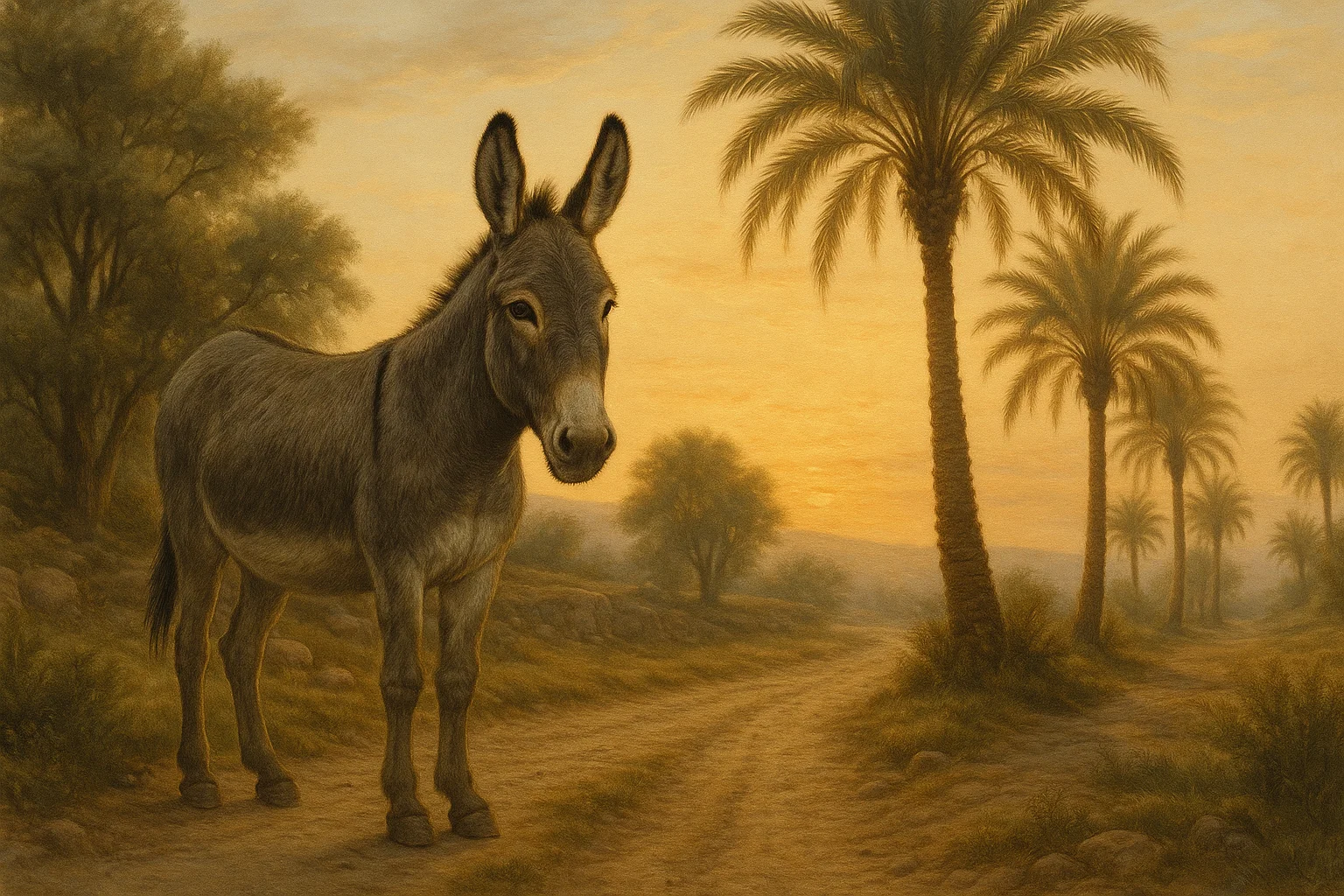
 When we think of great biblical animals, we might picture lions, eagles, or lambs. Yet, quietly standing among them is the donkey an animal that rarely takes the spotlight but plays a deeply meaningful role in God’s story. The donkey’s image weaves through both the Old and New Testaments, symbolizing humility, service, peace, and divine purpose.
From Balaam’s talking donkey in the book of Numbers to the colt that carried Jesus into Jerusalem, this humble creature shows us something profound about how God works not through might or pride, but through gentle strength and obedience.
The Donkey as a Symbol of Humility and Service
In the ancient world, the donkey wasn’t an impressive animal. It wasn’t majestic like a horse or fierce like an ox. Yet, it was invaluable for ordinary people used for travel, carrying burdens, and serving in daily life. That’s where its biblical meaning begins: in humility.
Throughout Scripture, the donkey represents service and submission, not dominance. Kings rode horses to display power and victory, but servants and prophets often rode donkeys to show humility and peace. In this contrast lies a powerful lesson God’s kingdom does not advance by pride or status but through humility and servanthood.
In 1 Kings 1:33, Solomon rode King David’s mule (a donkey crossbreed) during his anointing. This wasn’t a show of force but a display of peaceful transition and divine appointment. Even Israel’s greatest kings, like David, recognized that real authority comes from God, not from appearances of strength.
The Hebrew word for donkey, “chamor,” comes from a root that means “to bear” or “to carry.” It’s a fitting image. Donkeys carry heavy loads without complaint, a quiet reflection of faithfulness much like how believers are called to “carry each other’s burdens” (Galatians 6:2).
The Donkey in Old Testament Stories
The donkey first appears early in the Old Testament, often connected with moments of revelation and obedience.
Balaam’s Donkey: God Speaks Through the Ordinary
In Numbers 22, Balaam, a prophet-for-hire, was on his way to curse Israel when his donkey suddenly stopped. Three times, the animal refused to move forward because an angel of the Lord blocked the path something Balaam couldn’t see. When Balaam struck the donkey, God opened its mouth, and it spoke:
“What have I done to you to make you beat me these three times?” (Numbers 22:28, NIV)
Through this miraculous event, God used the humble donkey to deliver truth and correction. It’s a reminder that God can use even the most ordinary creature or moment to get our attention. Balaam, blinded by greed and pride, was rebuked by a beast of burden. The donkey became a symbol of spiritual sight and obedience, showing that wisdom and understanding don’t always come from status but from being open to God’s voice.
Donkeys and God’s Provision
In Genesis 22, when Abraham journeyed to Mount Moriah to sacrifice Isaac, he saddled his donkey. Though the detail seems small, it reveals how donkeys often accompanied moments of faith and obedience. The donkey carried the supplies for sacrifice a silent companion in one of Scripture’s most profound acts of trust.
In stories like these, donkeys are never grand heroes; they are quiet participants in God’s plan. And that’s exactly the point: God often works through what the world considers small or simple.
Jesus and the Donkey: A Fulfillment of Prophecy
The most well-known appearance of a donkey in the Bible is during the final week of Jesus’ earthly ministry. As He entered Jerusalem, He chose to ride a young donkey, fulfilling the prophecy written hundreds of years earlier:
“Rejoice greatly, Daughter Zion! Shout, Daughter Jerusalem!
See, your king comes to you, righteous and victorious,
lowly and riding on a donkey, on a colt, the foal of a donkey.”
Zechariah 9:9 (NIV)
At first glance, this may seem like a simple choice of transportation. But for those who understood the symbolism, it was deeply meaningful. In ancient culture, a king who came riding a horse was declaring war. A king who rode a donkey came in peace.
By entering Jerusalem this way, Jesus declared the kind of King He truly was not a warrior of earthly kingdoms but the Prince of Peace (Isaiah 9:6). The donkey symbolized His mission: peace through humility, salvation through surrender.
The Spiritual Message Behind the Triumphal Entry
The crowds that day laid down palm branches and shouted, “Hosanna!” (John 12:13), expecting a political savior. But Jesus’ choice of a donkey quietly corrected their expectations. He wasn’t coming to overthrow Rome by force. He was coming to conquer sin through love.
The donkey carrying Christ represents the partnership between the divine and the humble. It shows how God chooses to work through ordinary vessels to carry His presence into the world. Just as that donkey bore Jesus into Jerusalem, we too are invited to carry His light into our homes, communities, and hearts.
When Jesus mounted that colt, He fulfilled prophecy, but He also offered an example: true greatness lies not in pride or position but in willingness to serve.
What the Donkey Teaches About God’s Character
The donkey’s nature reflects some of God’s most consistent qualities patience, faithfulness, and purpose.
- Patience – Donkeys are steady and enduring, not easily rushed. In Scripture, this reminds us that God’s timing often moves at a gentle pace, developing character before accomplishment.
- Faithfulness – A donkey doesn’t quit easily. Likewise, God’s faithfulness never fails, even when we falter.
- Purpose in the Ordinary – God uses what’s overlooked to accomplish the extraordinary. Whether a shepherd’s staff, a widow’s oil, or a donkey’s back He transforms the ordinary into instruments of grace.
The donkey also mirrors Jesus’ own character: meek but strong, simple but purposeful. Christ said in Matthew 11:29,
“Learn from me, for I am gentle and humble in heart.”
That same spirit is reflected in the donkey a creature of burden, yet chosen to bear the Savior.
The Hebrew Meaning of “Donkey”
In Hebrew, the word “chamor” (חֲמוֹר) not only means “donkey” but also comes from a root word meaning “material” or “clay.” It’s the same root as “chomer,” referring to something earthy or physical. That connection may hold a subtle spiritual truth: humanity, too, is made from the dust of the earth (Genesis 2:7).
Just as the donkey represents the earthly and ordinary, we are reminded that God formed us from simple clay but He can breathe His Spirit into us and give our lives divine purpose. When the Messiah chose a donkey, He affirmed that the lowly and earthly can carry the divine.
The Donkey’s Role in Prophecy and Redemption
The donkey’s presence in prophecy (Zechariah 9:9) and fulfillment (Matthew 21:5) shows how God’s Word connects across centuries. It stands as proof that God’s promises never fail, even when they unfold quietly.
There’s also a redemptive layer to its symbolism. In the law of Moses, Exodus 13:13 commands that every firstborn donkey be redeemed with a lamb. If not redeemed, the donkey’s neck was to be broken. This law foreshadows salvation: the unclean (donkey) redeemed by the sacrifice of the innocent (lamb).
What a picture of grace. We, too, are redeemed not by our worthiness but by the Lamb of God. The donkey’s redemption reminds us that salvation is a gift of substitution where mercy takes the place of judgment.
Lessons We Can Learn from the Donkey
When we look closer, the donkey’s story is filled with lessons for believers today:
- Serve quietly. True greatness doesn’t need to announce itself.
- Be willing to carry God’s presence. Like the colt that bore Christ, we’re called to be vessels of peace.
- Listen for God’s voice, even in unexpected ways. Balaam’s donkey teaches us that God can speak through the humble and surprising.
- Stay steady in faith. The donkey’s endurance reminds us to keep walking with God, even when the road feels long.
- Value humility over pride. The donkey’s simplicity reflects the heart that pleases God most a heart ready to serve.
What This Teaches Us About Living with Humility
In the end, the donkey’s story isn’t just about an animal it’s about a way of living. In a world that celebrates power and prestige, the Bible lifts up humility and obedience. The donkey reminds us that God delights in the lowly and often works through the overlooked.
When Jesus rode into Jerusalem on that donkey, He wasn’t only fulfilling prophecy; He was showing us the path of the kingdom of heaven a kingdom where peace conquers pride, and love outshines power.
So, the next time you see a donkey whether in Scripture or in life remember its lesson: God can take what’s ordinary and use it for something eternal. All He asks is a willing heart.
Dr. Rachel is very smart and knows a lot about the Bible. He helps us understand the Bible better by talking about the old texts in a simple way.