

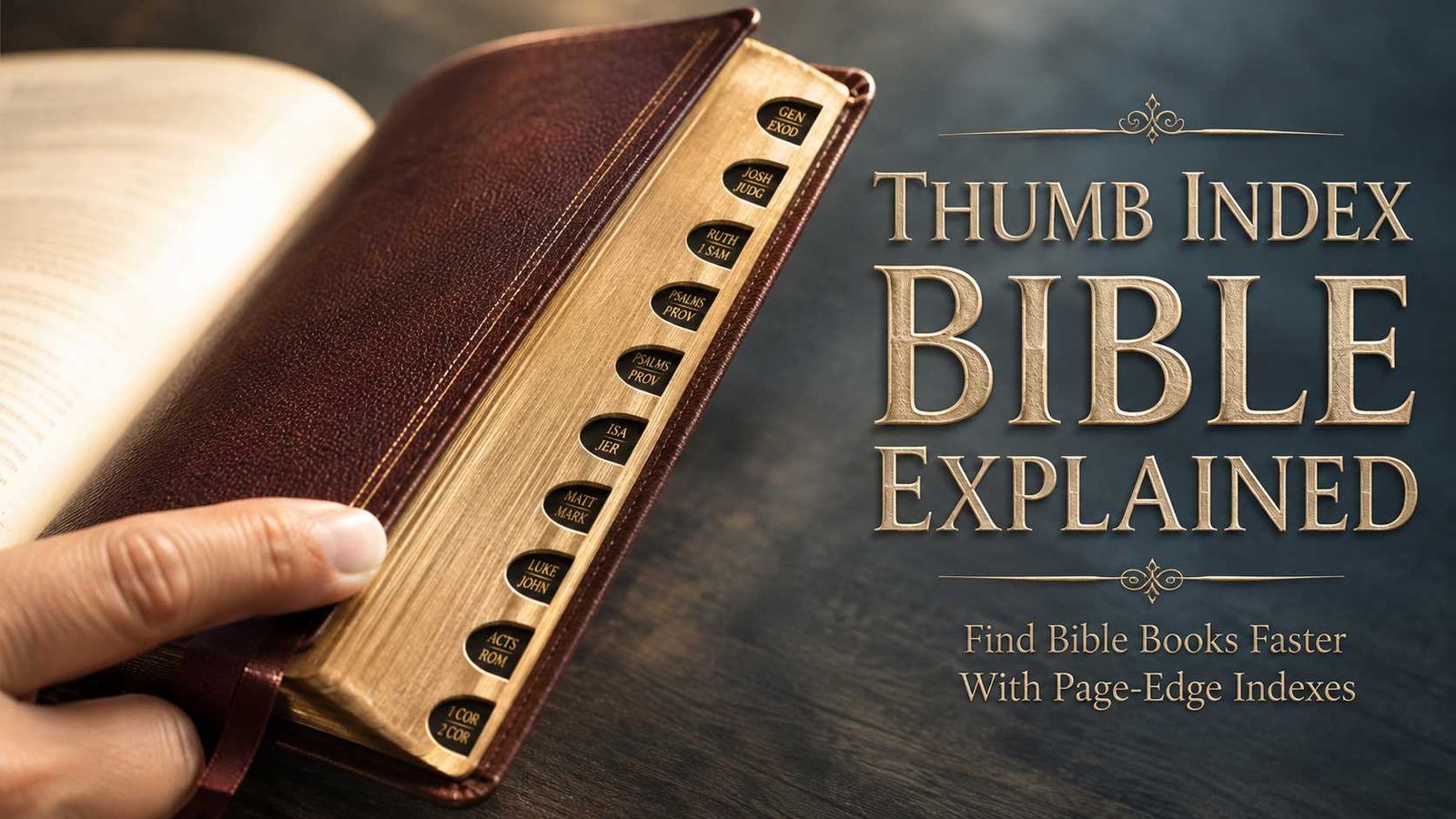
 A thumb index Bible is a Bible with small cut-out sections along the outer edge of its pages. These sections help you quickly find books such as Genesis, Psalms, Matthew, John, or Romans without turning through many pages.
Think of the indexes like built-in page guides. You look along the edge of the Bible, find the book or section you want, place your thumb or finger into that small cut-out area, and open the Bible near that book.
The important thing to understand is that thumb indexing does not change the words of Scripture. It is simply a physical feature added by Bible publishers to make navigation easier.
Major Bible publishers offer thumb-indexed editions today. Crossway, for example, describes thumb indexes as a feature that helps readers navigate Scripture more easily, while Zondervan presents thumb-indexed editions and peel-and-stick Bible tabs as ways to make Bible books easier to find.
For someone who already knows exactly where every book of the Bible is located, a thumb index may seem like a small convenience. For a new reader, a child, a Bible-study student, or anyone following many Scripture references during a sermon, it can make a surprisingly big difference.
What Does a Thumb Indexed Bible Mean?
When a Bible is described as thumb indexed, it means that sections have been cut into the outer edge of the pages to help the reader locate different books of the Bible.
Look at the closed edge of a thumb-indexed Bible and you will normally see a series of small curved openings arranged from top to bottom.
These openings are sometimes called thumb cuts, thumb indexes, or index tabs.
Instead of opening the Bible at random and searching through pages, you can use these sections as a guide.
For example, suppose your pastor says:
“Turn to the Gospel of John.”
If you are using a regular Bible, you may need to remember that John comes after Luke and before Acts. Then you turn through the New Testament until you find it.
With a thumb-indexed Bible, you can look for the index associated with John, place your finger there, and open close to the correct location.
That is the main purpose of thumb indexing.
It is about finding Scripture faster.
Crossway currently sells several Bible formats with thumb indexes, including standard reading Bibles and study Bibles, showing that indexing is a physical navigation feature rather than a separate kind of biblical text.
Is “Thumb Index” a Biblical Term?
No.
You will not find the phrase “thumb index Bible” in Scripture.
Thumb indexing is a modern publishing and bookbinding feature. It was created to help people move through a large book more easily.
The Bible itself does not command Christians to use indexes, tabs, ribbons, chapter headings, study notes, or other reading tools.
These things are simply aids.
That distinction matters because sometimes the many types of Bibles available today can make a new reader feel confused. You may see terms such as:
- Study Bible
- Reference Bible
- Journaling Bible
- Large-print Bible
- Red-letter Bible
- Thinline Bible
- Thumb-indexed Bible
Some of these terms describe what has been added around the biblical text. Others describe the Bible’s size, print, layout, or navigation system.
None of those features makes Scripture more sacred.
They simply affect how you use the printed Bible.
How Does a Thumb Index Bible Work?
A thumb index works almost like the alphabetical tabs found in an old address book or dictionary.
The page edge is divided into several small sections.
Each section points the reader toward one Bible book or a small group of books.
When you want to find a passage, you scan the edge instead of flipping through hundreds of pages.
Imagine that you are attending a Bible study.
The teacher asks everyone to read:
- Genesis 12
- Psalm 23
- Isaiah 53
- Matthew 5
- Romans 8
- Revelation 21
Those passages are spread across very different parts of the Bible.
A reader who knows the order of all the books can move between them fairly quickly. Someone who is still learning may spend much more time searching.
A thumb index reduces that problem.
You are still doing the reading yourself. The index simply helps you arrive at the correct book faster.
Why Beginners Often Find It Helpful
Learning the books of the Bible takes time.
There are 66 books in the Protestant Bible, while Catholic and Orthodox Christian traditions include additional books in their biblical canons. Because Bible editions can therefore differ in contents, the exact indexing arrangement may also depend on the Bible being published.
For a beginner, even familiar names can be difficult to locate.
Where is Habakkuk?
Does Galatians come before or after Ephesians?
Is Hebrews before James?
Where does Zephaniah appear?
These questions become easier with experience, but a thumb index can help while you are learning.
It can also encourage confidence.
Instead of feeling embarrassed while everyone else has already found the passage, you can move through the Bible more easily and focus on what the passage actually says.
What Is the Difference Between Indexed and Non-Indexed Bibles?
The main difference is simple:
An indexed Bible has a page-edge navigation system. A non-indexed Bible does not.
The biblical text can be exactly the same in both editions.
For example, a publisher could produce the same translation and layout in two versions. One might have thumb indexing while another has a smooth page edge.
The words of Scripture do not become different because one edition has indexes.
Here is an easy comparison:
| Feature | Thumb-Indexed Bible | Non-Indexed Bible |
|---|---|---|
| Page-edge cut-outs | Yes | No |
| Finding Bible books | Usually faster | Requires more page turning |
| Biblical text | Depends on translation | Depends on translation |
| Smooth outer page edge | No | Yes |
| Helpful for beginners | Often | Depends on reader |
| Helpful during sermons | Often | Still fully usable |
| Appearance | Visible index sections | Cleaner page edge |
The choice is therefore mostly about convenience and preference.
Some people love the indexes.
Others prefer the clean appearance of a traditional Bible.
Neither choice says anything about how seriously a person takes Scripture.
Are Thumb-Indexed Bibles Better?
Thumb-indexed Bibles are not automatically better than non-indexed Bibles.
They are better for certain needs.
That is an important difference.
If you regularly move between many passages, thumb indexing may save time. If you usually read one book straight through from chapter to chapter, the indexes may matter much less.
A thumb-indexed Bible may be especially useful if you:
- Are new to Bible reading
- Are learning the order of Bible books
- Attend Bible studies
- Follow many references during sermons
- Teach Sunday school or small groups
- Look up passages frequently
- Prefer physical navigation aids
- Have difficulty quickly locating smaller Bible books
But you may prefer a non-indexed Bible if you:
- Already know the Bible’s order well
- Want smooth page edges
- Prefer a simpler appearance
- Mostly read Scripture from beginning to end
- Do not like extra markings around the page edge
There is no spiritual advantage in either design.
A Bible that you can comfortably read and understand is more useful than one chosen simply because it has more features.
What Is a Thumb Index Bible Good for During Church?
One of the clearest benefits appears during sermons.
A preacher may move quickly from one passage to another.
You might begin in Matthew, move back to Isaiah, turn to Romans, and finish in Psalms.
If you are not familiar with the order of Scripture, much of your attention can disappear into searching for pages.
You hear:
“Turn to Micah.”
Then you start wondering:
Is Micah before Nahum?
Is it near Isaiah?
Is it in the Old Testament or New Testament?
By the time you find the passage, the speaker may already be reading it.
A thumb index can reduce that distraction.
The same benefit applies to:
- Sunday school
- Family Bible study
- Theology classes
- Personal study
- Group devotionals
- Scripture memorization
- Pastoral teaching
The feature does not help you understand the meaning of a difficult verse. It simply helps you get to the passage more efficiently.
That is why it should be viewed as a tool, not as a study method by itself.
Thumb Index Bible vs. Bible Tabs
Thumb indexing and Bible tabs perform similar jobs, but they are not exactly the same thing.
Both help you locate Bible books.
The difference is mostly in how they are made.
Built-In Thumb Indexes
A true thumb-indexed Bible usually has sections cut into the pages during manufacturing.
The indexes are therefore part of the finished Bible.
They do not stick out beyond the page edge in the same way that many adhesive tabs do.
This often gives the Bible a neat, built-in appearance.
Stick-On Bible Tabs
Bible tabs are separate labels that you attach to the page edges yourself.
Each tab may display the name or abbreviation of a Bible book.
You can purchase an ordinary Bible and add tabs later.
Zondervan specifically presents both thumb-indexed Bibles and peel-and-stick indexing tabs as options for helping readers find Bible books more easily.
Tabs can be a good choice if you already own a Bible you love and do not want to buy another one simply to gain an indexing system.
If you are considering adding them yourself, our related topic on how to put Bible tabs on can help you understand the process.
Which Is Better?
Neither system is always better.
Built-in thumb indexes may feel cleaner and more permanent.
Adhesive tabs may offer more flexibility.
Your choice may depend on:
- The Bible you already own
- Your budget
- How much you use the Bible
- Whether you like labels extending beyond the pages
- Whether you want a professionally indexed edge
The goal is the same: making Scripture easier to navigate.
Can You Get a Bible Thumb Indexed?
Yes.
Many Bible publishers sell editions that already include thumb indexing.
You do not have to buy one particular translation or one specific kind of Bible.
Crossway currently lists thumb-indexed ESV editions in several formats, including standard Thinline Bibles, Study Bibles, and large-print editions. Thomas Nelson also offers reference editions with thumb-indexing options.
That means you may be able to find a thumb-indexed edition that also matches your other preferences.
For example, you might want:
- Larger print
- A compact Bible
- Study notes
- Cross-references
- A leather cover
- A traditional translation
- A modern-English translation
- Red-letter text
- Maps
- A concordance
Thumb indexing is only one feature among many.
Can a Regular Bible Be Thumb Indexed Later?
This question needs a careful distinction.
You can easily add Bible tabs to many ordinary Bibles.
Professional thumb indexing, however, involves cutting sections into the page block. That is different from attaching adhesive labels.
Because Bible paper is thin and delicate, cutting a finished Bible yourself could damage the pages if it is done poorly.
For most readers, the safer choices are simple:
Buy a professionally thumb-indexed Bible, or add Bible tabs to a Bible you already own.
There is rarely a good reason to experiment with cutting the pages yourself.
Is a Thumb Index Bible the Same as a Reference Bible?
No.
This is one of the most important differences to understand.
A thumb index helps you find a book of the Bible.
A reference system helps you find related passages.
Suppose you are reading a verse in Matthew that connects with a prophecy in Isaiah.
A reference Bible may give you a small cross-reference that points to the related passage in Isaiah.
A thumb index does something different.
Once you know you need Isaiah, the thumb index may help you open the Bible to Isaiah more quickly.
So the two features can actually work together.
Thomas Nelson, for example, publishes center-column reference Bibles containing extensive cross-references and also offers thumb indexing on some editions.
In simple terms:
Thumb indexing = navigation
Cross-references = connections between passages
If you want to understand this second feature more deeply, our related guide on what is a reference Bible explains how cross-references help readers study Scripture with Scripture.
Can Study Bibles Have Thumb Indexes?
Yes.
A study Bible and a thumb-indexed Bible are not competing categories.
One Bible can be both.
A study Bible normally includes additional material designed to help the reader understand Scripture. Depending on the edition, this may include:
- Study notes
- Book introductions
- Maps
- Charts
- Timelines
- Historical background
- Cross-references
- Theological articles
- Character profiles
Thumb indexing can then be added as another navigation feature.
Crossway’s ESV Study Bible is one clear example. Its thumb-indexed editions combine study notes and other study resources with built-in indexes.
This is helpful because study Bible users often move back and forth between books while comparing passages.
If you enjoy writing observations beside Scripture, you may also want to understand what a journaling Bible is. Journaling Bibles focus more on writing space, while study Bibles focus more heavily on explanatory resources.
Different Bible formats solve different problems.
Can Large-Print Bibles Be Thumb Indexed?
Yes.
Large print and thumb indexing can appear together.
Large-print describes the size and readability of the text.
Thumb indexing describes the navigation system at the page edge.
Crossway currently publishes a large-print ESV Study Bible with thumb indexing, as well as a personal-size large-print ESV Bible that includes thumb indexes.
That combination can be especially useful for readers who want both:
- Easier-to-read text
- Faster navigation
If print size matters to you, see our guide What Is the Best Large Print Study Bible for Easy Reading for a closer look at readability and study features. That guide is already available on WhatBibleSaying.
What Should You Look for When Buying a Thumb Index Bible?
It is easy to focus so much on the indexes that you forget everything else.
But thumb indexing should probably not be your first decision.
Start with the Bible itself.
1. Choose a Translation You Can Read
A beautiful indexing system cannot help much if you struggle to understand the translation.
Different Christian communities use different translations, and readers have different preferences.
Look for a translation that is trustworthy, understandable, and suitable for the kind of reading or study you plan to do.
2. Check the Print Size
Some Bibles look compact because their text is very small.
That may be fine for a younger reader with strong eyesight, but uncomfortable for someone who reads for long periods.
If possible, look at a sample page before buying.
Ask yourself:
Can I read this comfortably for twenty or thirty minutes?
3. Think About Bible Size and Weight
A thick study Bible can contain wonderful resources, but it may not be convenient to carry every day.
A smaller Bible is easier to transport but may use smaller print or include fewer study tools.
There is always a balance.
4. Decide Whether You Need Study Notes
If your main goal is simple Scripture reading, you may not need hundreds of pages of notes.
If you regularly ask questions about history, culture, language, or theology, a study Bible may be useful.
5. Consider Cross-References
Cross-references can help you compare Scripture with related Scripture.
They are especially useful when studying repeated themes, prophecies, quotations, people, and events.
If this matters to you, a reference Bible with thumb indexing can combine both features.
6. Examine the Index Layout
Not every indexed Bible looks exactly the same.
Look at whether the markings are easy for you to read and whether your fingers can comfortably use the cut-outs.
A feature is only useful when it works comfortably for you.
7. Look at Binding and Paper Quality
A Bible is often used for years.
If you plan to carry it regularly, underline passages, highlight verses, or use it in weekly study, construction matters.
Good binding can be more important over time than decorative features.
If you enjoy marking Scripture, our guide on what to highlight in the Bible is another helpful topic to explore. The WhatBibleSaying site already includes guidance on using highlighting as part of personal Bible study.
Does Thumb Indexing Damage Bible Pages?
A professionally manufactured thumb-indexed Bible is designed with those cut-outs as part of the finished book.
Normal use should therefore not be confused with accidentally tearing pages.
Bible paper, however, is usually thin because publishers need to fit a large amount of text into a manageable book.
That means any Bible should be handled with reasonable care.
Do not force your finger deeply into an index cut.
Use a gentle touch.
If the pages are sticking together, separate them carefully rather than pulling.
The same principle applies to any well-used Bible.
A worn Bible may show years of reading, notes, highlighting, and page turning. That is not necessarily a problem. A Bible is meant to be opened.
Is a Thumb Index Bible Good for Children?
It can be.
Children who are learning the order of Bible books may find visual navigation especially helpful.
Crossway even offers a children’s Bible edition with thumb indexes specifically described as helping children navigate the books of the Bible.
Of course, the indexes themselves do not teach a child what Genesis, Matthew, or Romans means.
Parents and teachers still need to explain the structure of Scripture.
But indexes can make the physical process easier.
A child may gradually begin to notice:
Genesis is at the beginning.
Psalms is near the middle.
Matthew begins the New Testament.
Acts comes after the four Gospels.
Revelation comes at the end.
Over time, the child may rely less on the indexes because the order becomes familiar.
That is a good thing.
The tool has served its purpose.
Does a Thumb Index Help You Understand the Bible?
Not directly.
This may be the most important limitation.
Finding Romans quickly is not the same as understanding Romans.
Finding Revelation quickly does not explain Revelation.
Finding Proverbs quickly does not automatically give you wisdom.
Thumb indexing solves a physical navigation problem. Biblical understanding still requires careful reading.
Acts 17:11 describes the Bereans as people who examined the Scriptures carefully. Second Timothy 3:16–17 teaches the value of Scripture for teaching, correction, and training in righteousness.
Those passages remind us that the purpose of Bible tools is ultimately to bring us back to the text itself.
Indexes, concordances, maps, study notes, and reading plans can all be useful.
But none should replace reading Scripture thoughtfully.
What Is a Thumb Index Bible Good For in Everyday Study?
The best way to understand the value of thumb indexing is to picture ordinary Bible use.
Imagine your morning reading takes you from Psalm 27 to Matthew 6.
A few minutes later, you remember a verse in Philippians.
Your Bible-study notes point you toward Isaiah.
You then want to compare the passage with Romans.
The indexes make those movements easier.
That may sound like a small thing.
Sometimes small things shape habits.
If a feature removes frustration and makes you more willing to open your Bible, it has served a useful purpose.
Psalm 119:105 describes God’s Word as a lamp for the feet and a light for the path. The spiritual value lies in God’s Word, not in the physical indexing system.
Still, a well-designed Bible can make spending time with that Word more comfortable.
That is why features such as large print, reference columns, ribbons, Bible tabs, journaling space, and thumb indexes continue to exist.
They serve readers in different ways.
Are Thumb-Indexed Bibles Worth It?
For many readers, yes.
But it depends on how you use your Bible.
Consider paying for an indexed edition if you frequently look up passages and value speed.
You may find it especially worthwhile if you:
- Teach Scripture regularly
- Attend Bible studies
- Follow sermon references
- Are new to the Bible
- Have trouble remembering book order
- Prefer printed Bibles over Bible apps
- Move between many books during study
You may not need it if you already own a Bible you love and rarely have trouble finding passages.
In that case, inexpensive Bible tabs may give you most of the navigation benefit without buying another Bible.
Remember that buying more Bible features is not the same as reading more Scripture.
A simple, worn Bible that is opened every day may serve you better than an expensive Bible that stays on a shelf.
What a Thumb Index Bible Can and Cannot Do
A simple summary can help.
A Thumb Index Bible Can:
- Help you find Bible books more quickly
- Reduce unnecessary page flipping
- Help beginners learn their way around Scripture
- Make sermon following easier
- Help teachers move between passages
- Work together with study notes and cross-references
- Be combined with large-print or study Bible formats
A Thumb Index Bible Cannot:
- Change the meaning of Scripture
- Make one translation more accurate
- Explain difficult verses by itself
- Replace careful Bible study
- Replace prayer or thoughtful reading
- Make someone spiritually stronger simply by owning it
That last point is worth remembering.
Christian faith has never depended on having the most expensive or most feature-filled Bible.
The value is in receiving, studying, remembering, and living by God’s Word.
Is a Thumb Index Bible Right for You?
So, what is a thumb index Bible?
It is simply a Bible with built-in page-edge indexes designed to help you find the books of Scripture more quickly.
It is not a new Bible translation.
It does not contain a different message.
It is not spiritually superior to a regular Bible.
It is a navigation tool.
For beginners, children, teachers, pastors, study groups, and anyone who moves frequently between biblical passages, it can be very useful. Major publishers continue to offer thumb-indexed reading, study, reference, and large-print Bibles, showing how widely the feature is used across Bible formats.
For other readers, a normal Bible or a Bible with adhesive tabs may work just as well.
The best choice is the one that removes barriers between you and regular Scripture reading.
Do not become anxious about finding the perfect Bible.
A Bible is meant to be opened, read, studied, remembered, and lived.
If thumb indexes help you do that more easily, they are worth considering.
If you do not need them, you are not missing anything essential.
What matters most is not how quickly your thumb finds the page.
It is what happens when your heart meets the Word written there.

Dr. Rachel is very smart and knows a lot about the Bible. He helps us understand the Bible better by talking about the old texts in a simple way.